The JainMatrix Investments Outlook – June 2017

A short market note

  • When demonetization happened in Nov-Dec 2016, there was high uncertainty and markets fell sharply. By end Dec however, the Indices bottomed out. The cash shortage was being overcome and other fears receded. Since then, the key indices recovered smartly by about 21%. We feel that the event is behind us and even the worst affected firms are now nursing back to pre-demon health.
  • The budget in Feb and the 5 state elections after this strengthened the positivity and good feel factor. Markets appear to be resuming the broad multi-year bull-run.
  • The next major event is the imminent GST implementation which is bringing many changes, many good and some bad:
    • As GST rates are being declared, companies are reacting to them eg. Gems and Jewellery firms rose sharply on 5th June, reacting to the 3% GST on gold, which was positive.
    • Sectors like Logistics, Transportation and FMCG are beneficiaries of GST and they have appreciated in the last 6 months on GST news.
    • However, the destocking and restocking by dealers /wholesalers to deal with GST and compliance requirements and changes to systems and processes at all levels will take a quarter to settle. Incremental tax fears may see weak June orders but a strong July may cover up.
    • Unorganized sector and MSME may see a net increase in taxes as GST compliance covers all, and this may affect profits and competitiveness.
  • Round UP of other factors:
    • The INR remains stable in the Rs 63-68 zone with a strengthening bias in light of lowered inflation, good forex reserves and exports looking robust.
    • In Indian markets, liquidity flow is strong from retail and FII investors into Indian markets. This reflects in the IPO markets, which look strong with the CDSL IPO subscribed 170 times, a new record. GoI too is planning a number of disinvestments.
    • The 3rd Fed rate hike happened and it did not appear to affect Indian markets. Fear around inflation looks unfounded, and a bad monsoon in 2017 looks unlikely.
  • The risks or negatives that we see now are – 1) bank NPAs need resolution, the GoI is focused on this and there needs to be some progress here  2) along with some clarity around PSBs restructuring 3) cross border and terrorism issues 4) The Q4FY17 results were fair, and the market is in ‘above average’ valuations zones. However current levels are not excessive. Mid and small caps continue to do well.
  • Stay positive on the markets !!

Happy investing,

Punit Jain,

JainMatrix Investments

JAINMATRIX KNOWLEDGE BASE

See other useful reports:

  1. Eris Lifesciences IPO
  2. JainMatrix Investments – Track Record 
  3. IndiGo Airways – Flying High, Wide and Handsome
  4. Eicher Motors – It’s Firing on Both Engines
  5. Hudco IPO – Sector Uncertainties, AVOID
  6. S Chand IPO: An Educational Content Powerhouse
  7. Vikas Ecotech – Get ‘Vikas’ for your Investments
  8. Investment Notes – Euphoria
  9. Whats different about the Investment Service from JainMatrix? – A video
  10. Why are Indian stock markets attractive for Investments? – A video
  11. Why Stocks, and Investment Outlook – Dec 2016 – A Video
  12. Investment Outlook – Short Term Pain, Medium Term Gain
  13. Do you want to be a value investor?
  14. Announcement – SEBI approval as a Research Analyst

DO YOU FIND THIS SITE USEFUL?

  • Visit the Investment Service page to find how you can get more. Or Click LINK
  • Register Now to get our Free reports and much more, on the top right of this page, or by filling this Signup Form CLICK.

DISCLAIMER

This document has been prepared by JainMatrix Investments Bangalore (JM), and is meant for use by the recipient only as information and is not for circulation. This document is not to be reported or copied or made available to others without prior permission of JM. It should not be considered or taken as an offer to sell or a solicitation to buy or sell any security. The information contained in this report has been obtained from sources that are considered to be reliable. However, JM has not independently verified the accuracy or completeness of the same. Neither JM nor any of its affiliates, its directors or its employees accepts any responsibility of whatsoever nature for the information, statements and opinion given, made available or expressed herein or for any omission therein. Recipients of this report should be aware that past performance is not necessarily a guide to future performance and value of investments can go down as well. The suitability or otherwise of any investments will depend upon the recipient’s particular circumstances and, in case of doubt, advice should be sought from an Investment Adviser. Punit Jain is a registered Research Analyst under SEBI (Research Analysts) Regulations, 2014. JM has been publishing equity research reports since Nov 2012. Any questions should be directed to the director of JainMatrix Investments at punit.jain@jainmatrix.com.

Eris Lifesciences (IPO) is Strong on B2D

  • Date 15th June; IPO Open 16-20th June at Rs. 600-603
  • Valuations: P/E 34.3 times TTM, P/B 15.4 times
  • Mid Cap: Rs. 8,300 crore Mkt cap
  • Industry – Pharma sector
  • Advice: Investors can BUY with a 2 year perspective

Overview: Eris is an Ahmedabad based firm that develops, manufactures and sells branded pharma products from the chronic and acute categories in the Indian pharma market. Revenues for FY17 were Rs. 725 cr. and profit Rs. 242 cr. ERIS’s revenues, EBITDA and PAT grew at 16.6%, 34.7% and 42.8% CAGR in 5 years. Within the growing industry, Eris has a market share of 0.7% achieved in just 10 years of existence. There is certainly ample scope for Eris to grow both market share and absolute revenues. Eris is already growing fast and stands out for the domestic focus, strong marketing & sales, good business relationships with doctors (B2D) and efficient mfg. & procurement giving high margins. At a P/E of 34.25 TTM the valuations in the IPO are high but not aggressive, and justified by Eris’ growth rates.

Key risks: 1) Pending complaints with the Medical Council of India 2) Adherence to voluntary code of UCPMP 3) We are unsure that Eris will be able to maintain its high growth rates, high procurement of products and subsequently margins

Opinion: This IPO offering is rated BUY, and investors can invest with a 2 year perspective.

Here is a note on Eris Lifesciences Ltd. (Eris) IPO.

IPO highlights

  • The IPO opens: 16-20th June 2017 with the Price band: Rs. 600-603 per share.
  • Shares offered to public number 2.87 cr. The FV of each is Rs. 1 and market Lot is 24.
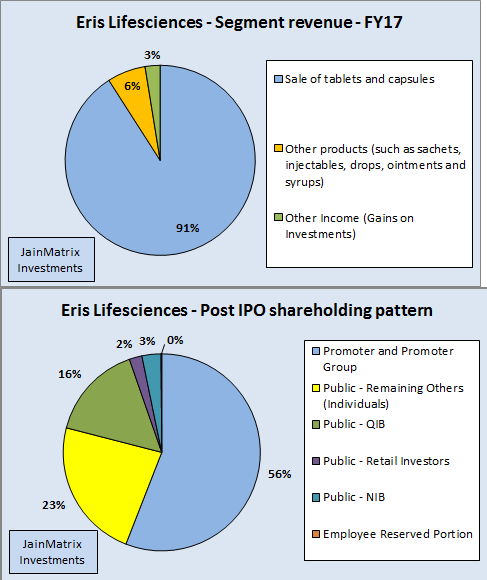
  • The IPO in total will collect Rs 1,741 cr. while selling 21% of equity. The offer is a complete OFS and the selling shareholders will receive the entire sum. ChrysCapital’s investment arm Botticelli would be exiting by selling its current 16.3% stake. Botticelli’s average cost of acquisition in Eris was Rs 87.27/share giving them 6.9x on their investment in 6 years. The other selling shareholders are individuals who hold around 4-9% stake individually in the company. The promoter & promoter group owns 59.18% in ERIS which will fall to 55.9% post-IPO.
  • The IPO share quotas for QIB, NIB and retail are in ratio of 75:15:10.
  • The unofficial/ grey market premium for this IPO is Rs. 86/share. This is a positive.

Introduction

  • Eris is an Ahmedabad based firm that develops, manufactures and sells branded pharma products from the chronic and acute categories in the Indian pharma market.
  • Revenues and profit for FY17 were Rs. 725 cr. and Rs. 242 cr. It has 2,645 full time employees out of which over half – 1,501 are sales reps.
  • So Eris has strong sales, marketing and distribution capabilities with 7 sales divisions focused on developing and growing engagement with doctors.
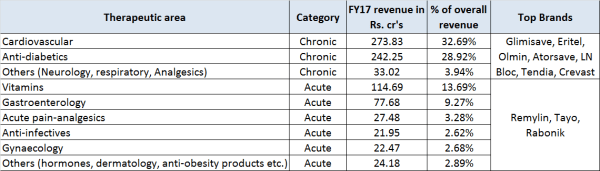
  • Eris products are cardiovascular, anti-diabetics, vitamins, gastroenterology and anti-infectives from the chronic and acute category which are linked to lifestyle disorders. The chronic category contributed 65.6% of its revenues in FY17. The product portfolio has 80 mother brand groups (FY17) and is focused on therapeutic areas which are handled by specialists and super specialists such as cardiologists, diabetologists, endocrinologists and gastroenterologists. See Exhibit 1.
JainMatrix Investments, Eris Lifesciences

Exhibit 1 – Eris products, therapeutic areas, revenues and brands, Source RHP

  • Between FY13 and FY17, there has been an increase in the no. of doctors prescribing their products from 37,842 (about 13.8% of doctors in metros and class 1 towns in India) to 50,282 (15.7% of doctors in metro and class 1 towns) with a prescription share of 1.3% for FY17.
  • Eris owns and operates a mfg. facility in Guwahati, Assam. They also outsource the mfg. of some products, and currently have 20 third party mfg. vendors.
JainMatrix Investments, Eris Lifesciences

Fig 2 – ERIS Segment revenue and Fig 3 Post IPO Shareholding Pattern

  • Eris has 3 subsidiaries namely Eris Therapeutics Pvt. Ltd (wholly owned), Aprica Health (wholly owned) and Kinedex. As of June 2017, Eris and subsidiaries have registered 138 trademarks for various brand names. It has a team of 32 personnel working in its IP and R&D department.
  • In July 2016, Eris acquired trademarks in relation to 40 brands, from Amay Pharma for Rs.32.8 cr., in order to grow their product portfolio in the cardiovascular and anti-diabetics therapeutic areas. Amay Pharma’s revenues, from these brands were Rs. 19.3 cr.
  • In Nov 2016, ERIS acquired 75.48% share of Kinedex for Rs. 77.2 cr.
  • It focuses on products for mobility related disorders in the musculoskeletal therapeutic area, within the acute pain-analgesics therapeutic area. Kinedex’s revenues were Rs. 83 cr. for FY17.
  • Eris’s facility in Guwahati had a capacity utilization for tablets, capsules and sachets of 76%, 57.6% and 19.6% resp. It enjoys tax break under Income Tax Act, which will continue post GST till FY24.
  • For FY16 and FY17, the products made at Guwahati contributed to 51.6% and 59.3% of their revenues. An additional 28.2% and 18.7% of revenues for the same periods was mfg. in partnership with Sozin Flora Pharma. Eris was a partner in Sozin up to Aug 2016, and then transferred their stake to the other partners of Sozin, to enhance operational efficiency and productivity.
  • Leadership is Amit Bakshi (CMD), Kaushal Shah (Head mfg. & dist.) Sachin Shah (CFO), Rajendra Patel (Head procurement)

News, Updates and Strategies of ERIS

  • Eris with Indian Medical Association and Heart Care Foundation of India conducted a national study for ambulatory blood pressure readings amongst medical fraternity in May 2017. It was found that 50% physicians were suffering from hypertension despite taking hypertensive medicines; 56% from irregular BP at night and 21% from masked hypertension.
  • Eris will consolidate its position in therapeutic areas in which they have good presence including:
  • Targeting new categories within its existing therapeutic areas, e.g. strengthening its position in the anti-diabetes therapeutic area by launching new products.
  • Continuing to expand its network of key opinion leaders (KOL) in existing therapeutic areas and increase its coverage of specialists to drive growth in prescriptions.
  • Continuing to execute on its doctor-patient engagement model by leveraging diagnostics and technology to aid better outcomes and enhance patient compliance.
  • Eris will explore in-licensing and co-development opportunities with other pharma firms. It will also utilize its R&D efforts to target select products which are currently under patent protection in India.

Indian Pharma Market Outlook

  • India is one of the largest pharma markets in the world. Between FY13-17, revenues grew at 11.8% CAGR to reach Rs. 1,14,326 lakh cr. The IPM is the 13th largest market globally in terms of value and 3rd largest in terms of volume.
  • The IPM is expected to grow at a CAGR of 11.6% between CY16-21. The underlying growth is driven by: 1) Favorable demographics and macro-economic developments 2) Rising prevalence of chronic diseases and 3) Medical talent including specialists and super specialists 4) increasing insurance coverage and 5) the under-penetration of medical infrastructure and talent.
  • The IPM can be classified into acute and chronic The acute category comprises therapies intended for diseases of short duration and recent onset, including anti-infectives, gastro intestinal medication, vitamins and gynecology. The chronic category caters to non-communicable diseases that are prolonged in duration like heart disease, diabetes, cancer and arthritis.
  • Eris has a 0.7% market share in IPM. It was ranked 20th out of the 377 domestic and MNC firms in the chronic category, in terms of revenues, for FY17, compared to 26th in FY13.
  • Market share by revenue in the chronic category increased from 0.9% in FY13 to 1.4% in FY17.

Financials of ERIS

  • ERIS’s revenues, EBITDA and PAT grew at 16.6%, 34.7% and 42.8% CAGR in 5 years, see Fig 4.
  • The EPS has risen sharply in 5 years. This is excellent.
  • Eris has positive cash from operations and FCF all the last 5 years, Fig 5. This is a positive.

JainMatrix Investments, Eris Lifesciences

Fig 4 – ERIS Financials

JainMatrix Investments, Eris Lifesciences

Fig 5 – ERIS Cash Flow

  • Eris has declared dividend an interim dividend for FY16 amounting to Rs. 83 cr. (62.2% of FY16 PAT). Apart from this, the company hasn’t declared any dividend in the last 5 years including FY17.
  • Eris had a RoE of 44.8% in FY17 while the 3 year avg. RoE stood at 42.9% (FY15-FY17). The RoCE stands at 50.9%. These are high, healthy and consistent return ratios.
  • EBITDA margins jumped from 29.3% (FY16) to 39.7% (FY17), whereas the PAT margin increased from 22.4% (FY16) to 33.4% (FY17), reflecting a massive positive change. Such high margins were on account of low input costs, low interest costs and low effective tax rate (tax benefit at mfg. facility).
  • Eris has a reserves and surplus balance of Rs. 526 cr. which is Rs. 38.26/share.

Benchmarking

We benchmark Eris against peers from pharma sector. See Exhibit 6.

  • PE appears high at 34.25 compared to peers, but not a worry. The D/E ratio at 0.19 is comfortable.
  • The P/B ratio is high at 15.36 times, but this is because just 52% of products are mfg. in-house, and the rest is procured. As long as vendor-partners can adhere to the quality norms, it’s good.

JainMatrix Investments, Eris Lifesciences

Exhibit 6 – Benchmarking

  • Eris has witnessed fair sales but good profit growth recently. The 3 year PAT growth, EBITDA and PAT margins are high, coming in second highest of this group.
  • The return ratios are excellent and highest in the group at 45-51% each. This is a positive, and allows Eris to command premium valuations as returns are on a small equity base of Rs. 13.75 cr.
  • The company has not declared any dividend in FY17 unlike other pharma companies.

Positives for ERIS and the IPO

  • Eris is a fast growing pharma company with a portfolio of complementary products. In the chronic category, they were the fastest growing, among the top 25 in terms of revenues.
  • Eris has a portfolio of high volume and leading brands. Its focus is on metro cities and class 1 towns which have higher incidence of lifestyle disorders.
  • Eris has strong sales, marketing and distribution capabilities and good engagement with doctors.
  • The product range does not contain OTC products, so Eris has avoided the investment heavy consumer space. Instead it focuses on the B2D or Business to Doctor marketing. This we feel entails lower costs and helps maintain margins.
  • The financial health of the company is good, and the company has grown rapidly under the leadership of Amit Bakshi. He was a pharma salesman who worked in companies like Torrent, Eli Lilly and Intas and had many years of experience in the pharma industry before starting Eris.
  • Eris is immune to the global approvals/ USFDA risks as they have a domestic focused business.
  • Leadership appears to be dynamic and aggressive, and using strategies that play to their strengths.

Risks and Negatives for ERIS and the IPO

  • Eris has received letters from the Medical Council of India and certain state medical councils in connection with anonymous complaints, which allege that they have provided special benefits to several doctors. In the event the allegations are found to be true and in violation of applicable regulations and statutes, their reputation and business may be adversely affected.
  • Stricter norms in India for companies doing business in the pharma industry could affect their ability to effectively market its products. The Dept. of Pharma announced details of the UCPMP, which became effective across India from Jan 1, 2015. The UCPMP is a voluntary code which, among other things, provides detailed guidelines about promotional materials, conduct of medical reps, physician samples, gifts and relationships with healthcare professionals. Although these guidelines are voluntary in nature, they may be made mandatory in the future.
  • Will Eris be able to sustain the high growth rates and margins as it grows larger? While Eris still has a small market share in a growing market, typically pre IPO and small cap growth rates are difficult to sustain as a mid-cap firm. Competition too is intensifying in Eris’ key segments, and they will have to envision new strategies to continue on the growth path.
  • By procuring 48% of products from vendors, Eris has kept investments low and got high margins. Will this strategy be suitable in future? Any quality control problems at their mfg. facility or those of their third party mfg. may damage their reputation and expose them to litigation or other liabilities.
  • Some generic pharma sector risks: 1) If any of their products cause, or are perceived to cause, severe side effects, their reputation, revenues and profitability could be adversely affected. 2) The availability of counterfeit drugs, such as drugs passed off by others as their products, could adversely affect their brands.

Overall Opinion and Recommendation

  • As India accelerates its per capita income from a low base, a lot of the individual income gains are directed to the pharma sector for better healthcare.
  • Within the growing industry, Eris has a market share of 0.7% achieved in just 10 years of existence. There is certainly ample scope for Eris to grow both market share and absolute revenues.
  • Eris is already growing fast and stands out for the domestic focus, strong marketing & sales, good connect with doctors & medical ecosystems, and efficient mfg. & procurement giving high margins.
  • While the IPO is an exit opportunity for some investors, it empowers Eris for the next phase of growth by providing visibility and prestige, and the ability to raise fresh funds at low cost.
  • At a P/E of 34.25 TTM the valuations in the IPO are high but not aggressive, and justified by Eris’ growth rates.

Opinion: This IPO offering is rated BUY, and investors can invest with a 2 year perspective.

JAINMATRIX KNOWLEDGE BASE

See other useful reports:

  1. JainMatrix Investments – Track Record 
  2. IndiGo Airways – Flying High, Wide and Handsome
  3. Eicher Motors – It’s Firing on Both Engines
  4. Hudco IPO – Sector Uncertainties, AVOID
  5. S Chand IPO: An Educational Content Powerhouse
  6. Vikas Ecotech – Get ‘Vikas’ for your Investments
  7. CPSE ETF FFO 2 – An Energizing Offer – BUY
  8. Investment Notes – Euphoria
  9. Avenue Supermarts IPO: The Mart of Choice
  10. Bharat Electronics OFS
  11. Whats different about the Investment Service from JainMatrix? – A video
  12. Why are Indian stock markets attractive for Investments? – A video
  13. BSE IPO: Put this Exchange on Hold – Report plus Video
  14. Balmer Lawrie – An Update
  15. Why Stocks, and Investment Outlook – Dec 2016 – A Video
  16. Investment Outlook – Short Term Pain, Medium Term Gain
  17. PNB Housing Finance IPO: A Transformed Lender
  18. RBL Bank IPO 
  19. Do you want to be a value investor?
  20. Mahanagar Gas IPO 
  21. Announcement – SEBI approval as a Research Analyst

DO YOU FIND THIS SITE USEFUL?

  • Visit the Investment Service page to find how you can get more. Or Click LINK
  • Register Now to get our Free reports and much more, on the top right of this page, or by filling this Signup Form CLICK.

DISCLAIMER

This document has been prepared by JainMatrix Investments Bangalore (JM), and is meant for use by the recipient only as information and is not for circulation. This document is not to be reported or copied or made available to others without prior permission of JM. It should not be considered or taken as an offer to sell or a solicitation to buy or sell any security. The information contained in this report has been obtained from sources that are considered to be reliable. However, JM has not independently verified the accuracy or completeness of the same. JM has no stake ownership or known financial interests in Eris Lifesciences or any group company. Punit Jain may choose to apply for this IPO in the Retail category. Neither JM nor any of its affiliates, its directors or its employees accepts any responsibility of whatsoever nature for the information, statements and opinion given, made available or expressed herein or for any omission therein. Recipients of this report should be aware that past performance is not necessarily a guide to future performance and value of investments can go down as well. The suitability or otherwise of any investments will depend upon the recipient’s particular circumstances and, in case of doubt, advice should be sought from an Investment Adviser. Punit Jain is a registered Research Analyst under SEBI (Research Analysts) Regulations, 2014. JM has been publishing equity research reports since Nov 2012. Any questions should be directed to the director of JainMatrix Investments at punit.jain@jainmatrix.com.

IndiGo Airways – Flying High, Wide and Handsome

  • Date: 30th May, 2017
  • CMP: Rs 1,060
  • Advice: HOLD
  • Industry – Airlines
  • Large Cap – 38,500 cr. mkt cap 

Overview:

  • Overview: IndiGo is the market leader in Indian aviation with a low cost carrier model. They have a leading domestic market share of 40.4%. The revenue and profit were Rs 19,370 crores and Rs 1,659 cr. resp. for FY17. The Income, EBITDA and profits have grown 32.7%, 25.6% and 19.4% CAGR over 8 years. Aggressive growth plans are in place for capacity addition.
  • Key risks: 1) Competition has intensified in the domestic market, weakening pricing power 2) A sharp rise in fuel prices is a risk to profitability. As a result EPS has reduced recently.
  • Opinion: The valuations are rich currently and hence investors are advised to HOLD the stock until earnings recovery process begins.

On 5th Feb, 2016 we had published a report for subscribers for a BUY call at Rs. 829 after sharp share price fall on account of a one-time event. The share price is up 21.8% since then and is now being released for public viewing. SIGN UP for the investment service subscription to gain exclusive access to such high quality investment reports.

Here is a note on the IndiGo Airlines (IGO).

Description and Profile

  • IndiGo is a low-cost carrier airline based in Gurgaon, India in operation since 2006,.
  • IGO’s revenue and profit were Rs 19,370 crores and Rs 1,659 cr. resp. for FY17.
  • Market share based on passenger volume was 40.4% in FY17 for the domestic market.
  • Owned by InterGlobe Enterprises, IGO operates 896 daily flights to 44 destinations including 6 abroad of Bangkok, Dubai, Kathmandu, Muscat, Singapore and Doha. It has its primary hub at Indira Gandhi Intl. Airport, Delhi and operates 131 aircrafts all of which are Airbus A320.
  • IGO’s domestic ASKs (Available Seat-Km.) increased from 530 crore (FY09) to 5458 crore in FY17, growing at 33.8% CAGR. It has an aggressive growth plan, with a current order book of 400 A320 neo aircrafts.
  • IGO added 5 new aircrafts in Q4 FY17. It is also venturing into regional routes, and has signed a term sheet for the purchase of 50 ATR’s (small aircraft). Deliveries will start in Q3 FY17, and by FY19, it will be a fleet of 20 ATRs.
  • IGO’s maintenance costs are the lowest among Indian carriers.
  • Leadership team is Aditya Ghosh (President), Riyaz Mohamed (Aircraft Acquisition/ Financing), Ankur Goel (Director) and Rohit Philip (CFO).
  • Shareholding in % is: Promoters 85.88, QFI’s 6.42, DII 1.65, Individuals 3.40 & others 2.65.

Business Notes, Strategies and Events

  • IGO declared a final dividend of Rs 34/share which is a payout ratio of 90% and yield 1.4%.
  • IGO plans to use ATR-72 planes to feed its mainline network in a hub and spoke model. Recently it announced a provisional order for 50 ATR-72 planes valued at $1.3 bn. IGO expects deliveries to commence from 2017-end. The new aircrafts will be used to launch flights under the government’s regional air connectivity scheme, UDAN (Ude Desh Ka Aam Naagrik).
  • IGO reported a 24.6% fall in the Q4 FY17 net profit at Rs 440.2 cr. against Rs. 583.7 cr. posted during the same period last year. Its total income was up 18.5% at Rs. 4,848.2 cr. against Rs 4,090.6 cr. YoY. The PAT fell sharply on account of higher fuel prices.
  • IGO recently partnered with Australian flight training institute, Flight Training Adelaide (FTA), to provide training to its pilot cadets.
  • The management of IGO is looking to convert some of its Airbus A320neo planes to A321neos that will allow it to fly more passengers per flight and increase flight range.
  • Engine Problem: Pratt & Whitney 1100G engines of Airbus A320 neo faced technical issues recently. The engine is facing twin problems. One in the combustion chamber and the other is with the third bearing of the engine. IGO executives expect A320 neo engine-maker Pratt & Whitney to provide a solution to the combustion chamber problem by Q4 2018.

Indian Aviation Industry Review

  • The Indian aviation industry is the 9th largest market globally. Total passenger traffic stood at 22.36 cr. in 2016 and there were 85 international airlines connecting to over 40 countries.
  • In terms of number of seats per capita, India is quite low – India has 0.08 domestic seats per capita, while Philippines (0.29), China (0.31), Indonesia (0.41) and Thailand (0.48) are much higher. (FY15)
  • Domestic air passenger volumes are likely to grow 25% for FY18.
  • The Airline industry is a very tough globally, characterized by high airplane costs (the Airbus and Boeing duopoly), high fuel costs, parking, airport and MRO charges. Costs are largely fixed. On the other hand, demand is cyclical and varies by season & economic cycle.
  • Anecdotal evidence shows that the sector is a destroyer of value. Many countries support their national carriers, even though there are losses, as it may be a matter of national prestige.
  • Industry market shares in Mar 2017 are presented in Fig 2. (Source DGCA).

jainmatrix investments, indigo

Fig 1 Industry Market Shares /Fig 2 – IGO Operational revenues

  • The Indian aviation industry has been aided by a slow moving Indian Railways, that is losing market share, had weak capacity growth, poor passenger service levels and slow trains.
  • Indian aviation is expected to become the 3rd largest market by 2020. Indian carriers plan to increase their fleet to 800 aircrafts by 2020. (Source: GoI/ DIPP).
  • A number of foreign investors are present in India including Airbus, Boeing, AirAsia, Singapore Airlines, Rolls Royce, Frankfurt Airport Services, Honeywell Aerospace, Malaysia Airports Holdings, GE Aviation, Airports Company South Africa and Alcoa Aerospace.
  • Indian aviation is experiencing dramatic growth with the emergence of LCC, as well as new carriers, and a growing middle class ready to travel by air for business and leisure.
  • Growth in airlines is causing demand growth for MRO (maintenance, repair and overhaul) facilities. Indian authorities plan to double the number of airports to 250 by 2030.
  • The failure of Kingfisher Air indicates the market is not ready to pay prices of 2-3X of LCC tickets.

Stock Evaluation, Performance and Returns

jainmatrix investments, indigo airways

Fig 3 – Price History

  • See price history detailed in Fig 3. The IPO was in Nov 2016, at an issue price of Rs. 765, and the share price has appreciated 38% generating good returns.
  • We can see that the share price had an all-time high of Rs 1,396 in Jan 2016 and a low of Rs. 702 in Feb 2016. Today the share price is 31.7% below the peak and 51% above the low.

jainmatrix investments, indigo airways

Fig 4 – Indigo financial performance

  • The annual and quarterly financials of IGO in Fig 4 reveal a steady increase in revenues. Margins and PAT have fallen in FY17 on account of high crude prices.
  • The Income, EBITDA and profits have grown 32.7%, 25.6% and 19.4% CAGR over 8 years.
  • The total debt by end FY17 was Rs. 2,596 cr. The entire debt for IGO is aircraft related. IGO does not have any working capital debt. The D/E of the firm is high at 3.16 times. This is a negative.
  • The margins are moderate with Operating and Profit margins at 15.1% and 8.6% for FY17.

jainmatrix investments, indigo airways

Fig 5 – Cash Flow Position 

jainmatrix investments, indigo airlines

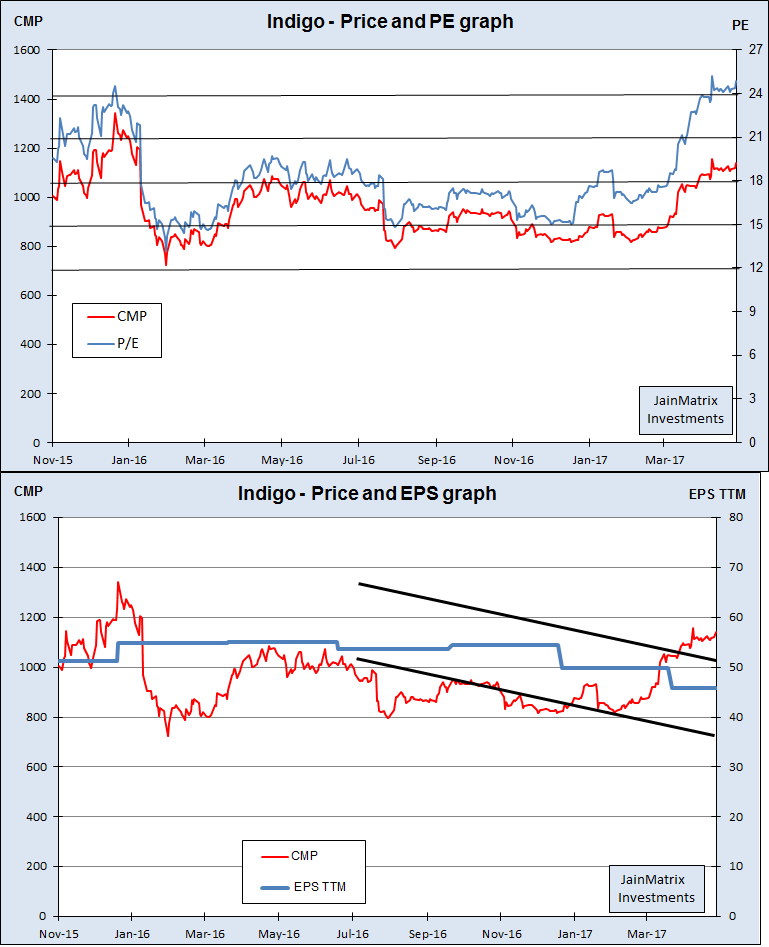
Fig 6 – Price and PE graph / Fig 7 – Price and EPS graph

  • The business has generated free cash flows throughout in the last 6 years. This is a positive.
  • The share has traded at an average PE of 18.12 times since listing. Today it is at 24.70 times, so valuations are above historical average. See Fig 6. However trading history is short.
  • The EPS TTM has fallen in the recent quarters, see Fig 7. This is on account of fall in demand post demonetization, higher fuel costs & engine rentals and greater competition.

jainmatrix investments, indigo airways

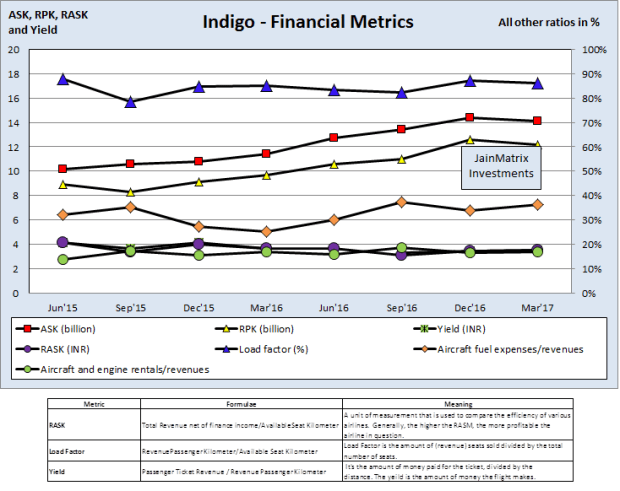
Fig 8 – Financial Metrics

  • In the airlines sector, fuel costs are a significant proportion of overall revenues. In this context, we can see IGO’s ratio has been volatile and is high currently. See Fig 8. The aircraft fuel expenses and engine rentals have risen sharply in 2 years. The load factor has been flat over the last 8 quarters.
  • From the chart below we can see that the yield has fallen significantly over the last 8 quarters. In the recent quarter, the yield was impacted on account of fall in consumer spending post demonetization. However the management in confident of fast recovery in yields. See Fig 8.
  • With load factor 86.1% recently and rising, IGO is performing impressively.

Benchmarking

jainmatrix investments, indigo airlines

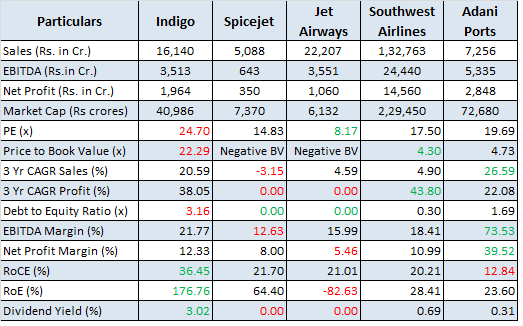
Exhibit 9 – Benchmarking

We benchmark IGO against listed peers and an Infra asset firm. Based on Exhibit 9, we conclude:

  • Sales and PAT Growth has been impressive at IGO over the last 3 years.
  • Debt is high and that is expected in this industry. With cash flow improving in recent quarters, we can expect that they would be able to control debt while investing in capacities.
  • Margins are moderate, however leading amongst the listed Indian peers. Dividend yield is high. This is positive. The valuations appear expensive, both in terms of P/E and P/B ratio.

Positives of the firm

  • IGO dominates with a large market share in one of the largest & fastest growing aviation markets.
  • It’s a successful implementation of the LCC business model with single aircraft type, high aircraft utilization, high operational reliability, no-frills product, and low distribution & maintenance costs.
  • IGO is a strong brand developed with good advertising & marketing strategies.
  • It has maintained consistent profitability and strong cash flow generation in the last 6 years.
  • By placing a large Airbus aircraft order, IGO has gained a structural cost advantage with favorable terms on aircraft, engines and components, and got a young, modern and fuel-efficient fleet.
  • On delivery, the aircrafts are sold and leased back. This arrangement is efficient as it converts fixed costs into variable. The asset light approach keeps capital expenses under control.
  • Experienced management with US background, has executed well so far in the Indian context.
  • IGO has been fast to plan for UDAN, which is a new opportunity in regional connectivity.

Risks and Negatives

  • The quality issues with newer airplane deliveries can threaten operations and services. The management feedback is that in 1-2 quarters the issues will be handled by the vendors.
  • Depreciation of the INR against USD may have an adverse effect on IGO’s operations and costs. This has worked in favor of IGO with rupee strength in last 1 year.
  • Crude oil prices are a high cost component, that is outside management control. Prices have risen sharply in the last 1 year and they can further rise again. IGO does not hedge for fuel cost volatility, hence if fuel costs rise further, it could further impact financial performance.
  • Competition may intensify with the entry of Air Asia and Vistara, which have strong backgrounds, and capacity expansions of Spice Jet and Jet Air.
  • Any production delays with ordered aircraft would affect IGO’s expansion plans.
  • IGO’s international routes expose them to higher operational risks. However it is believed that these routes have higher profit potential compared to domestic routes.
  • IGO’s financials may fluctuate due to seasonality as well as economic cycles.
  • There may be a skills shortage in areas such as airline pilots, maintenance engineers, etc. In the past airlines needed to hire expatriate staff at high costs to overcome this.
  • Airlines are a cause of pollution due to usage of fossil fuels. There may be increasing pressure on airlines to reduce this in terms of capacity limitations or carbon credit requirements.
  • IGO, like other airlines, faces operational risks such as accidents and terrorism.
  • There are high regulatory challenges for IGO including DGCA and AAI compliances, policies and execution and ATF taxes. However the business climate in India is improving.

Opinion, Outlook and Recommendation

  • There’s no doubt that the Airline industry in India is at a early phase of growth. With high population and weak railways execution, growth will track economic growth and affluence in India.
  • IGO has a strong brand with a commanding domestic market share, consistent delivery and high growth. It has a good track record of profitability and free cash flows. It has executed well on its LCC strategy. IGO has expanded the market with its growth.
  • We feel that IGO will continue to dominate Indian skies due to network effect and good capacity additions. Any fall in crude prices can provide high upside risks to IGO profitability.
  • While IGO has been in profits consistently, the margins depend inversely on crude prices.
  • The valuations are rich currently and hence investors are advised to HOLD the stock until earnings recovery process begins.

JAINMATRIX KNOWLEDGE BASE 

See other useful reports

  1. Eicher Motors – It’s Firing on Both Engines
  2. Hudco IPO – Sector Uncertainties, AVOID
  3. S Chand IPO: An Educational Content Powerhouse
  4. Vikas Ecotech – Get ‘Vikas’ for your Investments
  5. CPSE ETF FFO 2 – An Energizing Offer – BUY
  6. Investment Notes – Euphoria
  7. Avenue Supermarts IPO: The Mart of Choice
  8. Bharat Electronics OFS
  9. Indigo Airlines IPO report Nov 2015 

Search for companies/ sectors of your interest in Search box in the right panel.

Visit and Like JainMatrix FB or Follow on JainMatrix Twitter for reports

Disclaimer

This document has been prepared by JainMatrix Investments Bangalore (JM), and is meant for use by the recipient only as information and is not for circulation. This document is not to be reported or copied or made available to others without prior permission of JM. It should not be considered or taken as an offer to sell or a solicitation to buy or sell any security. The information contained in this report has been obtained from sources that are considered to be reliable. However, JM has not independently verified the accuracy or completeness of the same. JM has no known financial interests in IGO or Interglobe Aviation or any related firm. Punit Jain has however flown Indigo Airlines several times as a paying customer. Neither JM nor any of its affiliates, its directors or its employees accepts any responsibility of whatsoever nature for the information, statements and opinion given, made available or expressed herein or for any omission therein. Recipients of this report should be aware that past performance is not necessarily a guide to future performance and value of investments can go down as well. The suitability or otherwise of any investments will depend upon the recipient’s particular circumstances and, in case of doubt, advice should be sought from an independent expert/advisor. Punit Jain is a registered Research Analyst under SEBI (Research Analysts) Regulations, 2014. JM has been publishing equity research reports since Nov 2012. Any questions should be directed to the director of JainMatrix Investments at punit.jain@jainmatrix.com

Hudco IPO – Sector Uncertainties, AVOID

  • 9th May 2017 
  • Industry – Loans PSU
  • IPO Open 8-11th May at Rs. 56-60  
  • Large Cap: Rs 11,611 crore Mkt cap 
  • P/E 16.52 times and P/B 1.30 times 
  • Retail investors and employees get a discount of Rs. 2/share 
  • Advice: The IPO is rated AVOID   

Overview: HUDCO is a PSU engaged in providing loans for housing and urban infrastructure projects in India. HUDCO primarily lends to state governments and their agencies. 69% of HUDCO’s loan portfolio is in the urban infrastructure segment and the remaining 31% is in the housing finance loan segment. It’s revenues, EBITDA and PAT have grown at 4.8%, 4.2% and 6.8% CAGR over FY12-16. Revenues for FY16 were Rs. 3,350 cr. and profit Rs. 810 cr. It has 874 full time employees. 

Key risks: 1) HUDCO has weak growth in a recent environment of shortages and massive demand 2) High GNPA’s and NNPA’s 3) It’s a weak institution and performance is unpredictable. Clearly the activities are not commercially driven, so how can investment results be attractive? 4) It is far better to own a wonderful business at a fair price than a fair business at a wonderful price”. We feel that HUDCO is an average business available at a good price.

Opinion: This IPO offering is rated AVOID, and investors may look elsewhere for long term gains.

The detailed report will be attached soon for your reference.  

For full report, see LINK 

Disclaimer 

This document has been prepared by JainMatrix Investments Bangalore (JM), and is meant for use by the recipient only as information and is not for circulation. This document is not to be reported or copied or made available to others without prior permission of JM. It should not be considered or taken as an offer to sell or a solicitation to buy or sell any security. The information contained in this report has been obtained from sources that are considered to be reliable. However, JM has not independently verified the accuracy or completeness of the same. JM has no known financial interests in HUDCO or any group company. Neither JM nor any of its affiliates, its directors or its employees accepts any responsibility of whatsoever nature for the information, statements and opinion given, made available or expressed herein or for any omission therein. Recipients of this report should be aware that past performance is not necessarily a guide to future performance and value of investments can go down as well. The suitability or otherwise of any investments will depend upon the recipient’s particular circumstances and, in case of doubt, advice should be sought from an Investment Advisor. Punit Jain is a registered Research Analyst under SEBI (Research Analysts) Regulations, 2014. JM has been publishing equity research reports since Nov 2012. Any questions should be directed to the director of JainMatrix Investments at punit.jain@jainmatrix.com.

S Chand IPO: An Educational Content Powerhouse

  • IPO Open 26-28th Apr at Rs. 660-670
  • Mid Cap: Rs. 2,328 crore Mkt cap
  • Industry – Education Publishing
  • P/E 36.8 times TTM
  • Advice: Investors can BUY with a 3 year perspective

Summary

  • Overview: SCL is a 70 year old firm that delivers books, content and services in education to the K-12, higher education and early learning segments with strong presence in CBSE/ICSE schools. SCL revenues, EBITDA and PAT have grown at 32.6%, 47.5% and 33.9% CAGR from FY12 to FY16. SCL had a strong distribution and sales network across India. SCL has good relationships with authors who create and refine content. Textbook quality is excellent. The recent M&A strategy has given them a strong position across subjects, central and state boards and multiple languages. SCL is a thought and execution leader in this space with good content through authors and reach through distribution networks. It is capturing innovation by buying good education firms to enhance offerings. The IPO will help reduce debt even as operational revenues grow at 32.6% CAGR.
  • Key risks: 1) At a PE of 36.8 TTM, the valuations are expensive. 2) SCL has a seasonal business 3) NCERT provides subsidized textbooks and may prevent usage of SCL textbooks.
  • Opinion:   This IPO offering is rated BUY, and investors can invest with a 2 year perspective.

Here is a note on S Chand and Company Ltd. (SCL) IPO.

IPO highlights

  • The IPO opens: 26-28th Apr 2017 with the Price band: Rs. 660-670 per share.
  • Shares offered to public number 1.08 cr. The FV of each is Rs. 5 and market Lot is 22.
  • The IPO in total will collect Rs 729 cr. while selling 31.34% of equity. Of this, SCL will raise Rs. 325 cr. by issuing fresh shares and the selling shareholders will receive Rs. 404 cr. at the UMP. The promoter group owns 58.33% in SCL which will fall to 46.7% post-IPO.
  • SCL would benefit from the fresh issue of shares and the proceeds of Rs. 325 cr. would be used for:

Exhibit 1 – Utilization of proceeds from fresh issue of shares

  • The IPO share quotas for QIB, NIB and retail are in ratio of 50:15:35. This is good for Retail.
  • IFC holds 9.4% stake in SCL (Pre-IPO) and Everstone Capital Partners holds 32.3% (Pre-IPO). IFC will remain invested, while Everstone is selling half of its current stake in SCL.
  • The unofficial/ grey market premium for this IPO is in the range of Rs. 160. This is a positive.
  • The first day of IPO saw that it is already 52% subscribed, so it looks like it will sail through very successfully.

Introduction

  • SCL is a 70 year old firm that delivers books, content and services in education to the K-12, higher education and early learning segments and has a strong presence in CBSE/ICSE affiliated schools.
  • Revenues for FY16 were Rs. 541 cr. and profit Rs. 47 cr.
  • It has 2,135 full time employees (Dec ‘16.), whereas Chhaya has 309 employees (Dec ‘16.).
  • In Dec2016, SCL bought a 74% stake in Kolkata-based publisher Chhaya Prakashani Pvt. Ltd for Rs. 170 cr. SCL will acquire remaining 26% by Nov2018. In the past S Chand acquired Delhi-based publishers New Saraswati House in 2014 and Vikas Publishing House in 2012.
  • SCL has 55 consumer brands across knowledge products and services including S. Chand, Vikas, Madhubun, Saraswati, Destination Success and Ignitor. It recently acquired 74% of Chhaya Prakashani Pvt. Ltd. and now also offers 4 Chhaya brands including Chhaya and IPP.
  • SCL has a contractual relationship with 1,958 authors (including co-authors) for over 5 years. Additionally, Chhaya has contractual relationships with at 24 authors.
  • SCL had a sales and distribution network of 42 warehouses in 19 states, 4,932 distributors and dealers, and a sales team of 838 working from 52 branches and marketing offices. Chhaya Acquisition has expanded presence in East India to add 771 distributors and dealers.
  • SCL has developed a robust supply chain. In FY16, 85% of printing requirements were met by facilities in Sahibabad and Rudrapur. The paper purchases are integrated, which lowers costs.
  • About 72.5% of SCL’s sales are derived from the K-12 segment (KG to 1st to 12th grade). And 75% of sales of SCL are generated in the 4th quarter every year, at the start of the new academic year. Fig 2.

Fig 2 – a) SCL revenue over the years and  b) FY16 segments

  • Leadership is Desh Raj Dogra (Chairman), Himanshu Gupta (MD), and Saurabh Mittal (CFO).
  • In FY11, SCL’s key subjects were English grammar, Math and Science. It has since made many acquisitions. In 2013, SCL acquired Madhubun and Vikas – to improve its Hindi language titles. In FY15, it acquired Saraswati brand to strength its French, languages, arts and crafts titles.
  • SCL has 12 subsidiaries including Chhaya Prakashini. But 7 of these 12 have incurred losses in FY16.

News, Updates and Strategies of SCL

  • In FY16, SCL sold 3.55 crore copies of 11,144 titles. Additionally, Chhaya sold 98.8 lakh copies of 433 titles. SCL’s top 10 best-selling titles accounted for sales of 29.6 lakh copies in FY16, and 15 of their authors had each sold over 10 lakh copies of their titles during the last 5 years.
  • On the website, schandpublishing.com the firm offers ecommerce services.
  • SCL is looking to acquire firms in the higher education business, particularly in the test prep market. It plans to do so to increase its market share in the State Board segment in attractive markets.
  • SCL invested in online test prep startup Testbook in Mar2016. It is an online test prep platform for competitive exams such as GATE, CAT, SBI PO and IBPS PO, besides others. The platform allows students to simulate an environment similar to the actual examination.
  • SCL invested Delhi-based Smartivity Labs Pvt Ltd, an online venture that deploys augmented reality and robotics for kids learning projects in Oct 2015.

Education Sector Outlook

  • A recent survey by market research agency Nielsen revealed that India’s book publishing market is the sixth-largest in the world at Rs 26,100 crore, and is likely to touch Rs 73,900 crore by 2020.
  • The formal education segment comprises both K-12 schools (including secondary and senior secondary schools) and higher education institutions (colleges, higher education institutes). Whether government or privately owned, this segment is governed by the ‘not for profit’ diktat, meaning that such educational institutions in India cannot be operating on a ‘for profit’ basis.
  • The informal segment comprises test preparation, tutoring, early education and vocational/skill-based training segments. The informal segment does not have restrictions on operating on a ‘for profit’ basis and does not have restrictions on profit distribution.
  • The formal, informal and ancillary segments are collectively estimated at US $90 billion as of 2015 and expected to reach US $188 billion by 2020. India has a large population in the education age bracket of students aged 5-24, which stood at 52 crores in 2016. This may grow to approximately 53.4 crores by 2020. In addition to the growing population, a reduction in drop-out rates is expected to contribute to increase in market size.
  • The K-12 education system in India is one of the largest in the world, with a market size of US $49.5 billion, comprising 11 lakh govt. schools and 4 lakh private schools. Schools have grown from 13.6 lakh (FY11) to 15.2 lakh in (FY15). During 2011-2014, the share of private unaided schools recorded the highest growth rate among other types of schools from 14.2% to 19%.
  • Most schools in India are affiliated to 1 of 3 main governing bodies for K-12 schools: (a) state level SSC education board; the Central Boards of (b) CBSE; and (c) ICSE.
  • CBSE schools have grown at the fastest CAGR of 8.9% during 2011-2015.
  • The growth drivers of the K-12 education segment are: 1) Rising disposable incomes 2) Consumer preference for private unaided schools 3) Government initiatives on promoting primary education
  • SCL is a market leader with a share of 13% in education content. The closest peers are Oxford Publication and Orient Black Swan have a share of 6% each. (source – newspaper reports).

Financials of SCL

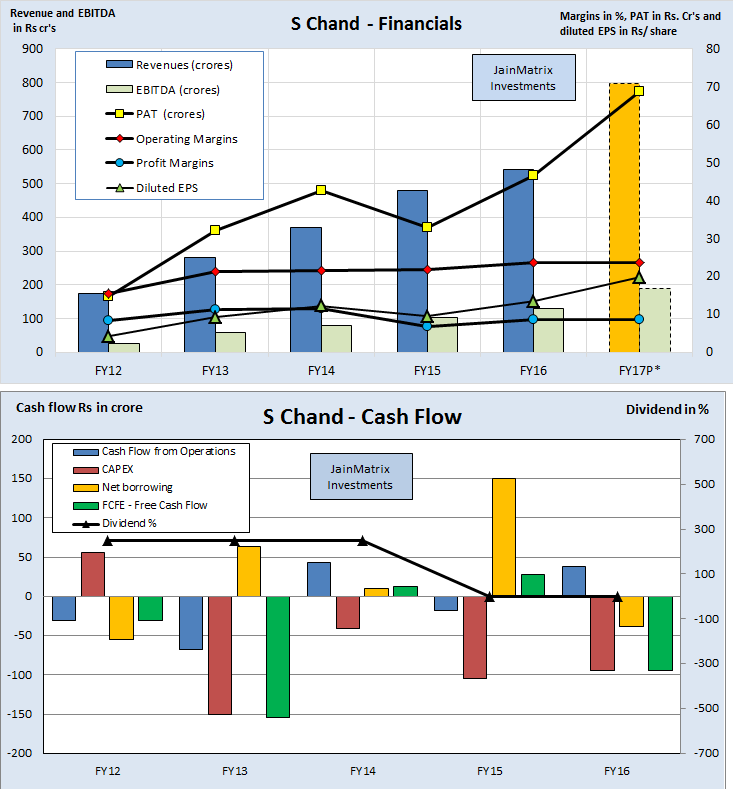
  • SCL’s revenues, EBITDA and PAT grew at 32.6%, 47.5% and 33.9% CAGR in 5 years, see Fig 3.
  • FY17 revenues is a projection of 9M FY17 financials, assuming 75% comes in Q4; and adding financials of Chhaya Prakashini. Thus revenue and PAT growth are good.
  • The EPS has risen sharply in 5 years. This is excellent. But there was a fall in FY15. Here SCL witnessed a disruption due to Chennai floods; it also acquired 51% in New Saraswati House.

Fig 3 – SCL Financials/ Fig 4 – SCL Cash Flow

  • SCL has negative cash from operations and FCF in 3 of last 5 years, Fig 4. This is a negative. However this is explained by the vigorous M&A activity as SCL has grown inorganically.
  • SCL has not declared dividend in the last 2 years, however it hadan interim dividend for FY17.
  • SCL has an ROE of 7.8% in FY16 which is low.
  • Operating margins have been flat while profit margins have fallen a little. However with acquisition of Chhaya Prakashini, the margins should improve, it had a net profit margin of 12.4% (Dec 2016).
  • SCL has a cash balance of Rs. 24.4 cr. today which translates into Rs. 7.03 as cash/share which is low.

Benchmarking

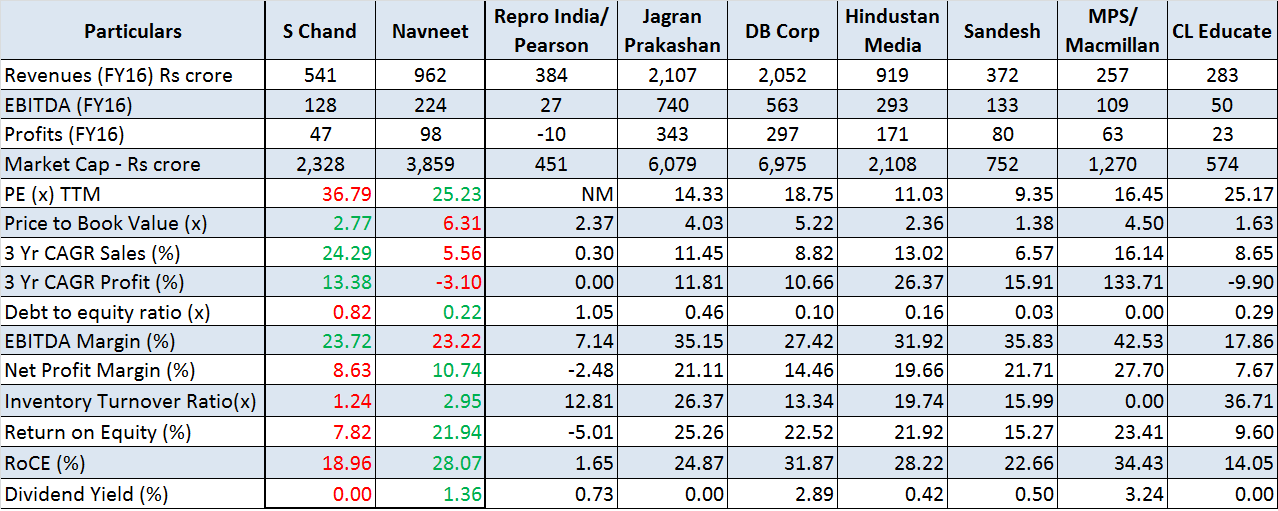
We benchmark SCL against peers from education /publishing sector. However the main comparison is with Navneet due to Repro (losses), MPS (technology), CLE (classroom) and others (newspaper publishing). Note that Navneet too has a significant stationary business. See Fig 5.

Exhibit 5 – Financial Benchmarking

  • PE for SCL appears expensive at an FY17P* of 36.8 as compared to Navneet at 25.2 times with better financials. The valuation of SCL is moderate in terms of P/B ratio.
  • SCL has witnessed high sales growth in the last few years. The EBITDA margins are good, while profit margins have dragged.
  • The 3 year PAT growth is moderate at 13.4%. The D/E ratio at 0.82 is moderate, however the highest in the industry. The return ratios are poor. This is a negative.
  • The SCL numbers are consistent with a firm on a growth and acquisition spree that is well on the way to becoming a textbooks and education content leader. In 2-3 years the benefits of this will accrue to shareholders.

Positives for SCL and the IPO

  • The IPO is beneficial to SCL. The fresh issue proceeds will retire some of the debt and improve financials.
  • SCL has strong brand equity with high consumer recall. The IPO and post listing visibility will enhance the brand of SCL as a consumer product.
  • SCL has in the last 4 years followed a coherent M&A strategy – first to expand subjects under coverage, then including state boards, regional languages and education innovation tech firms.
  • SCL is a comprehensive consumer education content player across the education lifecycle.
  • A strong presence in the CBSE/ICSE schools and increasing presence in state board schools.
  • SCL has strong integrated in-house printing and logistic capabilities. In FY16 over 85% of their printing requirements were met by their facilities located in Sahibabad and Rudrapur.
  • SCL has a pan-India sales and distribution network driving deep market reach.

Risks and Negatives for SCL and the IPO

  • SCL has a highly seasonal business of their main K-12 business segment with 75% of their sales generated in Q4 every year. This also means seasonality in working capital.
  • The valuations look expensive in terms of P/E ratio. Debt is high, with ok margins and low RoE.
  • SCL operates in a highly-competitive and fragmented industry. Many of the content providers have strong brand recognition in local markets and long term relationships with schools, school authorities and educational authorities. They also face competition from the govt. National Council of Educational Research and Training (NCERT) and the State Council of Educational Research and Training (SCERT), which publish books for the K-12 market at subsidized costs.
  • For the past 2 years, CBSE board has issued an advisory circular advising CBSE affiliated schools to use only NCERT books for all classes. CBSE issued the circulars in response to reports and complaints from parents that schools were asking them to buy books published by private companies. The CBSE books are much cheaper (subsidy) but there is a big difference in quality and content of these.
  • A large portion of SCL revenues are derived from titles of their top authors. In FY16, their top 20 authors contributed to 48.9% of revenues. The loss of such authors could adversely affect business.
  • SCL has an obligation to acquire the remaining 26% of share capital of Chhaya Prakashani by Nov 2018 which may need to be financed with additional debt.
  • SCL may be impacted by the introduction of the GST. However it is likely that after making the operational alignment changes, it may be beneficial for business and ease distribution and pricing.
  • The presence of 55 consumer brands sounds daunting. It may be a legacy of M&A. It may be necessary for SCL to simplify branding by merging many and focusing on 5-10 key brands.
  • M&A are often risky and SCL needs to ensure success of all acquisitions, and suitable synergy gains.

Overall Opinion and Recommendation

  • India has a very young population that is underpenetrated in terms of education. A lot of govt. focus is already on improving availability and outcomes in K-12 education.
  • Education content continues to be an important aspect of K12 education with textbooks, guides and question papers being key elements.
  • SCL is a thought and execution leader in this space with good content through authors and reach through distribution networks. It is also aggressively growing across subjects and languages, from central to state boards, and from paper to online distribution. It is capturing innovation by buying good education firms to enhance offerings.
  • At a PE of 36.8 TTM, the valuations are expensive. However we feel that debt can be reduced post IPO even as operational revenues gallop forward at 32.6% CAGR.
  • Opinion: This IPO offering is rated BUY, and investors can invest with a 2 year perspective.

JAINMATRIX KNOWLEDGE BASE

See other useful reports:

  1. Vikas Ecotech – Get ‘Vikas’ for your Investments
  2. CPSE ETF FFO 2 – An Energizing Offer – BUY
  3. Investment Notes – Euphoria
  4. Avenue Supermarts IPO: The Mart of Choice
  5. Bharat Electronics OFS
  6. Whats different about the Investment Service from JainMatrix? – A video
  7. Why are Indian stock markets attractive for Investments? – A video
  8. BSE IPO: Put this Exchange on Hold – Report plus Video
  9. CPSE ETF FFO – An Energizing Offer – Report plus Video
  10. Balmer Lawrie – An Update
  11. Why Stocks, and Investment Outlook – Dec 2016 – A Video
  12. Investment Outlook – Short Term Pain, Medium Term Gain
  13. PNB Housing Finance IPO: A Transformed Lender
  14. RBL Bank IPO 
  15. New Banks: Big Changes in Small Change 
  16. Do you want to be a value investor?
  17. Mahanagar Gas IPO 
  18. A Repurpose for our PSUs
  19. How to Approach the Stock Market – A Lesson from Warren Buffet
  20. Announcement – SEBI approval as a Research Analyst

DO YOU FIND THIS SITE USEFUL?

  • Visit the Investment Service page to find how you can get more. Or Click LINK
  • Register Now to get our Free reports and much more, on the top right of this page, or by filling this Signup Form CLICK.

Disclaimer

This document has been prepared by JainMatrix Investments Bangalore (JM), and is meant for use by the recipient only as information and is not for circulation. This document is not to be reported or copied or made available to others without prior permission of JM. It should not be considered or taken as an offer to sell or a solicitation to buy or sell any security. The information contained in this report has been obtained from sources that are considered to be reliable. However, JM has not independently verified the accuracy or completeness of the same. Punit Jain intends to apply for this IPO in the Retail category.  Other than this, JM has no known financial interests in SCL or any group company. Neither JM nor any of its affiliates, its directors or its employees accepts any responsibility of whatsoever nature for the information, statements and opinion given, made available or expressed herein or for any omission therein. Recipients of this report should be aware that past performance is not necessarily a guide to future performance and value of investments can go down as well. The suitability or otherwise of any investments will depend upon the recipient’s particular circumstances and, in case of doubt, advice should be sought from an Investment Advisor. Punit Jain is a registered Research Analyst under SEBI (Research Analysts) Regulations, 2014. JM has been publishing equity research reports since Nov 2012. Any questions should be directed to the director of JainMatrix Investments at punit.jain@jainmatrix.com.

Vikas Ecotech – Get ‘Vikas’ for your Investments

  • Date: 24th Apr 2017
  • CMP: Rs. 21.25
  • Small Cap – Mkt Cap is 610 crores 
  • Industry: Specialty Chemicals
  • Target price is Rs. 52.7 by May 2019, a growth of 143% over 25 months 
  • A High Risk but High Gain opportunity for aggressive investors

Summary

  • Overview: Vikas Ecotech is engaged in mfg. and trading of specialty chemicals. It has factories in Shahjahanpur (Raj.) and J&K. The FY’16 revenues and profits were Rs 312 cr. and 26 cr. and these have grown 21% & 29% CAGR over 6 years. Products are niche, high value and eco-friendly, many are import substitutes. Exports are growing and are 49% of revenues. Current operations are lean.
  • Why buy now: VET is commissioning new plants in Noida SEZ, Kandla SEZ and Dahej (Guj) as well as extensions at Shahjahanpur. It expects a revenue growth of 35% CAGR in the next few years as outlook is strong.
  • Key risks: 1) Competition from large Indian players or Chinese firms can affect business. 2) The raw materials for VET are crude derivatives and any rise in crude oil prices will increase input costs. 3) VET has been free cash flow negative for 5 of the last 6 years. This has raised debt.
  • The Target Price is Rs. 52.7 by May 2019, a growth of 143% over 25 months. This is a High Risk but High Gain opportunity for aggressive investors.

Here is a note on Vikas Ecotech Ltd. (VET).

VIKAS ECOTECH – DESCRIPTION AND PROFILE 

  • VET does mfg. and trading of specialty polymer compounds & additives like Polymer compounds, Organotin stabilizers, Plasticizers and Flame retardants.
  • The FY’16 revenues were Rs 312 cr., profits Rs 26 cr. and market cap is Rs 610 cr.
  • Located in Delhi, VET has factories located in Shahjahanpur (Raj.) and Samba (J&K).
  • VET started as a trader/ agency for chemical products, then expanded into mfg.
  • VET has 250+ work force and products are exported to 20 countries, like B’desh, Pakistan, Sri Lanka, China, UAE, Turkey, Spain, S’pore, Germany, Ukraine and USA.
  • VET makes chemical products used in Agricultural Pipes, Auto Parts, Wires & Cables, Artificial Leather, Footwear, Organic Chemicals, Polymers, Pharma and Packaging, and distributes specialty chemicals and polymers of MNCs. 3 categories:
    • Specialty Additives – toxin free high perf. additives for mfg. applications.
    • Plastic Compounds – polymer compounds like Thermoplastic Rubber (TPR), Thermoplastic Elastomer (TPE) and Specialty compounds of PVC, PET and EVA.
    • Recycling – It recycles material to create virgin-grade PVC compounds.
  • Clients – RR Kabel, Relaxo F’wear, Liberty, Escorts, KEI, Havells, Apollo Pipe & SRF.
  • In FY15, VET sold stake (and exited) from a subsidiary, Moonlite Technochem. It also acquired the balance 25% stake of Sigma Plastic Industries thereby having 100% stake. By Q4FY15, VET became a standalone firm without any Subsidiary. In 2015 the firm rebranded itself from Vikas Globalone to Vikas Ecotech Ltd.
  • Leadership team is Vikas Garg (MD), Vivek Garg (Dir.), Ashutosh Verma (CEO), and Pankaj Gupta (CFO). Vikas Garg has been with VET (group) for 18 years and provides hands on leadership.
  • Shareholding % is: Promoter and Group-41.6%, Institutions-29.25%, individual-8.9%, others-20.25%.

JainMatrix Investments, Vikas Ecotech

Fig 1 – Segment and Geographic Revenue

Recent Events, Business Plans and Strategies

  • VET commenced construction of a mfg. plant and R&D center at Dahej, Gujarat. It will provide import substitution for additives and stabilizers. The plant will add capacity and produce 6,000 MT of organotin stabilizers (methyl tin mercaptide or MTM) and 5,000 MT of specialty polymer compounds annually. The plant cost is Rs. 30 cr. Production was to start by Apr2017, but a delay in environmental clearances may delay it by 6 months.
  • VET is also setting up plants at Noida SEZ and Kandla SEZ Guj. as well as extensions at Shahjahanpur (Raj.) to handle higher volumes and get exports benefits at SEZs.

JainMatrix Investments, Vikas Ecotech

Fig 2 – VET Capacity Growth  

  • Prince Pipes and Fittings Pvt Ltd’s CMD, Jayant Chheda, and his associates have acquired, in their individual capacity, 2.63 crore shares of VET or over 8%. PPF is a strategic customer of VET. The funds received of Rs 34 cr. are to be utilised for expansion of R&D facilities, new plants and marketing for domestic and exports.
  • VET formed a strategic tie up with PPF, India’s 3rd largest PVC pipes mfg. firm for supply of specialty chemicals to replace current with eco-friendly variants.
  • VET produces Organotin Stabilizers which are required to produce Lead free non-toxic, safe and eco-friendly PVC pipes. It’s a valuable tech. available with only few producers worldwide.
  • VET aims to produce bio plastic by using waste cooking oil through a technology called Wastol-P, and grow as one of India’s leading eco-friendly firms. It has entered into a contract with Haldiram, the large snack mfg. for supply of waste cooking oil.
  • Exports may grow around 30-40% for FY17. VET expects revenues to grow 35% CAGR for a few years, as per management.
  • VET’s mfg. plant in Raj. was affected by a fire in Apr2017. But damage was limited to only one building that housed the polypropylene section and a material warehouse; 4 other units in the same factory are safe and fully operational. The unit contributes 3% to sales. It may take 4 months to restore full production. According to estimates, damages could be Rs. 15-20 cr. but the factory is fully insured.
  • During the current year VET’s market share in India for Organotin Stabilizers was 10%. Their vision is to attain 25% share of the expanded market in the near future.
  • VET allotted 2.56 cr. equity shares of Re 1/- each at a premium of Rs. 16/- in Mar2017 to non-promoters on preferential basis. Promoter holding fell 4% in the Company.
  • Crisil rated VET a BBB for long Term Borrowings; A3+ for Short Term in Feb2017.
  • In Feb2016 Merrill Lynch Capital Markets bought 19 lakh shares of VET.
  • Employee strength has grown rapidly from 63 (FY15) to 81 (FY16) and 250+ today.

Industry Outlook

  • The Indian Specialty Chemical Industry is experiencing a good growth and is fast emerging as global specialty chemicals mfg. hub. Total production was 2.1 crore tons in FY’16. Industry delivered 13% growth over the 5 years led by domestic consumption; more recently it was 30% growth over FY13-15 to $2.67 bn.
  • India is 3rd after China & Japan in Asia and 6th globally in volumes.
  • The Industry is expected to grow at CAGR of 15% for next 5 years.
  • Indian specialty chemicals firms will gain over China due to strict implementation of environmental norms & safety standards there, which may lead to closure of many firms. Exports have already slowed. This may help boost exports from India.
  • Make in India initiative will facilitate growth and flow of FDI to this sector.
  • Indian specialty chemical firms will have 6-7% share globally by 2023, double the current level.
  • The India demand for Organotin Stabilizers at 6,000 MT p.a. (growth 20%) and PVC heat stabilizer (60,000 MT p.a.); and global PVC heat stabilizer market demand are growing fast, and VET expansion plans are in line with domestic and int’l. demand. This year VET’s market share in India for Organotin Stabilizers was 10%. The vision is to attain 25% share of the expanded market in the near future.

Stock Evaluation, Performance and Returns

JainMatrix Investments, Vikas Ecotech

Fig 3 – Price History

  • See VET’s 5 year price history in Fig 3. Investors for 5 years gained by 51.4% CAGR.
  • The share price shot up sharply in 2015. The recent one year low is Rs. 10.85 in Jun 2016, and the high was Rs 23.3 in Mar2017. The share price is 9% below this high.
  • Dividends have been consistent for 4 years at 5% giving 0.24% yield. This is low.
  • The Revenues, EBITDA and Profits have grown 21%, 35% and 29% CAGR over 6 yrs.
  • In Q3 FY17 VET had revenue of Rs. 84.8 cr. and growth of 0.3% YoY due to demonetization and fall in trading. But the mfg. revenue grew 17%. See Fig 4.
  • DE ratio is 1.41 which is high. VET will fund expansions through internal accruals.
  • Note: VET data in Fig 4 is consolidated until Mar 2015 and standalone thereafter.

JainMatrix Investments, Vikas Ecotech

Fig 4 – Quarterly Financials/ Fig 5 – Cash Flow  

JainMatrix Investments, Vikas Ecotech

  • VET has weak cash flow position. It has been FCF positive only in 1 of last 6 years. This is a negative. See Fig 5. However the reason is investments in R&D and mfg. capacities. The firm raised funds through preferential stock issue and promoter holding dilution. As a result the debt position is still moderate.
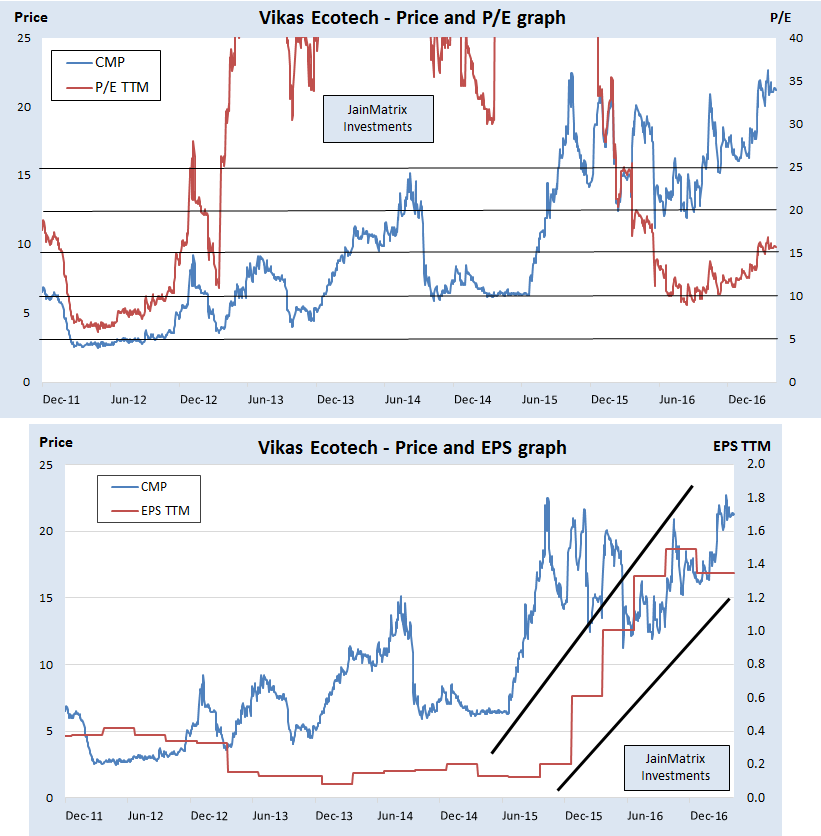
  • In Fig 6a, the 6 year PE chart for VET has a historic average PE of 15. Current P/E is 15.74 times (TTM earnings), while the P/B is 8.25 times. In Fig 6b we see that EPS TTM had an upward trend in last 2 years in a channel. But in Q3FY17 there was a drop due to challenges like demonetization.

JainMatrix Investments, Vikas Ecotech

Fig 6 – a) Price and PE Chart Above and b) Price and EPS Chart 

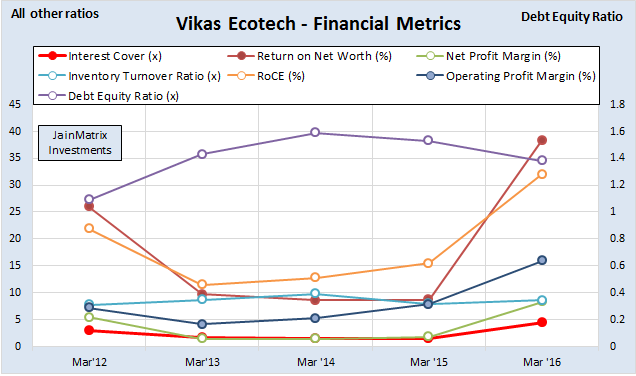
  • The DE ratio reduced in Mar’16, Fig 7. Interest coverage ratio improved. The inventory turnover ratio rose, operating & profit margins are higher, ROCE doubled to 32%. Similarly RoNW. These are positive.
  • Beta of the stock is 0.93 (Reuters) which is indicates low volatility.

JainMatrix Investments, Vikas Ecotech

Fig 7 – Financial Metrics

Benchmarking and Financial Estimates

Exhibit 8 – Financial Benchmarking

In a benchmarking exercise we compare VET with listed peers in similar businesses.

  • In terms of valuations, VET has a low PE ratio in spite of a recent rise in the share price. However P/B is high at 8.25 times. VET has the lowest dividend yield, however this is OK for a high growth company. D/E ratio is high among peers, however it is at manageable levels.
  • VET’s 3 year CAGR PAT has grown at 86.8%. This is good, but on a small base. VET has return ratios over 35%, that are likely to sustain. This is excellent.
  • The numbers show that the firm that is moving to a high growth / high profit phase.

Exhibit 9 – Projections  

The financial projections have been made based on following assumptions.

  1. Production starts at Dahej plant in mid FY18 and ramps up to full capacity in 2 years. Noida and Bhuj plants too start contributing to revenues in FY18.
  2. Exports and domestic demand continue to grow at a combined 30-35%.
  3. R&D continues to develop new products; demand for lead free chemicals grows; eco-friendly mfg. processes for PVC compounds from recycled materials gain in visibility and demand.
  4. Analyst judgement.

Strengths of Vikas Ecotech

  • Good R&D that works with prospects and customers to develop new products & solutions. The recent revenue upswing was the result of years of R&D work.
  • Capacity additions will start from Dahej, Noida and Bhuj plants in FY18.
  • A domestic focus on substitution for expensive imported niche chemicals.
  • Exports focus will continue and build on the current 49% share of revenues.
  • There exists a good synergy between trading chemicals business and mfg.
  • Remarkable cost consciousness including salaries for promoters and employees.
  • Current customer base is derisked across a large number of firms and industries, providing stability.

Weaknesses and Risks

  • The raw materials used by VET are crude oil derivatives. Any rise in crude oil prices will increase the input cost and margins. However crude is in a 45-55 $ range.
  • VET has weak cash flow position. It has been FCF negative. The D/E ratio at 1.4 times is moderate, but any further capital raise can push D/E to excessive levels.
  • Promoter shareholding is low at 42%. However the promoter has sacrificed holdings to raise funds for expansion. He may be in a position to raise this in a few years. He still has sufficient holdings today that provide him a good incentive to grow and develop the firm VET.
  • In terms of valuation, the P/B ratio looks expensive.
  • VET’s mfg. plant in Raj. suffered in a fire in April 2017. The damage could be Rs. 15-20 cr. But these assets were insured. One plant in J&K is in a sensitive area, there have been terrorist attacks recently.
  • Chinese chemical producers can be competitive on price and volume. The other massive player in the sector is Reliance Industries. VET has potential as a niche chemicals player as long as other larger players do not enter these segments. However these segment volumes may not be attractive for RIL.
  • VET can in future be a takeover target by large players. But it will benefit investors.
  • VET sales are B2B, used as raw material, so it’s difficult for analysts to verify & validate output.

Opinion, Outlook and Recommendation

  • The chemicals sector is a massive market, and specialty chemicals can be a valuable and large niche within this. India offers many competitive advantages to this sector.
  • VET has taken this strategy and has ample room to grow in this niche.
  • VET is rated highly on lean business operations, aggressive growth – both mfg. capacities and workforce, good R&D team, eco-friendly products and growth in domestic & export markets.
  • Valuations are reasonable as VET is a largely undiscovered firm. With a turnover of Rs 312 cr., VET has ample room to grow in domestic and exports markets.
  • Key risks are: 1) As VET is a small firm, competition from larger players or Chinese firms can affect business. 2) The raw materials are crude derivatives and any rise in crude oil prices will increase input costs. 3) VET has been free cash flow negative for 5 of the last 6 years. This has raised debt.
  • The target price is Rs. 52.7 by May 2019, a growth of 143% over 25 months.

JAINMATRIX KNOWLEDGE BASE 

See other useful reports:

  1. CPSE ETF FFO 2 – An Energizing Offer – BUY
  2. Investment Notes – Euphoria
  3. Avenue Supermarts IPO: The Mart of Choice 
  4. Bharat Electronics OFS
  5. Whats different about the Investment Service from JainMatrix? – A video
  6. Why are Indian stock markets attractive for Investments? – A video
  7. BSE IPO: Put this Exchange on Hold – Report plus Video
  8. CPSE ETF FFO – An Energizing Offer – Report plus Video
  9. Balmer Lawrie – An Update
  10. Why Stocks, and Investment Outlook – Dec 2016 – A Video
  11. Investment Outlook – Short Term Pain, Medium Term Gain
  12. The Natural Quotient: A Sustainability Metric for Business
  13. PNB Housing Finance IPO: A Transformed Lender
  14. RBL Bank IPO 
  15. New Banks: Big Changes in Small Change 
  16. Equitas IPO – Leader in SF Banks
  17. Do you want to be a value investor?
  18. Mahanagar Gas IPO 
  19. A Repurpose for our PSUs
  20. Announcement – SEBI approval as a Research Analyst

DO YOU FIND THIS SITE USEFUL?

  • Visit the Investment Service offering page to find how you can get more.
  • Register Now to get our Free reports and much more, on the top right of this page, or by filling this Signup Form CLICK.

Disclaimer and Additional Details

The target price basis is 1) Financial projections – Exhibit 9, 2) A target P/E of 20 times, higher than current 15.74 times 3) Analyst judgement.

This document has been prepared by JainMatrix Investments Bangalore (JM), and is meant for use by the recipient only as information and is not for circulation. This document is not to be reported or copied or made available to others without prior permission of JM. It should not be considered or taken as an offer to sell or a solicitation to buy or sell any security. The information contained in this report has been obtained from sources that are considered to be reliable. However, JM has not independently verified the accuracy or completeness of the same. Punit Jain and JM have no current shareholding, and no known financial interests in Vikas Ecotech & Co or any related firm. Neither JM nor any of its affiliates, its directors or its employees accepts any responsibility of whatsoever nature for the information, statements and opinion given, made available or expressed herein or for any omission therein. Recipients of this report should be aware that past performance is not necessarily a guide to future performance and value of investments can go down as well. Equity investments are subject to market risks. The suitability or otherwise of any investments will depend upon the recipient’s particular circumstances and, we recommend that investors looking to invest in equity should take advice from a Registered Investment Adviser. Punit Jain is certified and registered under SEBI (Research Analysts) Regulations, 2014. Any questions should be directed to the director of JainMatrix Investments at punit.jain@jainmatrix.com

CPSE ETF FFO 2 – An Energizing Offer – BUY

  • FFO Applications: 15-17th Mar; Listing by 7th Apr 
  • ETF has 10 PSUs; Oil and Gas heavy
  • Raising amount: Rs. 2,500 cr. 
  • Managed by Reliance Nippon Life Asset Management
  • Central PSEs, Exchange Traded Fund, Further Fund Offer 2
  • Buy with a 1 year perspective

Overview: The Scheme is a further follow on issue (FFO 2) after the January 2017 offer which was successful. CPSE ETF facilitates GoI’s initiative to disinvest stake in CPSEs through the ETF route. Past performance of CPSE ETF 2014 has been good with 19.2% CAGR over 3 years. A discount of 3.5% on the “FFO Reference Market Price” of the Nifty CPSE Index shall be offered in this Scheme. There are high sectoral risks in Oil and Gas sector with a commodities play. Also typically the asset rich PSUs are slow moving firms with a poor, lethargic culture. However overall the offer is attractive and rated a BUY with a 1 year perspective.

Advice: This is a medium risk, medium return offering suitable for conservative investors. Buy with a 1 year perspective.

Here is a note on the CPSE ETF FFO 2 offer 2017.

Offer Differences

  • This is a smaller offer, of Rs 2,500 crores compared to Rs 6,000 crores FFO earlier in Jan 2017
  • Very similar product, with CPSE ETF as benchmark
  • The retail discount on offer is 3.5% this time compared to 5% in the first FFO in Jan 2017
  • There is a small change in the allocation to the 10 companies of the Index, with PSU firms having more central govt. holdings getting a few % higher allocations.

Description

  • The Scheme is an open-ended index scheme, listed on the Exchanges in the form of an ETF. The investment objective is to provide returns like the Nifty CPSE Index.
  • In this offer 70% is reserved for Retail and QIB, while max 30% is for Anchor investors.
  • The CPSE ETF 2017 has been created to help in GoI disinvestment of PSUs. The Further Fund Offer (FFO) launched in Jan 2017 received good response; collections were Rs.13,742 cr., out of which Rs.7,742 cr. was refunded to investors due to limited issue size of Rs.6,000 cr.
  • The ten PSUs’ included in the ETF are known high dividend, low capital gains, asset rich firms.
  • FFO Price: The FFO Units being offered will have a face value of Rs. 10/- each and a premium equivalent to the difference between FFO Allotment Price and the FV . The FFO Allotment Price would be equal to 1/100th of Nifty CPSE Index less discount.
  • Discount: A discount of 3.5 % on the FFO Reference Market Price of the underlying shares of Nifty CPSE Index shall be offered to FFO of the Scheme by GOI. A discount of 5% was offered to retail investors in the first FFO in Jan 2017 which has been reduced to 3.5% this time.
  • The scheme is being managed by Reliance Nippon Life Asset Management Ltd.

Investment Details of the Scheme

  • Amount to be raised: Rs. 2,500 cr. The Scheme will invest at least 95% of assets in stocks of the Nifty CPSE Index. It may invest in Money Market Instruments upto a max of 5% of assets which could include T-Bills, commercial paper of public private sector corporate entities, etc.
  • The AMC will use a passive or indexing approach to try and achieve Scheme’s investment objective. Unlike other Funds, the Scheme does not try to beat the markets they track and do not seek temporary defensive positions when markets decline or appear overvalued.
  • Sectoral asset Allocation and historic returns:

jainmatrix investments, CPSE ETF

Table 1 – Sector allocation           Table 2 – CPSE ETF 2014 returns including Dividend

Source: Reliance Mutual Fund FFO 2 document

Analysis of the ten PSUs as part of this ETF:

jainmatrix Investments, cpse ETF

Table 3 – CPSE ETF FFO PSUs analysis

  • Note 1: The Engineers India report by JainMatrix Investments is available on LINK
  • Note 2: The Bharat Electronics report by JainMatrix is available at LINK
  • Note 3: When we say price is high, it is relative to 5 year historical prices. We have not done valuation exercises on these firms.
  • Portfolio Turnover: It is expected that there would be a number of Subscriptions and Redemptions on a daily basis. Portfolio Turnover Ratio of the Scheme is 1.02 as on Feb 28, 2017.
  • Dividend: The income received by way of Dividend shall be used for recurring expenses and redemption requirements or shall be accumulated and invested as per the investment objective of the Scheme. The Trustees may declare Dividend to the Unit holders under the Scheme subject to the availability of surplus, and at the discretion of the Trustees. If the Fund declares Dividend, the NAV of the Scheme will stand reduced by that amount.
  • Listing: The units of the Scheme will be listed on NSE and BSE by maximum April 7, 2017.
  • RGESS Eligibility: Investments made by a Retail Individual Investor in the RGESS Scheme will qualify for a 50% deduction of the actual amount invested from the taxable income of the financial year.

The ETF structure is explained below.

JainMatrix Investments, CPSE ETF

Table 4 – Nature of ETFs             Source: Reliance Mutual Fund FFO 2 document

Past Performance since launch in March 2014

jainmatrix investments, cpse

Table 5 – Performance of CPSE ETF since 2014 (as on 13th Mar 2017)

The CPSE ETF 2014 was listed in April 2014, and has been able to give original NFO retail investors an absolute 69.4% returns over 36 months. This includes a 1 year bonus for Retail, which is not available in CPSE ETF 2017. The CAGR returns are 19.2%, higher than those in Table 2 published in FFO. See reports:

  • JM Investments Mar 2014 report – CPSE ETF 2014 – New Fund Offer report
  • JM Investments Sept 2015 performance review – Review Sept 2015 of CPSE ETF 2014
  • We had published a report on the FFO (Further Fund Offer) of CPSE ETF on 14th Jan, 2017. And recommended a BUY with a 1 year perspective. You can have a look at the report on the following LINK and the video on this LINK.
  • Subscription response: The Reliance Mutual Fund managed CPSE ETF opened for applications from 17-20th It was subscribed by 2.30 times, with bids worth Rs13,802 cr. coming in against the issue size of Rs 6,000 cr. The FFO received 250,000 applications, with good demand across investor segments.
  • FFO Price: The FFO Allotment Price is approximately equal to 1/100th of Nifty CPSE Index minus discount. The allotment price was Rs 25.21 and this tranche was listed on 31st
  • Performance: The EOD closing price on the exchange was Rs. 27.71 today, i.e. 13thMar, 2017. This translates into a gain of 9.9% in 1.5 months.

PROS

  • This ETF has a lower management charge as this automatic. The expense ratio is 0.065% annualized.
  • The fund will offer 3.5% discount to the FFO 2 subscribers.
  • The 5 year share returns are 7.47% CAGR, see Table 3. This is fair but below Sensex of 10.63%.
  • The dividend yield for these stocks is 5.18% today which is good, Table 3.
  • The average beta of these stocks is 1.15 indicating higher volatility than indices.
  • Many of these firms own wonderful assets, the family silver of the GoI. Some of these firms also enjoy monopoly status in their sectors. See our opinions in Table 3.
  • GoI is asking for higher dividends from PSUs and allowing operational freedom to exploit assets and be more productive. This will benefits investors also. See report, A Repurpose for our PSUs
  • The crude oil price fall from USD 100+ levels to sub 50 per barrel is complete. While it is volatile, crude in next 1 year should be in USD 40-60 range. If it does, the Oil & Gas sector can perform well.
  • This fund is Oil and Gas heavy with 57% weightage. However it does have a mix of upstream, mid and downstream O&G firms, which together can de-risk the portfolio against commodity volatility.

CONS

  • This third fund raising is an opportunistic attempt by GoI to raise funds in FY17 based on the good market conditions and the success of the Jan 2017 offer. However every successive offer dilutes incremental gains and novelty of the offer. This dilution is being run in parallel with stock level dilution efforts like the Offer for Sale (OFS) with Bharat Electronics and Engineers India.
  • There is no strategic clarity on GoI shareholding in these firms – will they be fully divested, or a strategic sale, or as JVs, or retained with GoI majority holding in the long run.
  • While the expense ratio of the ETF is low, the high dividend paid by the PSUs is not being passed on to the unit holders, but used for recurring expenses, as per FFO document. The CPSE ETF 2014 too has not paid dividend for 3 years. The 5.18% dividend yield involves substantial monies. It’s not clear if dividends have contributed to the NAV of the CPSE ETF 2014.
  • This fund is O&G heavy with 57% weightage. If one extends the description to Energy/Coal/ Power/ Oil & Gas and related financing, it increases to 90%. These sectors are essential to the economy, but are typically operationally constrained and not shareholder friendly. They are dependent upon global prices, and so even well managed firms can swing to losses with a fall in commodity prices.
  • In Oil & Gas sector, the upstream Oil Exploration firms have been hit by falling crude oil prices. The CPSE ETF is upstream Oil & Gas heavy with ONGC having 25% weightage.
  • Even though Gail India has a monopoly, it has been hit in pipeline construction by interstate politics, farmer /social pressures and weak infra execution environment.
  • PFC and REC are executors of GoI programs in power sector. Their returns are sometimes guaranteed by GoI but when the entire sector gets stressed, they can suffer poor performance.
  • These stocks performance depends on revenue growth, which has been inconsistent in recent years.
  • Many of these firms depend on GoI policies and monopoly situations to grow. Some are externally constrained by weak infrastructure that hampers distribution (Railways for coal, pipelines for gas).
  • This CPSE ETF 2017 offering is managed by Reliance Mutual Fund.

Overall Opinion

  • The current govt. is focusing on good execution and better administration with a series of reforms. The environment is more result oriented with less political interference in PSUs.
  • The outlook for Oil & gas sector is stable this year. Domestic demand is high.
  • Past performance of CPSE ETF 2014 has been good with 19.2% CAGR over 3 years.
  • There are high sectoral risks with an Oil & Gas heavy commodities play. Also typically the asset rich PSUs are slow moving firms with a poor, lethargic culture.
  • However overall the offer is attractive and rated a BUY with a 1 year perspective.
  • This is a medium risk, medium return offering suitable for conservative investors.

JAINMATRIX KNOWLEDGE BASE

See other useful reports:

  1. Investment Notes – Euphoria
  2. Avenue Supermarts IPO: The Mart of Choice 
  3. Bharat Electronics OFS
  4. Whats different about the Investment Service from JainMatrix? – A video
  5. Why are Indian stock markets attractive for Investments? – A video
  6. BSE IPO: Put this Exchange on Hold – Report plus Video
  7. CPSE ETF FFO – An Energizing Offer – Report plus Video
  8. Balmer Lawrie – An Update
  9. Why Stocks, and Investment Outlook – Dec 2016 – A Video
  10. Investment Outlook – Short Term Pain, Medium Term Gain
  11. The Natural Quotient: A Sustainability Metric for Business
  12. PNB Housing Finance IPO: A Transformed Lender
  13. GNA Axels IPO
  14. RBL Bank IPO 
  15. New Banks: Big Changes in Small Change 
  16. Equitas IPO – Leader in SF Banks
  17. Do you want to be a value investor?
  18. Mahanagar Gas IPO 
  19. A Repurpose for our PSUs
  20. How to Approach the Stock Market – A Lesson from Warren Buffet
  21. Announcement – SEBI approval as a Research Analyst

DO YOU FIND THIS SITE USEFUL?

  • Visit the Investment Service page to find how you can get more. Or Click LINK
  • Register Now to get our Free reports and much more, on the top right of this page, or by filling this Signup Form CLICK.

Disclaimer

This document has been prepared by JainMatrix Investments Bangalore (JM), and is meant for use by the recipient only as information and is not for circulation. This document is not to be reported or copied or made available to others without prior permission of JM. It should not be considered or taken as an offer to sell or a solicitation to buy or sell any security. The information contained in this report has been obtained from sources that are considered to be reliable. However, JM has not independently verified the accuracy or completeness of the same. Punit Jain holds CPSE ETF units since NFO in 2014. Other than this JM has no known financial interests in CPSE ETF / Reliance Mutual Fund or any related firm. Neither JM nor any of its affiliates, its directors or its employees accepts any responsibility of whatsoever nature for the information, statements and opinion given, made available or expressed herein or for any omission therein. Recipients of this report should be aware that past performance is not necessarily a guide to future performance and value of investments can go down as well. The suitability or otherwise of any investments will depend upon the recipient’s particular circumstances and, in case of doubt, advice should be sought from an independent expert/advisor. Punit Jain is a registered Research Analyst and compliant with SEBI (Research Analysts) Regulations, 2014. Any questions should be directed to the director of JainMatrix Investments at punit.jain@jainmatrix.com .