LIC IPO – Buy the Family Silver

JainMatrix Investments presents an Investment Report on RACL Geartech Ltd.

  • 03rd May 2022
  • Sector – Life Insurance
  • IPO Opens 4-9th May
  • Price range ₹902-949 /share; discount for policyholders is ₹60, and for employees is ₹45
  • Large Cap: ₹ 6,00,000 crore Mkt cap

Summary

  • Positives: 1) High life insurance market share 2) massive Assets Under Management and equity market ownership 3) LIC is a solid brand  4) low operating cost 5) good all India sales presence 6) the IPO can be transformative to make LIC more flexible, competitive and profitable.
  • Risks: 1) govt. initiatives and directives that are unprofitable 2) capital and profit ratio restructuring makes financials unpredictable 3) competition from private players and falling market share 4) High NPA ratio 5) attrition in sales agents team 6) Periodic FPOs can subdue the share price.
  • Opinion: Conservative Investors can SUBSCRIBE to this IPO with a 2 year perspective.

Other related IPO reports

Here is a note on LIC IPO.

IPO highlights

  • LIC IPO will have a price band of ₹ 902-949 and will open from May 2 for anchor investors and May 4-9 ‘22 for others.
  • The firm will raise ₹ 21,000 cr. by selling 3.5% stake sale through Offer for Sale (OFS) by promoter. LIC market cap at this pricing is ₹ 6 lakh cr.
  • Promoters of LIC are the President of India, acting through the Ministry of Finance, Government of India. Currently GoI holds 100% stake and post-IPO this will come down to 96.5%.
  • The IPO quotas are: Policy Holders 10%, employees 0.7%, QIB 44.6%, Non Institutional 13.4% and retail 31.25%. The total number of shares in IPO are 22.14 crore shares. This discount for policyholders is ₹60, and for employees is ₹45.
  • Objects of the issue: GoI unloads stake to list LIC. Since it is an OFS, it will not receive any funds in IPO
  • The grey market premium (GMP) of LIC is ₹85 as of today. 
  • One lot is 15 shares and Face Value is ₹10. Retail investors can bid for 1 to 14 lots i.e. 210 shares.
  • The anchor investor portion of Life Insurance Corporation of India’s (LIC) initial public offering (IPO) was oversubscribed on Monday, raising around ₹5,620 crore from anchor investors.

Introduction to LIC

  • LIC is the largest public life insurance companies in India, and took its current form in 1956.
  • It has a 64.1% market share in Gross Written Premium (GWP) in FY21 (CRISIL). It is the #5 largest life insurer globally by GWP, see Fig 1b. LIC has a distribution network of 5,004 offices spread across 36 states and UTs, with 28 cr. policies served as on FY22. It has a workforce of 1,05,207 employees.
  • The proposed IPO will make it the biggest Indian IPO ever.
  • In India, LIC has the largest agent network of 13.5 lakh individuals in 2021, which is 55% of the total agent network in the country and was 7.2 times the number of agents of the second largest life insurer.
  • LIC is the largest asset manager in India (Dec’21) with AUM (includes policyholders’ investment, shareholders’ investment and assets held to cover linked liabilities) of ₹ 41 lakh crores, which was (i) 3.2 times the AUM of all private life insurers in India, (ii) 15.6 times the AUM of the #2 player in Indian life insurance industry in terms of AUM, (iii) 1.1 times the entire Indian MF industry AUM and (iv) 17% of India’s GDP for FY22. (CRISIL). LIC’s investments in listed equity represented 4% of the total market capitalisation of NSE as at that date. (CRISIL). See Fig 1a. Close to 25% of this is equity oriented, and they own more government bonds than the RBI. Thus it is a mega player that can dominate and profit from the growing Indian capital markets. Thus it is India’s Family Silver, which is made available in the IPO.
  • LIC is thus both a Life Insurance and an Asset Management firm.

The rest of the report is available as a download, see PDF –

Do read our insightful research, we attach the complete Investment report in PDF format here.

Disclaimer

This document has been prepared by JainMatrix Investments Bangalore (JM), and is meant for use by the recipient only as information and is not for circulation. This document is not to be reported or copied or made available to others without prior permission of JM. It should not be considered or taken as an offer to sell or a solicitation to buy or sell any security. The information contained in this report has been obtained from sources that are considered to be reliable. However, JM has not independently verified the accuracy or completeness of the same. JM has no stake ownership or financial interests in LIC or any group company. Punit Jain has been a retail – insurance and annuity customer of LIC for 20+ years. Punit Jain intends to apply for this IPO. Neither JM nor any of its affiliates, its directors or its employees accepts any responsibility of whatsoever nature for the information, statements and opinion given, made available or expressed herein or for any omission therein. Recipients of this report should be aware that past performance is not necessarily a guide to future performance and value of investments can go down as well. The suitability or otherwise of any investments will depend upon the recipient’s particular circumstances and, in case of doubt, advice should be sought from a RIA – Registered Investment Advisor. Punit Jain is a registered Research Analyst under SEBI (Research Analysts) Regulations, 2014. JM has been publishing equity research reports since Nov 2012. Any questions should be directed to the director of JainMatrix Investments at punit.jain@jainmatrix.com.

25 Lessons – Great Investing Wisdom

First published by me on May 11, 2018

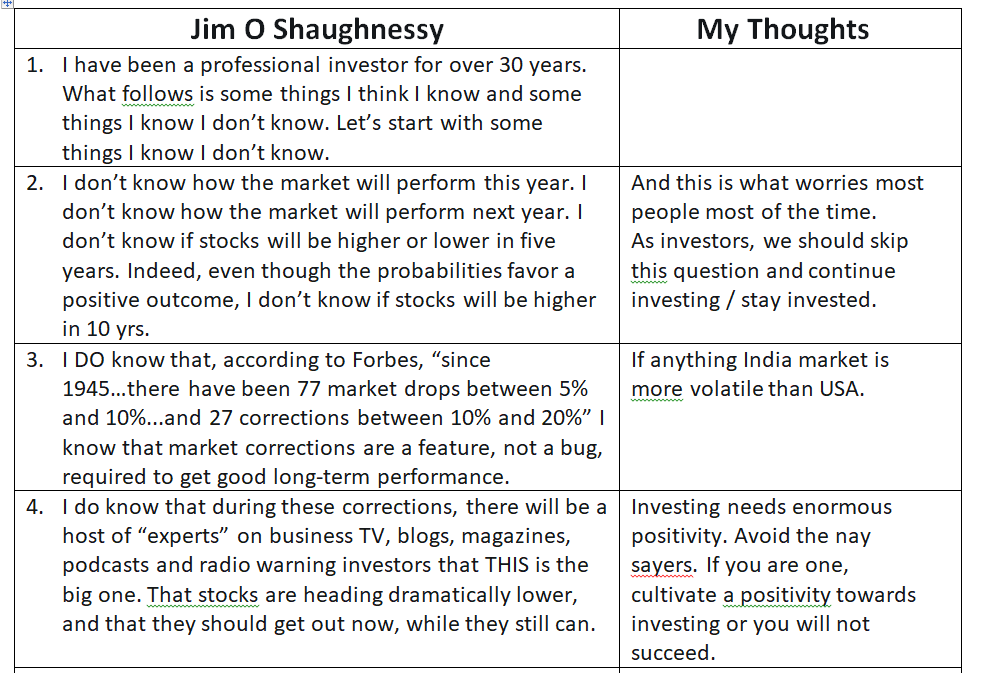
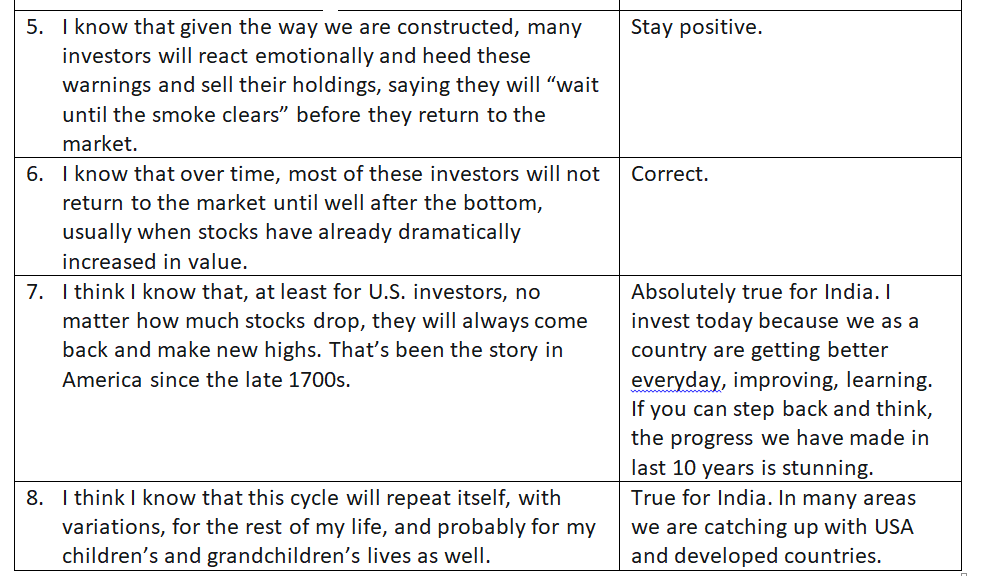
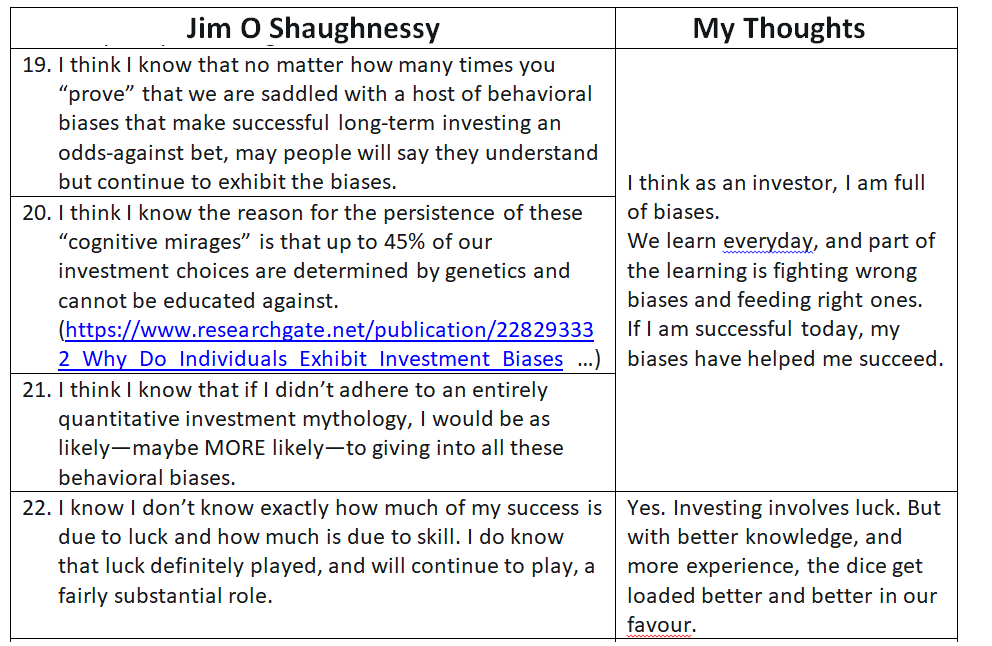
Here is a brilliant tweet from @jposhaughnessy. I have added to it some of my commentary. In the note, he touches upon the classic challenges – uncertainty, fear, under-performance, the big new industries, standing out, biases and luck. It is great investing wisdom. 

Jim O Shaughnessy My Thoughts

I’ve added a few of my thoughts, and an Indian angle.

jainmatrix investments

Here are the links that Jim had referred to in case you are interested

Hope you liked this. Do comment below.

Punit Jain

DISCLAIMER:

This document has been prepared by JainMatrix Investments Bangalore (JM), and is meant for use by the recipient only as information and is not for circulation. This document is not to be reported or copied or made available to others without prior permission of JM. It should not be considered or taken as an offer to sell or a solicitation to buy or sell any security. The information contained in this report has been obtained from sources that are considered to be reliable. However, JM has not independently verified the accuracy or completeness of the same. Neither JM nor any of its affiliates, its directors or its employees accepts any responsibility of whatsoever nature for the information, statements and opinion given, made available or expressed herein or for any omission therein. Recipients of this report should be aware that past performance is not necessarily a guide to future performance and value of investments can go down as well. The suitability or otherwise of any investments will depend upon the recipient’s particular circumstances and, in case of doubt, advice should be sought from an Investment Advisor. Punit Jain is a registered Research Analyst under SEBI (Research Analysts) Regulations, 2014. JM has been publishing equity research reports since Nov 2012. Any questions should be directed to the director of JM at punit.jain@jainmatrix.com.

When to make a stock SELL decision

First published July 8, 2014

With the Indian markets pushing to new highs over the last 6 months, its time to ask a loaded, important, yet difficult question.

When should you SELL your stock?

I assume here that you are a long term investor. You are growing your equity portfolio from a minimum 3 year perspective and want to see it meet your big life goals.

Of late you would have looked at your nest egg with a glad eye. In the last 6 months, chances are you have been surprised at the excellent performance of these stocks. It is in these very happy times that you should note the importance of a Sell decision. After all it is very difficult to Time the Market. In stocks it is important to think contrarian. It makes more sense to decide for yourself on your sell decision, execute on it and be satisfied with it.

On a personal note, my favorite holding period for a stock is forever. This is a wisdom gained from the greats of investing. However there are some practical and real situations that we can face. The Indian market is more volatile than the ones the greats live in. These are the situations where you need to think of the Sell decision, and take a call. Here they are:

1. You need the Cash urgently 

The best of well laid out plans can get interrupted. It could be a medical condition. Or education admissions time. Or it could be a desired asset that has become available. Go ahead, and sell. You have earned the luxury of encashing your Demat balance.

Embed from Getty Images

2. Maintain your asset allocation 

Asset classes are varied such as Direct Equity, equity mutual funds, debt/ bond mutual funds, Gold ETFs, real estate, fixed deposits, insurance and cash. You may in consultation with your ‘Investment Adviser’ have agreed to maintain your asset classes in a certain proportion. So when the time comes to re-allocate, its possible that selling of Equity is the call by the agreed formula. This is good, and can help you align your portfolio risk with your personal risk appetite and objectives.

3. Switch to a stronger share 

For a long term investment portfolio, your objective should be to enter into investments with a chosen set of stocks. Read up and track them. And always be on the lookout for a better investment idea. If one comes by and you are convinced, make a switch from a weaker stock to a stronger one. It could be from the same industry. Or even an industry change. You now have a stronger stock portfolio.

Embed from Getty Images

4. Tax considerations 

In India any listed stock investment when sold at a profit after holding for one year constitutes a Long Term Capital Gain, which is not taxed. The one year period should be noted & considered before deciding to Sell.

Sophisticated investors may also consider the converse situation. A Short Term Capital (STC) Loss can be declared in case a loss is booked in an equity investment for a period less than one year. This can then be set off against a STC Gain, in the same year or (by carry forward) in the next few tax years. Speak to your Chartered Accountant before using this strategy.

5. Exceptional gains from a stock 

If you are invested for the long term in a number of stocks, you may be witness to a lot of stock specific activity that can be quite interesting. If your stock has recorded massive recent gains, which are difficult to justify on the basis of fundamentals, it may be time to book partial or even full gains in the stock. Things happen. Shares can appreciate suddenly and unexpectedly. This is a good problem to have. Greed may stop you from doing this. This is where good advice from your Equity Service can be useful.

(JainMatrix Investments is an Equity Service that tracks 3 portfolios for its subscribers, the Large Cap Portfolio 2014, the Mid Cap Portfolio 2014 and the Post Elections Investment Seven)

6. Business has deteriorated (but does not reflect yet in the price) 

You got some good equity research, assessed an opportunity and the risk, and decided that XYZ stock was a great investment. Six months later, something unexpected happened. Maybe one of your investment assumptions went wrong, or an industry specific regulation change, or such. And the future doesn’t look so good for XYZ now. Review the situation with inputs from your Equity Service. Bite the bullet. If justified, take the Sell call. Don’t get married to your stocks. You have to be solid yet nimble in your long term investment decisions. Get out quickly to minimize your losses.

Embed from Getty Images

7. The share price has fallen sharply 

Markets, and shares, by nature are volatile. If the share you hold has seen a sharp fall in price recently, this needs to be analysed. If the fall is due to temporary reasons, like some bad publicity over a minor issue, a temporary technical correction or such reason, then it can be ignored. It may even be a good point to accumulate more shares. But if the reason for the fall is found to be due to a ‘fundamental’ deterioration, then again it may be time to exit.

8. The market changes direction for the worse 

Sometimes the market reaches an inflection point and changes direction. If it is positive like the recent elections schedule announcement then its good for your portfolio. But if it is negative then it may be time to exit, at least partially. This is a tough call to predict. Here again, you can review the situation with inputs from your Equity Service.

Having said all this, it is in the nature of stocks to see long periods of both under and over performance. The market is very very inefficient, and this gives good value and growth investors in India lots of opportunities.

The Converse, a few reasons why you should NOT Sell your stocks in these times:

  1. You can get 10 baggers only if you leave your high potential appreciating stocks alone and let them fly.
  2. If the Modi government delivers on their potential, promise and visibly bold approach, the party for Indian investors has just begun.
  3. For a long term investor, a short term correction of say 10% is not something to worry about. Markets move in a ripple or zig-zag fashion in the short term, but pan to the multi year view, and the Indian indices haven’t looked so bullish since 2004-05.
  4. Valuations for the Indian indicies are just above the average. If the investment cycle is kick starting again, aided by a Modi government, earnings will accelerate and valuations may stay just above average even if the Indices forge ahead sharply.
  5. Indian Retail, hurt by the dull period of 2008-12 and big damaging overpriced IPOs, is just about starting to join this market rally, if MF numbers are anything to go by. Picture abhi baki hai mere dost.

Overall Opinion

  • Stay positive.
  • Book partial gains in some stocks.
  • Temper future expectations from Indian Indices after the recent run up.
  • Watch for cues from the budget.

But as usual there are no easy answers.

Happy Investing,

Punit Jain, JainMatrix Investments

Do you find this site useful?

  • Visit the SUBSCRIBE page to find how you can get more. Click LINK
  • Register Now to get our Free reports and much more, on the top right of this page, or by filling this Signup Form CLICK.

Disclaimer

This document has been prepared by JainMatrix Investments Bangalore (JM), and is meant for use by the recipient only as information and is not for circulation. This document is not to be reported or copied or made available to others without prior permission of JM. It should not be considered or taken as an offer to sell or a solicitation to buy or sell any security. The information contained in this report has been obtained from sources that are considered to be reliable. However, JM has not independently verified the accuracy or completeness of the same. Neither JM nor any of its affiliates, its directors or its employees accepts any responsibility of whatsoever nature for the information, statements and opinion given, made available or expressed herein or for any omission therein. Recipients of this report should be aware that past performance is not necessarily a guide to future performance and value of investments can go down as well. The suitability or otherwise of any investments will depend upon the recipient’s particular circumstances and, in case of doubt, advice should be sought from an independent Financial Expert/Advisor. Either JM or its affiliates or its directors or its employees or its representatives or its clients or their relatives may have position(s), make market, act as principal or engage in transactions of securities of companies referred to in this report and they may have used the research material prior to publication. Any questions should be directed to the director of JainMatrix Investments at punit.jain@jainmatrix.com

Equity Portfolio Thoughts – Control, Wealth and your Reflection

——————————————————————————————————-

Date 28/01/2022, first published 23rd March 2015  

Summary

  • An Indian investor is free to invest in any of 5000+ stocks listed on the exchanges.
  • He may have a range of needs in his equity portfolio, which we have captured in a hierarchy.
  • He may like to progress on this range and exercise his choices in a calibrated fashion

Introduction

I was speaking to an investor a few weeks ago. A busy executive, he had a medium size equity portfolio by value. But I was astonished to see that he had almost a hundred shares in his Demat account. And he looked at me and asked, “So what should I do with my portfolio?” I was of course on a tight time schedule, and ran through my 4-5 step standard template for portfolio discussions.

A little later, on reflecting on the above question, I realized that the answer to the above question can be very nuanced. And really there can be multiple approaches and answers to this question.

Let’s step back to the very basics of the question, what does a person need from his equity portfolio?

An Equity Portfolio – A Hierarchy of Needs

To answer this question, we need to draw parallels from the Maslow’s hierarchy of needs, and it is summarized below. Expressed simply, every human can have a number of needs, but at different times in his life, and in different situations, the needs change. Generally speaking, the needs follow a hierarchy.

Portfolio hierarchy, JainMatrix Investments

An Equity Portfolio – A Hierarchy of Needs. Source: JainMatrix Investments. Click to enlarge.

In a similar way as Maslow’s needs hierarchy, a person’s equity portfolio reflects different needs in investing and his ability to focus efforts and achieve his personal needs and objectives. Here are the levels that I am able to present:

  1. Gain Control: I have seen many equity portfolios that are nothing more than a legacy of 15 years of sporadic investment enthusiasm. With funds available and a pep talk by anyone, individual investors may make a series of purchases. This may be followed by 6 months of watching the results unravel, followed by 4.5 years of inaction. All of which may be repeated again. As a result the shares may be an uncoordinated mass of choices from the past. Selling is more difficult than buying.
    • It may seem that ‘Do nothing’ is an option here. After all these stocks can sit in your portfolio for another 5 years, and your carrying cost is as less as Rs 1000/year. Wrong. If you are not in the right stocks for a ‘long only’ portfolio, chances are that over time your portfolio will decay in value rather than strengthen.
    • The task of the Investor (along with his portfolio adviser) would be to try and gain control of this portfolio. The basic issues here are –
      • 1. What’s the objective and primary need of this portfolio?
      • 2. How many shares are we comfortable with?
      • 3. Whats the risk appetite and profile of the investor?
      • 4. How do we achieve these 1, 2 & 3, and in what time frame?
    • Also essential to Gain Control, is the need to identify and exit the low potential stocks.
    • In my opinion even stable long term (example – avg. holding of 10 years) investment portfolios should be reviewed once a year to align with macro/ sector events and to evaluate opportunities.
  2. Absolute Returns and Profits: Typically equity trading has a very clear objective, of maximizing returns from any trade. Similarly we obviously invest money with the plan of gaining profits and building wealth. The question here is, over what time span? One hour? One week? One year? A decade? New investors are typically looking for a simple quick absolute return.
    • For an investor, the portfolio strategy here is to simply find the shares that have a high confidence rating of highest upside potential. To find such shares is an ongoing exercise. Many successful finds for example may achieve their potential and may not be investment worthy any longer. Others may continue appreciating for decades. However this exercise is also fraught with risks. Many highly rated shares may fail. Or a sector may be affected by an unexpected event.
    • Its critical here to not just understand a target investment firm for its financials, management and business assets, but also the sector and macro context of this firm.
  3. Safety and Stability: Very soon a trader/ investor may realize that just desire for profits and available funds is not enough. One has to approach investing with a safety plan, and temper high profit expectations with realistic back up plans and a safety net. Am I taking too high a risk, with the possibility of a big loss? What’s my worst case scenario? What risk am I comfortable with? And for how much of my portfolio? With some experience, an investor is able to balance the profit expectation with an understanding of risk, and build his checks and balances.
    • For some thoughts on Risk v/s asset classes see LINK.
    • Every asset class has an associated risk. And a good fundamental researcher can assess and understand this risk well. So for a long term equity investor to have a 100% returns per annum expectation is asking for too much. He may actually get it but only once or twice in a decade. And this may soon be followed by a hurtful loss, equally unexpected.
    • A good equity Portfolio should be able to limit equity holdings within individual firms and within a sector, and also align the market cap focus with risk profile such as Safety – large caps, Higher risk – mid caps and Aggressive – small caps.
    • Embed from Getty Images
  4. Belonging: Community, Region, Profession, etc: At another level of the investment hierarchy, a wealthy investor may start thinking of his investments not just as a means to grow wealth, but as an expression of his place in society. This means the person is focusing a part of his funds towards the things that are important to him, an extension of his personality.
    • This could perhaps mean that for a Bangalore based person like me, I could invest in firms like Titan, Brittania Industries, BF Utilities, Mindtree, etc. which are local firms. I may get a feeling of pride to see these firms doing well, and even though a small shareholder, would be sharing a part of a big success.
    • Similarly as a former software executive, I may like to invest in a few software small caps that I not just understand well but also hope that my ownership in a small way can contribute to its success. It’s more about encouragement and support than just returns.
    • In terms of an exclusion list, a lot of people may be uncomfortable about investing in sectors such as cigarettes and liquor/alcohol. Its really upto the investor to be comfortable with his investments, right?
  5. Self Actualization: A wealthy investor may actually decide to focus his funds towards doing real good, or addressing problems of society. In the past the only way one could do this was in making donations to NGOs, and Education or Religious Trusts. In today’s economy there are several listed corporates that address the needs of the weaker sections of society, or of the environment, and still have an objective of making profits for shareholders. I see no essential compromise in achieving both these objectives. There is, possibly, “A Fortune at the bottom of the Pyramid”.
    • I believe firms in sectors like education, environment, renewable energy and some NBFC’s in housing finance and micro-finance may be addressing and solving large problems of society.
    • Readers are invited to revert to me with their ideas or suggestions of such firms that they have come across.

In Conclusion

Different investors may have vastly different needs in their equity portfolio, and we have mapped these in the form of a simple hierarchy. Many of us could be frozen in inaction at Stage 1 of this hierarchy. Others may have progressed along the stages and gained control and solid wealth from it. Some may actually have a portfolio that expresses their hopes and dreams for their society. Its essential for an Investor to reflect objectively about his own portfolio and think about improvements.

So where are you in this hierarchy? Drop me an email to see if I can help you with aligning your Equity Portfolio to your own needs. See Portfolio Review for a short description of our services.

JainMatrix Knowledge Base:

See other useful reports

Disclaimer

This document has been prepared by JainMatrix Investments Bangalore (JM), and is meant for use by the recipient only as information and is not for circulation. This document is not to be reported or copied or made available to others without prior permission of JM. Many firms are mentioned in this report, and it should not be considered or taken as an offer to sell or a solicitation to buy or sell any security. The information contained in this report has been obtained from sources that are considered to be reliable. However, JM has not independently verified the accuracy or completeness of the same. Neither JM nor any of its affiliates, its directors or its employees accepts any responsibility of whatsoever nature for the information, statements and opinion given, made available or expressed herein or for any omission therein. Recipients of this report should be aware that past performance is not necessarily a guide to future performance and value of investments can go down as well. The suitability or otherwise of any investments will depend upon the recipient’s particular circumstances and, in case of doubt, advice should be sought from an independent expert/advisor. Either JM or its affiliates or its directors or its employees or its representatives or its clients or their relatives may have position(s), make market, act as principal or engage in transactions of securities of companies referred to in this report and they may have used the research material prior to publication. Any questions should be directed to the director of JainMatrix Investments at punit.jain@jainmatrix.com


Investor Charter and Complaint Data in respect of Research Analyst (RA) JainMatrix Investments

Updated Jan 2026

Investors can read this Investor Charter for SEBI guidelines, to set expectations and complaints redressal.

SEBI Annexure AInvestor Charter for Research Analyst (RA)

A. Vision and Mission Statements for investors.

  • Vision – Invest with knowledge & safety.
  • Mission – Every investor should be able to invest in right investment products based on their needs, manage and monitor them to meet their goals, access reports and enjoy financial wellness.

B. Details of business transacted by the Research Analyst with respect to the  investors.

  • To publish research reports based on the research activities of the RA.
    • To provide an independent unbiased view on securities.
    • To offer unbiased recommendations, disclosing the financial interests in recommended securities.
    • To provide research recommendations, based on analysis of publicly available information and known observations.
    • To conduct audit annually.
    • To ensure that all advertisements are in adherence to the provisions of the Advertisement Code for Research Analysts.
    • To maintain records of interactions, with all clients including prospective clients (prior to onboarding), where any conversation related to the research services has taken place.

C. Details of services provided to investors (No Indicative Timelines)

  • Onboarding of Clients.
    • Sharing of Terms and Conditions of research services
    • Completing KYC of fee paying clients
  • Disclosure to Clients
    • To disclose, information that is material for the client to make an informed decision, including details of its business activity, disciplinary history, the terms and conditions of research services, details of associates, risks and conflicts of interest, if any
    • To disclose the extent of use of Artificial Intelligence tools in providing research services
    • To disclose, while distributing a third party research report, any material conflict of interest of such third party research provider or provide web address that directs a recipient to the relevant disclosures
    • To disclose any conflict of interest of the activities of providing research services with other activities of the research analyst.
  • To distribute research reports and recommendations to the clients without discrimination.
  • To maintain confidentiality w.r.t publication of the research report until made available in the public domain.
  • To respect data privacy rights of clients and take measures to protect unauthorized use of their confidential information
  • To disclose the timelines for the services provided by the research analyst to clients and ensure adherence to the said timelines
  • To provide clear guidance and adequate caution notice to clients when providing recommendations for dealing in complex and high-risk financial products/services
  • To treat all clients with honesty and integrity
  • To ensure confidentiality of information shared by clients unless such information is required to be provided in furtherance of discharging legal obligations or a client has provided specific consent to share such information.

D. Details of grievance redressal mechanism and how to access it

  1. Investor can lodge complaint/grievance against Research Analyst in the following ways:
    • Mode of filing the complaint with research analyst
      In case of any grievance / complaint, an investor may approach the concerned Research Analyst who shall strive to redress the grievance immediately, but not later than 21 days of the receipt of the grievance.
    • Mode of filing the complaint on SCORES or with Research Analyst Administration and Supervisory Body (RAASB)
      • SCORES 2.0 is a web based centralized grievance redressal system of SEBI for facilitating effective grievance redressal in time-bound manner (https://scores.sebi.gov.in)
      • Two level review for complaint/grievance against Research Analyst:
        • First review done by designated body (RAASB)
        • Second review done by SEBI
      • Email to designated email ID of RAASB
  2. If the Investor is not satisfied with the resolution provided by the Market Participants, then the Investor has the option to file the complaint/ grievance on SMARTODR platform for its resolution through online conciliation or arbitration.
  3. With regard to physical complaints, investors may send their complaints to:
    • Office of Investor Assistance and Education, Securities and Exchange Board of India, SEBI Bhavan, Plot No. C4-A, ‘G’ Block, Bandra-Kurla Complex, Bandra (E), Mumbai – 400 051

E. Rights of investors

  • Right to Privacy and Confidentiality
  • Right to Transparent Practices
  • Right to fair and Equitable Treatment
  • Right to Adequate Information
  • Right to Initial and Continuing Disclosure -Right to receive information about all the statutory and regulatory disclosures
  • Right to Fair & True Advertisement
  • Right to Awareness about Service Parameters and Turnaround Times
  • Right to be informed of the timelines for each service
  • Right to be Heard and Satisfactory Grievance Redressal
  • Right to have timely redressal
  • Right to Exit from Financial product or service in accordance with the terms and conditions agreed with the research analyst
  • Right to receive clear guidance and caution notice when dealing in Complex and High-Risk Financial Products and Services
  • Additional Rights to vulnerable consumers – Right to get access to services in a suitable manner even if differently abled
  • Right to provide feedback on the financial products and services used
  • Right against coercive, unfair, and one-sided clauses in financial agreements

F. Expectations from the investors (Responsibilities of investors).

  • Do’s
    1. Always deal with a SEBI registered Research Analyst.
    2. Ensure that the Research Analyst has a valid registration certificate.
    3. Check for SEBI registration number. Please refer to the list of all SEBI registered Research Analysts which is available on SEBI website in the following link: (https://www.sebi.gov.in/sebiweb/other/OtherAction.do?doRecognisedFpi=yes&intmId=14)
    4. Always pay attention towards disclosures made in the research reports before investing.
    5. Pay your Research Analyst through banking channels only and maintain duly signed receipts mentioning the details of your payments. You may make payment of fees through Centralized Fee Collection Mechanism (CeFCoM) of RAASB if research analyst has opted for the mechanism. (Applicable for fee paying clients only)
    6. Before buying/ selling securities or applying in public offer, check for the research recommendation provided by your Research Analyst.
    7. Ask all relevant questions and clear your doubts with your Research Analyst before acting on recommendation.
    8. Seek clarifications and guidance on research recommendations from your Research Analyst, especially if it involves complex and high risk financial products and services.
    9. Always be aware that you have the right to stop availing the service of a Research Analyst as per the terms of service agreed between you and your Research Analyst.
    10. Always be aware that you have the right to provide feedback to your Research Analyst in respect of the services received.
    11. Always be aware that you will not be bound by any clause, prescribed by the Research Analyst, which is contravening any regulatory provisions.
    12. Inform SEBI about Research Analyst offering assured or guaranteed returns.
  • Dont’s
  1. Do not provide funds for investment to the Research Analyst.
  2. Don’t fall prey to luring advertisements or market rumours.
  3. Do not get attracted to limited period discount or other incentive, gifts, etc. offered by Research Analyst.
  4. Do not share login credentials and password of your trading and demat accounts with the Research Analyst

SEBI Annexure B – Complaint Data for JainMatrix Investments

Data for the month ending – Dec 2025

Sr. No.Received fromPending at the end of last monthReceivedResolved*Total Pending#Pending complaints > 3 monthsAverage Resolution time^ (in days)
1Directly from Investors00000n.a.
2SEBI (SCORES)00000n.a.
3Other Sources (if any)00000n.a.
 Grand Total00000 

No. of complaints received during month against the RA due to impersonation by some other entity: 0
Note: In case of any complaints received against the RA due to impersonation of the RA by some other entity, the RA may adjust the number of such complaints from total number of received/resolved complaints while preparing the above table. Further, RA must close such impersonation related complaints after following the due process as specified by SEBI/ RAASB.

* Inclusive of complaints of previous months resolved in the current month.

#Inclusive of complaints pending as on the last day of the month.

^ Average Resolution time is the sum total of time taken to resolve each complaint, in days, in the current month divided by total number of complaints resolved in the current month.

Trend of monthly disposal of complaints

Sr. No.MonthCarried forward from previous monthReceivedResolved*Pending#
1Oct 20250000
2Nov 20250000
3Dec 20250000
 Grand Total    

* Inclusive of complaints of previous months resolved in the current month.

# Inclusive of complaints pending as on the last day of the month.

Trend of annual disposal of complaints

SNYearCarried fwd from previous yearReceivedResolved*Pending#
12022-230000
22023-240000
32024-250000
 Grand Total0000

*Inclusive of complaints of previous years resolved in the current year. #Inclusive of complaints pending as on the last day of the year.

Disclosure wrt compliance with Annual Compliance Audit

Disclosure in compliance with Annual Compliance Audit requirement under Regulation 25(3) of SEBI (Research Analysts) Regulations, 2014 for last and current financial year are as under:

Sr. No.Financial YearCompliance Audit StatusRemarks, If any
1FY 2022-23ConductedNone
2FY 2023-24ConductedNone
3FY 2024-25ConductedNone

Regards,

Punit Jain

Star Health IPO – A Toast, to your Health!!

  • Date 30th Nov; IPO Opens 30-2nd Dec, at ₹ 870-900/share
  • Large Cap: ₹51,800 cr. Mkt cap; Sector – Insurance, Health
  • Advice: SUBSCRIBE
  • Why Buy Now: The waves of Covid have pushed SHI into losses but 1) we do not anticipate more severe waves in future, and 2) SHI should be able to recover through faster business growth and adjustment of prices for the covid pandemic. By having an IPO at this time, investors have an opportunity to buy SHI at low valuations We expect profitability in SHI by 2022, even as it grows rapidly in revenues and network. Once this happens, this IPO entry price will look reasonable.
  • Risks: 1) Loss making entity, so this is a risky investment opportunity 2) Uncertain covid outlook 3) high competition 4) New infectious diseases 5) regulatory uncertainty.  
  • Opinion: Investors with a risk appetite can SUBSCRIBE to this IPO with a 2 year perspective.  

Here is a note on Star Health and Allied Insurance IPO (SHI).

IPO Highlights

  • Star Health IPO will open from Nov 30 – Dec 2 with a price band of ₹ 870 – ₹ 900.
  • The firm will raise ₹ 7,249 crores, including fresh issue ₹ 2,000 cr. and offer for sale 5.83 cr. shares by promoters & shareholders, for max. ₹ 5,249 cr., together 14% of post IPO shareholding.
  • Star Health is looking for a market cap of ₹ 51,796 cr.
  • Promoters currently hold 66.22% stake and post-IPO this will come down to 58.3%. Public holding will increase from the current 33.78% to 41.70%. The quotas are QIB 75%, NII 15%, and Retail 10%.
  • Promoters of Star Health are Safecrop Investments India LLP, WestBridge AIF I and Rakesh Jhunjhunwala. The shareholders selling shares in the IPO include promoter Safecrop Investments India LLP, and many other (public) shareholders.
  • The grey market premium (GMP) of SHI has declined sharply to below ₹ 10 per share, according to people who deal in unlisted stocks; it has fallen from ₹ 90 per share last week.
  • Objects – with the funds raised from fresh offering, SHI plans to augment the company’s capital base and maintain solvency levels.
  • One lot size is 16 shares and Face Value is ₹ 10. Retail investors can bid for one or more lots, and a minimum of ₹ 14,400 or multiples of this, upto a maximum of ₹ 1,87,200 for 13 lots and 208 shares.

Introduction to Star Health and Allied Insurance

  • Star Health and Allied Insurance is the largest private health insurer in India with a 15.8% share in FY21 (CRISIL Research). Started in 2006, it is #1 based on health GWP over 3 years.
  • It had retail health GWP of ₹ 9,349 cr. in Fiscal 2021. SHI made a loss for the first time in 3 years in FY21 even as revenue rose, due to Covid.
  • Its health insurance product suite insured 2.05 cr. lives in retail and group health, which accounted for 89.3% and 10.7%, resp, of total health GWP (Gross Written Premium) in FY21.
  • It has a distribution network of 779 health insurance branches spread across 25 states and 5 UTs. Its agency distribution channel also includes corporate agent banks and other corporate agents, which accounted for ₹ 220.9 cr. and ₹ 19.1 cr., resp., of its GWP in FY21.
  • Promoter of SHI are Safecrop Investments India LLP, WestBridge AIF I and Rakesh Jhunjhunwala.
  •  The proposed IPO will make SHI the fourth private sector insurance provider to list on Indian stock exchanges, following HDFC Life, ICICI Prudential Life and ICICI Lombard General.
  • Star Health’s total number of individual agents grew at a CAGR of 27.3% from 2.9 lakh (Mar’19), to 4.6 lakh (Mar’21) and 5.1 lakh (Sept’21). Under the IRDA (Appointment of Insurance Agents) Regulations, 2016, insurance agents are only permitted to sell the policies of three insurers: one life insurance company, one non-life insurer and one health insurer.
  • SHI has enabled online purchase of policies in as less as 5 minutes on website Starhealth.  
  • SHI has already allocated ₹ 3,217 cr. to 62 anchor investors today.
  • Key leaders: V Jagannathan, Chairman & CEO, Dr. S. Prakash, MD (since ‘19), Anand Roy MD (‘19)

Fig 1a) Revenue Segments in FY21 and b) Industry Market Shares

Insurance 101, and Health Insurance in India

  • Insurance is a very useful product. There are several types – Life, Health, Automobile, Property, Farm/crop, and all kinds of asset insurance products. Products are for retail or business consumers.
  • Health insurance is a long term product. Having a health problem is not highly predictable, so it is bought so that in case a hospitalization happens, you are protected to the extent of Sum Assured.
  • Salaried employees may get Group health insurance from their employer. They should check if their families are also covered – this may be an add-on. Non salaried need to buy on their own.
  • The health insurance penetration in India is low at just 0.36% of GDP whereas the global average comes around 2% of GDP. Countries like the UK, China, Argentina and the United States have higher penetration level of 0.61%, 0.65%, 0.78% and 4.1%, respectively.
  • The players are regulated by IRDAI (Insurance Regulatory and Development Authority of India) and is subject to regulatory uncertainty and compliance requirements.

Fig 2a) Penetration

Fig 2b) Premium per person

Fig 2c) Industry segments  

  • The average premium paid per person in India at $5 / ₹ 375 per year on average for the population.
  • Health in India is a split sector – the govt. of India does offer public hospitals and facilities that are free, but there are insufficient facilities in most places to cover the population. Wherever govt. facilities are insufficient or inadequate, people have to pay and use private medical services.
  • The Covid crisis of FY21 & FY22 has shown the importance of Health insurance. At the same time we can see India has low penetration of health cover, high out-of-pocket expenses, and only 10% of the population has insurance policies outside of government plans, according to CRISIL Research.
  • The total expenditure spent on healthcare by the centre and states for FY20 was 1.6% of GDP, including establishment expenditure of salaries, gross budgetary support to various institutions and hospitals and fund transfers to states under centrally sponsored schemes such as Ayushman Bharat.
  • Health insurance industry data shows the types of companies and product segments.
  • Personal experience: As a customer of the Family Floater product from SHI, I had it for several years with no claims. About 3 years ago, I suddenly had to use the insurance for a hospitalization and operation. It was a relief that these were covered. The process was easy and a doctor came to verify the patient, operation and hospital. SHI finally reimbursed about 90% of my claim.

Financials of SHI

  • Revenues have grown steadily, but PAT fell in FY21 & H1FY22 due to Covid.
  • The cash flow for SHI is shown in Fig 3b. It’s clear that FY20 and FY21 have been negative for FCF.

Fig 3a) Financials, and Fig 3b) Free Cash Flow

Benchmarking

We benchmark SHI against listed insurance firms in India, and PolicyBazaar. See Fig 4.

Fig 4 – Benchmarking

  • As a loss making firm, the PE is negative for SHI. As are the profits.
  • On sales growth we can see that SHI is close to the leader, SBI Life. New India lags here.
  • As a result, the key valuation parameters are P/B, EV/Sales and Mcap / GWP.
  • The P/B of SHI is about average. New India is valued low partly as it’s a PSU. HDFC Life is expensive.
  • On EV to sales, SHI is a value leader. Highest is SBI Life. On Market Cap to GWP, again SHI is the leader while HDFC Life is most expensive. On revenues, we can see that SHI is the leader. However, the loss making situation is marring the valuations of SHI on traditional parameters of PE and ROE.
  • Putting this together, we sense that SHI is a valuable asset available at low valuations due to the covid related losses. It’s entirely possible that post covid, SHI may emerge quite profitable.
  • Star Health stands out among other standalone health insurers (SAHI) in terms of size, strong growth rates (32% Gross Written Premium CAGR over FY18-21) and better operational performance which is reflected in pre-Covid numbers for the company (~93% combined ratio).

Positives for SHI and the IPO

  • Largest private health insurance firm in India with leadership in the attractive retail health segment.
  • There is low penetration of health insurance in India. Also Post covid, awareness of health insurance has risen. This category may continue to see high growth.
  • The famous Indian investor Rakesh Jhunjhunwala has backed SHI as promoter. As he has a large following in India, this helps with publicity and investor confidence.
  • India has an aggressive plan for vaccination and has covered a good proportion of population. The one dose number has crossed 100 cr. and two doses 37 cr. There is a plan for a booster dose too.
  • SHI has a good brand, a national presence, and the largest network distribution in health industry.
  • Diversified product suite with a focus on innovation and launch of new and specialized products.
  • Strong risk management with superior claims ratio and quality customer services.
  • Demonstrated track record of operating and financial performance.   
  • Low valuations as per benchmark analysis.
  • The sector is divided 46-54% between PSU and private. There is ample opportunity to grow for SHI.
  • The second wave was better handled by people & hospitals compared to the first. With this experience, any further waves should be handled better in terms of prevention and cure.

Risks and Negatives for SHI and the IPO

  • In India we appear to be in a recovery from Covid, but we cannot accurately predict any 3rd/4th wave in India and the business impact of the same. Omicron is a new variant found recently also.
  • The company has suffered a setback for the last 18 months due to covid, and has run into losses.
  • In order to emerge from this crisis, SHI may have to raise the prices of its products.
  • There are 29 active health insurance companies in India. It’s a competitive space and thus it may be difficult for any one company to dominate or win a 40%+ market share.
  • Post covid, GoI may be forced to raise spending on healthcare, which is mostly free services.
  • The Medical Council of India has been replaced by the National Medical Commission in FY20 for the purpose of medical education and medical professionals. The poorly regulated sector has seen shortages of doctors and nurses, and hopefully this will improve in future.
  • Recent loss making firms that have IPO’ed had uneven results. Zomato and PolicyBazar have done well, but Paytm had a rough first week.

Overall Opinion and Recommendation

  • Public sector healthcare is inadequate and of insufficient capacity. With rising medical services and medicine costs there is ample demand for health insurance.
  • SHI has grown rapidly and is well focused on the health insurance sector.
  • The waves of Covid have pushed SHI into losses but 1) we do not anticipate more severe waves in future, and 2) SHI should be able to recover through faster business growth and adjustment of prices for the covid pandemic.
  • There is a massive growth opportunity for health insurance in India as affluence grows. This will also be driven by higher inflation in medical services.  
  • As the largest private player, SHI has an opportunity to grow the market and service the demand.
  • We expect profitability in SHI by 2022, even as it grows rapidly in revenues and network. Once this happens, this IPO entry price will look reasonable.
  • Risks: 1) Loss making entity, so this is a private equity type, risky investment opportunity 2) Uncertain covid outlook 3) high competition 4) New infectious diseases
  • Opinion: Investors with a risk appetite can SUBSCRIBE to this IPO with a 2 year perspective.

Disclaimer

This document has been prepared by JainMatrix Investments Bangalore (JM), and is meant for use by the recipient only as information and is not for circulation. This document is not to be reported or copied or made available to others without prior permission of JM. It should not be considered or taken as an offer to sell or a solicitation to buy or sell any security. The information contained in this report has been obtained from sources that are considered to be reliable. However, JM has not independently verified the accuracy or completeness of the same. JM has no stake ownership or financial interests in Star Health or any group company. He has been a retail customer of SHI for 5+ years. Punit Jain intends to apply for this IPO. Neither JM nor any of its affiliates, its directors or its employees accepts any responsibility of whatsoever nature for the information, statements and opinion given, made available or expressed herein or for any omission therein. Recipients of this report should be aware that past performance is not necessarily a guide to future performance and value of investments can go down as well. The suitability or otherwise of any investments will depend upon the recipient’s particular circumstances and, in case of doubt, advice should be sought from a RIA – Registered Investment Advisor. Punit Jain is a registered Research Analyst under SEBI (Research Analysts) Regulations, 2014. JM has been publishing equity research reports since Nov 2012. Any questions should be directed to the director of JainMatrix Investments at punit.jain@jainmatrix.com.

A View on the Sensex

Date: 28th Nov 2021

The Sensex Returns V/S GDP Growth chart

Chart Explanation

  1. Chart Notes: 2021SF is 2021 So Far. CY is calendar year. Also a positive ‘High-Low Return’ number indicates that intra-year high was after intra-year low and vice-versa. Data Sources: wikipedia, Bloomberg, Credit Suisse.
  2. The CY Sensex returns reflect key events – 1999 dot com up; 2000 crash, 2008 crash etc.
  3. The average CY Sensex return over 20 year period is 18%.
  4. The High Low Return is the intra CY volatility. The GDP real growth line largely runs similar to Sensex return while being mostly positive and smoothened out. Except 2020.

Key Observations

  1. The CY Sensex return over 2018-2021SF isn’t very high. It looks like just average returns. The volatility is high with higher highs and lower lows. GDP growth has fallen in 2020 and now looks in recovery mode.
  2. It does appear that the GDP fall is not reflected in the Sensex returns.

Conclusion

  • Sensex returns have been low to average, contrary to public opinion. Volatility has been high.
  • A good GDP recovery in CY21-23 can raise Sensex returns to above average levels.

Disclaimer:

This document has been prepared by JainMatrix Investments Bangalore (JM), and is meant for use by the recipient only as information and is not for circulation. This document is not to be reported or copied or made available to others without prior permission of JM. It should not be considered or taken as an offer to sell or a solicitation to buy or sell any security. The information contained in this report has been obtained from sources that are considered to be reliable. However, JM has not independently verified the accuracy or completeness of the same. Neither JM nor any of its affiliates, its directors or its employees accepts any responsibility of whatsoever nature for the information, statements and opinion given, made available or expressed herein or for any omission therein. Recipients of this report should be aware that past performance is not necessarily a guide to future performance and value of investments can go down as well. The suitability or otherwise of any investments will depend upon the recipient’s particular circumstances and, in case of doubt, advice should be sought from an independent expert/advisor. Punit Jain has applied for certification under SEBI (Research Analysts) Regulations, 2014. Any questions should be directed to the director of JainMatrix Investments at punit.jain@jainmatrix.com