Dilip Buildcon IPO – This is a Rough Road

  • Date: 1st Aug 2016 
  • IPO Period: 1st – 3rd Aug, IPO Price range: Rs. 214-219 
  • Mid Cap: Rs 2,995 crore Mkt cap 
  • Industry – Roads Construction EPC 
  • Advice: The DBL IPO is an AVOID

Summary

  • Overview: DBL is a construction firm undertaking projects in the roads and irrigation sectors like national and state highways, city roads, culverts and bridges.
  • DBL had revenues and profits of Rs 4,315 crores and Rs 197 cr. resp. in FY16. Its revenue, EBITDA and PAT have grown 58.1%, 61.0% and 38.1% CAGR over 6 years.
  • DBL has a policy of no subcontracting and no equipment on rental. It owns the equipment fleet of 7,345 vehicles and is a large employer with 19,746 employees. In this sector Dilip Buildcon has built a good momentum of business, and is growing from an MP centric firm to an all India operating entity. It has good policies and business model. It has a 3.9% market share in its industry.
  • Valuations, with a PE of 15.2 times, look expensive compared to quality peers such as IRB.
  • Sector specific challenges like cash flows, debt, litigation and regulatory issues worry us. The roads construction sector by its very nature currently offers very few attractive opportunities. Investors need to look at profitable / high certainty sectors other than real estate.
  • Outlook: As an investment, we recommend an AVOID on DBL IPO.

Here is a note on Dilip Buildcon Ltd (DBL).

IPO highlights

  • IPO opens: Monday 1-3rd August 2016 with Issue Price band: Rs. 214-219 per share.
  • Shares offered to public: 2.99 crores of Face Value: Rs. 10 / share, Market Lot is multiples of 65.
  • Shares offered are 21.8% of post IPO equity. The offer is of Rs 654 cr. (upper band) which is a sale by current shareholders (Rs 224 cr.) and fresh issue of shares (Rs 430 cr.)
  • The promoters of DBL are Dilip & Seema Suryavanshi and Devendra Jain who holds 90.25% stake, (post IPO 75.6%). PE fund Banyan Tree Growth Capital holds 9.75% (post IPO 2.53%).
  • The shares quotas to QIB, NIB and retail are of 50:15:35. Objects of the issue – repayment of term loans (Rs 202 cr.); working cap. funds (Rs 200 cr.) and general corp. purposes (Rs 252 cr.)
  • Post IPO holding % are Promoter 75.6, Banyan Tree GC 2.5, IPO -QIB 10.9, NIB 3.4, retail 7.6%
  • The IPO grey market premium on DBL is Rs 17-19, a positive indication (on 29th July).

Introduction

  • DBL is an EPC firm into construction projects for roads, irrigation and commercial buildings.
  • DBL had revenues and profits of Rs 4,315 crores and Rs 197 cr. resp. in FY16. Its revenue, EBITDA and PAT have grown 58.1%, 61.0% and 38.1% CAGR over 6 years.
  • DBL owns a fleet of 7,345 vehicles and other construction equipment. DBL is one of the largest employers in construction in India with 19,746 employees in FY16.
  • DBL’s business comprises of: (i) construction business, where they undertake roads, irrigation and urban development projects on an EPC basis; and (ii) infrastructure business, under which they undertake road projects on a BOT basis with a focus on annuity projects. See Fig 1.
  • For FY16 govt. contracts accounted for 76.3% and private contracts 23.7% of the order book.
Dilip Buildcon, Revenues and Order book, JainMatrix Investments

Fig 1 – Revenues by Vertical/Fig 2 – State wise order book for FY16 (click to enlarge images)

  • Mr. Dilip Suryavanshi is the CMD. He has 32 years’ experience in construction, and is President of the MP Builders Association. Devendra Jain is the CEO & ED of DBL has 17 years’ experience in construction. Prior to joining DBL, he was an assistant professor.
  • The DBL Directors pay is detailed in Exhibit 3.
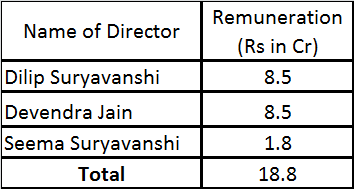
Remuneration, JainMatrix Investments

Exhibit 3 – Director Remuneration in FY16

  • DBL’s marketing and business development for construction are carried out centrally in Bhopal, MP. DBL is currently pre-qualified to bid for BOT projects with a contract price up to Rs 2,140 cr. and EPC projects with a contract price up to Rs 1,253 cr. The pre-qualification has helped increase their target market size and maintain the order book growth.
  • As of FY16 end, DBL had an order book of Rs 10,778 cr., consisting of 50 third party road EPC projects – 6 own road BOT, 3 irrigation, 1 mining, 1 cable-stayed bridge and 3 urban development. The construction order book was 84.6% of total in FY16. Also see state wise break-up in Fig 2.
  • In the last 5 years, DBL has completed 47 road projects in MP, Gujarat, HP, Rajasthan and Maharashtra, with an aggregate length of 5,612 lane km.

Business Model, News and Updates for DBL

  • DBL has a policy of no subcontracting and no equipment on rental. This has helped it build in house human resource capabilities as well as own and maintain capital equipment.
  • DBL carefully selects projects and strives for geographical clustering of these outside MP. This helps in utilization of construction assets and reduce environmental and forest clearance risks. It also paves the way for regional strengths. DBL leverages its manpower, equipment and materials and saves transportation costs, thus achieving economies of scale.
  • DBL has a good record for projects completed on time. DBL received early completion bonuses of Rs 192 cr. for 11 of its BOT projects and Rs 28.6 cr. for 10 govt. EPC projects over the last 5 years.
  • DBL won a contract to build India’s second largest cable bridge on Zuari river in Goa.
  • DBL is targeting to realize around Rs 11,000 cr. revenue by FY18.
  • In June 2012 Income Tax dept. conducted raids on promoter Dilip Suryavanshi, teacher-turned local business tycoon Sudhir Sharma and associates at 10 locations, including Indore and Bhopal in MP. The IT officers found incriminating documents related to tax evasion that were seized. The ED later sought details from the IT dept. regarding an alleged Rs 140 cr. FEMA violation from South Africa. (TOI news).
  • DBL on 29th July raised ₹196 crore from anchor investors ahead of the IPO. It allotted 89.6 lakh shares at ₹219 apiece to 10 anchor investors. They include SmallCap World Fund, American Funds Insurance Series, Abu Dhabi Investment Authority, Nomura Singapore, Grandeur Peak Emerging Markets, DB International (Asia), HDFC Trustees Company and IDFC Infrastructure Fund.

Roads Industry Outlook

  • We are skeptical of the sector as it faces risks like high working capital, long project gestation, poor and expensive funding options, land acquisition issues, PIL & litigation pressures and many govt. clearances.
  • The transport sector constitutes 6% of the country’s GDP and 70% of this is from roads. India has an extensive road network of 52.3 lakh km which is the 2nd largest in the world.
  • Roads form the most common mode of transportation and are the main arteries for travelling across India. It is estimated that 60% of the freight and 85% of the passenger traffic is carried by roads.
  • National highways (NH) which account for 2% of the total road network length in India, carry 40% of the road traffic volume. Additionally, state and major district roads carry another 40% of traffic volume and account for 20% of road length (adding up, the 80-20 rule applies).
  • Under NDA rule, GoI has launched initiatives to upgrade and strengthen highways and expressways. The NHAI and the Ministry of Road Transport & Highways sanctioned projects for 2,337 km in FY16. An outlay of Rs 26,600 cr. was provided, and 6,300 km of NHs & 8 bypasses were to be completed.
  • GoI aims to develop 57,653 km of National Highways under programs like NH Dev. Project (NHDP), Special Accelerated Road Dev. Program for NE (SARDP-NE) and NH Interconnect Improvement Project (NHIIP).
  • In the BOT model private developers invest funds for constructing roads, and recover this through toll collection. However the BOT model has in 2010-15 faced high failure rates. To revive the sector, the new govt. reverted to the EPC model, where the road construction is funded by the govt. In Apr 2015 the govt. launched a hybrid annuity model where project costs are shared with developer in a 40:60 ratio. So govt. provides 40% of the project cost to start work while the rest of investment is from developer.
  • IRB Infra Ltd and Sterlite Power Grid are preparing to list their Infra Investment Trusts (InvITs). These Trusts hold income-generating infra assets, and offer regular yields and liquidity to developers. They may attract longer duration funds, allowing better asset – liability matching. InvITs are expected to encourage higher FDI in the infra sector, reduce the burden on bank funding and allow developers to unlock tied-up capital. This is a positive sign for the industry including Dilip Buildcon.
  • Over the next 5 years, it is expected that NHAI would award more than 22,500 km of projects. With BOT projects losing favour, NHAI has been awarding more EPC and hybrid projects.
  • It is expected that investments in road projects will grow 2X to Rs 8.6 lakh crores over the next 5 years. Investments in state roads are expected to grow steadily, while those in rural roads will rise at a slower pace, impacted by a drop in budgetary allocations and funding constraints. Source: RHP/CRISIL Research.
  • As per IBEF (GoI), the Roads and Bridges construction sector size in 2016 was Rs 1,11,209 cr. So the market share of DBL in the sector is 3.9%. 

Financials of DBL

  • DBL’s revenue, EBITDA and PAT have grown 58.1%, 61.0% and 38.1% CAGR over 6 years.
  • The revenues have grown steadily, however the margins of DBL are volatile. The years 2014-15 saw poor financials (the entire sector was underperforming). Most contracts awarded earlier faced implementation and cost & time overruns. See Fig 4.
Fig 4 – DBL financials, JainMatrix Investments

Fig 4 – DBL financials

Fig 5 – DBL cash flows, JainMatrix Investments

Fig 5 – DBL cash flows

  •   DBL paid a dividend of Rs 0.025/share (Rate of 0.25%) in FY16, a yield of 0.01% which is very small. Dividend has been paid for several years but the rates have been falling.
  • DBL has been able to generate free cash flows only in FY16 of the last 6 years. DBL could be on a strong revival backed by govt. policy initiatives and growing order book size. Fig 6.
  • The cash per share including Reserves & Surplus and Cash in Balance sheet is Rs 73/share (post IPO). This indicates that the current operations of DBL are available in IPO at (219-73) = Rs 146/share.
  • DBL has a ROE of 19.6% in FY16 (source RHP) making it the industry leader. This is a positive.
  • It has a booked to bill ratio of 2.5 (FY16) – is good and improving  over 3-4 years, Fig 6.
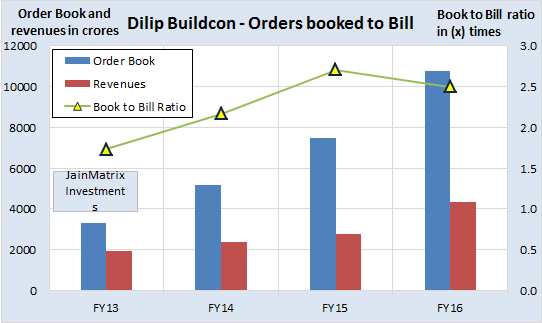
Order book position, JainMatrix Investments

Fig 6 – Order book position

Benchmarking                                                         
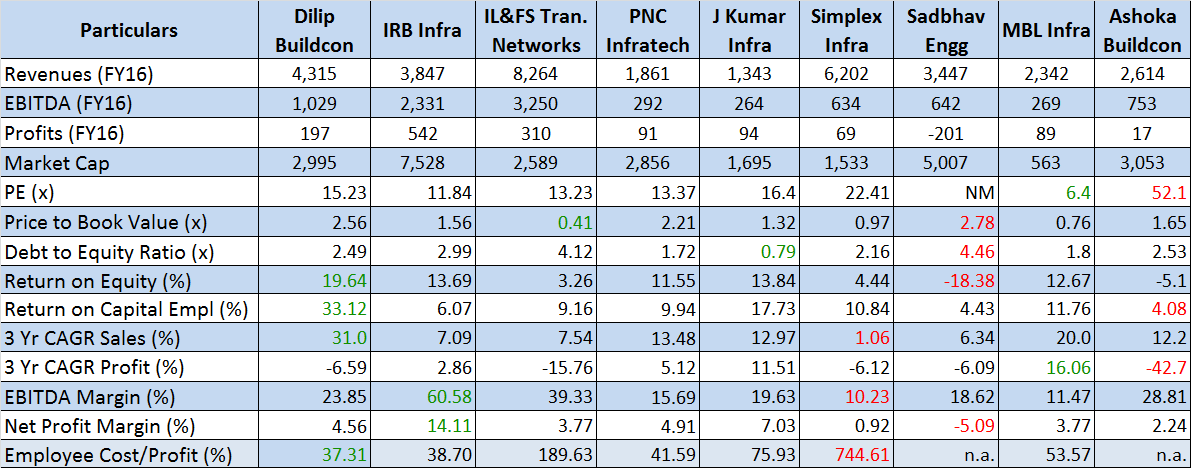
Benchmarking, JainMatrix Investments

Fig 7 – Benchmarking (Click Image to enlarge)

We benchmark DBL against peer Infra companies like Ashoka Buildcon, IRB Infra, etc. See Fig 7.

  • DBL appears to be available at slightly expensive valuations in terms of P/E and P/B.
  • High RoE, RoCE and 3 year sales growth are positives.
  • Employee costs are good in proportion to profits.
  • D/E is moderate to high. Margins are average in line with other industry players.

Positives for Dilip Buildcon Ltd and the IPO

  • DBL has a good presence in MP, its home state. Beyond MP, it operates in geographical clusters for projects which helps with efficiency and asset utilization. DBL has an efficient business model. The execution through strong operations helped DBL receive early completion bonuses for many projects.
  • Large employee strength and construction assets. It also has a fine factory/ campus in Bhopal.
  • Strong growth in financials and order book. Their O/B grew at 48.1% CAGR over 4 years.
  • Promoters Dilip Suryavanshi and Devendra Jain have solid experience profiles.

Internal Risks

  • The firm has a business concentration in MP with 40% of the O/B coming from there Fig 2.
  • All firms in the sector faces business risks like high working capital requirement, long project gestation periods, govt. clearances and PIL/ litigation issues. DBL is no exception.
  • We worry about allegations of political connections in MP and the litigations listed in the RHP. While we understand that in a business such as infra development, there are always going to be legal, law and order and regulatory challenges, but DBL appears to having an excessive number of such issues.
  • The 2012 IT Department case of tax evasion and FEMA is an issue. While the firm is attempting to settle this issue, there is no clarity on addl. tax liabilities, or even more such cases against the firm.
  • The top 3 promoters were paid high salaries – 10% of FY16 profits. This is not shareholder friendly.
  • DBL has an accounts receivable period of 108 days, higher than industry average of 80-90 days. This is partly because the govt. is the major customer.
  • A promoter has pledged 54.1 lakh equity shares, 4% of the post IPO share capital, to raise funds. We understand this is a norm in Real Estate/ construction sectors. But its a negative.
  • DBL’s revenues from projects are unpredictable and subject to seasonal variations. However the firm records revenues using % completion method and revenues are not recognized until there is reasonable progress on a contract. This is a good/ conservative method.

External Risks

  • A political regime change in MP may affect their current projects and orders booked pipeline.
  • Competition is intense in road projects, particularly in EPC projects rather than BOT.
  • The Land acquisition Act in India specifies the process and compensation. It has undergone several changes recently, and we expect more changes. The uncertainty affects the roads EPC industry.
  • BOT projects are evaluated based on traffic projections. In this sector, many BOT companies are facing financial pressures due to rosy projections during evaluation and high competition during bidding.

Overall Opinion

  • There is an urgent need to upgrade Indian infrastructure such as roads and highways. This was reflected in the Feb 2016 Indian budget announcements. We can see that on one side highways have improved a lot in the last decade; at the same time most newly launched capacity is quickly at a high utilization!!
  • There are signs of revival in old stuck projects as well as momentum in bidding for new ones.
  • In this sector Dilip Buildcon has built a good growing business, and is expanding from an MP centric firm to an all India operating entity. It has good policies and business model.
  • However valuations for DBL are expensive compared to higher quality peers such as IRB.
  • Sector specific challenges like cash flows, debt, litigation, pledging and regulatory issues worry us. The roads construction sector by its very nature today offers very few attractive opportunities. Investors can look at profitable / high certainty sectors other than infra EPC.
  • As an investment, we recommend an AVOID on DBL IPO.

JAINMATRIX KNOWLEDGE BASE 

See other useful reports:

  1. IRB Infrastructure – May 2012 report
  2. Do you want to be a value investor?
  3. Mahanagar Gas IPO 
  4. How will Brexit impact Indian investors?
  5. A Repurpose for our PSUs
  6. How to Approach the Stock Market – A Lesson from Warren Buffet
  7. An IPO Roundup and Update 
  8. JainMatrix Track Record May 3rd, 2016
  9. Thyrocare IPO – Wellness for your Wealth
  10. New Banks: Big Changes in Small Change
  11. Equitas IPO – Leader in SF Banks
  12. Announcement – SEBI approval as a Research Analyst
  13. Alkem Labs IPO
  14. Goods And Services Tax (GST): Integration And Efficiency
  15. Syngene IPO: Good Pharma R&D spinoff from Biocon

DO YOU FIND THIS SITE USEFUL?

  • Visit the Investment Service page to find how you can get more. Or Click LINK.
  • Register Now to get our Free reports and much more, on the top right of this page, or by filling this Signup Form CLICK.

Disclaimer

This document has been prepared by JainMatrix Investments Bangalore (JM), and is meant for use by the recipient only as information and is not for circulation. This document is not to be reported or copied or made available to others without prior permission of JM. It should not be considered or taken as an offer to sell or a solicitation to buy or sell any security. The information contained in this report has been obtained from sources that are considered to be reliable. However, JM has not independently verified the accuracy or completeness of the same. JM has no known financial interests in Dilip Buildcon or any related group. Neither JM nor any of its affiliates, its directors or its employees accepts any responsibility of whatsoever nature for the information, statements and opinion given, made available or expressed herein or for any omission therein. Recipients of this report should be aware that past performance is not necessarily a guide to future performance and value of investments can go down as well. The suitability or otherwise of any investments will depend upon the recipient’s particular circumstances and, in case of doubt, advice should be sought from an Investment Advisor. Punit Jain is a registered Research Analyst under SEBI (Research Analysts) Regulations, 2014. JM has been publishing equity research reports since Nov 2012. Any questions should be directed to the director of JainMatrix Investments at punit.jain@jainmatrix.com.

Do you want to be a value investor?

I came across a Question on Quora, the Q&A website, and would like to share my Answer here:

The question was – How do I start value investing?

To a new individual investor, learning Value investing can open the doors to wealth and a nice side income. In fact if Indians take to investing like in the developed countries, half the population may eventually have at least some money in stocks.

Here’s what to Do: 

You may find some points are from an Indian context:

  1. Start by looking at your finances. Can you set aside some money for a 2 year period without needing it, and which if your experiment fails, you can lose? This is your seed money.
  2. Get a brokerage account. If you are internet savvy, online only accounts are sufficient. Look for convenience and low brokerage. Buying or selling a share today is as easy as eCommerce.
  3. Next you need to find listed companies whose products or services you (or people around you) love. It could be your bath soap. Or your savings bank. Or your biscuit snack. Whats the brand? And company. Connect backwards. Use moneycontrol.com to see if the company is listed.
  4. Now Research this company identified. What else do they make. How are their finances. Who owns the firm. Are the promoters good people. Have they done well in the past. What are growth plans. There are some financial ratios that you need to check. The P/E, P/B and D/E should not be too high. Look for companies with high RoE. There are other ratios, but this is a good start. Value stocks are those that are worth much more than indicated by their current share prices. The research can result in a fundamental thesis for a company, like “with a new factory revenues will grow 45% and profits 60% in 2 years”, or  “the 40% fall is share price is unjustified and we expect a full recovery plus 20% based on growth of financials”.
  5. Investing is like growing a tree. It can’t be hurried. It needs care. Embed from Getty Images
  6. If you feel good about the research for a certain company, start your investing exercise by buying a few shares, a fraction of your seed money, say 20%.
  7. Repeat above exercise in some time to find 2-3 more companies and add 20% of the seed money for each. Track these firms for a few months. Keep reading up about them. See if the news flow is positive or negative.
  8. Review your company in 3-4 months by relooking at (4) questions periodically, say after the quarterly results. Sell the company if (4) answers on review don’t add up or price has gone too high. Buy more if the company performance is good but price goes low.
  9. Remember, a fall in share price and a notional loss for you is not necessarily a sign of a bad company. Check against (4) questions. Similarly the converse. A gain in share price may not necessarily be the sign of a good company.
  10. Build your learnings. Find non consumer companies that you understand or are comfortable with, to invest. Read books by great investors like Warren Buffet, Peter Lynch and our own Mohnish Pabrai. Keep learning.
  11. Cut out investing noise. Any stock tips you get should only be starting point for research with (4). There are a lot of hot stock picks floating around. But who is tracking it for you?
  12. Both greed and the pain of loss will hit you over the years. There will be times where you see a 30% notional loss in a share. Just check against (4) questions for buy and sell decisions. Try to stay satisfied with past decisions, while learning from them.
  13. Be humble. You will be wrong many times, but you have to bounce back.
  14. If you get it right, over the years you can outperform the Sensex / Nifty Indexes, equity Mutual Funds and Portfolio Managers. If you grow in learning and confidence over months and years, as does your portfolio, this door has opened for you. Congratulations.
  • This is how I did it. This is my process and some lessons learned over 12 years as an investor. I am now a SEBI registered and certified Research Analyst.
  • Visit JainMatrix Investments  to fast track your above process, or to get an experienced stock market Analyst to partner and help you. Note that not everyone can be a good value investor, or even spare the time required. A section called Investor Education has been created only to guide you along.
  • Read Disclaimer below also …… one point from there I would like to emphasise is – The suitability or otherwise of any equity investments will depend upon the person’s particular circumstances and, in case of doubt, advice should be sought from an Investment Advisor.

Upvote my answer on Quora if you liked it – Quora

JAINMATRIX KNOWLEDGE BASE 

See other useful reports:

  1. L&T Infotech IPO – An Exciting Tech Spinoff
  2. Mahanagar Gas IPO 
  3. How will Brexit impact Indian investors?
  4. A Repurpose for our PSUs
  5. How to Approach the Stock Market – A Lesson from Warren Buffet
  6. An IPO Roundup and Update 
  7. JainMatrix Track Record May 3rd, 2016
  8. New Banks: Big Changes in Small Change
  9. JainMatrix Investments Announcements
  10. A Superior Investing Process – Do a DIP SIP
  11. JainMatrix Investments presents the Investment Outlook for 2016
  12. Alkem Labs IPO
  13. Goods And Services Tax (GST): Integration And Efficiency
  14. Café Coffee Day IPO – Very Hot Coffee 
  15. Syngene IPO: Good Pharma R&D spinoff from Biocon.
  16. JainMatrix IPO Reports deliver 60.5% returns

DO YOU FIND THIS SITE USEFUL?

  • Visit the Investment Service page to find how you can get more. Or Click LINK.
  • Register Now to get our Free reports and much more, on the top right of this page, or by filling this Signup Form CLICK.

DISCLAIMER

This document has been prepared by JainMatrix Investments Bangalore (JM), and is meant for use by the recipient only as information and is not for circulation. This document is not to be reported or copied or made available to others without prior permission of JM. It should not be considered or taken as an offer to sell or a solicitation to buy or sell any security. The information contained in this report has been obtained from sources that are considered to be reliable. However, JM has not independently verified the accuracy or completeness of the same. Neither JM nor any of its affiliates, its directors or its employees accepts any responsibility of whatsoever nature for the information, statements and opinion given, made available or expressed herein or for any omission therein. Recipients of this report should be aware that past performance is not necessarily a guide to future performance and value of investments can go down as well. The suitability or otherwise of any investments will depend upon the recipient’s particular circumstances and, in case of doubt, advice should be sought from an Investment Advisor. Punit Jain is a registered Research Analyst (SEBI Registration No. INH200002747) under SEBI (Research Analysts) Regulations, 2014. JM has been publishing equity research reports since Nov 2012. Any questions should be directed to the director of JainMatrix Investments at punit.jain@jainmatrix.com.

L&T Infotech IPO – An Exciting Tech Spinoff

Summary

  • IPO Applications: IPO Period: 11th-13th July
  • IPO Price range: Rs. 705-710 with Retail discount: Rs 10/share
  • Mid Cap – Rs 12,056 crore Market Cap and Industry – IT services
  • Overview: LTECH is the sixth largest Indian IT services firm, and part of L&T group.
  • LTECH had FY16 revenues and profits of Rs 6,143 crores and Rs 922 cr. LTECH’s revenue, EBITDA and PAT have grown 16.4%, 17.4% and 20.7% CAGR over 5 years.
  • LTECH is a leader among IT services midcaps. It has a good balance sheet, solid global presence and diversified business vertical segments. It has access to rich knowledge pools. We are optimistic that leadership in LTECH will settle down to start shaping a better trajectory in the next few years.
  • Valuations appear attractive. The asking PE at 12.65 times is lower than listed peers. There is a discount of Rs 10/- for retail. There is something on the table for investors.
  • However there are a few risks: the uncertainties at LTECH are on current leadership, low growth rates, and planned acquisitions. Business development appears weak.
  • Outlook: As an investment, the LTECH IPO is rated a medium risk, medium return type of offering. Investors may Buy LTECH with a 2-3 year perspective.

Here is a note on L&T Infotech Ltd (LTECH)

IPO highlights

  • IPO opens: Monday 11-13th July 2016 with Issue Price band: Rs. 705-710 per share.
  • A discount of Rs 10/- is offered to retail category investors.
  • Shares offered to public: 1.75 crores of Face Value: Rs. 1 per share, Market Lot: multiples of 20.
  • Shares offered are 10.3% of equity. The IPO is of Rs 1,242 cr. (upper band) which is a sale by current shareholders; there is no fresh issue of shares.
  • The promoter of LTECH is L&T which holds 94.9% stake, and post IPO this will fall to 84.6%. The IPO shares are available to QIB, NIB and retail in ratio of 50:15:35. Post IPO shareholding will be promoter 84.6%, IPO (QIB 5.1%, NIB 1.5%, retail 3.6%) and Others 5.1%.
  • This IPO will unlock value for L&T, as LTECH will be independently valued in line with IT firms.
  • The IPO grey market premium on LTECH is Rs 80 – 83, a positive indication.

Introduction

  • LTECH is the sixth largest Indian IT services firm, is Mumbai based and part of L&T group.
  • LTECH had revenues and profits of Rs 6,143 crores and Rs 922 cr. resp. in FY16.
  • Its revenue, EBITDA and PAT have grown 16.4%, 17.4% and 20.7% CAGR over 5 years.
  • LTECH has 41 sales & 22 delivery offices globally. See Fig 1. It has 20,072 employees.
  • It addresses clients in diverse industries such as BFSI, insurance, energy, CPG, retail, pharma, etc. See Fig 2. Their range of services includes application development, maintenance, outsourcing, enterprise solutions, infrastructure mgt., testing, digital solutions and platform-based solutions.
  • LTECH has 258 active clients which include 49 from the Fortune 500. LTECH’s top client Citibank accounted for 14.9%, while the top 10 clients constituted 52.7% of FY16 revenue.
  • Citibank, Chevron, Barclays and Time Warner are the largest clients. Revenue geography is in Fig 1.
JainMatrix Investments

Fig 1 – Geographic revenue/ Fig 2 – Revenues by Vertical (JainMatrix Investments)


L&T Infotech, JainMatrix Investments

Fig 3 – Segment Margins (Click on images to expand)

  • In 2015, NASSCOM ranked LTECH the 6th largest Indian IT services firm in export revenues. They were among top 20 IT service providers globally in 2015 (Everest Group’s PEAK Matrix).
  • A. M. Naik is the non-executive Chairman; Sanjay Jalona is the CEO & MD of LTECH.
  • As part of a business restructuring by L&T, all engineering services businesses of L&T were consolidated under the subsidiary – LTTSL (L&T Technology Services Ltd). The IT services were retained by LTECH. In Jan 2014, LTECH sold and transferred their PES Business to LTTSL. The PES business included the telecom cluster, for services and solutions to telecom clients.
  • As we can see from Fig 3, the operating margins of the telecom business were witnessing a fall. Hence transferring the business to LTTSL was perhaps beneficial for LTECH.

Promoter (L&T) – Snapshot and Financials

  • L&T is a diversified engineering, construction, manufacturing, technology and financial services company.
  • Income and PAT has grown at 12.4% and 4.3% CAGR resp. over 5 years. In the same duration EPS witnessed a fall of -8.03% CAGR. P/E ratio has however risen to 22.34 times. See Fig 4.
JainMatrix Investments

Fig 4 – L&T financials (JainMatrix Investments)

  • L&T has low net profit margin of 5.21%. The current dividend yield for L&T stands at 1.24%. The RoCE stands at 10.6% and RoE at 11.33%. This is average performance.
  • This is the third listing from the group after L&T India and L&T Finance.
  • L&T has struggled in the last 3 years. Its hydrocarbon division reported a loss in the 2014 June quarter. Profitability in segments such as power, material handling and metallurgy were flat. In West Asia, there is uncertainty on account of falling crude prices. There was slow revenue recognition in Indian projects due to weak project execution and delay in client payments.
  • L&T’s share price has gained only 4.9% CAGR over 5 years with high volatility.
  • However we are positive that the investment cycle and infra focus will re-emerge over the next 2 years as the economy picks up. Sectors like defense, railways, roads and construction are recovering. L&T is best placed to benefit from this, given its exposure to diverse sectors, its strong balance sheet and positive cash flow as compared to its peers. So we are positive on L&T.

Business Model, News and Updates for LTECH

  • It as part of the L&T group benefits from their expertise and experience in a range of verticals. This strong domain experience and understanding of businesses assists in developing and delivering IT services and solutions. This model called “Business-to-IT Connect” by LTECH is a key strength.
  • The management plan is to enhance key new technologies such as their digital platforms, build industry and technology frameworks, the internet of things (IoT), business process digitalization and end-to-end digital transformational delivery capabilities.
  • LTECH plans to increase its geographical reach in markets that have potential which includes Australia, Singapore, Japan, South Africa, India and the Middle East.
  • The INR is holding up against USD, and we expect a range of 66-70 Rs/$, a positive for LTECH.
  • LTECH is targeting a doubling of revenues in the next 3-4 years through acquisitions and organic growth. For acquisitions, the company will focus on the North American and European markets.
  • A news article said LTECH had issued 1,500 engineering graduates job offer letters on campus in 2015 but withdrew these in May 2016. (news – Indian Express)
  • There was industry speculation that exits of senior executives at LTECH were due to the interference of A. M. Naik. However he has denied this, and said the exits were due to their own decisions.
  • The unofficial/ grey market premium for this IPO is in the range of Rs 80 – 82.

Industry Outlook

  • In 2015-16, the global economy was characterized by volatility and turmoil. According to NASSCOM, developed and emerging countries experienced multiple headwinds with as economies stagnating, terrorism increase, turbulence in currency and equity markets, and high unemployment.
  • Globally, the total capital investment in technology is estimated at USD 6 trillion in 2014.
  • As per NASSCOM the shift towards digital is inevitable. Incremental expenditures over the next decade may be driven by digital technologies.
  • According to NASSCOM, worldwide IT & business process management spend in 2015 (excluding hardware) was impacted by the volatility in global currencies resulting in a near flat growth of 0.4% (USD 1.2 trillion) in 2015. IT services saw a slight decline in growth (-0.2%). A shift to cloud-based applications led to a decline in traditional IS outsourcing and Network and Desktop Outsourcing.
  • According to NASSCOM, exports in FY16 were USD 108 billion, a 10.3% annual growth.
  • The industry projection is 10-12% for FY17, lower than the 12-14% for FY16.
  • We feel that Indian IT services are gaining market share against US and European firms. This is because of good IT talent & lower cost structures in India, and better service maturity in firms.
  • There are rapid changes in IT services, from linear to non-linear business models, from isolated applications to cloud services & networks. The firms have to take a lead in introducing tech changes.

Financials of LTECH

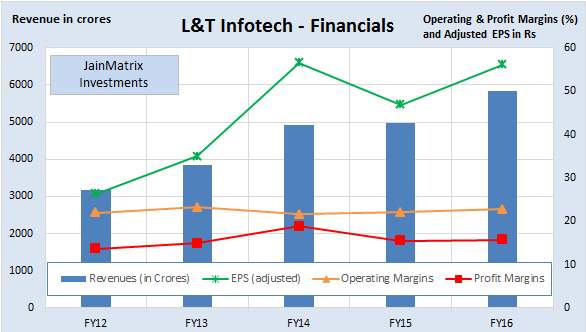
  • LTECH’s revenue, EBITDA and PAT grew 16.4%, 17.5% and 20.8% CAGR over 5 years. Revenue has grown steadily and margins of LTECH are stable, see Fig 5.
  • However for FY16 LTECH reported a gain of Rs 276.5 cr from forex on a profit of Rs 922.2 cr. Thus 30% of the profits were from Forex gains.
JainMatrix Investments

Fig 5 – L&T Infotech Financials (JainMatrix Investments)

  • The operating margins have been flat over the years. The net profit margin improved marginally to 15% in FY16 from 13.6% in FY12.
  • LTECH witnessed a massive jump 61.8% in PAT for FY14. There was an extraordinary gain of Rs 239.7 cr. for that year since the PES business unit was sold to LTTSL.
  • LTECH paid a dividend of Rs 32.65/share in FY16, a yield of 4.6%. This is a big positive.
  • LTECH has positive Free Cash Flow over the last 5 years, a big positive. See Fig 6. LTECH has a ROE of 45.55% (FY16) making it the leader in the industry.
  • The cash per share including Reserves & Surplus and Cash in B/Sheet is Rs 130/share. Hence the operations of LTECH are available in IPO at (710-130) = Rs 580/share.
JainMatrix Investments

Fig 6 – L&T Infotech Cash Flows (JainMatrix Investments)

Benchmarking

JainMatrix Investments

Fig 7 – Benchmarking (JainMatrix Investments)

We benchmark LTECH against peers like Mindtree, Infosys, Wipro etc. See Fig 7.

  1. LTECH appears to be available at reasonable valuations in terms of PE. It doesn’t look cheap on P/B though.
  2. Highest ROE is a positive. But this is because it has a tiny share capital of Rs 16.8 cr.
  3. Dividend yield is very good; the balance sheet is strong and can be leveraged in future. Debt is very low, free cash flows are positive. However this is common across the Indian IT sector.
  4. Margins are average. Also unimpressive are 3 year growth rates, utilization and profit/ employee.
  5. However if we relook at this firm as a mid-cap comparable to only Mindtree and Hexaware, its margins, utilizations and profit/ employee suddenly look good. Only growth looks weak.

Positives for LTECH and this IPO

  • LTECH has an advantage of association with L&T group, which gives it a great access to 1) specialized knowledge in many sectors 2) a big customer base in India and Middle East. LTECH has a sister firm LTTSL, which is focused on engineering services. There are good synergies between them for cross selling and common sales teams. We believe these two firms are already working together in Sales.
  • With revenues > Rs 5,000 crore and employees > 20,000, LTECH is well placed to pitch for and win large orders of size $10-50 million (70-350 crores).
  • The IPO pricing is attractive. At the upper band of Rs 710/share, LTECH’s asking P/E is 12.65 times which is lower than Mindtree (18.33 times) and other peers. Also there is a retail discount.
  • LTECH is a low debt firm, with strong balance sheet, cash balance and high return on equity. It has a high dividend yield of 4.6%. This makes LTECH attractive.
  • With a good geographic spread and employee strength, LTECH has the potential to grow rapidly. Per management it will double revenues in 3-4 years with acquisitions & organic growth.
    • However we are unconvinced about this, with little evidence of high growth in recent past.
  • We are positive that new leadership will settle in and rally this firm to new heights.
  • The small share capital base (in relation to revenues and profits) is not right and LTECH is likely to award bonuses and rights to shareholders in the next few years to expand this.
  • LTECH has a focus on emerging technologies such as Social, Mobile, AIM, Cloud Computing, Big Data, IoT, Enterprise Integration, Biz Process Digitalisation, User Experience and Cognitive Computing. This is good.

Internal Risks

  • LTECH bears a client concentration risk, and top 10 accounts get 52.7% of revenues.
    • However this is not a worry, if the firm gets good growth from new clients.
  • Leadership – There have been many top level exits in LTECH in recent years. This is worrying as any new executive takes time to settle down. Current CEO-MD Sanjay Jalona has been here for less than 1 year.
  • We don’t see a clear strategy from LTECH or how it differentiates itself. The strategy and vision has to come from top management, and so again this issue is related to the executive changes.
  • In FY2014, a restructuring was taken up to transfer the engineering services unit to LTTSL. Typically IT firms like TCS and Infosys include both IT and engineering services. We are unable to find the reasons or justification for this demerger, since we see a good synergy among the firms. Is this a pre IPO clean-up of LTECH?
  • The sister company, LTTSL operates in the engineering services space and has global clients. While these 2 firms have well defined focus, there may be many areas where strong coordination is required. There can be areas of business and sales conflict.
  • About 15 contracts which make up 22% of FY16 business contain benchmarking and most favored customer provisions. They allow customers to benchmark services provided by LTECH to competition, and if found wanting, LTECH may have to reduce pricing, improve the quality of services or provide higher service levels. These can impact revenues and profits.
  • LTECH had reneged on campus job offers – while the firm may not be legally bound to honor such promises, the public perception of the firm can take a beating with such incidents.
  • The attrition rate in LTECH in FY16 was 18.4%, which is slightly higher than industry. It also means that a lot of energy in the firm is wasted in handovers & takeovers and so much knowledge is lost.

External Risks

  • There is high competition in the IT services market from Indian firms and MNCs.
  • 30% of FY16 profits were gains from forex hedges. This is typically an unpredictable and volatile source of other income, and can easily reverse in the future.
  • All IT exports firms face forex rate fluctuations which have an effect on revenues.
    • The firm does appear to have a good forex hedging policy in place.
  • About 97% of revenue in FY16 came from existing clients. This could be a sign of weak new business and sales pipelines.
  • LTECH has plans to take up acquisitions in future. However the firm does not have much of a history of acquisitions. The task of M&A /integration is complex and risky.
  • The Brexit event recently caused volatility in forex and may affect UK business. This is an example of global business risks.

Overall Opinion

  • Indian IT services industry clearly has a lot of competitive advantages and as the #6 player, LTECH is in a good position to ride this multi decade rise of Indian tech firms.
  • LTECH is the leader among IT services midcaps. It has a good balance sheet, solid global presence and diversified business vertical segments. It has access to rich knowledge pools. We are optimistic that leadership in LTECH will settle down to start shaping a better trajectory in the next few years.
  • Valuations are at a discount to peers and are attractive. At a PE of 12.65 times, it looks cheaper than other midcaps.
  • There are a few risks listed above that must be understood.
  • Overall, as an investment, the LTECH IPO is rated a medium risk, medium return type of offering.
  • Investors may Buy LTECH with a 2-3 year perspective.

JAINMATRIX KNOWLEDGE BASE 

See other useful reports:

  1. Mahanagar Gas IPO 
  2. How will Brexit impact Indian investors?
  3. A Repurpose for our PSUs
  4. How to Approach the Stock Market – A Lesson from Warren Buffet
  5. An IPO Roundup and Update 
  6. Parag Milk Foods IPO – Let This Drink Go
  7. JainMatrix Track Record May 3rd, 2016
  8. Thyrocare IPO – Wellness for your Wealth
  9. New Banks: Big Changes in Small Change
  10. Equitas IPO – Leader in SF Banks
  11. JainMatrix Investments Announcements
  12. A Superior Investing Process – Do a DIP SIP
  13. JainMatrix Investments presents the Investment Outlook for 2016
  14. Alkem Labs IPO
  15. Goods And Services Tax (GST): Integration And Efficiency
  16. Café Coffee Day IPO – Very Hot Coffee 
  17. Syngene IPO: Good Pharma R&D spinoff from Biocon.
  18. JainMatrix IPO Reports deliver 60.5% returns

..

DO YOU FIND THIS SITE USEFUL?

  • Visit the Investment Service page to find how you can get more. Or Click LINK.
  • Register Now to get our Free reports and much more, on the top right of this page, or by filling this Signup Form CLICK.

Disclaimer

This document has been prepared by JainMatrix Investments Bangalore (JM), and is meant for use by the recipient only as information and is not for circulation. This document is not to be reported or copied or made available to others without prior permission of JM. It should not be considered or taken as an offer to sell or a solicitation to buy or sell any security. The information contained in this report has been obtained from sources that are considered to be reliable. However, JM has not independently verified the accuracy or completeness of the same. Punit Jain has a small equity ownership < Rs 2 lakhs in L&T, where he is a shareholder since 2007. Other than this JM has no known financial interests in L&T Infotech Ltd. or any group company. Neither JM nor any of its affiliates, its directors or its employees accepts any responsibility of whatsoever nature for the information, statements and opinion given, made available or expressed herein or for any omission therein. Recipients of this report should be aware that past performance is not necessarily a guide to future performance and value of investments can go down as well. The suitability or otherwise of any investments will depend upon the recipient’s particular circumstances and, in case of doubt, advice should be sought from an Investment Advisor. Punit Jain is a registered Research Analyst (SEBI Registration No. INH200002747) under SEBI (Research Analysts) Regulations, 2014. JM has been publishing equity research reports since Nov 2012. Any questions should be directed to the director of JainMatrix Investments at punit.jain@jainmatrix.com.
How will Brexit impact Indian investors?

  • Date: Monday June 27th, 2016
  • Report Type: News Analysis 

What is Brexit?

Brexit refers to the UK including Britain, Scotland, Wales, Ireland and Northern Ireland, exiting from the European Union. This is a significant historic event as if it goes through UK will have broken off from the European Union, and will go independent in terms of economics, government, immigration, business & commerce, etc.

So what is Brexit actually about? It was about the British identity. The concern among the people of UK was about immigration and jobs. Do the British have shared interests with other European countries? Was the association helpful or harmful? People started having doubts on all these aspects, which resulted in the Brexit vote.

What were the results?

So to decide this, a referendum was held in UK on Thu 23rd June, 2016. 51.7% people voted for UK to exit the EU. It was a close decision. The Prime Minister, David Cameron has resigned as PM after people voted to leave the EU and will leave his post in 2-3 months.

Immediate Effect of Brexit Vote

It was an unexpected vote. By next day, Friday, the pound sterling had crashed by 10% against USD, the highest fall in its trading history and its lowest level since Sept 1985. The INR too weakened and stock markets across the world fell sharply – FTSE fell by 500 points while the Sensex closed lower by more than 600 points.

What might happen next?

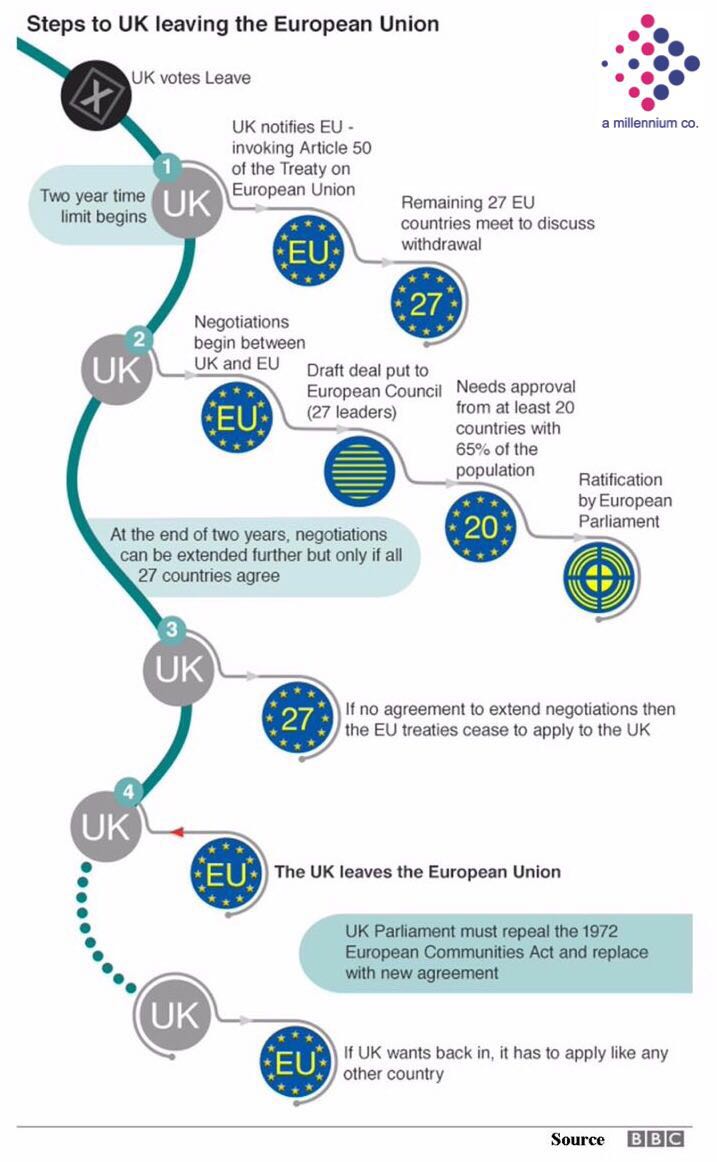
But quitting the EU for UK is not an automatic process. It has to be negotiated with the remaining members. These negotiations are meant to be completed within 2 years but the European Parliament has a veto over any new agreement formalizing the relationship between the UK and the EU. What will happen is difficult to predict. A flow chart from BBC captures the next steps for UK and European Union:

Post Brexit-20160625, JainMatrix Investments

Click to enlarge image

Our take on Brexit Referendum Effects

Europe hasn’t been doing too well in terms of growth and economics over the last few years; this will be a further blow. One fear is that this may encourage many countries to rethink EU and conduct their own referendum. However my feeling is RoE (Rest of Europe) barring maybe some East Europe countries will stay together. They have strong ties of culture, language, proximity and history. The EU may actually become faster and more responsive to each other’s economic and financial necessities, after this shakeup.

The UK is now exposed to several new uncertainties. It will be affected by some new barriers to trade with the EU, which will come into effect soon. Many work immigrants from RoE who were allowed easy access to UK may now have to head back to their countries. This will improve job prospects locally. However UK may suffer as a financial capital, and as European headquarters for many businesses. The red hot real estate market of London may cool a bit.

How will Brexit impact Indian investors?

We have seen a high volatility in the GBP against most major currencies. Indian firms with an exposure to UK and Europe too have fallen sharply. Certainly the unexpected Brexit vote has increased uncertainties.

  1. However UK has been quite resilient to currency fluctuations in the past. The country is both a big importer and exporter, and the net effect of the recent changes has to be calculated by sector and by company to understand the specific impact.
  2. The UK based manufacturer-exporters may actually see a gain due to weaker GBP. However if they need to import significant raw materials, then product prices may have to be adjusted upwards partially.
  3. Exports from UK to the EU may see some tariff and non-tariff barriers in future. However this may be compensated by other markets and new bilateral ties. And a weaker currency.
  4. Indian companies which have invested a lot in the UK have concerns. Over 800 Indian firms have invested $2.75 billion into Britain in the last few years. Listed Indian firms with operations or subsidiaries in UK may see an immediate 10% drop in revenues and other financials due to the weakened currency.
  5. Indian firms with EU assets or subsidiaries should be less affected, as the Euro has weakened only 1.5-2%  so far. However higher pessimism prevails as the 27 country EU looks weaker economically.
  6. However note that in a 3 month period post Brexit, very little will change except these currency rates. Investors should take this as an opportunity to invest in high quality firms. The Indian investor needs to stay calm and take advantage of the situation. Read here: THE TOUGHEST LESSON IN LONG TERM INVESTING https://jainmatrix.com/2014/12/10/the-toughest-lesson/
  7. Investors in JainMatrix Investments – Model Portfolios may note that there is no change in the recommended firms due to Brexit. They may continue to hold these or invest in a SIP format as per their investment plan.

Regards,

Punit Jain

JAINMATRIX KNOWLEDGE BASE 

See other useful reports

  1. Mahanagar Gas – A Hot Piping IPO
  2. How to Approach the Stock Market – A Lesson from Warren Buffet
  3. An IPO Roundup and Update 
  4. Parag Milk Foods IPO – Let This Drink Go
  5. JainMatrix Track Record May 3rd, 2016
  6. Thyrocare IPO – Wellness for your Wealth
  7. New Banks: Big Changes in Small Change
  8. Equitas IPO – Leader in SF Banks
  9. JainMatrix Investments Announcements
  10. A Superior Investing Process – Do a DIP SIP
  11. JainMatrix Investments presents the Investment Outlook for 2016
  12. Alkem Labs IPO
  13. Goods And Services Tax (GST): Integration And Efficiency
  14. Café Coffee Day IPO – Very Hot Coffee 
  15. Syngene IPO: Good Pharma R&D spinoff from Biocon.
  16. JainMatrix IPO Reports deliver 60.5% returns

Search for companies/ sectors of your interest in Search box in the right panel.

Visit and Like JainMatrix FB or Follow on JainMatrix Twitter for reports

DO YOU FIND THIS SITE USEFUL?

Visit the Investment Service page to find how you can get more. Or Click LINK

Register Now to get our Free reports and much more, on the top right of this page, or by filling this Signup Form CLICK.

DISCLAIMER

This document has been prepared by JainMatrix Investments Bangalore (JM), and is meant for use by the recipient only as information and is not for circulation. This document is not to be reported or copied or made available to others without prior permission of JM. It should not be considered or taken as an offer to sell or a solicitation to buy or sell any security. The information contained in this report has been obtained from sources that are considered to be reliable. However, JM has not independently verified the accuracy or completeness of the same. Neither JM nor any of its affiliates, its directors or its employees accepts any responsibility of whatsoever nature for the information, statements and opinion given, made available or expressed herein or for any omission therein. Recipients of this report should be aware that past performance is not necessarily a guide to future performance and value of investments can go down as well. The suitability or otherwise of any investments will depend upon the recipient’s particular circumstances and, in case of doubt, advice should be sought from an Investment Advisor. Punit Jain is a registered Research Analyst (SEBI Registration No. INH200002747) under SEBI (Research Analysts) Regulations, 2014. JM has been publishing equity research reports since Nov 2012. Any questions should be directed to the director of JainMatrix Investments at punit.jain@jainmatrix.com.

Mahanagar Gas – A Hot Piping IPO

  • Date: 20th June 2016
  • Issue Price range: Rs. 380 – 421 and Period: 21st-23rd June
  • Industry – Gas Distribution
  • Mid Cap – Rs 4,156 crores Mkt cap
  • Advice: Buy for 2 years 

Summary

  • Overview: MGL is a city gas distribution firm that has the sole distribution rights for CNG and PNG supplies in and around Mumbai. It is a JV between GAIL and the British Gas of U.K.
  • MGL had revenues of Rs 2,121 cr. and profits of Rs 309 cr. in FY16. MGL’s revenue, EBITDA and PAT have grown 12.4%, 1.8% and 0.1% CAGR over 5 years. MGL has a good balance sheet, low debt, high cash and a high dividend yield.
  • MGL supplies CNG to over 4.7 lakh vehicles through a network of 188 CNG filling stations, and PNG to 8.6 lakh households, 2,866 commercial and 60 industrial consumers.
  • With global gas prices falling, demand for gas is expected to rise. MGL is growing pipeline networks.
  • It is available at attractive valuations. Based on the adjusted FY16 EPS, the asking PE stands at 13.47 which is lower than listed peers.
  • Opinion: The Mahanagar Gas IPO is rated a BUY with a 2 year perspective.

IPO highlights

  • IPO opens: 21-23rd June 2016 with Issue Price band: Rs. 380-Rs. 421 per share.
  • Shares offered to public: 2.46 cr. of Face Value: Rs. 10 per share, Market Lot is multiples of 35.
  • Shares offered are 25% of post equity. Promoter holding will fall from 90% to 65%. The IPO is of Rs 1,040 cr. which is a sale by current shareholders; there is no fresh issue of shares.
  • MGL is a JV between promoters GAIL and British Gas Asia Pacific Holdings (BGAS) where each owns 45% stake. Govt. of Maharashtra holds an additional 10%. Through the IPO, promoters would offload a stake of 12.5% each. The IPO helps MGL meet the 25% public holding norm.
  • The offering is available to institutional, non-institutional and retail in ratio of 50:15:35 of the offer.

Introduction

  • MGL is a city gas distribution (CGD) firm that supplies natural gas in Mumbai and surrounding areas. It is the sole distributor in Mumbai. MGL is a JV between GAIL and the British Gas of U.K. For abbreviations full form or glossary, see last page.
  • MGL had revenues and profits of Rs 2,121 crores and Rs 309 cr. resp. in FY16.
  • The firm distributes and sells natural gas, moving it from suppliers to end consumers. It distributes CNG for use in vehicles and PNG for domestic households, commercial and industrial use.
  • In FY16, MGL supplied CNG to over 4.7 lakh vehicles through a network of 188 CNG filling stations. It also provided PNG connection to 8.6 lakh domestic households, 2,866 commercial and 60 industrial consumers in Mumbai and adjoining areas.
  • For FY16, their CNG and PNG businesses accounted for 71% and 29%, of their total gas revenue. And 23.1% of the total CNG sales were to retail customers through company owned/ franchised outlets and 76.9% of CNG sales were through Oil Marketing Cos. and State Transport Units. See Fig 1.
  • MGL has a supply network of 4,646 km of pipelines, with 4,231 km polyethylene and 415 km steel.
  • Ashutosh Karnatak is Chairman; Rajeev Mathur is MD of MGL. In FY16, they had 499 employees.
  • MGL has the exclusive authorization (Infrastructure Exclusivity) to lay, build, expand and operate the CGD network in Mumbai until 2020, its adjoining areas until 2030 and the Raigad district until 2040.
JainMatrix Investments

Fig 1 – Segments by Value/ Fig 2 – Post IPO shareholding in MGL

British Gas Snapshot

  • BGAS (British Gas Asia Pacific Holdings) is a subsidiary of BG Group UK, which in turn is a subsidiary of Royal Dutch Shell plc. Shell is one of the world’s largest independent oil and gas firms.
  • In 2016, Shell had cash flow from operations of $30 billion. The Shell Group develops crude oil and natural gas supplies from major fields. Natural gas based liquefied natural gas (LNG) is shipped to markets around the world. The Shell Group’s portfolio of refineries and chemical plants enables it to add value to the oil and gas, turning them into a range of refined and petrochem products, which have domestic, industrial and transport uses.

GAIL Snapshot and Financials

  • GAIL (India) Ltd. is the largest state-owned natural gas processing and distribution firm in India. The company has 80% market share in natural gas transmission. It possesses about 11,000 km of gas pipeline network with a capacity of 210 mmscmd. It has presence in Egypt and China through city gas projects and in Myanmar through E&P. It acquired shale gas assets in USA through US subsidiary GAIL Global (USA) Inc.
  • Income has grown at 5.6% CAGR over the last 5 years Fig 3. In the same duration, EBITDA and PAT witnessed a fall of -6.5% and -17.4% CAGR. P/E ratio has however risen to 19.6 times.
  • GAIL has low net profit margin of 5.2% and a 80% market share (monopoly) in gas distribution, controlled by the govt. The current dividend yield for GAIL stands at 1.48%.
  • The RoCE stands at 9.57% and RoE at 9.24%. This is average performance.
JainMatrix Investments

Fig 3 – GAIL Financials Snapshot

  • The firm’s performance was poor because of long term contractual agreements. Under an agreement GAIL is liable to take 60% of Petronet LNG’s procurement which was sourced from Qatar based company RasGas. Based on the contract signed between the Petronet LNG and RasGas in 1999, Petronet LNG was getting LNG at $12-13 per mBtu (million British thermal unit) in FY16 whereas the spot gas prices had fallen to $7 per mBtu, leading to GAIL India suffering losses.
  • However the contract terms were renegotiated in FY16, under which the price for the buyer would be governed by market dynamics based on a crude price linked formula. So GAIL is expected to perform better in FY17 with reasonable costs, good demand and high utilization of pipelines.

Business Model, News and Updates for MGL

  • MGL has paid a dividend of Rs 17.5/ share in the previous 3 years, which gives a yield of 4.1%.
  • As per the MoPNG guidelines, MGL has access to cost effective domestic natural gas equal to 110% of their CNG and domestic PNG requirements (such customers are “Priority Sector”). The domestic natural gas is currently sold to them at US$ 3.06/ mmbtu (GCV), which is lower than the price of imported natural gas, for supply exclusively to the Priority Sector. These sales accounted for 84.1%, 85.0% and 85.6% of MGL total sales volume in FY14, FY15 and FY16, resp. For industrial and commercial PNG consumers, they source regasified liquefied natural gas both on term and spot basis. The selling price of natural gas is not regulated and thus they generally are able to pass on an increase in the cost to customers.
  • The price at which MGL sells natural gas is benchmarked to the price of alternate fuels as petrol, diesel, other liquid fuel and LPG, which are in turn linked to crude oil. MGL is given pricing flexibility based on procurement costs for both CNG and PNG. However CNG prices are regulated. It means that MGL is allowed to change the price, but govt. can intervene for the price of CNG, but not PNG.
  • The price of domestic natural gas allocated by the MoPNG is determined as per the Pricing Guidelines, this is the administered price mechanism (APM). The price of natural gas is presently US$ 3.06/MMBTU on GCV basis, this price is much lower than the price of imported natural gas.
  • MGL launched its mobile application ‘MGL Connect’ for its PNG and CNG customers. The mobile application featured various consumer friendly features and services.
  • In 2014 there was a Gas leak in MGL’s pipeline in Mumbai’s Worli area. The measures were taken at the right time and a major mishap was averted.
  • A ban on >2000 cc diesel engine car sales in New Delhi is meant to help clean the environment. It was imposed by the NGT (National Green Tribunal) in Dec 2015. This may soon be extended to other cities and regions in the country. It emphasizes the importance of natural gas as a clean fuel in India.
  • New Delhi was the first to enforce CNG as fuel for all bus services, helping clean the air. We expect this to be rolled out in all major cities over time.
  • Growth driver – MGL has commenced project activities in Raigad district to lay pipeline infrastructure. The Raigad district provides good opportunities for expansion of their networks.
  • On 21st June, the Day 1 of IPO, the issue was subscribed 110% by 5pm, indicating a good demand.
  • MGL collected Rs 309 crore from anchor investors, a day ahead of its IPO, by raised money from over 20 anchor investors, by selling shares at Rs 421 apiece – the higher end of the price range.
  • The unofficial/ grey market premium for this IPO is in the range of Rs 100 – 102.

Industry Outlook

  • Natural gas production in FY14 was 97 mmscmd by ONGC, OIL, non-state owned and JV companies. This however constitutes only about 26% of India’s gas consumption.
  • The Indian CGD market size was estimated at INR 24,000 cr. in FY14, with sales volumes of 20 mmscmd, accounting for 13% of India’s total natural gas consumption.
  • The PNGRB has envisaged a rollout plan of CGD network development through competitive bidding in more than 300 Geographical Areas (GA) in a phased manner. The actual rollout has been delayed due to lack of connectivity and supply constraints, with the Govt. needing to assure domestic gas supplies for CGD entities (CNG and domestic PNG). The PNGRB has bid out 34 GAs in the sixth round of CGD bidding. 106 GAs have been identified by PNGRB for subsequent bidding subject to natural gas pipeline connectivity.
  • PNGRB’s bidding rounds could be a large opportunity for growth with 11 GAs in Maharashtra and 60 GAs in rest-of-India offering multiple opportunities to MGL for expansion beyond Mumbai.
  • By the end of FY14, India had a natural gas pipeline network length of 14,988 km with capacity of 401 mmscmd spread over 15 states and UTs. GAIL as a leading player owns 73% of the network.
  • CRISIL Research expects CGD sales volumes to rise from 20 mmscmd in FY14 to 22.4 mmscmd in FY17. Volumes of both industrial and commercial segments have declined over the last 2 years. But volumes are expected to increase from 2015-16 and grow at approximately 6%, led by fleet additions to public transport, private vehicle conversions and rising economic activity.
  • Natural gas demand for CGD sector is expected to rise steadily due to the growth of gas networks in new cities, price advantage of CNG and increased use of PNG in domestic, industrial and commercial sectors. The Govt. plans to set up 15,000 kms of new gas pipelines would aid CGD usage in newer areas.
JainMatrix Investments

Exhibit 4 – Prospects for the CGD Sector, Source: MGL RHP

  • The last 2 years saw a sharp fall in prices of crude oil and natural gas, caused by both a supply glut and a fall in global growth. India however is a beneficiary as it is a major importer of natural gas.
  • Mumbai has a population of 20.7 mn with 5 mn households and 6.7 mn motor vehicles. MGL serves only 0.47 mn vehicle and 0.86 mn domestic users. Thus the penetration stands at 7.01% (0.47/6.7) for motor vehicles and 17.2% (0.86/5) for domestic users.

Financials of MGL

  • MGL’s revenue, EBITDA and PAT has grown 12.42%, 1.76% and 0.08% CAGR over the last 5 years.
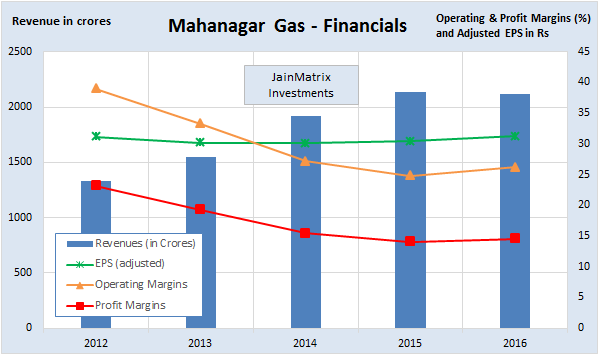
  • The revenue and EPS growth (Fig 5) were flat for FY15 and FY16 as CGD companies faced cost pressures and a fall in margins. MGL supplied 1.95 mmscmd of natural gas in FY12 which rose to 2.43 mmscmd for FY16, registering a CAGR of 5.67%. Thus over the years, MGL had increasing revenues and volumes, however there was almost no PAT growth because of rising input costs.
  • The operating margin fell from 39% (2012) to 26.9% (2016). The net profit margin also fell from 23.17% (2012) to 14.55% (2016). But margins are likely to be stable from now on.
MGL Financials, JainMatrix Investments

Fig 5 – MGL Financials

MGL Cash Flow, JainMatrix Investments

Fig 6 – Free Cash Flow

  • MGL has been able to generate Free Cash Flow over the last 5 years, a big positive. Fig 6.
  • MGL has a ROE of 20.2% (FY16) and RoCE of 22.0% (FY15). These are healthy return ratios.
  • The cash per share including Reserves & Surplus and Cash in Balance sheet is Rs 163/share. This indicates that the current operations of MGL are available at (421-163) = Rs 258/share.

Benchmarking

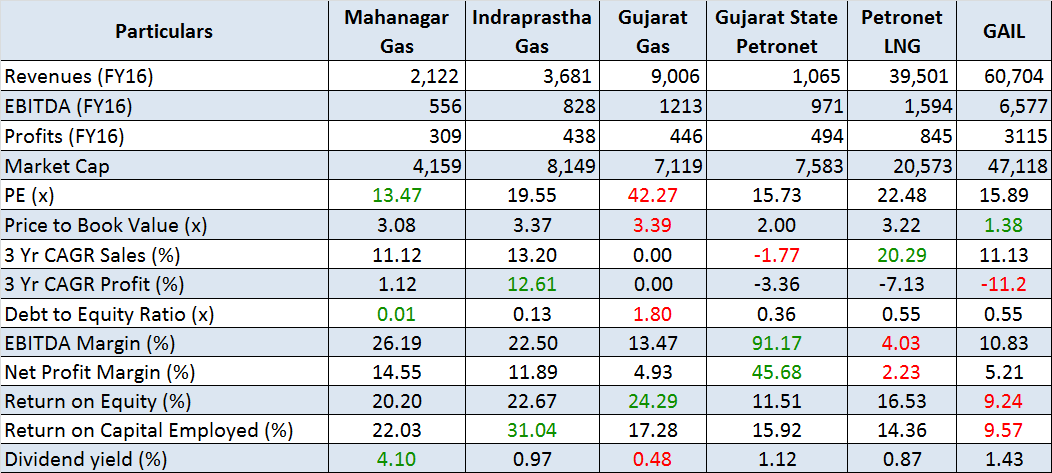
We have benchmarked MGL against peer gas companies like Indraprastha Gas, Gujarat Gas, etc.

JainMatrix Investments

Exhibit 7 – Benchmarking

  • MGL appears to be available at reasonable valuations. The low D/E is a positive. Dividend yield is the highest. The balance sheet is strong and can be leveraged for future business needs.
  • Margins are in the fair range. But MGL has good ROE (20% +) even with low margins. Margins are expected to improve from now on and volumes would also be higher. Thus return ratios are good.

Positives for MGL and the IPO

  • The IPO pricing is attractive. At the upper band of Rs 421/share, MGL’s asking price P/E is 13.47 times which is lower than its peer Indraprastha Gas Ltd. (19.55 times).
  • The CGD industry is at a turning point with a renewed focus on cleaner environment and lower costs of gas versus competing fuels which is likely to push volumes. Green efforts and NGT rulings will push transportation towards CNG as fuel. This is likely to benefit MGL.
  • MGL is a debt free, with strong balance sheet, cash balance and high return ratios (RoCE and RoE).
  • MGL has the exclusive rights for gas pipelines & sales in Mumbai (2020 limit), Raigad (2040) and Thane (2030). There is ample potential for MGL to grow in these regions.
  • The promoters of British Gas/ Shell can provide technology and commercial expertise for growth.
  • Piped gas supply by MGL is superior to the cylinder based LPG supply by state owned oil marketing firms. As soon as MGL sets up a network in an area, most consumers will switch.

Internal Risks

  • The price of domestic natural gas and RLNG purchased by MGL is USD denominated while the selling price is in INR. The currency risks have to be absorbed by MGL and its customers.
  • Transporting natural gas is hazardous and there can be accidents caused by floods, other utility company activities, road accidents, etc. These could adversely affect their reputation and business.
  • Smooth relations between the equal shareholder promoters is important for MGL.
  • MGL has a monopoly on Mumbai region gas pipelines and supply till 2020. It must rapidly set up a high quality network in this period to ensure it continues to dominate the gas business thereafter.
  • MGL will not have any gains from this IPO, and the proceeds will go to the promoters only.

External Risks

  • MGL’s gas supply is met by the allocation by the MoPNG at prices in accordance with the Gas Pricing Guidelines. Any increase in the cost price or reduction in allocation will adversely affect business.
  • MGL’s natural gas marketing exclusivity in Mumbai and adjoining areas has not been dealt with by PNGRB. The subject is subjudice in the Delhi High court for a case involving IGL. Their request to PNGRB to retain marketing exclusivity in Delhi was rejected, and which was in turn taken to Delhi HC. The Delhi HC verdict is pending on the issue. An unfavourable ruling would mean that CGD firms will have to distribute other competing companies’ gas through their own pipeline.
  • MGL may be restricted in its operation to the Mumbai/ Thane/ Raigad areas, and hence may not be allowed to continue to grow into a national player. Thus after a point, MGL growth may be limited.
  • The growth of renewables has been very rapid, encouraged by GoI. These are superior to fossil fuels but require a higher capex. After a few decades, gas may become a backup fuel source. However gas sector will continue to grow for 10-20 years as it is cleaner and superior to other fossil fuels.

Overall Opinion

  • Gas as a source of energy is superior to other fossil fuels. In energy hungry India, it will continue to grow as a fuel source. With the recent fall in prices, we see an upswing in demand.
  • MGL operates in a regional monopoly and has ample scope to grow in Mumbai & surrounding areas.
  • The recent financials of MGL were stressed by higher cost of gas. However measures have been taken and costs have stabilized for MGL. The outlook now is much superior for MGL. Inspite of this stress, MGL has a good balance sheet, no debt, high cash and a good dividend yield.
  • In a sector dominated by PSUs, MGL brings in a high level of governance, vision and shareholder friendliness. It is available at attractive valuations. Based on the adjusted FY16 EPS, the asking PE stands at 13.47 which is lower than listed peers.
  • MGL is not just a piping hot IPO, but also A Hot Piping IPO.
  • Hence, MGL is a BUY with a 2 year perspective.

Abbreviations

Exhibit 8 - Abbreviations

Exhibit 8 – Abbreviations

JAINMATRIX KNOWLEDGE BASE 

See other useful reports

  1. A Repurpose for our PSUs
  2. How to Approach the Stock Market – A Lesson from Warren Buffet
  3. An IPO Roundup and Update 
  4. Parag Milk Foods IPO – Let This Drink Go
  5. JainMatrix Track Record May 3rd, 2016
  6. Thyrocare IPO – Wellness for your Wealth
  7. New Banks: Big Changes in Small Change
  8. Equitas IPO – Leader in SF Banks
  9. JainMatrix Investments Announcements
  10. A Superior Investing Process – Do a DIP SIP
  11. JainMatrix Investments presents the Investment Outlook for 2016
  12. Alkem Labs IPO
  13. Goods And Services Tax (GST): Integration And Efficiency
  14. Café Coffee Day IPO – Very Hot Coffee 
  15. Syngene IPO: Good Pharma R&D spinoff from Biocon.
  16. JainMatrix IPO Reports deliver 60.5% returns

..

Do you find this site useful?

  • Visit the Investment Service page to find how you can get more. Or Click LINK.
  • Register Now to get our Free reports and much more, on the top right of this page, or by filling this Signup Form CLICK.

Disclaimer

This document has been prepared by JainMatrix Investments Bangalore (JM), and is meant for use by the recipient only as information and is not for circulation. This document is not to be reported or copied or made available to others without prior permission of JM. It should not be considered or taken as an offer to sell or a solicitation to buy or sell any security. The information contained in this report has been obtained from sources that are considered to be reliable. However, JM has not independently verified the accuracy or completeness of the same. JM has no known financial interests in Mahanagar Gas Ltd. or any related group. Neither JM nor any of its affiliates, its directors or its employees accepts any responsibility of whatsoever nature for the information, statements and opinion given, made available or expressed herein or for any omission therein. Recipients of this report should be aware that past performance is not necessarily a guide to future performance and value of investments can go down as well. The suitability or otherwise of any investments will depend upon the recipient’s particular circumstances and, in case of doubt, advice should be sought from an Investment Advisor. Punit Jain is a registered Research Analyst (SEBI Registration No. INH200002747) under SEBI (Research Analysts) Regulations, 2014. JM has been publishing equity research reports since Nov 2012. Any questions should be directed to the director of JainMatrix Investments at punit.jain@jainmatrix.com.

A Repurpose for our PSUs

Thought for the day

Background: 

The Central Public Sector Enterprises were set up with the purpose of promoting “national interest” and “public investments in large industries” – something which could not be done by the private sector. This was done way back in the 1960s and 70s.
Forty years on, a lot has changed in the economic and business environments. Private sector lead by Reliance, Tatas and Bharti Group has surged ahead and shown them quite capable of setting up and handling global scale industries. Even the holy grail of “Defense” production is now being handed over slowly to Indian private sector firms. So why should GoI own large swathes of sectors like Oil & Gas, steel, other metal producers, telecom, banks, FMCG, pharma, even Indian Railways? In fact govt. ownership has actually allowed a lot of firms to fall back and wither away in terms of competitiveness and financial health (Air India!!??).

The Repurpose: 

The GoI appears to be relooking at our national “family silver” in this new environment and gearing up to repurpose our CPSEs. We feel the main purposes now should be:

  1. Just retain a few PSUs of strategic and national importance in the long run.
  2. Wherever the CPSE is in good health, is listed, and serves no major national interest, monetize these assets quickly. This can be through dividends, divestment and/or strategic sales (like Maruti !!??).
  3. Improve the health of the others, and set them up for listing, divestment and/or strategic sales.
JainMatrix Investments, CPSE

Please … not the Taj Mahal

The Capital Restructuring: 

The Central Govt. has issued comprehensive guidelines on capital restructuring of CPSEs by way of buyback, dividends, issue of bonus and splitting of shares to rake in more revenue. The finance ministry issued fresh norms which are as follows:

  • CPSEs having surplus cash can no longer invest funds in FD’s in banks, which generate a poor post-tax return of 4-5%. Every CPSE having net worth greater than Rs 2,000 crores and cash & bank balance of over Rs 1,000 cr. would have to buy back their shares.
  • Related to dividend, the new guidelines mandate that every CPSE would have to pay a minimum annual dividend of 30% of PAT or 5% of the net worth (whichever is higher) subject to the maximum dividend permitted under the current regulations.
  • CPSE’s will have to issue bonus shares if their reserves and surplus is equal to or more than 10 times of its paid up capital. Further, all CPSEs have to consider issue of bonus shares if their reserves and surplus are more than 5 times of the paid up capital.
  • The order has replaced the general guidelines on splitting of shares, by mandating that every CPSE, whose market price or book value of its share exceeds 50 times of its face value, will have to split its shares to make it affordable for retail investors. (Source Financial Express)

A quick look at some of the CPSEs we track reveals that many of these firms meet the stated criteria. The chart indicates likely corporate action by these PSUs.

  • In green are the firms that pass the criteria for the corporate action.
  • We have also calculated the dividend payable threshold, in crores, for the firms per these guidelines. It is still subject to the maximum dividend permitted regulations.
JainMatrix Investments

The new norms applied to a few PSUs

Benefits:

  • Most of these new norms are very good and uniformly benefit all shareholders. Buy backs improve the Earnings per Share of the firm, and should soon raise their market prices. Dividends, splits and bonuses are shared by both GoI promoters and all other shareholders.
  • This is also superior to the Follow on Public Offer method of encashing the GoI’s PSU shareholding, which was damaging to the share price and generally manipulated by the market participants.
  • Funds raised from these divestments/ sales should be used for infrastructure, education and capital expenditures rather than mere funding of deficits. Of course one can only hope for this kind of discipline from the GoI.

Open questions:

The real challenge before the government is to decide if it wants the CPSEs to become:

  • Independent institution and public owned firms, like ITC and L&T, benefiting the broad investing public, or
  • Owned by strategic partners/ new owners, like Maruti Suzuki, where they take over the firm for a large ownership premium, benefiting the coffers of GoI.

Either way, I have a feeling the CPSEs, PSUs and who knows, maybe even PSBs, may once again become valuable for the public shareholders !!

JAINMATRIX KNOWLEDGE BASE 

See other useful reports

  1. How to Approach the Stock Market – A Lesson from Warren Buffet
  2. An IPO Roundup and Update 
  3. Parag Milk Foods IPO – Let This Drink Go
  4. JainMatrix Track Record May 3rd, 2016
  5. Thyrocare IPO – Wellness for your Wealth
  6. New Banks: Big Changes in Small Change
  7. Equitas IPO – Leader in SF Banks
  8. JainMatrix Investments Announcements
  9. A Superior Investing Process – Do a DIP SIP
  10. JainMatrix Investments presents the Investment Outlook for 2016
  11. Alkem Labs IPO
  12. Goods And Services Tax (GST): Integration And Efficiency
  13. Café Coffee Day IPO – Very Hot Coffee 
  14. Syngene IPO: Good Pharma R&D spinoff from Biocon.
  15. JainMatrix IPO Reports deliver 60.5% returns

Search for companies/ sectors of your interest in Search box in the right panel.

Visit and Like JainMatrix FB or Follow on JainMatrix Twitter for reports

DO YOU FIND THIS SITE USEFUL?

Visit the Investment Service page to find how you can get more. Or Click LINK

Register Now to get our Free reports and much more, on the top right of this page, or by filling this Signup Form CLICK.

DISCLAIMER

This document has been prepared by JainMatrix Investments Bangalore (JM), and is meant for use by the recipient only as information and is not for circulation. This document is not to be reported or copied or made available to others without prior permission of JM. It should not be considered or taken as an offer to sell or a solicitation to buy or sell any security. The information contained in this report has been obtained from sources that are considered to be reliable. However, JM has not independently verified the accuracy or completeness of the same. Neither JM nor any of its affiliates, its directors or its employees accepts any responsibility of whatsoever nature for the information, statements and opinion given, made available or expressed herein or for any omission therein. Recipients of this report should be aware that past performance is not necessarily a guide to future performance and value of investments can go down as well. The suitability or otherwise of any investments will depend upon the recipient’s particular circumstances and, in case of doubt, advice should be sought from an Investment Advisor. Punit Jain is a registered Research Analyst (SEBI Registration No. INH200002747) under SEBI (Research Analysts) Regulations, 2014. JM has been publishing equity research reports since Nov 2012. Any questions should be directed to the director of JainMatrix Investments atpunit.jain@jainmatrix.com.

How to approach the Stock Market – a lesson from Warren Buffet

This year the world’s most famous investor Warren Buffet did something unusual during his firm Berkshire Hathaway’s AGM.  He let the Apr 30th one-day event be telecast live over internet to anyone interested. I have taken one wonderful lesson delivered that day by Warren Buffet and rewritten it for the Indian market. It is here in 7 simple points.

  1. Lets say there are a 100 people sitting in front of us, and these 100 represent the entire Indian stock market shareholders, they own all the shares available. See Picture 1.  jainmatrix investments. audience
  2. Lets make a line in the center, and separate them out with the left half owning 50% of all shares and similarly the half on the right. The left half are passive investors. They do not trade shares much, just buy and hold. The ones on the right are active investors and traders. They invest through equity mutual funds, equity futures, buy and sell options, trade intraday, hedge funds, etc.
  3. The Indian Sensex has given 14.8% CAGR annual returns in 14 years since 2002. See Fig 2. jainmatrix investments, Sensex May 2016
  4. The people on the left are going to get the average returns of the Sensex, ie. 14.8 % CAGR over this entire period. They are passive, and so they will get the average returns. Tax on profits that are Long term capital gains (>365 days) on equity is zero.
  5. The ones on the right are also going to get an average of 14.8% over this entire period. However, their real returns will be much less due to tax, commissions, brokerage, AMC charges and success fees.
  6. Why is this? This is because:
    • The equity mutual funds are going to take away as much as 2.5% per year of AMC charges.
    • The traders in Futures and Options are essentially playing a +14.8% sum game, where the underlying equity is on average appreciating by 14.8%, and all the trading only declares some winners and some losers. The losses of the trading losers get transferred to the winners. Also, the intraday, momentum and swing traders too are in the same boat as F&O.
    • Trading is governed by an equation, Profits (by winners) + commissions + taxes = Losses (by losers). Of course if you are a good trader, you will get superior returns while another group will face the losses. But risks are higher here.
    • A lot of your money is eaten up by brokerage, taxes, AMC charges, fees and commissions.
  7. The lesson here is – become a passive long term investor and get the 14.8% long term average of returns. Spend your time on more useful things, and get good returns on investments.

Once again we thank the great investor for his simple but powerful messages.

JainMatrix Investments helps you in your investing process with good stock picks for the long term, monitoring of the firms over these periods and superior returns, all at a low fixed subscription rate!!

We have given Sensex plus returns in our Large Cap Model portfolio for over 3 years. And our Mid and Small Cap Model Portfolio has actually provided exceptional returns. See JainMatrix Track Record !!

Annual subscription for the Investment Service is available for Rs 11,999/- (India located) or US$ 210 (located outside India), for individual / Retail investors.
Investment firms, wealth professionals and Institutions may contact us for a quote for Investment Services.

MAKE PAYMENT NOW

Warren Buffet enthusiasts may see the entire 7 hours of the AGM event on video on LINK.

JAINMATRIX KNOWLEDGE BASE 

See other useful reports

  1. An IPO Roundup and Update 
  2. Parag Milk Foods IPO – Let This Drink Go
  3. JainMatrix Track Record May 3rd, 2016
  4. Thyrocare IPO – Wellness for your Wealth
  5. New Banks: Big Changes in Small Change
  6. Equitas IPO – Leader in SF Banks
  7. JainMatrix Investments Announcements
  8. A Superior Investing Process – Do a DIP SIP
  9. JainMatrix Investments presents the Investment Outlook for 2016
  10. Alkem Labs IPO
  11. Goods And Services Tax (GST): Integration And Efficiency
  12. Café Coffee Day IPO – Very Hot Coffee 
  13. Syngene IPO: Good Pharma R&D spinoff from Biocon.
  14. JainMatrix IPO Reports deliver 60.5% returns

Search for companies/ sectors of your interest in Search box in the right panel.

Visit and Like JainMatrix FB or Follow on JainMatrix Twitter for reports

DO YOU FIND THIS SITE USEFUL?

Visit the Investment Service page to find how you can get more. Or Click LINK

Register Now to get our Free reports and much more, on the top right of this page, or by filling this Signup Form CLICK.

DISCLAIMER

This document has been prepared by JainMatrix Investments Bangalore (JM), and is meant for use by the recipient only as information and is not for circulation. This document is not to be reported or copied or made available to others without prior permission of JM. It should not be considered or taken as an offer to sell or a solicitation to buy or sell any security. The information contained in this report has been obtained from sources that are considered to be reliable. However, JM has not independently verified the accuracy or completeness of the same. Neither JM nor any of its affiliates, its directors or its employees accepts any responsibility of whatsoever nature for the information, statements and opinion given, made available or expressed herein or for any omission therein. Recipients of this report should be aware that past performance is not necessarily a guide to future performance and value of investments can go down as well. The suitability or otherwise of any investments will depend upon the recipient’s particular circumstances and, in case of doubt, advice should be sought from an Investment Advisor. Punit Jain is a registered Research Analyst (SEBI Registration No. INH200002747) under SEBI (Research Analysts) Regulations, 2014. JM has been publishing equity research reports since Nov 2012. Any questions should be directed to the director of JainMatrix Investments at punit.jain@jainmatrix.com.