IPOs of Subsidiaries of Listed firms – are Safer and Create Value

20th July 2025

Summary

This article investigates a trend in Indian markets — listing of subsidiaries by Corporates that are large conglomerates and sector leaders. Who really benefits from these listings? Are they a source of genuine value creation? To understand this, we map the data on subsidiary IPOs by reputed Indian Corporates between Jul’23 and Jul’25. Building on our earlier analysis, which focused on a few prominent examples, we now expand the scope to 10 IPOs across diverse industries. This deeper dive presents more robust insights into the value creation effects of these IPOs for the Corporates, their shareholders, and IPO investors.

Subsidiary Listings over 2023-25

We identified 10 IPOs over the last 2 years, of subsidiaries of well known, listed, Corporates. We share the Market Capitalization data over this period (Jul’23 – Jul’25) at three key timelines – See Table 1:

  • Market Cap of the firm prior to listing of Subsidiary (5 days before IPO listing)
  • Post-listing of Subsidiary (30 calendar days after the listing day)
  • Current levels as on (15th July 2025) to uncover whether value is truly created so far.
Table 1 – Market Cap Data (click image to enlarge)

Some Findings:

Table 2 – Average Parameter Performance
  • The combined firms Market Cap one month Post Listing rose by 16%. In 9 of 10 cases, the combined firms market cap rose within 30 calendar days of the subsidiary IPO. See Table 2.
    • The highest post-listing rise was in Tata Motors + Tata Tech, with a combined gain of 33%.
    • Other notable increases include TVS Motor + TVS SCS: 26%
      • Federal Bank + Fed bank Financial: 20%
      • Bajaj Finance + Bajaj Housing Finance: 20%
    • This confirms a pattern: listing a subsidiary can unlock immediate shareholder value, especially when the market perceives the spinoff as a high-potential, distinct scalable business.
  • The average of gains & losses in the IPO subsidiary firms in the period from listing to today was 9%.
    • Only 4 out of 10 firms that IPO’d had positive gains as of today; remaining 6 had losses. Thus there are uncertain returns from IPOs, the firms appear to lose market cap after listing.
    • This is tough to generalize. It could be due to aggressive valuations. Or excess IPO demand.
  • The combined market caps of all the 10 firms (including subsidiaries) gained by an average of 34% in the period from Pre IPO to today. This is a very high number. Even benchmarked against the average Sensex gain of 16% in this period, the combined market caps gain is excellent.

Observations and Patterns

  • Value creation is visible in most Subsidiary listings, for the combined firms.
  • The Corporates often benefit despite initial volatility in market cap.
  • Combined value generally grows faster than Nifty or Sensex.

So, Who Really Gains from a Subsidiary Listing?

  • Corporates: The Parent company benefits from improved market visibility and simplification of the business. Valuation of the subsidiary is easier, and due to value unlocking, the Post-listing combined valuation has risen. Only in 2 of 10 cases, the combined valuation was flat Post listing of subsidiary.
  • Existing Shareholders of Corporates: Shareholders of Corporates don’t automatically benefit from the subsidiary IPO. To get gains, they have to invest additional capital in the subsidiary IPO. There is an IPO quota that helps parent company shareholders to get good allotment.
  • For Subsidiary IPO Investors: The reputation of the parent, coupled with listing of a firm with simpler business, sometimes from high potential sectors, has seen some of these IPOs do well. But with just 9% average gains as of today since listing, and with only 40% of the IPO firms positive today, investing in IPOs must be done carefully.

Conclusion: Value Unlocking, Risks and final thoughts

  • Subsidiary listings unlock value — the data supports this. For Corporates, it’s a clean move that sharpens focus and delivers a mkt. cap. growth. For investors, gains may depend on taking some action. Passive investors in the Corporate may experience short-term stagnation or dips. Active investors in the Corporate, and IPO participants, however may see faster capital appreciation.
  • The best strategy for Corporate shareholders is to actively invest in subsidiary IPOs in good offerings.
    • IPO investing in general is High Risk, but investing in the IPO of a listed company’s subsidiary is a much safer bet, due to past listed history, transparency and better available information.
    • The subsidiary being listed often has a simpler structure & business model, so is easier to value. 
  • As India’s capital markets mature, we observe that legacy structures of complex conglomerates morph and simplify by way of subsidiary IPOs. These may evolve into a strategic norm — not just for restructuring, but as a deliberate value creation mechanism. The IPO of a subsidiary may also be a regulatory requirement (eg. Bajaj Housing Finance, perhaps a few more) so its a compliance activity, not driven by market cap objectives.
  • Excess demand has returned to the IPO market, and so IPO investors need to expect over-subscription and high IPO valuations while evaluating IPO opportunities.
  • These are 10 recent IPOs, from widely different industries, offered at different valuations, we cannot generalize results with high confidence, every new IPO case could be a different situation.
  • Several cases have emerged of firms preferring to raise funds by QIP rather than debt – an aggressive move. This also may result in several equity dilutions in a short time period. Conservative and well run firms prefer to not dilute their Equity Share Capital for years, giving better ROE.

Disclaimer

  • Punit Jain discloses that he has no shareholding in any of the firms mentioned in this article except Bajaj Finance (since April 2003, ownership <1%) and Bajaj Housing Finance (since Sept’24 IPO, ownership <1%), and these have been mentioned here only as one of the 10 samples/ examples chosen. He is also a telecom consumer with services from Bharti Airtel and Reliance Jio. Other than these, he has no financial interest or transactions, with any firms mentioned here or any group company. In addition, JMI and its promoters/ employees have no direct or financial interest in these companies, and no known material conflict of interest as on date of publication of this report, to the best of his knowledge.
  • This document has been prepared by JainMatrix Investments Bangalore (JMI), and is meant for use by the recipient only as information and is not for circulation. This document is not to be reported or copied or made available to others without prior permission of JMI. This report should not be considered or taken as an offer to sell or a solicitation to buy or sell any security. The information contained in this report has been obtained from sources that are considered to be reliable. However, JMI has not independently verified the accuracy or completeness of the same. Neither JMI nor any of its affiliates, its directors or its employees accepts any responsibility of whatsoever nature for the information, statements and opinion given, made available or expressed herein or for any omission therein. Investment in the securities market are subject to market risks. Read all the related documents carefully before investing. The suitability or otherwise of any investments will depend upon the recipient’s particular circumstances and, in case of doubt, advice should be sought from a SEBI RIA Registered Investment Advisor. JMI has been an equity investment adviser commercially since Nov 2012, and a SEBI certified and registered since 2016, under SEBI (Research Analysts) Regulations. Registration granted by SEBI, and certification from NISM in no way guarantee the performance of the Research Analyst or provide any assurance of returns to investors.
  • Any questions should be directed to punit.jain@jainmatrix.com. Name of the RA as registered with SEBI – Punit Jain, SEBI Registration No. INH200002747. Logo/brand name –

RP Tech – The ICT Distribution Leader – IPO

  • Also known as Rashi Peripherals Ltd.
  • 07th Feb, IPO Opens 7-9th Feb
  • Pricing range – ₹ 295-311/share
  • Valuations: P/E 16.6, EV/EBITDA – 2.07, P/B 2.6 times
  • Small Cap: ₹ 2,000 cr. Mkt cap
  • Sector – Technology

Summary

  • RP Tech distributes global technology brands in India. They specialize in ICT products and have a 9.5% market share in India sales. Part of the ICT global supply chain. The organization and structure set up looks good to handle the growth. At current pricing range, RP Tech looks fairly valued. We expect margin expansion after reduction in debt levels even as it grows rapidly in revenues. Once this happens, valuations will look reasonable.
  • Risks: 1) Thin operating margins, high working capital and high debt 3) Supplier Concentration – top eight brands accounted for 82% of revenue 4) Indirect Tax contingent liabilities.
  • Opinion: Medium rated. Aggressive Investors can SUBSCRIBE for short-term gains.

Here is a note on RP Tech IPO.

IPO highlights

  • The IPO opens from 7-9th Feb 2024 in a Price Band of ₹ 295-311 per share
  • It is a Fresh Issue of ₹ 600 cr. of 6.58 cr. shares, which is 36.6 % of the equity share capital.
  • The promoters are Choudhary & Pansari families that own 89.65% which will fall to 63.41% post-IPO.
  • The main objects of the IPO are 1) Repayment of debts of ₹ 326 cr. and 2) Funding working capital requirement ₹ 220 cr. 3) The remaining 50+ cr. is for general corporate purposes.
  • The lot size is 48 shares and Face Value ₹ 5 per share
  • The IPO share quotas are QIBs: Non-Institutional Investors: Retail is 50:15:35%.
  • The unofficial/ grey market premium of RP Tech is ₹ 70 /share over IPO price. This is a positive.
  • The IPO allotment is likely to be finalized on 12 Feb, refunds will be on 13 Feb, and also crediting of shares to eligible allottees. RP Tech shares will list on BSE and NSE, on 14 Feb.

Introduction

  • RP Tech distributes global technology brands in India. They specialize in products related to Information and Communication Technology (ICT). It has value-added services such as pre-sales, technical support, marketing services, credit solutions and warranty management services.
  • Revenue from operations grew at a CAGR of 26.32% from ₹ 5,930 cr. in FY’21 to ₹ 9,468 cr. in FY’23, PAT generated CAGR of -4.80% and EBITDA with CAGR of 11.38% over last three years.
  • RP Tech is the national distributor for 53 global technology brands and has 50 branches, and 63 warehouses across India, with 8,657 distributors across 680 locations in 28 States and UTs.
  • These 50 branches operated as sales & service centres and warehouses, and distributed and sold 10,508 SKUs and 34.38 million units in FY23. Exports are just 2.6% of the business, rest is domestic.
  • It had 1,433 employees, including 549 in Sales & Marketing and 64 in the technical support team.
  • The company has two business verticals –
  • Personal computing, Enterprise and Cloud Solutions (PES): This includes personal computing devices, enterprise solutions, embedded designs/products and cloud computing.
  • Lifestyle and IT essentials (LIT): This includes products such as (i) components such as graphics cards, central processing units (CPUs) and motherboards; (ii) storage and memory devices; (iii) lifestyle peripherals and accessories such as keyboards, mice, webcams, monitors, wearables, casting devices, fitness trackers and gaming accessories; (iv) power devices such as UPS and inverters; and (v) networking and mobility devices.
  • The Fig 1.1 below shows the Revenue By Vertical; and Fig 1.2 the Market Share by Product

Fig 1.1 – Revenues by Vertical and Fig 1.2 Market Shares

  • The company’s clients include ASUS Global., Dell International, HP India, Lenovo India, Logitech Asia Pacific, NVIDIA Corp, Intel Americas, Western Digital (UK), Schneider Electric IT Business, Eaton Power Quality Pvt. Ltd., ECS Industrial Computer Co. Ltd., Belkin Asia Pacific, TPV Technology India, LG Electronics India, and Toshiba Electronic Components, Taiwan Corporation, among others.
  • RP Tech has a good relationship with marquee customers for a very long time.
  • RP Tech differentiate itself by offering end-to-end services such as pre-sale activities, solutions design, technical support, marketing services, credit solutions and warranty management services.

Fig 1.3 Locations

Fig 1.4 – Distribution and 1.5 – Shareholding pattern

  • RP Tech distributes products through several channels or networks – General Trade (81%), e-commerce 13% and Modern trade 6%. Above Fig 1.4 shows the distribution network and channels.
  • See shareholding pattern pre-IPO in Fig 1.5.
  • Below Fig 1.6 – Strong Customer Relationships in years with prominent brands.

Fig 1.6 Clients

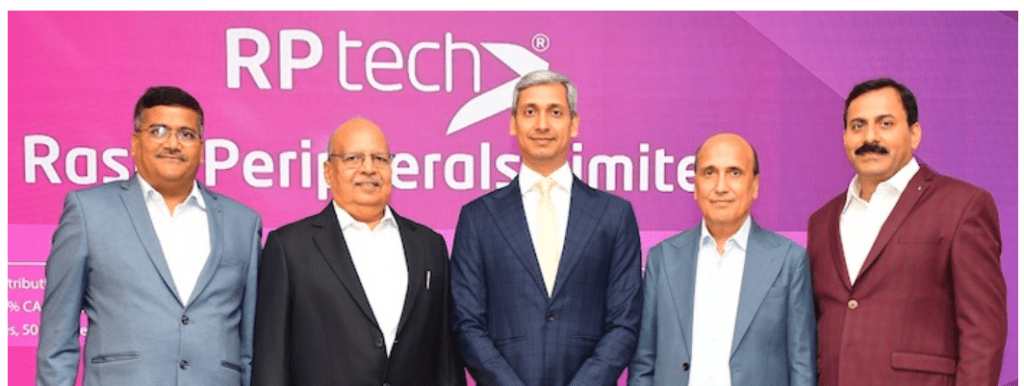
  • Fig 1.7 – Key leaders:
  • (L- R) Himanshu Kumar Shah CFO, Krishna Kumar Choudhary, Chairman, Kapal Pansari MD, Sureshkumar Pansari, Vice-Chairman and Rajesh Goenka, CEO.

News, Updates and Strategies

  • In a pre-IPO placement, ace investor Madhusudan Kela’s wife Madhuri Kela invested ₹ 50 cr. and Volrado Venture Partners Fund-III-BETA, a venture capital fund, invested ₹ 100 cr. and were allotted 48.23 lakh equity shares at an issue price of ₹ 311 apiece.
  • A day before the IPO, the firm made allotments to Anchor investors. It allotted 57.88 lakh shares to 18 funds at ₹ 311 per share, at the upper limit. The anchor investors who participated in the bidding process include prominent foreign and domestic institutions such as White Oak Capital, Ashoka India, ICICI Prudential MF, Volrado Venture Partners Fund, and Bajaj Alliance Life Insurance Company. Other notable participants in the bidding round were Aditya Birla Sun Life Insurance Company, SBI General Insurance Company, Singularity Growth Opportunity Fund, and Authum Investment and Infra.
  • Out of the total allocation of 57.88 lakh equity shares, domestic mutual funds were allotted 19.61 lakh equity shares through a total of 8 schemes, amounting to ₹ 61 crore.

Industry Outlook of ICT in India

  • India has a young population, and is a developing nation, so it has a faster growing market than developed nations such as USA, UK, and Canada in terms of retail consumption. They are better exposed to media and technology, which presents an opportunity for domestic consumption in the form of branded products and organized retail.
  • Govt. of India has an initiative of Make in India and is also promoting Electronic Mfg. Clusters throughout the country to provide world-class infrastructure and facilities.
  • The GoI is aiming to increase the production of electronic items to USD 300 billion by Fiscal 2026. The domestic consumption of products is expected to increase from USD 75 billion in Fiscal 2022 to USD 150- 180 billion by Fiscal 2026.
  • India’s ICT Industry size is about 1 lakh cr. now and is expected to reach ₹ 1,08,700 cr. by 2025.

Fig 2 – ICT Industry Size

  • Govt. of India’s Production-linked Incentive (“PLI”) scheme provides Incentives to boost domestic mfg. and attract large investments in IT Hardware value chain with target segments of laptops, tablets, all-in-one PCs, and servers, and boost the export market for the same. In electronic/technology products and telecom and network products, the approved financial outlay over the five years period is ₹ 12,200 cr.
  • We estimate that RP Tech has a Market Share of 9.5% of the Indian ICT distribution market.

Financials of RP Tech

  • RP Tech revenues, EBITDA and PAT over the years are in Fig 3a. Revenue, EBITDA & PAT grew by 26.36%, 11.38% and (4.80) % respectively.
  • Increase in interest costs is hurting their PAT.
  • In below Fig 3b Cash Flow we can see that the Free Cash Flow FCF is negative. The firm has made many investments in inventories, assets and payables that have made FCF negative.
  • EBITDA Margin is constant over 2.8-3.5% and PAT around 1.30-2.29% variation due to externalities. This is average industry margins.
  • Considering ₹ 326 cr. will used from IPO proceeds for repayment of Debt, the firm’s debt to equity will reduce from current pre-IPO 1.82 to 1.30 post IPO.

Fig 3a – Financials

Fig 3b Cash Flow

Benchmarking

We benchmark RP Tech against listed ICT distribution and mfg. firms, See Fig 3c below.

Fig 3c – Benchmarking

  • P/E currently at 15.74 looks priced overpriced. Its EV/EBITDA is 2.07, which looks reasonable. Thus the valuations of RP Tech looks mixed.
  • The 3 year Sales and Profits growth look low. There was a massive sales growth for RP Tech in FY21 and FY22 during covid, and that is now normalizing.
  • D/E ratio is high, but post IPO, debt should fall as a main object of IPO is to reduce debt.
  • Margins are on par with competitors.
  • Return on Equity and RoCE are fair and in line with industry.
  • Putting this together, we sense that RP Tech will return to steady industry plus growth now, and improve its financial parameters in the next 1-2 years.
  • The strong business relationships, wide distribution network and digital growth of the economy will reflect well on RP Tech.

Positives for RP Tech

  • Strong technical expertise of firm across a range of ICT products for sales, service and support.
  • Long term relationship with marquee global tech clients to ensure availability of products.
  • Reputation as Leading and fastest growing Indian distribution partner for ICT products.
  • Repeat orders constitute 70-80% of business, this showcases the stickiness and moat of RP Tech.
  • Diversified portfolio offering with 10,000+ SKU’s and value-added solutions.
  • Pan-India and multi-channel distribution footprint backed by dedicated in-house infrastructure.

Risks and Negatives

  • High dependency on various vendors, who are global technology brands, revenues generated from distribution of products mfg. by top eight global technology brands amounted to 82% of revenue from operations. Any delay or failure on part of such global technology brands to supply products may materially and adversely affect business, profitability and reputation.
  • Good relationships with Channel Partners and enterprise customers is important as if any of these parties change the terms of their arrangements business could be materially and adversely affected.
  • RP Tech is operating on thin margins, an increase in debt or interest rates can affect the financials. There has been an increase in Debt to equity from 1.23 in FY21 to 1.82 in six month ended Sep’23.
  • Reduction in EBITDA margin from 3.63% in FY21 to 2.83% in FY 23 was due to higher interest rates.
  • Continued negative cash flows can affect the financials of the business. RP Tech will certainly have to stabilize their working capital needs while handling growth.
  • Risk of liability claims. Failure to maintain quality of customer service and deal with customer complaints could materially and adversely affect business and operating results.
  • RP Tech has Contingent Liabilities of ₹ 592 cr. (RHP), of which for Indirect Tax is ₹ 281 cr.
  • A Subsidiary ZNet Technologies Pvt. Ltd., has incurred losses in the last three Fiscals. There is no visibility on profitability.

Overall Opinion and Recommendation

  • India has a large and growing software and Tech industry, and it is an exports leader. Many global firms are setting up Global Competence Centers here. Within India too, technology is permeating the population through devices and internet, at work and leisure.
  • RP Tech is an important player in the ICT industry. It has a strong grip and 9.5% market share in sales. We expect growth at RP Tech to be strong. RP Tech have strengths of stickiness of customer with 70-80% of business from repeat orders and strong relationship with brands. Company management and board looks solid with rich experience in this field.
  • RP Tech is well set and a solid growth prospect in future.
  • However the firm is just settling down from 2-3 years of an unusual post covid business situation. Financials are in a recovery process and may take a few quarters to stabilize. This IPO helps to rest some of the debt. The recovery process needs to continue by controlling the working capital.
  • We expect reduction in debt to equity after IPO even as it grows rapidly in revenue and offerings. Once this happens, RP Tech valuations will rise and this IPO entry price will look reasonable.
  • Risks: 1) Thin operating margins, high working capital and high debt 3) Supplier Concentration – top eight brands accounted for 82% of revenue 4) Indirect Tax contingent liabilities.
  • Opinion: Medium rated. Aggressive Investors can SUBSCRIBE for short-term gains.

Disclaimer

This document has been prepared by JainMatrix Investments Bangalore (JM), and is meant for use by the recipient only as information and is not for circulation. This document is not to be reported or copied or made available to others without prior permission of JM. It should not be considered or taken as an offer to sell or a solicitation to buy or sell any security. The information contained in this report has been obtained from sources that are considered to be reliable. However, JM has not independently verified the accuracy or completeness of the same. JM has no stake ownership or financial interests in RP tech or any group company. Punit Jain intends to apply for this IPO. Neither JM nor any of its affiliates, its directors or its employees accepts any responsibility of whatsoever nature for the information, statements and opinion given, made available or expressed herein or for any omission therein. Recipients of this report should be aware that past performance is not necessarily a guide to future performance and value of investments can go down as well. The suitability or otherwise of any investments will depend upon the recipient’s particular circumstances and, in case of doubt, advice should be sought from a RIA Registered Investment Advisor. Investment in securities market are subject to market risks. Read all the related documents carefully before investing. Punit Jain is a registered Research Analyst under SEBI (Research Analysts) Regulations, 2014. Registration granted by SEBI, and certification from NISM in no way guarantee performance of the RA or provide any assurance of returns to investors. JM has been publishing equity research reports since Nov 2012. Any questions should be directed to the director of JainMatrix Investments at punit.jain@jainmatrix.com. Name of the RA as registered with SEBI – Punit Jain, SEBI Registration No. INH200002747. Logo/brand name –

Burger King India IPO – Try the Whopper!!

  • Date 01st Dec; IPO Opens 2-4th Dec, at ₹59-60/share
  • Small Cap: ₹ 2,438 cr. Mkt cap
  • Sector – Restaurant chain, QSR
  • Valuations: P/E negative, P/B 10.5 times, EV/EBITDA 4.4.
  • Loss making entity; profit looks 2 years away, so this is a private equity type, high risk investment
  • Advice: SUBSCRIBE

Summary

  • Why Buy Now: The Burger King chain is at an early stage of growth in India. The organization and structure set up looks good to handle the growth imperatives.  
  • The Burger King brand is quite strong in India.
  • We expect profitability in BKG in 2 years, by FY23, even as it grows rapidly in revenues and outlets. Once this happens, BKG valuations will rise and this IPO entry price will look attractive.
  • Relative to other MNC QSR chains in India, BKG valuations look reasonable.  
  • It has handled the covid period well, reducing costs and getting by. We expect normalcy in revenues to return in H2FY21.
  • Risks: 1) Loss making entity; profitability looks 2 years away, so this is a private equity type, high risk investment 2) Intense competition from Indian and MNC QSR chains in Tier 1 towns 3) Covid induced challenges – demand from customers as well as employee health. 4) High royalties to Principal.
  • Opinion: Investors can SUBSCRIBE to this IPO with a 2 year perspective.

JainMatrix Subscription Pricing and Payment Options

JainMatrix Investments reports….

Here is a note on Burger King India IPO (BKG) IPO.

IPO Highlights

  • The IPO opens from 2-4th Dec 2020 in a Price Band of ₹ 59-60 per share
  • The IPO includes a Fresh Issue of ₹ 450 cr. and Offer for Sale (OFS) of 6 cr. shares. So the total IPO size is max 810 cr. of about 13.5 cr. shares, and about 35.5% of the equity share capital.
  • The promoter is QSR Asia and it owns 94% in BKG which will fall to 60% post-IPO.
  • The main objects of Fresh Issue are funding new Company-owned Burger King Restaurants by 1) Repayment of borrowings taken for this of ₹ 165 cr. and 2) Capex for new Restaurants ₹ 177 cr. 3) Remaining ₹ 108 cr. are for general corporate purposes like paying for this IPO.
  • The promoter is a PE firm and the listing will help to monetize and profit from investments. 
  • The lot size is 250 shares and Face Value ₹ 10 per share
  • The IPO share quotas for QIBs: Non-Institutional Investors: Retail is 75:15:10%.
  • The unofficial/ grey market premium of BKG is ₹ 20-25 /share over IPO price. This is a positive.

Introduction

  • Burger King India is one of the fastest growing international QSR (Quick Service Restaurant) chains in India, started in Nov 2014.
  • In FY20 the Revenues, EBITDA and Profits of BKG were ₹ 847 crore, ₹ 105 cr. and ₹ (77) cr. resp.
  • It already has 261 restaurants across 57 cities, including Delhi-NCR, Mumbai, Pune, Chennai, Hyderabad, Bengaluru, Chandigarh and Ludhiana.
  • The restaurants serve food and beverages, see Fig 1a, with offerings like:

Fig 1a – Menu Range, Fig 1b – Cluster Map and Fig 1c – Outlets by Region

  • The globally recognized Burger King brand, also known as the “HOME OF THE WHOPPER®”, was founded in 1954 in USA and is owned by Burger King Corp., a subsidiary of Restaurant Brands Intl. Inc. The Burger King brand is the #2 largest fast food burger brand globally by number of restaurants, with a network of 18,000 restaurants in 100 countries and USA.
  • BKG has used a well defined restaurant roll out and development process. The Principal (BKG AsiaPac) helps and supports in this process.
  • BKG AsiaPac has to be paid monthly royalty (of 4-5% of sales annually). BKG is also required to pay BKG AsiaPac a non-refundable one-time fee on opening each new BK Restaurant of US$15k (₹11.25L), increasing to $25k (19L) from CY 2020-22 and US$35k (26L) for all periods thereafter.
  • Everstone Capital, the Singapore-HQ India-focused mid-market PE firm, owns 99.39% stake in BKG India, through investment vehicle QSR Asia Pte Ltd.
  • As of Sept 30, the number of BKG employees was 4,836.
  • Key leaders: Shivakumar Pullaya Dega (Chairman and Independent Director), Rajeev Varman (CEO and Whole Time Director) and Abhishek Gupta (Chief of Biz. Dev. and Operations).

News, Updates and Strategies

  • Burger King India aims to have 370 stores (101 additional) by Dec 2022. Under the Master Franchise and Development Agreement (MDA), BKG is required to develop and open 700 restaurants (both Company-owned and Sub-Franchised) by Dec 2026. This agreement renewal is by Dec 31, 2039.
  • Fund raising through the IPO will be used for expanding its store base in India and reducing debt.
  • The Indian promoter is a private equity firm Everstone Capital, even as BKG works under a MDA with Burger King Corp. USA.
  • Based on the FIFO methodology, Everstone will earn 3.58 times returns on its 7-year investment. Its cost of investment (of the IPO shares) is pegged at ₹ 110 cr. In return, it will fetch ₹ 360 cr. from the partial exit at upper end of IPO band, per VCCircle.
  • The company’s average meal ticket size is ₹ 500-550.
  • Covid had a massive impact on BKG, as first a lockdown, and later the containment zones, lack of permission from authorities and public fear of infection kept away dine in customers.
  • BKG responded by reducing costs: it negotiated with landlords on rentals, reduced inventories, etc.
  • In Sept 2020, the number of BKG employees decreased to 4,836 employees compared to 6,141 in Mar due to attrition, effect of Covid, and redundancies.
  • On date of RHP of 25th Nov., out of 268 total restaurants, only 249 are operational.
  • BKG has a strong supply chain for all food ingredients and raw materials, to ensure traceability, freshness, long term contracts, low prices and quality ingredients.

Food Industry Outlook in India

Fig 2 – Food Services Segments
  • The Indian food service sector can be divided into 4 segments, see Fig 2.
  • QSR have fast food cuisines and minimal table service, and cater to youngsters and working professionals, offering quick delivery of food, good ambience and option of home delivery. QSRs generally target people in the 16-35 years range. Frequency of eating out (4-5 per month) is low so there is headroom to grow.
  • QSRs are the most preferred destination, followed by casual dining restaurants when it comes to eating out, per the India Food Services Report 2016, made by the National Restaurants Association of India (NRAI) and consulting firm Technopak Advisors Pvt. Ltd.
  • The most popular eating out options in India are North Indian food (28% of the time), followed by Chinese (19%) and South Indian style (9%), according to a Livemint.com report.
  • Restaurants, cafes and international fast food outlets have proliferated in India and eating out has become popular. About 81% of consumers prefer to eat out, and 19% get delivery or takeaway.
  • The QSR segment is nascent and has a lot of scope for growth in India. A large number of global QSRs have established their outlets with franchise rights of various companies like McDonalds, KFC, Pizza Hut, Subway, Taco Bell, Burger King and Domino’s, in addition to Indian QSRs.
  • BKG has a 5% market share in India’s ₹ 34,800 crore QSR market.
  • With factors such as urbanization, rising income levels and improved investment climate, the food service sector holds a huge opportunity. The sector has observed tremendous development in the past 3 years, which grew at 11% CAGR during 2015-19. The sector is estimated to grow at a 9% CAGR by 2022-23 (Source: NRAI India Food Services, IFSR 2019).
  • GST rate cut from 18% to 5% for the restaurant business was a significant tailwind for the sector, and generally led to a sharp recovery in SSSG’s.

Financials of BKG

  • BKG revenues, EBITDA and PAT over the years are in Fig 3a. The firm grew revenues well over 3 years, and is EBITDA positive but loss making.
  • A possible profit in FY21 quickly became a loss in H1 due to Covid.
  • In Fig 3b we can see that from a FCF positive FY18, the firm has made many investments and become FCF negative in FY19-20. We can also see the number of outlets by FY.

Fig 3a – BKG Financials and Fig 3b – Free Cash Flow

Benchmarking

We benchmark BKG against listed food service firms, entertainment firms and the principals. See Fig 4.

Fig 4 – Benchmarking

  • As a loss making firm, PE is negative for BKG. So valuations are tracked using P/B and EV/EBITDA. On these parameters, the valuations of BKG are lower than the others. This is positive.
  • Sales growth has been good at BKG. On Profits BKG is in the negative.
  • D/E ratio is low, may fall after IPO. One of the objects of the fresh issue in IPO is to reduce debt.
  • Margins are still on the lower side as BKG is building scale for its operations.
  • Return ratios are low due to losses.
  • The Revenue per outlet is low, perhaps reflecting BKG is a newer restaurant chain.
  • Putting this together, we sense that BKG is an asset available at low valuations due to current losses. It’s entirely possible that if not for covid, BKG may have been much less lossmaking by now. Post covid, BKG should focus on growth, with branch expansion, brand building and consumer loyalty.

Positives for BKG and the IPO

  • Burger King is a strong global brand. It’s been handled well so far in India with high street, airport and malls locations of restaurants, good visibility and positive customer reviews.
  • As a customer, my visit to BKG in 2018 in Bangalore was memorable and the focus is excellent with burgers available in both veg. and non veg. It was tasty and fairly priced, and a good experience.
  • The core offering of burgers can work for both snacks and meals for the Indian palate. Traditional consumers may not be satisfied as it’s a light fried meal, but others can find it novel and tasty. The BKG brand is well positioned for the millennial customers.
  • The global franchise model has succeeded for competitors in Indian markets, and the BKG rollout looks like a lower risk proposition that has a fairly unique offering and good chance of success.
  • The growth plans of 700 outlets by 2026 looks achievable and necessary to get a scale of operations.
  • The firm has an experienced, passionate and professional management team
  • Due to the covid infection, BKG has been able to bring down its costs structures. In particular, real estate costs for QSR may reduce and stay low for some time. Employee nos too have reduced.
  • BKG has an MDA with Burger King USA is till 2039, giving a good visibility.

Risks & Negatives for BKG in the IPO

  • The covid pandemic has been a blow as BKG has switched from a growth mode to a ‘cutting costs’ and survival mode for H1, to get by during this dip. Even today after most of the outlets reopened, there is a demand issue as customers are worried about public gatherings and infection spread. The economic impact of covid means that people celebrate less and even eating out may be done at more ‘economic’ or ‘reasonable’ priced outlets than BKG. At the luxury end, demand is down.
    • Having said this, our opinion is that in T1 cities, demand will normalize in Q3FY21 and a combination of takeaway and home delivery should be able to bring demand back.  
  • BKG has not declared a profit so far in all these years. As a result, the IPO has been allowed by SEBI but the Retail portion is retained at the lowest, 10% of shares offered, due to higher risks.
    • So on PE we have a negative value, but on other valuation parameters like PB and EV/EBITDA, BKG looks attractive and undervalued.
  • BKG directly competes with McDonalds and Subway in India on bread based light food options. Thus this QSR food subcategory looks a little crowded and top heavy.
  • BKG is at an early growth phase in its Indian network. There is a possibility that it may take several years to make a profit or dividend as it opens new outlets and invests in branding and supply chain.
  • Investors looking for normal valuation parameters may not find this attractive. Conversely this investment may only give good gains over several years.
  • Food delivery aggregators like Swiggy and Zomato intensify competition by offering massive choice and delivery to customers. BKG partners with them, but they get large commissions on orders.
  • Royalties for BK USA are high and a big hurdle to franchisee profitability. In FY18-20 they were ₹ 12, 24 and 34 crores for BKG.

Overall Opinion and Recommendation

  • QSR has a good future in India with improving affluence, and a growing eating out culture. Beyond the FY21 covid blip, this category should grow fast.
  • The social type businesses like BKG have been hardest hit by covid. As a result, the BKG IPO offering is undervalued. Most stock investors today are ignoring H1FY21 results, and high but temporary valuations, and expecting a full recovery by H2.
  • On a big picture basis, BKG is at an early stage of growth in India. The organization and structure set up looks good to handle the growth imperatives.  
  • We expect profitability in BKG in 2 years, by FY23, even as it grows rapidly in revenues and outlets. Once this happens, BKG valuations will rise and this IPO entry price will look reasonable.
  • Risks: 1) Loss making entity. Profitability also looks 2 years away, so this is a private equity type, risky investment opportunity. 2) Intense competition from Indian and MNC QSR chains in Tier 1 towns 3) Covid induced challenges – demand from customers as well as employee health. 4) High royalties.
  • Opinion: Investors with a risk appetite can SUBSCRIBE to this IPO with a 2 year perspective.

Disclaimer

This document has been prepared by JainMatrix Investments Bangalore (JM), and is meant for use by the recipient only as information and is not for circulation. This document is not to be reported or copied or made available to others without prior permission of JM. It should not be considered or taken as an offer to sell or a solicitation to buy or sell any security. The information contained in this report has been obtained from sources that are considered to be reliable. However, JM has not independently verified the accuracy or completeness of the same. JM has no stake ownership or financial interests in BKG or any group company. Punit Jain intends to apply for this IPO. Neither JM nor any of its affiliates, its directors or its employees accepts any responsibility of whatsoever nature for the information, statements and opinion given, made available or expressed herein or for any omission therein. Recipients of this report should be aware that past performance is not necessarily a guide to future performance and value of investments can go down as well. The suitability or otherwise of any investments will depend upon the recipient’s particular circumstances and, in case of doubt, advice should be sought from an Investment Advisor. Punit Jain is a registered Research Analyst under SEBI (Research Analysts) Regulations, 2014. JM has been publishing equity research reports since Nov 2012. Any questions should be directed to the director of JainMatrix Investments at punit.jain@jainmatrix.com.

The Most Profitable Research this year from JainMatrix Investments

  • Apex Frozen Foods Ltd.
  • A 225% gain for our Subscribers for purchases from open markets in just 3 months. 
  • The IPO allottees still holding have got a 324% gain in 3 months. 

At JainMatrix Investments, we’ve done a lot of research reports in the last year. We’ve had our share of (many) successes and (a few) failures. This has been a good year for the stock markets so no surprises that our success rate has been high. Even so, lets focus on the best success we have had this year.

On 20th August 2017, we published an IPO report on Apex Frozen Foods Ltd. This was a public report, and you can see it even now at Apex Frozen Foods IPO – An Apex Buy.

jainmatrix investments, apex frozen foods

The subscription for this IPO was not impressive, it went just 6.1 times subscribed, not much by this years standards.

But at JainMatrix Investments we were very positive about it. So much so that before the firm’s listing on 4th Sept, we published a Pre-Listing Note on Apex. This was a Premium report, available only to subscribers, but the Summary is shared below:

JainMatrix Investments, Apex Frozen Foods IPO

The listing was good but not very impressive, it closed at Rs 210, a rise of 20% on first day. Thereafter, restricted by its 5% upper and lower price limit, it rose 5% every day for a few days, then actually fell by 5% for a few days too.

Our Subscribers who took our instructions got ample opportunity to buy this share below Rs 230.

And very soon, with the seafood industry doing well, and some news flow such as good results declared for the Half Year and Quarter ended Sept 2017, the share has done very well, see graphic.

jainmatrix investments, apex frozen IPO

Today we are happy to note that investors who took our recommendation to buy the share below Rs 230 have seen a 225% gain. IPO applicants still holding today have got a 324% gain on their investment in just 3 months. 

Clearly the share has by far exceeded our 1.75 year target of Rs 469, to reach Rs 742 today. This is a success beyond our imagination.

This is a marketing article. At this point we do not express any opinion of BUY, SELL or HOLD on Apex Frozen Foods. We are just happy to share with you that this is Our Most Profitable Research this year. 

Happy investing,

Punit Jain

DISCLAIMER

This document has been prepared by JainMatrix Investments Bangalore (JM), and is meant for use by the recipient only as information and is not for circulation. This document is not to be reported or copied or made available to others without prior permission of JM. It should not be considered or taken as an offer to sell or a solicitation to buy or sell any security. The information contained in this report has been obtained from sources that are considered to be reliable. However, JM has not independently verified the accuracy or completeness of the same. Punit Jain discloses that he holds Apex Frozen Foods shares since the IPO this year.  Other than this, JM has no known financial interests in Apex or any group company. Neither JM nor any of its affiliates, its directors or its employees accepts any responsibility of whatsoever nature for the information, statements and opinion given, made available or expressed herein or for any omission therein. Recipients of this report should be aware that past performance is not necessarily a guide to future performance and value of investments can go down as well. The suitability or otherwise of any investments will depend upon the recipient’s particular circumstances and, in case of doubt, advice should be sought from an Investment Advisor. Punit Jain is a registered Research Analyst under SEBI (Research Analysts) Regulations, 2014. JM has been publishing equity research reports since Nov 2012. Any questions should be directed to the director of JainMatrix Investments at punit.jain@jainmatrix.com.

Capacite Infraprojects IPO: Play the Trump Card

  • IPO Opens 13-15th Sep at Price range: Rs. 245-250
  • Small Cap: Rs. 1,700 crore cap
  • Industry – Construction
  • P/E 24.4 and P/B 2.37 times (Post IPO)
  • Advice: Investors can BUY this IPO with a 2 year perspective

Capacite Infraprojects IPO, jainmatrix investments

Summary

  • Overview: It is a Mumbai based construction contracting firm started in 2012; makes Residential & Commercial buildings in 7-9 major cities. Income and profit were Rs. 1,166 cr. and Rs. 70 cr. (FY17).
  • Operations: It is into the construction of high rise buildings (> 6 floors), super high rise (> 39), villaments and gated communities. It is building the Trump tower in Mumbai. CIP owns tools, technologies and processes that help it deliver with high quality and on time. CIP stands out as an innovative, aggressive building contractor. It has an excellent client base among Property firms. Given this client base and assuming the relationships stay strong, CIP can look at revenues rising at over 30% annually for 3-4 years which will give it a good size, market share and high return ratios.
  • Risks: The major risks are loss of a top 5 client, and project disruption due to labour or other issues.
  • Opinion: The valuations at the IPO price are average, however we are positive due to strong growth potential. This IPO offering is rated BUY, and investors can invest with a 2 year perspective.

Here is a note on Capacite Infraprojects Ltd. (CIP) IPO.

IPO highlights

  • This IPO opens: 13-15th Sep 2017 with the Price band: Rs. 245-250 per share.
  • Shares offered to public are 1.60 crore at UMP, these are 23.57% of equity. The FV is Rs. 10 and market lot is 60. The IPO will collect Rs 400 cr. by fresh issue of shares. There is no OFS by holders.
  • The IPO shares are available to institutional, non-institutional and retail in ratio of 50:15:35.
  • The promoter group owns 57.2% in CIP while Paragon Partners, Infina and New Quest own 30.7%. Paragon Partners is backed by Siddharth Parekh, the son of Deepak Parekh, the chairman of HDFC. The promoter group holding will reduce to 43.7% (Post-IPO) which is low, see Fig 3.
  • CIP benefits as it is a fresh issue and the proceeds will go to it. See utilization proceeds in Exhibit 1.
  • The unofficial/ grey market premium for this IPO is Rs.110/share. This is a positive.

Capacite Infraprojects IPO, jainmatrix investments

Exhibit 1 – Utilization of IPO proceeds

Introduction

  • CIP is a Mumbai based construction firm focused on Residential and Commercial buildings.
  • Total income for FY17 was Rs. 1,166 cr. and net profit Rs. 70 cr.
  • It has 1,711 full time employees and 10,035 contract workmen across all projects (May ‘17).
  • They provide end-to-end construction services for residential buildings, multi-level car parks, corporate offices, commercial buildings and for educational, hospitality and healthcare.
  • CIP is into the construction of villaments, gated communities, high rise buildings (> 6 floors) and super high rise buildings (> 39 floors). They operate in the Mumbai, NCR, Bengaluru, Pune, Patna, Chennai, Hyderabad, Kochi and Vijaywada, and projects in the West, North and South Zones constituted, 58.9%, 14.2% and 26.7% of total projects, resp. See Fig 2.

Capacite Infraprojects, jainmatrix investments

Fig 2 – CIP Project Portfolio Concentration /Fig 3 – CIP Post Shareholding Pattern

  • CIP works for reputed clients and are associated with marquee construction projects such as Trump Towers Mumbai. Clients include Kalpataru, Oberoi Constructions, Wadhwa Group, Saifee Burhani Upliftment Trust, Lodha Group, Rustomjee, Godrej Properties, Brigade Enterprises and Prestige.

Capacite Infraprojects, jainmatrix investments

Fig 4 – Order book by Project Purpose, and by Project Type – Fig 5

  • CIP had an order book of Rs. 4,602 cr. (May 2017). CIP majorly operates in residential projects space. The order book breakup by project purpose and by project type is in Fig 4 and Fig 5.
  • CIP has received an ISO 9001:2008 certification for their quality management system. They have also received an ISO 14001:2004 for environmental management system and an OHSAS 18001:2007 in respect of their occupational health and safety management systems.
  • Leadership is Deepak Mitra (Ch’man & Director), Rohit Katyal (ED & CFO) and Rahul Katyal (MD).

Business Model and news for CIP

  • CIP has a hub-and-spoke model, with 3 zonal hubs located at Mumbai, NCR and Bengaluru.
  • CIP believes in owning equipment that is required throughout the lifetime of a project, that is, formwork, tower cranes, passenger and material hoists, concrete pumps and boom placers (their core assets) as this allows them to have timely access to key equipment.
  • CIP uses specialised formwork tech., including vertical composite panel system for columns, horizontal composite panel system for slabs, crane enabled composite table formwork, aluminium panel formwork and automatic climbing system formwork. The modern formwork technologies help reduce the construction cycle time of replicating floors in a highrise construction compared to conventional formwork systems, such as cup-lock formwork.
  • CIP have the capabilities to undertake building construction projects using modern tech. including temperature-controlled concrete for mass pours, self-compacting free flow concrete for heavily reinforced pours and special concrete for vertical pumping in Super High Rise / High Rise Buildings.
  • The order book was Rs. 4,602 cr. in May 2017. CIP obtained orders worth Rs. 1,500 cr. from real estate developers like Oberoi, Wadhwa, Rustomjee and Kalpataru in Mumbai, Emaar in Gurgaon and Ozone in Bengaluru after the demonetisation in Nov 2016, an achievement in a tough economy. In addition, CIP received orders worth Rs. 305 cr. as sub-contractors for erecting the Trump Towers in Mumbai’s Lower Parel and 2 orders from Radius Developer worth Rs. 300 cr. in Aug 2017.
  • CIP plans to expand its business operations to Ahmedabad in 2-3 quarters.
  • New Quest, Infina, Paragon and JT HUF invested Rs. 60 cr. in CIP in 2017. They were issued 6,49,332 compulsorily convertible preference shares of FV Rs. 20 each.
  • CIP received the ‘Achievement Award for Construction Health, Safety & Environment’ at the 9th Construction Industry Dev. Council Vishwakarma Awards 2017 for 3 of its ongoing projects. It got the ‘Emerging Construction Company of the Year’ award at the Construction Times Builders Award 2017.
  • Promoter profiles: Mr. Rahul Katyal (age 42) has 16+ years experience in business development. He has been a Director of CIP since Sept 1, 2012. He focuses on Sales and Operations. Mr Rohit Katyal (age 46) has held roles of CFO and ED at CIP since Mar 1, 2014. He has 25 years of experience. He is a BCom from Podar College. Both are brothers. Both had senior/ director level positions in Pratibha Industries Ltd. before CIP.

Industry Outlook

  • The Real estate sector plays a crucial role in the Indian economy, contributing to 5-6% of the country’s GDP. It is the second largest employment generating sector after agriculture.
  • Apart from generating direct employment it also stimulates demand in over 250 ancillary industries such as cement, steel, paint, brick, building materials, furniture, consumer durables, fittings, etc.
  • India’s construction industry is expected to log materially faster growth, fuelled by spends in road, irrigation, rail and urban infra projects over 2016-21. Spending in the period is expected to be Rs. 23-24 tn., translating into a CAGR of 10-12%, way faster than a 2-4% rate observed between 2012-15, when an economic slowdown and attendant sluggish demand had stalled India’s investment cycle.
  • Over 5 years, infrastructure projects will provide construction demand of 92% of overall construction spend, owing to the govt. focus on roads, urban infrastructure and railways.
  • Demonetization may have limited impact on construction as such transactions are cashless.
  • The growth drivers in urban housing and commercial real estate are: Higher urban population, Nuclearisation of families, rising income levels and large working age population. Source: RHP
  • In India, urban housing stock was about 8.9 cr. units and rural stock was 17.9 cr. units as of 2015. It is estimated that the growth in rural housing stock will be at 1.7%-1.9% CAGR of over 2016-19, as compared to a 2-4% CAGR for urban housing over the same period. (Source – CRISIL from RHP).
  • The major competitors of CIP are L&T Construction, Shapoorji Pallonji Construction, Simplex Infrastructures, JMC Projects, and Ahluwalia Contracts. Competition from multinational companies is primarily from Leighton India Contractors, Samsung E&C India and Eversendai Construction.

Financials of CIP

Capacite Infraprojects IPO, jainmatrix investments

Fig 6 – CIP Financials

  • CIP Revenues, EBITDA and PAT have grown at 75.2%, 114% and 157% resp. CAGR in FY14-17, Fig 6. CIP has a ROE of 23.15% and ROCE of 24.15% for FY17 which is excellent.
  • CIP has moderate margins which have been stable over 3 years. The D/E was 0.51 in FY17 which is moderate, but has improved from 2.02 times (FY15). The EPS has risen in the last few years, Fig 6.
  • On May 2017, CIP had an order book of Rs. 4,602 cr. This gives 3.9 years of revenue visibility at the FY17 run rate. This is a positive. In practice, CIP must accelerate growth to deliver on OB.

Capacite Infraprojects IPO, jainmatrix investments

Fig 7 – CIP Cash Flow    

  • CIP had declared a dividend of 20% in FY16; but no dividend was declared for FY17.
  • CIP had positive cash from operations in 4 of 5 years, and has made investments steadily. CIP had positive FCFE in only 2 out the last 5 years, due to debt reduction as well as CAPEX. Fig 7.
  • Management has indicated a 60-90 days’ worth of account receivables on ongoing projects. That is about Rs 291 cr. based on FY17 revenues. Debt is low in comparison at about Rs 120 cr.

Benchmarking

We benchmark CIP against peers, both construction contractors and developers. See Exhibit 8.

Capacite Infraprojects IPO, jainmatrix investments

Exhibit 8 – Financial Benchmarking

  • The FY17 based PE for CIP appears moderate. However the high growth rates make the valuations look attractive for a 2 year holding period. The P/B ratio of CIP at 2.37 times is fair.
  • CIP has excellent Sales and PAT growth compared to peers over 4 years. This is a positive.
  • The D/E ratio at 0.51 is moderate. This has fallen from over 2 times in FY15. So growth has been with improving financials. This may also have come from funds raised from PE investors.
  • Margins are high among the Contractor pack. The RoE at 23.15% makes CIP a leader in this parameter. A lot of other real estate players have low or negative return ratios due to a variety of industry wide challenges.
  • The inventory turnover ratio, fixed assets turnover ratio and margins are average among peers.

Positives for CIP and the IPO

  • The rise and rise of CIP is due to the success of promoter brothers, Rohit Katyal and Rahul Katyal. With rich work experience from Pratibha Industries, they set up CIP together. They also handle different portfolios – Rahul as MD handles Sales and Operations and Rohit is CFO.
  • CIP has a good reputation of doing quality work in a timely fashion, which is delivered by using its proprietary tools and technologies which bring down the construction cycle time.
  • CIP has an exclusive focus on construction of buildings in major cities. The geographical spread of their projects has been limited to major cities in India, with a focus on Mumbai, NCR and Bengaluru.
  • CIP has a marquee client base and a large order book at 3.9 times revenues in May 2017.
  • They have secured repeat orders from some of their clients, like the Lodha Group, The Wadhwa Group, Godrej Properties, Transcon Developers, Ahuja Constructions and Puravankara Projects. In fact clients have taken them to new geographies outside Mumbai, and helped in their growth.
  • CIP has a strong track record of growth and profitability. They have reduced debt over 2 years.
  • The asking P/E at 24 times is moderate. CIP has low debt and a sustainable business model.
  • The IPO is a fresh issue of shares. Hence the promoters aren’t cashing out which is a positive.

Risks and Negatives for CIP and the IPO

  • CIP has risen to today’s strengths in less than 5 years of operations. This sounds incredible, in such a high competition business. However we have found that that the promoters had many years of work experience in a related business (Pratibha Industries) before starting CIP.
  • A revenue growth of 30-50% may be required to sustain high RoE for CIP. The high RoE of CIP is explained by high revenue growth of the firm. Margins are in average range and cannot rise sharply for a construction contractor. On time delivery is a given. To continue this high performance, CIP will need to continue growing at a fast clip, in the chosen high growth cities.
  • The brother promoter relationship must stay strong, for CIP to flourish.
  • To continue its success, CIP’s senior management team will also need to scale up.
  • Client concentration – projects awarded by their top 5 clients represented 38.7%, and top 10 clients have 59.7% of their Order Book, as of May 2017. This is a risk. However conversely we can say that if relationships stay strong, these solid customers can power future growth.
  • Promoters have diluted 43% of CIP pre IPO. This is not worrying as they retain 44% post IPO.
  • Typical Industry risks include 1) manpower shortage issues. 2) Liability claims or claims for damages or termination of contracts with clients for failure to meet project milestones or defective work issues. 3) fluctuating prices of steel, sand and ready-mix concrete. 4) Clients operate in a highly regulated environment, and existing and new laws, regulations and govt. policies can affect the sector. 5) Construction involves physical hazards and risks. 6) A competitive market, CIP must bid for and continue to win construction projects.

Overall Opinion and Recommendation

  • Construction sector is massive in India and likely to witness a revival from increased demand from real estate and infrastructure projects, govt. initiatives and funding and private sector investments.
  • In this massive sector with numerous players and high competition, CIP stands out as an innovative, aggressive building contractor which brings in technologies and processes that helps it deliver with high quality and on time delivery. It has an excellent client base among Property firms.
  • CIP has a professional management team, a reputed PE backing and clear growth strategies which are likely to take the company to new heights in the near future.
  • Given this client base and assuming relationships stay strong, CIP can look at revenues growth over 30% p.a. for 3-4 years which will give it a good size, market share and high return ratios.
  • Major risks are loss of any top 5 client, and project disruptions due to labour or other issues.
  • The valuations at the IPO price are average, however we are positive due to strong growth potential. This IPO offering is rated BUY, and investors can invest with a 2 year perspective.

JAINMATRIX KNOWLEDGE BASE 

See other useful reports:

  1. Apex Frozen Foods – IPO – An Apex Buy
  2. A Note on Crypto-currency
  3. Security and Intelligence Services IPO
  4. IRB Infra Developers – In INVIT We Trust – 25 JULY
  5. Stock Market Awareness Presentation by JainMatrix – July 
  6. Equity Investment Made Easy by JainMatrix – Updates July 2017
  7. A Rural focused Stock Pick – premium – 08 July
  8. Eris Life IPO – and Pre listing note – premium – 28 June
  9. AU Small Finance Bank IPO – 26 June 
  10. The JainMatrix Investments Outlook – 22 June
  11. MSC Portfolio Review – 10.8% CAGR Alpha – premium – 21 June
  12. JainMatrix – Track Record – 31 May
  13. IndiGo Airways – Flying High, Wide and Handsome – 30 May
  14. Eicher Motors – It’s Firing on Both Engines – 16 May
  15. Hudco IPO – Sector Uncertainties, AVOID – 09 May
  16. S Chand IPO: An Educational Content Powerhouse – 27 Apr
  17. Vikas Ecotech – Get ‘Vikas’ for your Investments – 24 Apr

DO YOU FIND THIS SITE USEFUL?

  • Visit the Investment Service page to find how you can get more. Or Click LINK
  • Register Now to get our Free reports and much more, on the top right of this page, or by filling this Signup Form CLICK.

Disclaimer

This document has been prepared by JainMatrix Investments Bangalore (JM), and is meant for use by the recipient only as information and is not for circulation. This document is not to be reported or copied or made available to others without prior permission of JM. It should not be considered or taken as an offer to sell or a solicitation to buy or sell any security. The information contained in this report has been obtained from sources that are considered to be reliable. However, JM has not independently verified the accuracy or completeness of the same. JM has no known financial interests in Capacite Infraprojects Ltd. or any group company. Neither JM nor any of its affiliates, its directors or its employees accepts any responsibility of whatsoever nature for the information, statements and opinion given, made available or expressed herein or for any omission therein. Recipients of this report should be aware that past performance is not necessarily a guide to future performance and value of investments can go down as well. The suitability or otherwise of any investments will depend upon the recipient’s particular circumstances and, in case of doubt, advice should be sought from an Investment Advisor. Punit Jain is a registered Research Analyst under SEBI (Research Analysts) Regulations, 2014. JM has been publishing equity research reports since Nov 2012. Any questions should be directed to the director of JainMatrix Investments at punit.jain@jainmatrix.com.

Apex Frozen Foods – IPO – An Apex Buy

  • Report – 20th Aug 2017 
  • IPO Open 22–24 Aug at Rs. 171-175 range 
  • P/E: 22.4 times TTM, P/B: 2.45 times 
  • Small Cap with Rs. 547 cr. Mkt cap 
  • Industry – Seafood exports 
  • Advice: BUY with a 2 year perspective 

Summary

  • Overview: Apex is a Kakinada AP based integrated producer and exporter of frozen shrimp. Exports are to the U.S., UK, and other European countries. In FY17 Revenues and PAT were Rs 709.7 crore & Rs 24.4 crore, and they have grown at 29.1% & 26.9% CAGR resp. from FY13-17.
  • Operations: Apex operates a shrimp processing facility in Kakinada of capacity 9,240 Metric Tons Per Annum and also leases an additional 6,000 MTPA. It also operates a shrimp farm which provides 15-20% of raw produce. These products are exported through nearby seaports to customers. The post IPO plans are to expand own processing facilities by 20,000 MTPA, increase its value-added product portfolio and expand shrimp farming area. Apex has a 2.3% share in volumes of shrimp exports from India.
  • Risks: 1) Promoter and promoter group dominate in current pre-IPO shareholding and executive positions in Apex. Top two promoter’s compensation was 22.2% of PAT in FY17. 2) Shrimp prices can suffer swings that can adversely affect revenues. Farming is also prone to weather changes and disease. 3) INR has strengthened affecting exporters. 4) High competition globally in sector.
  • Opinion: This IPO offering is rated BUY, and investors can invest with a 2 year perspective.

Here is our research report on Apex Frozen Foods Ltd. IPO. (Apex). Download the report in PDF format to study at leisure. JainMatrix Investments_Apex IPO_Aug2017

IPO highlights

  • Apex is an integrated producer and exporter of ready-to-cook frozen shrimp to developed economies including the U.S., UK, and other European countries.
  • This IPO opens: 22–24th Aug 2017 with the Price band: Rs. 171-175 per share.
  • The IPO issue size is Rs. 152.3 cr. at UMP. Selling shareholders will receive Rs. 25.4 cr. of this.
  • Shares offered in IPO are 83 lakh out of which 14.5 lakh are tendered under OFS route. The FV is Rs. 10 and market Lot is 80 nos. These shares are 26.6% of equity.
  • Apex would benefit with fresh issue of shares and the funds of Rs. 126.9 cr. would be used for:

jainmatrix investments, Apex Frozen Foods IPO

Exhibit 1 – Utilization of net proceeds from fresh issue of shares

  • The promoter and his group own 99.9% in Apex which will fall to 72.08% Post-IPO. Karuturi S Murthy and Karuturi Padmavathi have tendered 7.55% and 15.41% of pre-IPO shares for the OFS.
  • The IPO share quotas for QIB, NIB and retail are in ratio of 50:15:35, a positive for Retail.
  • The unofficial/ grey market premium for this IPO is in the range of Rs. 25. This is a positive.

Introduction to Apex

  • Apex is a Kakinada, AP based integrated producer and exporter of ready-to-cook shrimp products.
  • Revenues & PAT in FY17 were Rs 709.7 crore & Rs 24.4 cr. Apex has 1,344 employees.
  • It exports its frozen products to food companies, retail chains, restaurants, club stores, and distributors in the U.S., UK and Europe. Some major customers in the U.S. include Chicken of the Sea Frozen Foods, Ocean World Ventures LLC, and Pacific Sea Food Group.
  • Apex operates a few shrimp farms near the Kakinada processing plant in AP. The total cultivable farming land available to the company is 1,338 acres, of which 106 acres are owned and the rest are leased. The company is able to fulfill 15-20% of its raw shrimp requirements from these farms.
  • Fig 2a shows that majority of revenues are from USA. From Fig 2b, we can see that revenues and exports have been steadily trending upward along with the exports to Production ratio. However, capacity utilization declined in FY17. This is a negative.
  • In Fig 2c we can see the in house brands of Apex.
  • Leadership is Karuturi S Murthy (CMD), Karuturi S Chowdary (ED), G V Raghava Raju (Purchase), H. Rajashekhar (Operations), V. Thiyagarajan (Farm in Charge) and D. S. Madhavi (QA).

jainmatrix investments, Apex Frozen Foods IPOFig 2a – Revenue Mix

jainmatrix investments, Apex Frozen Foods IPO

Fig 2b – Revenues, Exports and Capacities

jainmatrix investments, Apex Frozen Foods IPO

Fig 2c – Brands

jainmatrix investments, Apex Frozen Foods IPO

Fig 2d – Remuneration Rs cr. (Source RHP)

News, Updates and Strategies of Apex

  • Promoter: Karuturi S Murthy, the founder of Apex, currently holds 40% stake. He has 22 years experience in aquaculture after setting up Apex Exports in 1995, which later became Apex Frozen Foods. He heads the company and handles strategic and business dev. decisions. Karuturi S Chowdary is Murthy’s son, also holds 40% stake, and has 12 years experience in aquaculture, and is involved in operations and marketing activities.
  • Promoter salary & dividend are high, see Fig 2d. It was 21.8%, 20.8% and 22.2% of PAT over FY15-17.
  • The U.S. Dept. of Commerce has imposed an anti-dumping duty on frozen warm water shrimp from India (and a few more countries). The U.S. DoC has pegged its preliminary anti-dumping duty on Indian shrimp at an average rate of 1.07%, according to the Business Standard.
  • Logistics are very good. Apex processes at the Kakinada plant, and procures from its own farm and others all close by. Exports are from ports of Kakinada (20 Kms) and Vizag (150 Kms).
  • In April, Apex and Royale Marine Impex extended their agreement to allow Apex to lease an additional 3,000 MTA processing capacity (total is 6,000 MTA) valid till FY18.
  • Apex plans to grow its business by:
    1. capacity expansion with a new processing facility of 20,000 MTA.
    2. Increase its value-added product (VAP) portfolio – 5,000 MTA of the new facility will be for VAP such as cooked, dusted, and breaded shrimp.
    3. Expand global footprint to Midde East, Africa, and Russia.
    4. Expand shrimp farming area to increase the ratio of procurement from own farms.

Shrimp Exporting Industry

  • The shrimp exporting industry in India underwent a big shift in 2009 when the Govt. approved commercial production of Whiteleg (Vannamei) shrimp. The species is more resistant to disease, grows faster, and is cheaper than the Tiger Shrimp, that was popular at the time.
  • In FY16, India was the 2nd largest producer of Whiteleg shrimp, after disease and labor issues affected production in Vietnam, Thailand, Indonesia, and China.
  • Agencies and the Marine Products Export Development Authority (MPEDA) are targeting an expansion of aquaculture by 20% per year. With a big coastline of 8,000 kms, there is great potential for growth. MPEDA is also encouraging freshwater aquaculture in inland areas.
  • The U.S. imported 188,617 MT of Indian seafood in FY17, an increase of 22.72% YoY volume wise and 33% value wise. The EU accounted for 16.73% of India’s seafood exports in FY17.
  • India is currently the top exporter of shrimp to USA. Shrimp exports grew 16.2% in FY17 in volume to 434,400 MTs and 20.3% in value to Rs. 24,439 cr. After only 3% growth in FY16 due to reduced prices, the industry bounced back in FY17 (MPEDA). See Fig 3.

jainmatrix investments, Apex Frozen Foods IPO

Fig 3 – Shrimp Imports by USA

  • Exports for Vannamei shrimp grew 28.5% YoY to 329,766 MTs. In value terms, 49.55% of Whiteleg Shrimp was exported to the U.S. followed by 23.28% to South East Asia, 13.17% to the EU, 4.53% to Japan, 3.02% to the Middle East and 1.35% to China (MPEDA).
  • GST will have no effect on the Shrimp exports as it does not apply to raw shrimp or exports.
  • Shrimp exports are expected to continue growing rapidly at a CAGR of 17-19% through 2021 supported by growth in aquaculture production of 11-13% through 2021 (CRISIL in RHP).
  • With the U.S. operating at a massive trade deficit, President Trump has signed an executive order to enforce countervailing duties strictly on countries held to be dumping goods. He has also ordered the DoC to review trade deficits contributing to the consolidated $500B deficit USA had in 2016. The shrimp trade deficit was estimated to be roughly $4.5B in 2016.
  • Apex has a 2.3% share in volumes of shrimp exports from India.

Financials of Apex

jainmatrix investments, Apex Frozen Foods IPO

Fig 4 – Apex Financials

jainmatrix investments, Apex Frozen Foods IPO

Fig 5 – Apex Cash Flow

  • Revenues, EBITDA and PAT have grown at 29.1%, 25.6% and 26.9% CAGR from FY13-17, Fig 4.
  • EPS has more than doubled in 5 years as the company grew exports and expanded capacity. EPS here is diluted, post IPO, assuming it is successful and price is at UMP.
  • Exports also grew by 15.7% CAGR in from FY14-17. In FY16, while Revenues and EPS grew, the lower growth can be attributed to low shrimp prices causing a slowdown in industry exports.
  • EBITDA margins improved in the last 2 years and PAT margins increased 3 years in a row.
  • Margins are slim in shrimp exports as raw material prices are market driven, but this can be mitigated by backward integration into farming as Apex is planning.
  • Apex has positive and increasing Free Cash Flows in the last 5 years. After repaying debt in FY16, the company took on fresh borrowings in FY17 to fund capital expenditures. See Fig 5.
  • Apex declared its first dividend in FY17 at Rs. 1/share equaling 10% of the FV.

Benchmarking

We benchmark Apex against Avanti Feeds, Zeal Aqua, and Waterbase. Players like Falcon Marine Exports and Nekkanti Seafoods are privately held. See Exhibit 6.

jainmatrix investments, Apex Frozen Foods IPO

Exhibit 6 – Benchmarking

  • Valuations of Apex appear attractive with a post-IPO P/E of 22.41 and P/B of 2.45.
  • Sales have grown moderately over 3 years. Avanti’s growth appears high because of its aquafeed business, but the exporting segment revenue grew at 12.3% CAGR.
  • Profits have grown at double the pace of sales as margins improved. Meanwhile Zeal Aqua and Waterbase had declining profits over the same period.
  • Apex is fairly leveraged with a D/E ratio of 1.14 falling at the high end of the peer group. However, post-IPO this ratio should fall to around 0.49.
  • Margins are high, again Avanti is higher due to the aquafeed business.
  • ROCE is excellent and better than ROE, perhaps because of high interest and Tax.
  • The dividend yield is the highest. It was calculated basis FY17 dividend and UMP.

Positives for Apex and the IPO

  • Valuations based on peer group analysis look attractive.
  • With this IPO, Apex will get funds for a capacity expansion of 216% of processing facilities. Margin expansion can come from scale increase, VAP and backward integration into farming.
  • The Govt. particularly AP is supporting the aquaculture industry, providing growth and employment.
  • Shrimp exports are expected to continue their high growth over the next 5 years with massive global market potential and the increasing focus on healthy food consumption in developed economies.

Risks and Negatives 

  • The current shareholders are dominated by the promoter and promoter family. Other IPOs have had PE participation as investors, but not Apex. Senior executives & directors too are dominated by them. For Apex to grow well over the years it will need to hire and develop professional managers.
  • The top two Promoters compensation has been high over the last 3 years. See Fig 2d. However at 22.2% of PAT for FY17 it is not excessive.
  • Production capacity utilization has declined slightly each of the last two years indicating operations may not be running as efficiently as they should.
  • While Apex was able to grow exports by 20% in FY16 in a down year, it is concerning that exports grew at only 3.82% in FY17 when overall shrimp industry exports grew at 16.2%.
  • Shrimp prices have seen volatile swings that can adversely affect Apex and industry.
  • India has benefited from disease affecting shrimp production of Vietnam, Thailand, Indonesia, and China. As these countries emerge from the problem, they make take back market share from India.
  • The cultivation of shrimp is highly dependent on climactic conditions such as rain, and any sharp variation – excess as well as insufficient rains, will affect shrimp farming. It is also disease prone.
  • USA under President Trump is making an effort to lower trade deficits by raising tariffs on imports. This could squeeze margins for Indian exporters. U.S. has a trade deficit with regards to shrimp.
  • After many years of weakening, the INR gained against the USD by 7% in the last 10 months (from Rs 68.5 to 63.7). Our view is that it will be in 60-65 range in the next one year. This will affect Apex.

Overall Opinion and Recommendation

  • Shrimp exports is a sunrise industry with a small base, ample global and India markets, opportunities for value addition and branding. The environment is also conducive with govt. support.
  • Apex’s revenues and earnings have grown substantially over the last 5 years as the company added processing capacity, exports and backward integration into shrimp farming.
  • The IPO will enable Apex to more than double shrimp processing capability. This is a good opportunity as current capacity utilization is in the 80-90% range. With the exports focus, demand may not be a constraint, so Apex should be able to grow fast after new capacity commissioning.
  • Promoters and management are industry veterans with experience handling the business.
  • The main risks are high Promoter compensation and strengthening of INR against USD.
  • This IPO offering is rated BUY, and investors can invest with a 2 year perspective.

JAINMATRIX KNOWLEDGE BASE 

See other useful reports:

  1. A Note on Crypto-currency
  2. Security and Intelligence Services IPO
  3. IRB Infra Developers – In INVIT We Trust – 25 JULY
  4. Stock Market Awareness Presentation by JainMatrix – July 
  5. Equity Investment Made Easy by JainMatrix – Updates July 2017
  6. A Rural focused Stock Pick – premium – 08 July
  7. Eris Life IPO – and Pre listing note – premium – 28 June
  8. AU Small Finance Bank IPO – 26 June 
  9. The JainMatrix Investments Outlook – 22 June
  10. MSC Portfolio Review – 10.8% CAGR Alpha – premium – 21 June
  11. JainMatrix – Track Record – 31 May
  12. IndiGo Airways – Flying High, Wide and Handsome – 30 May
  13. Eicher Motors – It’s Firing on Both Engines – 16 May
  14. Hudco IPO – Sector Uncertainties, AVOID – 09 May
  15. S Chand IPO: An Educational Content Powerhouse – 27 Apr
  16. Vikas Ecotech – Get ‘Vikas’ for your Investments – 24 Apr

DO YOU FIND THIS SITE USEFUL?

  • Visit the Investment Service page to find how you can get more. Or Click LINK
  • Register Now to get our Free reports and much more, on the top right of this page, or by filling this Signup Form CLICK.

Disclaimer

This document has been prepared by JainMatrix Investments Bangalore (JM), and is meant for use by the recipient only as information and is not for circulation. This document is not to be reported or copied or made available to others without prior permission of JM. It should not be considered or taken as an offer to sell or a solicitation to buy or sell any security. The information contained in this report has been obtained from sources that are considered to be reliable. However, JM has not independently verified the accuracy or completeness of the same. Punit Jain intends to apply for this IPO in the Retail category.  Other than this, JM has no known financial interests in Apex or any group company. Neither JM nor any of its affiliates, its directors or its employees accepts any responsibility of whatsoever nature for the information, statements and opinion given, made available or expressed herein or for any omission therein. Recipients of this report should be aware that past performance is not necessarily a guide to future performance and value of investments can go down as well. The suitability or otherwise of any investments will depend upon the recipient’s particular circumstances and, in case of doubt, advice should be sought from an Investment Advisor. Punit Jain is a registered Research Analyst under SEBI (Research Analysts) Regulations, 2014. JM has been publishing equity research reports since Nov 2012. Any questions should be directed to the director of JainMatrix Investments at punit.jain@jainmatrix.com.

Security and Intelligence Services IPO

Good Growth but Expensive

  • Date 01st Aug 2017 
  • IPO Open 31st Jul – 2nd Aug at Rs. 805-815
  • Mid Cap: Rs. 6,000 cr. Mkt cap
  • Industry – Security Services
  • P/E: 66.5 times
  • Advice: The IPO is rated as AVERAGE

Summary

  • Overview: SIS is a provider of private security and facility management services in India and Australia. It is the largest company in security services in Australia and the #2 in security services and cash management in India. SIS’s revenues, EBITDA and PAT have grown at 14.5%, 13.7% and 12.4% CAGR from FY13 to FY17. They have a network of 251 branches in 124 cities and towns in India. Also they have an employee base of 154,432 employees across India and Australia.
  • Key risk: Valuations look expensive in terms of P/E ratio at 66.5 times.
  • Opinion: We rate the IPO as AVERAGE.

Here is our research report on Security and Intelligence Services Ltd. (SIS) IPO.

IPO highlights

  • This IPO opens: 31st Jul – 2nd Aug 2017 with the Price band: Rs. 805 – 815 per share.
  • SIS is a provider of security services, cash logistics services, electronic security and facility management services (FMS).
  • The IPO issue size is Rs. 780 cr. at UMP. Shares offered to public number 0.95 cr. out of which 0.51 cr. are tendered under the OFS route. The FV of each is Rs. 10 and market Lot is 18. These shares are 13.07% of equity. The selling shareholders will receive Rs. 417 cr. at the UMP. See Exh. 1a.
  • SIS benefits as the fresh issue of shares will generate Rs. 362.25 cr. to be utilized as in Exh. 1b:

JainMatrix Investments, Security and Intelligence Services IPO

Exhibit 1a – Post IPO shareholding pattern

JainMatrix Investments, Security and Intelligence Services IPO

Exhibit 1b – Utilization of proceeds from fresh issue of shares

  • The promoter and promoter group owns 76.9% in SIS which will fall to 70.4% (Post-IPO).
  • The IPO share quotas for QIB, NIB and retail are in ratio of 75:15:10. Retail has low quotas.
  • Theano (the investment vehicle of CX partners, which is a leading private equity group in the Indian mid-market) holds 15.19% stake in SIS (Pre-IPO). Theano is partially exiting through the IPO by tendering 32.6% of its current holding. The average cost of acquisition of equity shares for the Investor selling shareholders (Theano and AAJV) is Rs. 182.84/share. Ravindra Sinha (Chairman) and Rituraj Sinha (MD) have tendered 2.75% and 7.47% of their pre-IPO shares in the OFS.

Introduction to Security and Intelligence Services

  • SIS is a provider of private security and facility management services in India and Australia. Started 32 years ago, it now has a #1 position in manned guarding in Australia and #2 in manned guarding and cash management in India. Revenues for FY17 were Rs. 4,577 cr. and profit Rs. 91 cr.
  • They are a massive employer with an employee base of 154,432 personnel across India & Australia, of which 150,325 are billing employees. SIS categorizes employees as ‘billing’ who are deployed at customer premises and ‘non-billing’ who perform administration and support.
  • SIS has a network of 251 branches in 124 cities and towns in India. Employees are not unionized, other than employees in their cash logistics business in Maharashtra; and some employees of a subsidiary. This is an advantage.
  • In Australia, they provide paramedic and allied health, fire rescue services, mobile patrol, loss prevention and other related services. For Revenue segments, see Fig 2.
  • SIS is the #2 cash logistics service provider in India. This includes transportation of bank notes and other valuables, doorstep banking and cash processing, ATM services include ATM replenishment, first line maintenance and safekeeping, and vault services for bullion and cash. The electronic security services include integrated and turnkey electronic security and surveillance solutions combining electronic security with trained manpower. They have recently entered into a JV in order to provide home alarm monitoring and response services. FMS in India include cleaning, janitorial services, disaster restoration and clean-up of damage, as well as facility operation and deployment of receptionists, lift operators, electricians and plumbers, and pest & termite control.

JainMatrix Investments, Security and Intelligence Services IPO

Fig 2 – SIS Segment Revenues FY17 / Fig 3 – SIS Revenue Geographies

  • SIS has strategic relationships with several MNCs in India. For the cash logistics and alarm monitoring and response businesses, they have a JV with Prosegur, a global player. They also have a JV with Terminix, a MNC provider of termite and pest control services. SIS has licensed the ‘ServiceMaster Clean’ brand, and associated processes, operating materials and knowhow for their FMS in India from ServiceMaster group, a top service provider.
  • Revenues grew faster in India at 33% compared to Australia – 5% CAGR over 5 years. See Fig 3.
  • It has deep geographical reach for manpower sourcing & training; operates 18 training academies (India) and 4 in Australia. Security personnel undergo extensive 28 day residential program in various aspects of security. They also pay for this course so this is a revenue center.
  • Leadership is Ravindra Sinha (Ch’man), Rituraj Sinha (MD), Uday Singh (CEO) and Arvind Prasad (CFO).

News, Updates and Strategies of SIS

  • Promoter Background: Ravindra Sinha is the founder. He currently holds 41.57% stake. He is a member of Partiament. He started his career as a journalist, then became an investigative reporter and served as a war correspondent during the Indo-Pak war 1971. He has served as an advisor to the MoHRD. Per reports he declared personal assets of Rs. 850 cr. in 2014.
  • In July’17 SIS, through a subsidiary SIS Australia, acquired an addl. 41% of the voting rights in SXP, formerly an associate, to now make it a subsidiary. In Aug’16, SIS acquired 78.7% of the equity of Dusters Total Solutions Services at a cost of Rs. 116.9 cr. Dusters is the 4th largest FMS provider in India, in terms of revenues, as of FY16.
  • SIS’s revenue share from Australia has fallen from 74.5% in FY13 to 52.45% in FY17, due to faster revenue growth in the Indian market. The trend is likely to intensify.
  • The strategy at SIS is to 1) Grow their businesses across customer segments including govt. and private sectors 2) Upgradation of technology to improve productivity. In Aug’16 they deployed ‘iOps’, a mobile security services operations platform; and deployed ‘SalesMaxx’ in Mar’17, a portable tablet sales kit, to enhance sales productivity and reduce time overheads 3) Leverage existing branches to achieve operational synergies 4) Inorganic growth through acquisitions 5) Australia business has good cash flows while the growth has been coming from the India businesses.
  • The unofficial/ grey market premium for this IPO is in the range of Rs. 105-107. This is a positive.

Industry Reviews:

  • In India: The security services market in India is witnessing high growth due to an improved economic environment, concerns about crime, terrorism, public safety measures and urbanization.
  • The market for security services in India grew at 18.2% CAGR from FY10-15 to reach Rs. 39,000 cr. by FY15. It may grow at the rate of 20% between FY15-20 to reach Rs. 97,000 cr. by 2021.
  • The industry works on a credit period of 60-90 days from completion of services. Many smaller operators pay wages only when they receive payments from customers while larger players pay wages on a monthly basis. In addition, security services is a low margin, high volume business. This makes the security services industry a working capital intensive business. This operating model is not expected to undergo much change in the next few years.
  • The industry faces high attrition (57% for SIS), but that does not mean the guards are exiting the industry. When a large contract is lost or expired, the guards already employed in that location may be absorbed on the payrolls of the firm that wins or takes over the contract. This is a common business practice in the Indian security services market.
  • The security services market is fragmented but has good growth. National operators currently have 20% share and regional /local operators have 80%. However, with the rollout of GST and stricter enforcement of PSARA (Private Security Agency Regulation Act 2005), the share of national operators is going to improve and local operators may get hit by cost of compliance. By FY20, national and regional operators are likely to have 90% of the market in India.
  • The demand drivers of the Indian security services are 1) Increasing economic activity and GDP growth leading to need for improved security 2) Growth in Wages 3) Increased threat from anti-social elements and terrorist outfits 4) Societal perception on threats and awareness on security.
  • Facility Management Industry in India: FMS refers to the outsourcing of services and functions which are considered non-core activities. The total FMS market has grown at a CAGR of 16% from FY10-15. The total FMS market in India is estimated to grow with a CAGR of 20.3% between FY16-20.
  • Demand for FMS is consistently growing with increasing awareness among end-users. End-users include offices, hotels, hospitals, malls, residential spaces, the auto industry, the pharma industry, electronics, food and infra development, mostly the commercial sector.

Financials of SIS

JainMatrix Investments, Security and Intelligence Services IPO

Fig 4 – SIS Financials

  • SIS’s Revenue, EBITDA and PAT grew at 14.5%, 13.7% and 12.4% CAGR from FY13-17, see Fig 4.
  • The EPS grew moderately in the last 5 years. There was a fall in FY15 as the bonus was increased from Rs. 10,000 to Rs. 21,000 with retrospective effect from Apr 1, 2014 per a Dec 2015 amendment in Payment of Bonus Act. As a result SIS incurred additional expenses of Rs. 8.75 cr. in FY15. Also a change in depreciation calculations as per new regulations impacted the bottom-line for FY15.
  • SIS has an ROE of 16.8% and a RoCE of 22.4% for FY17 which is good. The return ratios are high. Dividend declared grew at a CAGR of 30.7% from FY13-16. But in FY17 there was no dividend. SIS has low and flat margins over the years which is due to the nature of the business and industry. Thus high sales growth is essential for attractive PAT growth.
  • SIS had negative FCFE in only 1 out of the last 5 financial years, see Fig 5.
  • The attrition rate of employees in the security services business in India for FY15, FY16 and FY17 was 65.7, 57.7% and 55.7% resp. The attrition rate of employees in Australia, for FY15, FY16 and FY17 was 24.2%, 21.4% and 20.6%, resp. The industry faces high attrition.
  • But borrowings have been high recently on account of acquisitions. The current D/E ratio is 1.37 (FY17). This may improve after Rs. 200 cr. debt is paid off post IPO from a total debt Rs. 762.5 cr.

JainMatrix Investments, Security and Intelligence Services IPO

Fig 5 – SIS Cash Flow

Benchmarking

We benchmark SIS against Quess Corp and TeamLease Services. The business segments for these firms are different as compared to SIS. Majority of Quess revenues are derived from recruitment (RPO), general staffing, training and skill development etc. whereas TeamLease is into multiple HR services ranging from temp staffing (general & IT), permanent recruitment, payroll processing etc. However they are close comparables. We also view but not rate Redington and NIIT. See Exhibit 6.

JainMatrix Investments, Security and Intelligence Services IPO

Exhibit 6 – Benchmarking

  • PE for SIS is moderate at 66.52 times as compared to its peers. Quess Corp enjoys PE valuations at 117 times largely due to high expectations from investors due to high recent sales and PAT growth.
  • The valuation is moderate in terms of P/B ratio (adjusted post IPO at 6.67 times).
  • SIS has witnessed poor sales growth compared to its peers in the last few years. The 3 year sales growth below 13.8% and the 3 year PAT growth at 9.9% is moderate. However the India business has grown much faster than the Australia business and is now over 50% of revenues.
  • The D/E ratio at 1.37 is highest but is expected to improve post IPO.
  • The margins are moderate. The return ratios are good with RoE at 16.8% and RoCE at 22.44%.
  • The dividend yield is the highest, however the yield is low on a standalone basis.
  • Note: The dividend yield has been calculated basis FY16 and the UMP of the IPO at Rs. 815/share.

Positives for SIS and the IPO

  • Leader: SIS is #1 in security services in India & Australia, and #2 cash logistics provider in India.
  • SIS has a diverse customer base, so is de-risked from economic cycles and customers dependence.
  • SIS has a scalable business model. Also security services are becoming essential over the years and this makes the business shock-proof to any kind of demand fluctuations.
  • New initiatives like GST are positive for organized players like SIS.

Risks and Negatives for SIS and the IPO

  • The valuations look expensive in terms of P/E ratio. SIS has the high D/E, low margins and low growth rates for the asking PE ratio which stands at 66.5 times FY17 which is expensive.
  • Rising labour costs are worrisome for SIS and will impact profitability.
  • SIS has a large workforce deployed across workplaces and customer premises, in high risk/ crime affected roles. They may be exposed to service claims and losses or employee disruptions that could have an adverse effect on the business.
  • SIS is exposed to 18 criminal proceedings and 27 taxation related matters currently. Any adverse outcome in any of these proceedings may negatively affect the business.
  • SIS’s businesses involve carrying and handling of firearms by employees. Any misuse or contravention of laws or policies relating to firearms by personnel may affect their reputation.

Overall Opinion and Recommendation

  • Employment generation is a challenge in today’s environment. SIS with its large workforce and structure is well placed to create jobs and build strong brands around services of security, cash management and FMS.
  • With deep relationships in govt. and private sectors, and a good niche, SIS may continue to get good growth in the Indian market.
  • The Indian securities business of SIS grew 33% YoY in FY17 and grew 50% faster than the industry. The management is focused on the Indian market for the years to come.
  • The valuations are expensive at a P/E of 66.5 times of FY17 earnings, so we rate the IPO as AVERAGE.

JAINMATRIX KNOWLEDGE BASE

See other useful reports:

  1. IRB Infra Developers – In INVIT We Trust – 25 JULY
  2. Stock Market Awareness Presentation by JainMatrix – July 
  3. Equity Investment Made Easy by JainMatrix – Updates July 2017
  4. A Rural focused Stock Pick – premium – 08 July
  5. Eris Life IPO – and Pre listing note – premium – 28 June
  6. AU Small Finance Bank IPO – 26 June 
  7. The JainMatrix Investments Outlook – 22 June
  8. MSC Portfolio Review – 10.8% CAGR Alpha – premium – 21 June
  9. JainMatrix – Track Record – 31 May
  10. IndiGo Airways – Flying High, Wide and Handsome – 30 May
  11. Eicher Motors – It’s Firing on Both Engines – 16 May
  12. Hudco IPO – Sector Uncertainties, AVOID – 09 May
  13. S Chand IPO: An Educational Content Powerhouse – 27 Apr
  14. Vikas Ecotech – Get ‘Vikas’ for your Investments – 24 Apr

DO YOU FIND THIS SITE USEFUL?

  • Visit the Investment Service page to find how you can get more. Or Click LINK
  • Register Now to get our Free reports and much more, on the top right of this page, or by filling this Signup Form CLICK.

Disclaimer

This document has been prepared by JainMatrix Investments Bangalore (JM), and is meant for use by the recipient only as information and is not for circulation. This document is not to be reported or copied or made available to others without prior permission of JM. It should not be considered or taken as an offer to sell or a solicitation to buy or sell any security. The information contained in this report has been obtained from sources that are considered to be reliable. However, JM has not independently verified the accuracy or completeness of the same. Punit Jain intends to apply for this IPO in the Retail category.  Other than this, JM has no known financial interests in SIS or any group company. Neither JM nor any of its affiliates, its directors or its employees accepts any responsibility of whatsoever nature for the information, statements and opinion given, made available or expressed herein or for any omission therein. Recipients of this report should be aware that past performance is not necessarily a guide to future performance and value of investments can go down as well. The suitability or otherwise of any investments will depend upon the recipient’s particular circumstances and, in case of doubt, advice should be sought from an Investment Advisor. Punit Jain is a registered Research Analyst under SEBI (Research Analysts) Regulations, 2014. JM has been publishing equity research reports since Nov 2012. Any questions should be directed to the director of JainMatrix Investments at punit.jain@jainmatrix.com.