JainMatrix reports on Indian Telecom

————————————————————————————————————————————-

  • Date: Oct 15, 2014
  • Sector: Telecom Services
  • Advice: The sector is recovering from several years of hyper-competition. Consolidation and M&As will reduce the number of players in the next 4-6 years. At the same time the survivors will win big.

The JainMatrix Investment Service is available for a subscription fee

..

Introduction

  • The Indian Telecom services industry was about Rs 2,38,000 crores ($ 39.1 billion) in size in 2013.
  • It directly contributes 3% of the Indian GDP. In addition there is a high indirect contribution through sectors like Retail (cellphones, accessories, prepaid recharge), hardware manufacture, trading, etc. where businesses are associated with Telecom sector. Fig 1.

Revenues, Telecom Sector, JainMatrix InvestmentsFig 1 – Revenues from Telecom Industry

  • Telecom works as a productivity enhancer due to BYOD, personal computing and availability.
  • The telecom sector provided about 28 lakh direct jobs and 70 lakh indirect jobs in 2013 (as per PwC).
  • The sector represents a wonderful story of progress in India where in two decades the sector has leapfrogged from obsolete, poor technology and lagging service standards to a contemporary, modern industry. Mobile penetration in India at an individual level is today superior to TVs.
  • The consumer has benefited as costs of voice and internet are among the lowest in the world.
  • The listed entities in this space are Idea Cellular, Reliance Infocomm, Bharti Airtel, MTNL and Tata Teleservices. It is possible that Vodaphone may list in India in a few years.

Industry News

  • There are 13 operators in India – see Fig 2. The top 5 have 79% of the Telecom Subscriber Shares.
  • Revenue market shares for Mar ’14 are Airtel 31.1%, Vodafone 23% and Idea 16.6%.

Revenues, Telecom Sector, JainMatrix InvestmentsFig 2 – Telecom Subscriber shares

  • The governance for Telecom involves TRAI, DoT, Ministry of Communication & IT and TDSAT for disputes.
  • The NTP-2012 has targeted 100% tele-density and 600 million broadband connections by 2020.
  • The total number of Indian subscribers of telecom services, wireless & wireline, is 93.6 cr. There has been a drop since companies are removing the inactive users from the subscriber base and hence focusing on revenue generating subscribers. The tele-density is 75.7%. Broadband penetration is at 7% (6.53 cr).
  • As of May 2014, the total Indian wireless subscriber base stood at 91.0 cr. There has been a monthly growth of 0.3% in the total wireless subscriber base from April-May 2014. In terms of net additions (April-May), Bharti led with 16.55 lakhs followed by Idea, Vodafone and Aircel with 11.61L, 9.82L and 9.42L resp.

The JainMatrix Investment Service is available for a subscription fee

..

  • In Feb 2012, the Supreme Court of India ordered the cancellation of 122 unified access service licenses issued in Jan 2008 by former telecom minister A Raja. Players were given the option of buying licenses in auctions. As a result, competition in the Indian telecom sector is reducing. While a few players exit the market (NTT Docomo is divesting stakes, Sistema and Uninor – partial exits), others are selling their operations.
  • In Dec 2015, 4 licenses of Airtel, 7 each of Idea Cellular and Reliance Telecom and 6 of Vodafone will complete their 20-year term and would require renewal. The next auction for spectrum will start from Feb 3, 2015.
  • Reliance Jio Infocomm is expected to launch telecom services in 2015. This Mukesh Ambani firm may be a fierce competitor due to aggression and large balance sheets and investment plans.
  • There is a proposal pending with government for reducing the number of telecom circles in India from the current 22. This will reduce the roaming charges and benefit consumers.
  • The 3G & 4G subscriber base was 4.19 cr. in Jan ’14, a good growth from 2 cr in 2012. Data traffic powered by 3G services grew at 146% in India in 2013, higher than the global average. About 0.3 cr. 3G connections were added during the last quarter Q1FY15.
  • The OTT (Over the Top) services like Skype, Whats app, etc. have been allowed by TRAI (in a case/ dispute) and current operators are able to monetize this in terms of data revenues.
  • A comparison of GSM and CDMA shows higher ARPU for GSM. Both technologies are seeing an improving revenue trend. MoU of GSM is higher, but CDMA is able to charge more RPM. See Fig 3.

ARPU, Telecom Sector, JainMatrix Investments

Fig 3 – ARPU, MoU and RPM for last 4 quarters (source: TRAI) 

Observations and Inferences

  • The near term outlook of the sector looks positive due to reduced costs of acquisitions, higher realized rates on voice calls, improved EBIDTA margins and increased data traffic.
  • Airtel, Idea Cellular and Vodafone India FY15 Q1 performance had been better than the rest.
  • Revenue from the voice segment will grow at a slower pace, while data traffic will grow faster.
  • National Mobile Number Portability is likely to be implemented by March ‘15.
  • GSM 3G/ 4G adoption will accelerate. In the longer run, CDMA usage may stagnate (or even be dropped) as the 3G/ 4G on GSM is better for data & smartphones.

Key Challenges in Telecom:

  1. Competition intensity in Industry: It was low till 2007, but went into hyper-competition levels with newer players in 2008. It is still high today but trending lower with reduction to 13 players, from 16 earlier.
    • The cancellation of licenses issued in 2008 by the government has affected several operators. As a result some foreign and Indian players are exiting, or scaling down their operating and growth plans.
    • There was a squeeze in profitability of telecom firms due to high competition. Profit margins declined, but are now seeing a rebound for larger players. For the first time in several years, the larger operators have been able to actually raise their telecom rates, and we can see a recovery in quarterly profits.
    • Call prices which were among the lowest in the world (and termed uneconomic for operators) are now on the rebound. Some pricing power is returning to operators.
    • Reliance Jio launch is expected in 2015. However it will take long for them to become a significant player.
  2. Regulatory uncertainty: This has reduced a lot since 2012. However there is still a severe shortage of spectrum affecting quality of services by current players.
    • The telecom sector regulatory troika of Indian Govt., TRAI and DoT (and Supreme Court) are slowly resolving issues faced by industry like spectrum and license fees, availability, excess spectrum charges, refarming of spectrum, sharing of 3G services among operators, etc.
    • A successful auction of spectrum happened in Feb 2014 and there has been a stable license regime, negating the effect of cancellation of 2008 licenses. We are seeing that consolidation in Indian telecom is being accelerated by the licenses cancellation. The telecom industry will also soon have new M&A norms which will allow it to consolidate and smaller players will be able to exit at reasonable valuations.
    • But allocation of spectrum won in the Feb 2014 auction has still not been done. And for several operators the 20-year license agreement for some circles expires very soon. So these firms are demanding compensation from DoT and extension of licenses to prevent any loss of service.
  3. Driving usage and utilization of 3G/ 4G assets: The purchase of 3G/4G spectrum and licenses by operators has initially looked like a very expensive buy, as adoption of these by consumers has been slow. It is a complex ecosystem play dependent on online content, applications, games, available hardware (mobile phones and devices) and network rollouts / availability. However the jigsaw puzzle is falling into place for 3G already. In parallel, usage of 4G is being accelerated by Airtel with the launch of data devices.

Embed from Getty Images

Risks

  • The regulatory risks continue to be high. The complex troika of Indian Govt., TRAI and DoT have slow decision making, and govt. acting as both regulator and operator (BSNL/ MTNL) are issues. They have mapped industry needs badly with failed spectrum auctions, many pending litigation/arbitration and delays in spectrum release.
  • The current expectation is that M&As and exits will reduce competitive intensity in the sector. If this does not happen, it will affect profitability and margins of current players.
  • Overpriced auctions and excessive government costs can affect the growth and profitability of this sector. Older players have mentioned a 5% revenue share payable to government, in addition to taxes and cess.

Industry Outlook

  • In infrastructure, success requires the setting up of capacities, achieving critical volumes and ensuring that the cash flows exceed required additional investments in the business. This is true of Telecom too. Many of the 12-13 Indian Telecom firms have not yet have hit sustainable volumes yet.
  • In the next 4-6 years, with consolidation and M&A, the number of mobile services operators may reduce to 6-7.
  • Industry revenues will now be driven by sector consolidation, price increases, mobile based governance, growth of data services, 3G/4G adoption, audio & video, internet and applications usage, rising affluence and small penetration increases.
  • With maturity, the telecom sector will develop FMCG type characteristics, reflecting personal affluence and usage habits.
  • Telecom will continue to be a powerhouse industry as it is consumed by individuals, IT, software and education sectors, and devices such as cellphones, computers and tablets, and in future, the internet of things.
  • We expect that the Telecom sector growth will accelerate from current 10.4% to 12-15% for the next 4 years, driven by an economic recovery in India, better regulations & governance, rising personal affluence and business/ corporate demand.

JainMatrix Knowledge Base:

See other useful reports from telecom, infra, etc. sectors.

  • Snowman Logistics IPO 
  • Bharti Airtel: This is a year of consolidation – LINK
  • Bharti Infratel IPO: Aggressive offering of Passive Infrastructure: Invest – LINK 
  • Telecom: Auctions speak louder than words – LINK 
  • Indian Telecom at Cross-Roads – LINK 
  • Motherson Sumi – Global Auto Ancillary Growth – LINK
  • Why is it that great investors are also good card player? See my thoughts
  • Mid Cap review – LINK
  • CPSE NFO
  • Engineers India FPO
  • When should you Sell your equity portfolio? See Article

Do you find this article useful?

  • Please share your opinion in the Reply box below.
  • Visit the SUBSCRIBE page to find how you can get more. Click LINK
  • Register Now to get our Free reports and much more, on the top right of this page, or by filling this Signup Form CLICK.

Disclosures and Disclaimer

  • This document has been prepared by JainMatrix Investments Bangalore (JM), and is meant for use by the recipient only as information and is not for circulation.
  • This document is not to be reported or copied or made available to others without prior permission of JM. It should not be considered or taken as an offer to sell or a solicitation to buy or sell any security.
  • The information contained in this report has been obtained from sources that are considered to be reliable. However, JM has not independently verified the accuracy or completeness of the same.
  • Neither JM nor any of its affiliates, its directors or its employees accepts any responsibility of whatsoever nature for the information, statements and opinion given, made available or expressed herein or for any omission therein.
  • Recipients of this report should be aware that past performance is not necessarily a guide to future performance and value of investments can go down as well. The suitability or otherwise of any investments will depend upon the recipient’s particular circumstances and, in case of doubt, advice should be sought from an independent expert/advisor.
  • JM has been providing equity research and portfolio advisory services commercially since Nov 2012.
  • Any questions should be directed to Punit Jain, the Director of JainMatrix Investments at punit.jain@jainmatrix.com ,
  • Also see: https://jainmatrix.wordpress.com/disclaimer/

—————————————————————————————————————————————

Motherson Sumi – Global Ancillary Growth

Dear Investors,
as part of our initiative to reward investors, JainMatrix Investments is proud to present its report,
Motherson Sumi – Global Auto Ancillary Growth !!
The entire report dated Feb 2014 is published here, for the first time in public, for your benefit.
Readers may note that the share has appreciated by 79% in 6 months since my Buy call. Another blockbuster report from JainMatrix Investments !!

Click Links below to access this report.

Happy Investing,
Punit Jain

JainMatrix Investments's avatarJainMatrix Investments

________________________________________________________________________

  • Report Date: 25 Feb’14
  • Market Price: 220
  • Large Cap – Mkt Cap 19,460 crores
  • Advice: Buy with a Mar’16 target of 451, a 104% appreciation

Motherson Sumi Systems is an Indian auto ancillary firm that is growing rapidly through global acquisitions. It cut its teeth as a Maruti Suzuki vendor, then expanded capabilities, product lines and customer base. In recent years it bought undervalued global plants and rapidly turned them around, and now has operations in 25 countries, supplying to all major auto firms. Revenues, EBITDA and Net profits have grown at 77%, 57% and 20% CAGR over the last 5 years. The current high debt should be reduced soon to comfortable levels. MSS is a BUY at current levels.

Description and Profile

  • Motherson Sumi Systems (MSS) is a Noida UP based Auto Ancillary firm operating in 25 countries.
  • FY13 consolidated Revenues were Rs 25,200 cr, EBITDA 1,798 cr and…

View original post 1,549 more words

Petronet LNG – A Recovery in Kochi

————————————————————————————————————————–

  • Date: May 7th, 2014
  • Large Cap with Market Cap Rs 10,920 crores
  • CMP: Rs 146
  • Advice: Buy

JainMatrix Investments has published a report on Petronet LNG for its Subscribers. A partial report is available below. Removed sections include Bench-marking, Financial Projections, Risk factors, and 2 year target prices for the share. The JainMatrix Investment service is available for a subscription fee.

This is an update of the June 2012 report called Petronet LNG – A Solid Gas Company LINK

Executive Summary

Overview: Petronet LNG dominates the import of Natural Gas in India, and has a unique private sector status. It has a great record of creation and operation of LNG import facilities. Revenues have grown at a CAGR of 34%, EBITDA 9%, Profits 7% & Cash Flow 23% over 6 years.

Why Buy Now: 1) The Kochi plant utilization will improve with the addition of linkage gas pipelines in the next 1 year. 2) The Dahej facility will add 50% capacity in the next 2 years, which is already connected to consumers. 3) We anticipate the fall of LNG prices in the spot market, which will grow gas demand. 4) The PLNG share is today at 22% below the 185 high of Aug 2011. Thus the current market price offers an attractive entry point with a low downside probability.

Petronet LNG – Description and Profile

  • Petronet LNG (PLNG) imports, regassifies & sells gas in India, and is a JV of GAIL, ONGC, Indian Oil and BPCL.
  • Turnover in FY14 was Rs.37,747 cr. and PAT 711 cr. PLNG owns and operates two LNG terminals, at Dahej, Gujarat (capacity 10 million metric ton per annum – mmtpa) and Kochi (5 mmtpa).
  • Long-term contracts are in place for LNG supply from RasGas-Qatar (7.5 mmtpa), Exxon Mobil-Australia (1.44 mmtpa) and Gaz De France (0.6 mmtpa). These are at lower prices than spot prices.
  • PLNG also takes spot cargoes to meet demand and utilize available capacity. Spot price of LNG has been rising from 3-4 $/mmbtu a few years ago to 17-18 $/mmbtu today.
  • Sales of the long-term contracted gas are through GAIL, IOCL & BPCL, where PLNG keeps a regasification margin. With spot cargoes PLNG earns both marketing and regassification margins.
  • Imported LNG is regassified and supplied in pipelines or Cryogenic road Vehicles. The customers include power plants, household & commercial piped gas, fertilizer plants, Industrial boiler fuel, etc.
  • India Ratings has upgraded PLNG long-term issuer rating to ‘IND AA+’ from ‘IND AA’ while its Short-Term Issuer rating has been affirmed at ‘IND A1+’. The Outlook on the Long-term rating is Positive.
  • Shareholdings pattern is: Promoters 50%, MFs/ DII 4.8%; FIIs 18.9%, Individuals retail /HNI 13.4%, Bodies Corporate & others 12.9%.
  • PLNG has a private company status (PSU holdings <51%) that gives it operational flexibility.
  • Key Executives: Dr. AK Balyan (MD/CEO), Rajender Singh (Dir. Technical) and R K Garg (Dir. Finance).

Current Projects

  • PLNG has signed agreements to supply LNG to bulk consumers in Power, Refineries & Fertilizers.
  • Its joint venture with Adani Port for bulk Solid Cargo, Adani Petronet Port at Dahej, has commissioned its second jetty expanding its capacity to 20 MT/ year at an investment of 750 cr.
  • PLNG also directly markets LNG through trucks to LNG hubs and Satellite Stations to customer premises in regions not serviced by pipelines under the Brand name of Tarai Gas.
  • The recently commissioned Kochi terminal is being utilized to the extent of only 8%. PLNG set up the plant successfully, but its connectivity to demand centers through pipelines has been delayed inordinately. See Fig 1.
Demand Centers for PLNG Kochi, JainMatrix Investments

Fig 1 – Demand Centers for PLNG Kochi, JainMatrix Investments

(Click on any image in this report to enlarge)

  • GAIL is tasked with the creation of the Kochi/ Mangalore/Bangalore pipeline. This ran into local and political opposition, which delayed it. It is anticipated that this crucial infrastructure will be created in the next 12 months.

Future Plans

  • PLNG is exploring supply of LNG to coastal area consumers with LNG Vessels.
  • PLNG has signed the term sheet for a LNG Terminal at Gangavaram Port, AP, of 5 mmtpa capacity. It will be commissioned by 2016, at an investment of 4,500 cr. It received the MoEF clearance for 10 mmtpa LNG facilities.
  • PLNG board has approved setting up of a wind power generation plant of 40 MW at a cost of 250 cr. Commissioning is expected in next one year.

News

  • Oman may buy stake in PLNG’s planned unit at Gangavaram Port, of about 10-15% in this project, the Gulf nation’s oil minister Mohammed bin Hamad Al Rumhy said.
  • PLNG will lease out almost half of the capacity at its Dahej liquefied natural gas (LNG) terminal from 2017 as prices for the high-cost fuel have cut demand. PLNG has signed 20-year deals to lease 6 mmtpa of the terminal’s capacity to GAIL, IOC, BPCL and the GSPC in Gujarat.
  • PLNG is bullish on the domestic demand for LNG. The company will continue importing LNG in future and expects LNG prices to drop to $15/mmbtu in near-term from $17-18/mmbtu currently.
  • PLNG wants IOC to drop Ennore LNG terminal project. With Indian Oil Corp (IOC) planning to set up two LNG terminals on the east coast, PLNG has raised the issue of duplicate infrastructure and has offered to meet all of its gas needs through the Gangavaram facility.
  • PLNG plans to lease out one of the two storage tanks at its newly commissioned Kochi terminal to make the under-utilized facility commercially viable.

Industry Notes

  • Gas is a better fuel than Coal, Oil and Nuclear. It burns almost completely, so is the cleanest fuel.
  • India is a major gas/LNG consumer (13th position globally) and importer (5th largest).
  • The Indian economy is growing at a CAGR of 6-7% with similar growth in energy consumption.
  • Oil regulator PNGRB has extended the last date of bidding for licenses to retail CNG and piped cooking gas in 14 cities, including Bengaluru and Pune, by three months to 12 May’14.
  • Following the nuclear disaster in Japan in March 2011, there has been a big spurt in demand and also spot prices of LNG in Asia. See Fig 2.
NatGas prices, JainMatrix Investments

Fig 2 – Natural Gas Spot Prices

  • The huge demand/supply gap for gas is expected to continue for years to come. The demand: supply ratio in ‘13-14 was 2.42 and is expected to reach 2.57 in 2019-20 and 3.1 in 2029-30. Se Fig 3.
  • Indian gas demand is expected to reach 713.5 mscmd by 2030, compared with a supply of 231.4 mscmd. Thus there is a pent-up demand for gas. Domestic supply of Natural gas from Reliance (Krishna Godavari), ONGC and Oil India wells has not scaled up to meet this demand.
Gas Demand Supply Gap, JainMatrix Investments

Fig 3 – Gas Demand Supply Gap

  • The share of natural gas in Indian energy basket should increase from 10% to 20% by 2050. Fig 4.
Energy Consumption, JainMatrix Investments

Fig 4 – Energy Consumption, JainMatrix Investments.                           (Click on any image to enlarge)

  • Other LNG terminals are Hazira (Shell, 3.6 mmtpa), RGPPL, Maharashtra (GAIL – NTPC JV 5 mmtpa).
  • Other proposed regasification terminals in the country are Pipavav LNG terminal, Mundra LNG terminal (JV of GSPC and Adani, 5mt/year), Ennore LNG terminal (JV of IOCL and TIDCO), Mangalore LNG terminal and Paradip LNG Terminal (GAIL, 4.8 mt/year)

Stock Evaluation, Performance and Returns

  • PLNG had its IPO in Mar’04 priced at Rs 15, and was subscribed 4.2 times. The price rose to 120 in Jan’08, in the financial crisis fell to 30 in Nov’08; the all time high was 186 in Aug’11.
  • PLNG at CMP of 146, has given IPO investors a 28% return CAGR in 11 years, Fig 5. The maiden dividend of Rs 1.3 was paid in 2007. Thereafter dividend has shown a steady increase.
PLNG Stock Returns, JainMatrix Investments

Fig 5 – PLNG Stock Returns, JainMatrix Investments

  • Revenues, EBITDA and Profits have grown at 34%, 9% and 7% CAGR over 6 years (Fig. 6).
  • The Quarterly Operating and Profit Margins have fallen from early years even as volumes have ramped up rapidly.  The Earnings per Share (EPS) grew till FY12 but has shown declines thereafter.
Quarterly Revenues and Profits, JainMatrix Investments

Fig 6 – Quarterly Revenues and Profits, JainMatrix Investments

  •  Cash flow and EPS have a robust growth rate Fig 7. The Cash flow from operations is up 23% CAGR, but annualized EPS is up only 7% CAGR over last 6 years.
  • With good cash flow, PLNG has repaid some debt and D/E has fallen to 0.61, quite good.
Cash Flow and EPS, JainMatrix Investments

Fig 7 – Cash Flow and EPS, JainMatrix Investments

  •  Price and PE chart (Fig 8) shows that the historical mean of PE is 14 times. PE today is 15.3 and so the stock is just above average valuations.
Price and PE Chart, JainMatrix Investments

Fig 8 – Price and PE Chart, JainMatrix Investments

  • Price and EPS quarterly graph, Fig 9, shows that EPS grew sharply in FY11-12, but recently it is in a declining trend.
  • We can see in Fig 9 that the share price anticipates EPS performance by about 1 year, in both EPS peaks and troughs. The current share recovery too appears to be factoring in a 2015 EPS gain. 
Price and EPS chart, JainMatrix Investments

Fig 9 – Price and EPS chart, JainMatrix Investments

  • The company has an interest coverage ratio of around 15.5 times which is good.
  • ROCE and RONW are over 25% in FY14, which is excellent.
  • Beta of the stock is 0.36 (Reuters) and this indicates much lower volatility to that of the Sensex.
  • PEG is at 0.32 – indicates safety and great value.

Opinion, Outlook and Recommendation

  • India continues to be fuel starved, with many projects suffering for lack of gas supply. Domestic gas findings have underperformed and there is a large demand supply gap.
  • All PLNG capacities are fully utilized except Kochi where there is a temporary delay in pipeline infra.
  • Our opinion is that Kochi capacity utilization will move to 30% (in 1 year) and 80% (2 years). The TN section pipeline – disputes should get resolved (6 months), and constructed (1 year thereafter).
  • We are confident that in 2 years not only the current capacities, but also newer additions will be well utilized. Gas volumes supplied by PLNG will double by end 2016.
  • The PLNG share is today at 22% below the 185 high of Aug 2011. The recent low was 102.5 in Jan 2014 from which it has recovered sharply. This fall is complete.
  • The worst is over for the PLNG stock and the next 2 years will see a recovery – both of the 2013 financials high, and the past peak share prices.
  • Invest now and systematically to gain from long-term out-performance.

JainMatrix Knowledge Base:

See other useful reports

Do you find this site useful?

  • Visit the SUBSCRIBE page to find how you can get more. Click LINK
  • Register Now to get our Free reports and much more, on the top right of this page, or by filling this Signup Form CLICK.

Disclaimer

This document has been prepared by JainMatrix Investments Bangalore (JM), and is meant for use by the recipient only as information and is not for circulation. This document is not to be reported or copied or made available to others without prior permission of JM. It should not be considered or taken as an offer to sell or a solicitation to buy or sell any security. The information contained in this report has been obtained from sources that are considered to be reliable. However, JM has not independently verified the accuracy or completeness of the same. Neither JM nor any of its affiliates, its directors or its employees accepts any responsibility of whatsoever nature for the information, statements and opinion given, made available or expressed herein or for any omission therein. Recipients of this report should be aware that past performance is not necessarily a guide to future performance and value of investments can go down as well. The suitability or otherwise of any investments will depend upon the recipient’s particular circumstances and, in case of doubt, advice should be sought from an independent expert/advisor. Either JM or its affiliates or its directors or its employees or its representatives or its clients or their relatives may have position(s), make market, act as principal or engage in transactions of securities of companies referred to in this report and they may have used the research material prior to publication. Any questions should be directed to the director of JainMatrix Investments at punit.jain@jainmatrix.com

Yes Bank – A Rediscovery

  • 02 Apr 2014
  • CMP: Rs 415
  • Large Cap – Mkt Cap 14,900 crores.
  • Advice:  Buy

JainMatrix Investments has published a report on Yes Bank for its Subscribers. A partial report is available below. Edited from it are Financial metrics, Risk factors, Bench-marking, Financial Projections and 2 year target prices for YB stock. The JainMatrix Investment service is available for a subscription fee.

SUBSCRIBE NOW. Click on See Offering

Key Reasons to Invest:

  • The 24% fall since May ’13 is temporary in nature and gives an opportunity to invest at lower levels
  • Aggressive growth will continue in 20-35% range, with stable NIMs and profitability
  • Investments in Retail and SME will provide next phase of expansion
  • Resurgent share price indicates a recovery has started

Description and Profile

  • Yes Bank (YB) started in 2003, received the only greenfield bank license by RBI in last 15 years.
  • Based in Mumbai, Yes Bank’s FY13 revenue was Rs 9551 crore and net profit of 1300 cr.
  • Its market cap is 14,929 cr and it is among the top 6 private banks in India.
  • The leaders are Rana Kapoor (Founder, MD, CEO), Alok Gupta, Aditya Sanghi and Ajay Desai.
  • Share pattern %: Promoter 25.6, FIIs 39.6, MFs/DII 19.3, Retail/HNI 11.9, Corporate 2.5& Others 1.1.
  • YB has employee strength of over 9000, the bank branches are 550 and about 1,150 ATMs in India.
  • YB is focused on its Retail and MSME Loan portfolio, which has grown sharply, see Fig 1.
Business Segments, JainMatrix Investments

Fig 1 – Business Segments, JainMatrix Investments, click image to enlarge

Recent News and Updates

  • The recent Q3FY14 results were good. Net profit at 415.6 cr grew 21.4% YoY. NIM at 665 cr grew 13.9% YoY. NIM is at 2.9%. However results were not as good as Q2FY14.
  • RBI has permitted YB along with 5 other banks and 3 financial institutions to import gold under the 80:20 scheme. This is expected to lower gold cost and help the country’s external balances.
  • YB has raised USD 500 m in foreign currency loans and deposits in FY14 after regulatory relaxations introduced in the fiscal. RBI relaxed regulations by raising the borrowings limit from 50% to 100% of Tier I capital and concessional FCNR (B) deposit swap window. The loan facilities will be used to scale up general corporate lending and small and medium enterprise loan portfolios.
  • Ongoing Promoter legal tussle: Madhu Kapur, widow of Yes Bank co-founder Ashok Kapur, opposed in court the nomination of three directors to the lender’s board, an initiative led by her brother-in-law Rana Kapur. And, the Bombay HC admitted the plea.
  • Revised monetary policies favor YB. The RBI’s move to boost liquidity has brought down the Marginal Standing Facility rate from 10.25% (in July’13) to 9.0% (in Jan’14). This is positive for YB due to significant wholesale funding.
  • Savings rates deregulation in Oct’11 has aided retail customer acquisition, as YB aggressively hiked savings interest rates and shifted focus to growing the retail business.

Unique Strengths and Superior Strategies

  • YB has a vision to become “A global bank” and “India’s #4 private sector bank by 2015”. They have invested 60-75 cr. to expand branch network, and plan to open 100 new branches.
  • Their Vision-2015 was to create human capital of 12,750 employees, have 900 branch strength and a balance sheet of 150,000 cr. The bank is stretching to meet these objectives.
  • YB is focused on research and knowledge lead banking services. It pioneers lending to new sectors that have high potential growth prospects.
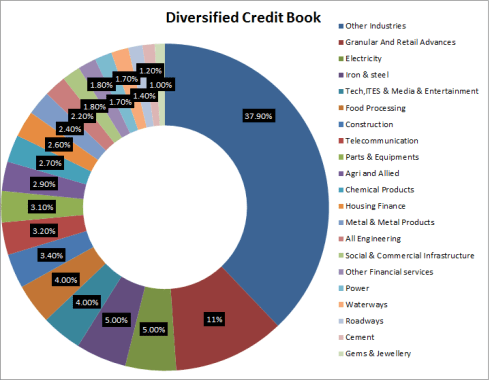
  • YB has a diversified and De-risked Credit Book.
Diversified Credit Book, JainMatrix Investments

Fig 2 – Diversified Credit Book, JainMatrix Investments

  • YB practices a strong employee value proposition of “Creating and Sharing value” with a vision to build their organization driven by professional entrepreneurship.
  • YB is focusing on the SME sector with access to finance and to help them excel in future.
  • YB has aggressively grown the CASA deposits to 20.9% from 18.3% last year. YB offers the savings bank interest rate of 7%, which is highest in the industry.
  • In an economy that used to be denied good banking, Yes Bank is building its brand around positivity, good services and fast approvals.

Stock Evaluation, Performance and Returns

  • YB had its IPO in July’05 priced at Rs 45. It was 31 times oversubscribed. At CMP of Rs 414 today, the stock has given a 28% CAGR return since IPO.
  • The share has risen well, but is volatile. After IPO, price rose to 277 in early 2008, fell to 41 in Mar ’09 and peaked at 547 in May ’13. Today, it is 24% below this peak price.
  • The Price fall around July-Aug’13 was much sharper for YB (56%) than the CNX Bank (33%).
  • This fall is linked to the events of 1) Taper of the monetary easing by Fed Bank in USA 2) A sharp fall in INR/USD value. 3) A case against YB by Promoter/owner Madhu Kapur.
  • Also YB which was an investment & trading favorite and had touched its all-time high of 547 in May’13, may have fallen more sharply due to exits by the trading community.
  • Total Income, NII & Other income and Profits have grown at 38%, 36% and 41% CAGR over 6 years.
Yes Bank Financials, JainMatrix Investments

Fig 3 – Yes Bank Financials, JainMatrix Investments

  • While total income has grown rapidly, margins have fallen a little in the last 3 years. This is natural as Yes Bank is growing into a Large Cap from a Mid Cap size. See Fig 3.
Yes Bank, Book Value, dividends, JainMatrix Investments

Fig 4 – Yes Bank, Book Value, dividends, JainMatrix Investments

  • The first dividend of Rs 1.5 was paid in ‘10, and since dividend has shown a steady increase, Fig 4.
  • The P/B ratio has fallen over 6 years, in spite of price rise, due to rapid growth in Book Value.
  • While NIM% has been flat for 5 years, other financial metrics like RoNW, RoE, CAR and CASA are showing YoY improvements. NIM has been between 2.7-3.2% over the past 5 years. This is low by industry standards as CASA is low. Capital Adequacy is at 18.3%, which is good. The ranges of ROE (20-25%) and RONW (15-23%) for last 5 years are high and growing.
  • The PE chart 5 shows that average PE over the last 6 years has been 15, with a range 5-25.
Yes Bank PE and EPS charts, JainMatrix Investments

Fig 5-6 – Yes Bank PE and EPS charts, JainMatrix Investments

  • PE has fallen today to 9.55 and is in the lowest quartile. This fall was in spite of EPS growth, Fig 6.
  • Price and EPS quarterly graph, shows that EPS has been rising very steadily. The Share Price has been roughly following EPS, except for the last one year.
  •  We expect the EPS of YB to stay within the channel in Fig 6.
  • It appears from Fig 6 that the price fall is not based on financials/ EPS but due to other reasons.
  • Gross & Net NPA rose by Q3FY14 to 0.39% & 0.08%, but are still at lowlevels for the industry.
  • Beta of the stock is 1.98 (Reuters) indicating high volatility.
  • Dividend yield is 1.46%, which is good for the banking sector.
  • PEG is at 0.36 – indicates safety and an undervalued stock.

Opinion, Outlook and Recommendation

  • India is under-banked. There is potential for Banks to invest in new sectors and stimulate growth.
  • The banking industry is a proxy to the overall economy, and should grow at 12-17% p.a.
  • YB as a new private bank is well placed to exploit the trend of Private sector growing faster than PSBs, will continue to be in the 20-35% range for the next 3 years.
  • The recent price fall of 24% since the peak in May ’13 provides an opportunity to invest in YB.
  • In Mar’14 YB crossed its 200DMA and has stayed above it for 2 weeks already. It is a bullish sign and may signal a long positive period for the stock.
  • YB will continue on the path of solid stock performance and dividends over the next decade. Invest now and systematically to gain for the long-term.
  • Our Call is a BUY.

JainMatrix Knowledge Base:

See other useful reports

Do you find this site useful?

  • Visit the SUBSCRIBE page to find how you can get more. Click LINK
  • Register Now to get our Free reports and much more, on the top right of this page, or by filling this Signup Form CLICK.

Disclaimer:

This document has been prepared by JainMatrix Investments Bangalore (JM), and is meant for use by the recipient only as information and is not for circulation. This document is not to be reported or copied or made available to others without prior permission of JM. It should not be considered or taken as an offer to sell or a solicitation to buy or sell any security. The information contained in this report has been obtained from sources that are considered to be reliable. However, JM has not independently verified the accuracy or completeness of the same. Neither JM nor any of its affiliates, its directors or its employees accepts any responsibility of whatsoever nature for the information, statements and opinion given, made available or expressed herein or for any omission therein. Recipients of this report should be aware that past performance is not necessarily a guide to future performance and value of investments can go down as well. The suitability or otherwise of any investments will depend upon the recipient’s particular circumstances and, in case of doubt, advice should be sought from an independent expert/advisor. Either JM or its affiliates or its directors or its employees or its representatives or its clients or their relatives may have position(s), make market, act as principal or engage in transactions of securities of companies referred to in this report and they may have used the research material prior to publication. Any questions should be directed to the director of JainMatrix Investments at punit.jain@jainmatrix.com
Motherson Sumi Systems – Global Auto Ancillary Growth

________________________________________________________________________

  • Report Date: 25 Feb’14
  • Market Price: 220
  • Large Cap – Mkt Cap 19,460 crores
  • Advice: Buy with a Mar’16 target of 451, a 104% appreciation

Motherson Sumi Systems is an Indian auto ancillary firm that is growing rapidly through global acquisitions. It cut its teeth as a Maruti Suzuki vendor, then expanded capabilities, product lines and customer base. In recent years it bought undervalued global plants and rapidly turned them around, and now has operations in 25 countries, supplying to all major auto firms. Revenues, EBITDA and Net profits have grown at 77%, 57% and 20% CAGR over the last 5 years. The current high debt should be reduced soon to comfortable levels. MSS is a BUY at current levels.

Description and Profile

  • Motherson Sumi Systems (MSS) is a Noida UP based Auto Ancillary firm operating in 25 countries.
  • FY13 consolidated Revenues were Rs 25,200 cr, EBITDA 1,798 cr and Net Profit 451 cr.
  • The flagship of the Samvardhana Motherson group, MSS consolidates business with Samvardhana Motherson Peguform (SMP) and Samvardhana Motherson Reflectec (SMR), owns 51% of both. MSS is a JV with Sumitomo Wiring Systems (Japan), and has JVs with Japanese, German and U.K. firms.
  • Vivek Chand Sehgal is the Vice Chairman of MSS. The shareholding pattern in % is: Promoters is 65.6% (Indian 40 & Foreign 25.6) FIIs 17.2, DIIs 7.8, Individuals (Retail/HNI) 5.8, and Others 3.6%.

Business Notes

Business Segments

Fig 1 – Business Segments

  • MSS is a major supplier of components, modules and systems to the auto industry globally. These include Polymer Components, Mirrors, Wiring Harness and Rubber & Metal products. Fig 1.
  • The diversified customer base includes most dominant Auto firms. Fig 2.

Customers

Fig 2 – Excellent Customer Base

  • The company offers products in both automotive and non-automotive segments. However non-automotive is very small at about 2%.
  • In non-automotive segment, the company is the largest supplier to industrial forklifts and material handling manufacturers. It also manufactures and assembles water purifier for HUL in India.

Strategies and Events

  • MSS has strong customer relationships and is focused on increasing its Content Per Car. It is mostly the OEM supplier, and this simplifies the Auto company’s vendor management process.
  • Revenues from overseas operations in MSS consolidated grew to 83% (FY13) from 66% (FY11). MSS expanded its global operations and acquired undervalued assets, with 9 acquisitions in 10 years.
  • Post-acquisition of loss making auto ancilliary assets, the MSS management was extremely focused on a plant by plant turnaround, which has been the main reason for MSS success.
  • But the international focus hasn’t hurt the company’s local operations, which are growing fast and setting up new plants. MSS is a key supplier to Hyundai, Maruti Suzuki, M&M and Tata Motors. The domestic auto sector slump did not affect it as exports posted a 25% growth.
  • MSS has an excellent de-risking strategy – the growth should happen such that no Single Customer, Single Country or Single Commodity should constitute more than 15% of the turnover.
  • According to the plan of MSS, by 2015 the company will become a $5b company, increase the global presence to 27 countries, and achieve a ROCE of 40%. It is already close to achieving many of these targets.
  • In May’12, an IPO of Samvardhana Motherson Finance, a group firm, was withdrawn due to poor investor response. MSS is the only India listed firm from this group.

Stock Evaluation, Performance and Returns

The price history of MSS is mapped here.

  • After the 2008 economic slowdown MSS share price fell to a low of 25. It has been on a steady recovery path to a recent Feb 2014 price of 231.
  • In 5 years, the share price has appreciated at 50% CAGR, providing excellent returns to investors.
  • Three bonus issues in the last 7 years (and 4 in last 10) have also accelerated the returns.

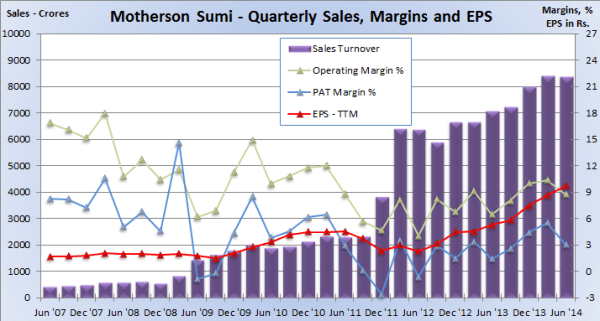
Financials

Fig 3 – Quarterly Sales, Margins and EPS

  • Revenues, EBITDA and Net profits have grown at 77%, 57% and 20% CAGR over the last 5 years.
  • The quarterly financials of MSS Fig 3, reveal periodic surges in revenues, due to new acquisitions. In 2009, Visiocorp became a part of MSS (renamed SMR). In 2011, Peguform was acquired (SMP).
  • Margins are on recovery path, along with a massive growth in volumes, reflecting in the adjusted EPS.
  • MSS has been investing heavily in its operations, Fig 4, even so it is enjoying good Cash flow from Operation, and a positive Free Cash Flow.
  • Dividends have steadily increased over the last 6 years. Including bonuses, it is up almost 3.5 times.

Cash Flow

Fig 4 – Cash Flow & Dividend – Standalone

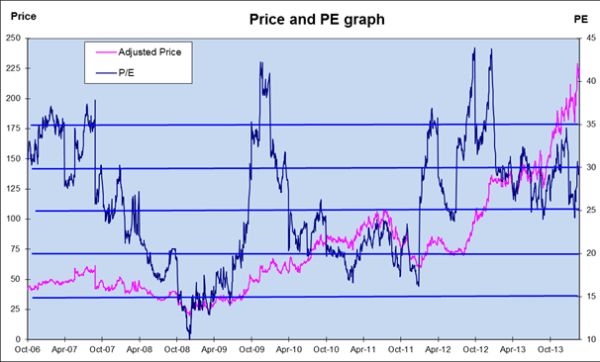
Price and PE_1

 Fig 5 – Price and PE movements

  • The Price and PE chart, Fig 5, reveals the variations in PE values along with the steady share price appreciation. In the last 5 years, the PE ratio has been in a range of 15-35 times, while this historical average is 25 times.
  • Today it is at 29 times, on the upper half of this range.
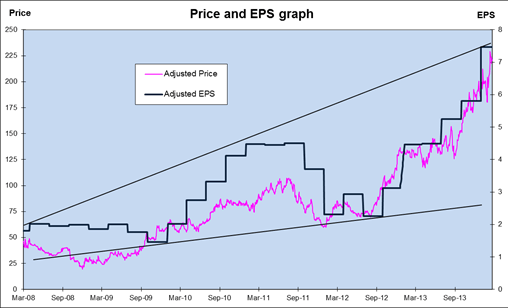
  • In the Price and EPS chart, Fig 6, we can see a sharp surge in EPS over the last 2 years. The share price has also been in line with this. The EPS growing within a channel represented by two lines.

EPS_1

Fig 6 – Price and EPS movements

  • Total debt is Rs 4071 cr, and D/E high at 1.78. However this is a spike, required to acquire firms, and is expected to be reduced to manageable levels in the next 1-2 years.
  • Return on Capital Employed is 17.4% while Return on Net Worth is 19.4%. These are good ratios.
  • PE is 29.6 currently, and PEG based on PE and EPS growth is at 0.98 – indicates a fairly valued stock.

Benchmarking

In the benchmarking exercise we compare MSS with industry plays like Bharat Forge, Bosch and Exide.

Benchmarking

Fig 7 – Industry Benchmarking

  • With its acquisitions in the recent past, MSS leads in terms of revenue growth. The cost of acquisitions reflects in the high debt.
  • With good cash management, the revenue growth should soon reflect on the profits and debt reduction. Good inventory turnover means factory assets are being well utilized.

Financial Estimate

The business financials are projected in Fig 8.

Projections

Fig 8 – Financial Projections

  • In the next 2-3 years, MSS will consolidate its acquisitions, steady the new operations, grow business volumes and repay debt from cash flows.
  • The recent revenues jumps will soon translate into profit increases.
  • MSS forex revenues is a plus as the INR over 2-3 years will be stable or may even depreciate a little.

Risks

  • Current expectations are that the domestic market’s current slowdown will end in 1-2 quarters, but if it extends for a longer period, domestic investments will be affected.
  • Foreign Exchange volatility. MSS has 83% of revenues in non INR currencies. A significant portion of debt is also in Forex. We can see large unpredictable quarterly gains and losses due to this.
  • Economic environment needs to be stable in key markets of USA, UK, Europe, China and India.
  • Complex corporate structure of group with many cross holdings, JVs and subsidiaries across firms.

Opinion, Outlook and Recommendation

  • The global automobile market recovered significantly in 2013 from the impact of the global financial crisis, buoyed by economic recovery and pent-up demand in the U.S. and Asia.
  • The automobile sector in India has many unique advantages – good local small car demand and production, export momentum, presence of many global names and design skills. Clearly the auto ancilliary industry also incorporates all of these.
  • MSS is a visible, dynamic player in auto ancillaries. They started as a vendor for Maruti Suzuki, and built capability, corporate maturity and finally global growth from this strong base.
  • By all indications, MSS is a successful Indian auto ancillary firm that has made bold moves to grow internationally, acquire technologies, listen to their customers and manage manufacturing well.
  • While the PE at 29.6 appears high, we expect profits growth to exceed this over the next 2-3 years
  • MSS is a buy with a Mar 2016 price target of 451, a 104% appreciation from today (25 Feb’14).

————————————————————————

The JainMatrix Investment Service is available for a subscription fee. SUBSCRIBE NOW. 

To get more Services Details, See Offering
To Make the Payment, See Payment Options

JainMatrix Knowledge Base:

See other useful reports

Contact

  • Ask for a call back by filling FORM
  • Register Now to get our Free reports and much more, on the top right of this page, or by filling this Signup Form CLICK.

Disclaimer

This document has been prepared by JainMatrix Investments (JM) of Bangalore, India, and is meant for use by the recipient only as information and is not for circulation. This document is not to be reported or copied or made available to others without prior written permission of JM. It should not be considered or taken as an offer to sell or a solicitation to buy or sell any security. The information contained in this report has been obtained from sources that are considered to be reliable. However, JM has not independently verified the accuracy or completeness of the same. Neither JM nor any of its affiliates, its directors or its employees accepts any responsibility of whatsoever nature for the information, statements and opinion given, made available or expressed herein or for any omission therein.Recipients of this report should be aware that past performance is not necessarily a guide to future performance and value of investments can go down as well. The suitability or otherwise of any investments will depend upon the recipient’s particular circumstances and, in case of doubt, advice should be sought from an independent expert/advisor. Either JM or its affiliates or its directors or its employees or its representatives or its clients or their relatives may have position(s), make market, act as principal or engage in transactions of securities of companies referred to in this report and they may have used the research material prior to publication. Any questions should be directed to the director of JainMatrix Investments at punit.jain@jainmatrix.com
Britannia Ind. – A Ready to Eat Investment

_________________________________________________________________

  • 03-Feb-2014
  • CMP: Rs 880
  • Mid Cap – Mkt Cap 10,500 crores

JainMatrix Investments has published a report on Britannia Industries for its Subscribers. A partial report is available below. Edited from it are Product Overview, Risk factors, Bench-marking, Financial Projections and 2 year target prices for BIL stock. The JainMatrix Investment service is available for a subscription fee.

SUBSCRIBE NOW. Click on See Offering

Here is a note on Britannia Industries (BIL).

Britannia Industries is a leading Indian food processing firm, making biscuits, dairy products and bakery items like cakes, rusks and breads. This firm has seen a turnaround since 2010, with fair revenue growth, but excellent margin improvements. The ongoing initiatives in manufacturing capacity addition, sales team synergies and ‘nutrition’ oriented product launches should see BIL emerge as a premium food giant. Buy. 

Business Profile

  • Britannia Industries (BIL) is a Bangalore based firm selling bakery and dairy products. Started in 1892, it is one of the largest food processing firms in India.
  • Sales turnover in FY13 was Rs 5,615 crores and PAT is 233.9 cr. Sales have grown 7.5% (CAGR) over the last 5 years. Market Cap is 10,500 cr., ranked 3rd in India in the food processing industry.

  • BIL has 30-33% biscuit market share in India, and a reach of 36 lakh retail outlets across the country. It has about 2190 employees.
  • The shareholding pattern is: Promoters-50.8%, FII’s-19.1%, Individuals/HNI-17.2%, FIs/Insurance-5.6%, MFs-4% and Bodies Corporate 3.3%.
  • Key executives are: Chairman Nusli Wadia, MD Vinita Bali, and COO Varun Berry.
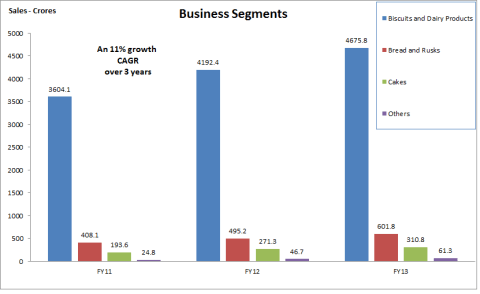
Britannia Business Segments, JainMatrix Investments

Fig 1 – Business Segments, JainMatrix Investments

Click on any graphic in report to see in full size.

Britannia Key Brands, JainMatrix Investments

Fig 2 – Key Brands, JainMatrix Investments

  • BIL’s products are high volume food products. It has a large distribution network reaching ~36 lakh outlets, with more than 40% of the consumption in rural India.
  • Economic Times Brand Equity placed BIL among the top 10 trusted brands of India.

Recent Events and Strategies

  • BIL is adding production capacities, and also reducing the dependence on contract manufacturing. To manufacture its own products, BIL has spent nearly Rs 300 cr to add capacities, much of which was earlier outsourced. Three new plants have come up in Bihar, Odisha and Gujarat. These plus one in TN will take the total plants owned by BIL to 12. These will take care of 50% of the company’s manufacturing needs, with the rest coming from contract manufacturers.
  • BIL is planning to set up another wholly owned subsidiary for baked goods in Tamil Nadu, to serve South Indian markets, at an estimated cost of Rs 100 crores in early 2015.
  • BIL is also driving innovation across the existing categories and has strengthened its R&D for this.
  • Synergies were created through integration of the bakery and dairy sales and distribution system.
  • Increased distribution of more high-priced products in urban areas, at the same time concentrating on rural areas is going to be the company’s primary objective for the FY14, according to company’s COO Varun Barry, which should help BIL grow sales by 15% in FY14.
  • MD Vinita Bali is set to exit the company in March’14 and will be succeeded by COO Mr. Varun Barry. The latter is already head of the India operations. He is also undertaking a management restructuring, to make the top team smaller and more focused.  

Stock Evaluation, Performance and Returns

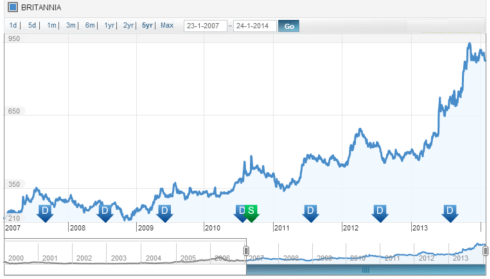
  • The price and dividend history is detailed in Fig 3. There was a split in Face Value (10 to 2) in 2010.
  • Post 2010 BIL has started a sharp uptrend. Investors in BIL over the last 5 years have seen a return on 25% CAGR on the share price. In the past 1 year itself, the share has appreciated over 60%.
  • Revenues have grown at 15.7% of CAGR in the past 4 years. The EBITDA and PAT have grown at 7.9% and 6.7% respectively in this period.
  • The all-time high of 972 was hit in Oct 2013. It is at 9.5% below these levels.  
Britannia Price History, JainMatrix Investments

Fig 3 – Price History, JainMatrix Investments

Britannia Quarterly Financials, JainMatrix Investments

Fig 4 – Quarterly Financials, JainMatrix Investments

  • The EPS has increased by 6.7% CAGR over the last 5 years – Fig 4. However post the losses of Mar’10, the recovery has been rapid. Dividend too has followed a similar pattern. The reasons for this are a combination of volumes growth and better margins.
  • Standalone Free Cash Flow has been positive for the last 5 years (Fig 5), this is positive. It allows the firm to reinvest in the business or reward shareholders. Dividend too has increased. Yield is 1%.
Britannia Cash Flow, Dividend, JainMatrix Investments

Fig 5 – Cash Flow, Dividend, JainMatrix Investments

Britannia Price PE Chart, JainMatrix Investments

Fig 6 – Price PE Chart, JainMatrix Investments

  • The P/E after FY11 has been in the 26-40 range, Fig 6. At 31 times today it’s in the low-end of this.
  • We can see the recent surge in EPS – Fig 7. The Price of BIL has been tracking EPS growth. The EPS now is in the channel indicated in the Chart.
Britannia Price EPS Chart, JainMatrix Investments

Fig 7 – Price EPS Chart, JainMatrix Investments

  • Other relevant consolidated financial parameters –
  • ROCE and RONW are 44.5% and 46.7%, both excellent numbers
  • BIL has just 24 cr. of equity capital; there is a good chance of bonus, split, dividend increase or other shareholder reward if performance continues to excel.
  • Debt equity fell from 0.61 (FY13) to 0.3 (Q1FY14), indicating a fast improving Balance Sheet.
  • PEG at 0.4 indicates undervalued status.

Opinion, Outlook and Recommendation

  • Buy 

JainMatrix Investments has published a report on Britannia Industries for its Subscribers. A partial report is available below. Edited from it are Product Details, Risk factors, Bench-marking, Financial Projections and 2 year target prices for BIL stock. The JainMatrix Investment Service is available for a subscription fee.

SUBSCRIBE NOW. Click on See Offering

JainMatrix Knowledge Base:

See other useful reports

Disclosure: It is safe to assume that if the JainMatrix website recommends a stock, the researcher has already invested in it.

Do you find this site useful?

  • Visit the SUBSCRIBE page to find how you can get more. Click LINK
  • Register Now to get our Free reports and much more, on the top right of this page, or by filling this Signup Form CLICK.

Disclaimer:

These reports and documents have been prepared by JainMatrix Investments Ltd. They are not to be copied, reused or made available to others without prior permission of JainMatrix Investments. Any questions should be directed to the director of JainMatrix Investments at punit.jain@jainmatrix.com

Also see: https://jainmatrix.wordpress.com/disclaimer/

Bajaj Finance – a Firm you can Bank on

_________________________________________________________________

  • 23-Jan-2014
  • CMP: Rs 1569
  • Mid Cap – Mkt Cap 7910 crores
  • Advice: Buy with a March 2016 target of Rs 3435

JainMatrix Investments presents investors the complete report on Bajaj Finance as part of the Investor Rewards Fortnight. 

Bajaj Finance is an NBFC on a rapid growth path. It is a leader in auto and consumer durable loans, and a strong contender for a Banking license. Key strengths are diversified business segments, good product range, broad geographical reach, strong ‘Bajaj’ brand and nimble business model. The performance has been steady in 2013, and operational metrics are good, with low NPAs. Gains can accelerate for Bajaj Finance if the Bank license comes through. Invest in this high potential mid cap.

This is a follow-up report to the one published in Jan 2012, entitled – Bajaj Finance, Auto-matic Growth.

Business Profile

  • Bajaj Finance (BFL) is a NBFC promoted by Bajaj Auto 26 years ago. Key management personnel are Rahul Bajaj – Chairman, Sanjiv Bajaj – Non Executive Vice Chairman and Rajeev Jain, CEO.
  • The total Income in FY13 was Rs 3111 crore and PAT 591 cr.  
  • BFL’s products portfolio includes loans for Consumer Durables, Personal use, Against Property & Securities, for Small Business, Construction Equipment, and Insurance Services. See Figs 1 & 2. About 60% of its business is consumer oriented – B2C, while rest is B2B, with a SME focus.
  • About 30% of the 2&3 wheelers of Bajaj Auto are today financed by BFL. In the last 6-7 years, BFL has converted itself into a professional, diversified financing company.
  • BFL has a network of 7,000+ distribution franchise across 112 cities, and 80 lakh plus customers.
  • In 2013, BFL added 1,565 permanent employees, taking the total employee strength to 3,090. This is a sign of business confidence and investments in expected growth.
Business Segments, JainMatrix Investments

Fig 1 – Business Segments, JainMatrix Investments

  • Funds sourcing – CRISIL has rated it at FAAA/Stable for FDs (high safety on timely payment of interest and principal), A1+ (short-term debt) and AA+/stable (long-term debt) by CRISIL & ICRA.
  • The share-holding pattern is 62.1% Promoters, and public shareholding includes 11.3% individuals, 10.2% FII’s, mutual funds/UTI 7.9%, and bodies corporate 7.3% and 1.2% others.
Fig 2 - Product offerings, JainMatrix Investments

Fig 2 – Product offerings, JainMatrix Investments

Recent News and Updates

  • BFL had a Rights issue in Jan 2013, and raised 750 cr. The issue ratio was 3:19 and pricing Rs 1100.
  • BFL extended its consumer electronics financing business recently to digital product financing.
  • BFL also launched a rural financing initiative in 7 branches and 30 spokes in Maharashtra.
  • The total customers acquired in Q3 FY14 grew by 15%.
  • The firm’s borrowing mix from banks & money market is 60:40. This appears a balanced mix.
  • The Bajaj Group has applied for a Bank license from RBI, which is expected to be issued in early 2014. There are totally 25 applicants. BFL is the firm proposed to be converted to a Bank if this application is successful. There may however be a need for a restructuring within the Bajaj group as after getting banking license there cannot be any preferential treatment to Bajaj Auto.
  • BFL was rated by Aon Hewitt as one of the top employers in India in terms on Employee Satisfaction.
  • Other business achievements – It is the first NBFC to launch online personal loans. It is among the few NBFC with active co-branded credit card (with Standard Chartered Bank. It is the first NBFC to tie up with UIDAI to access Aadhar card/eKYC database.
  • The recent Q3FY14 results were good. AUM grew 33% to 22,461 cr; customers acquired during Q3 rose 15% YoY to 9,62,204 and deployments climbed 45% YoY to 7,532 cr.

Industry Note

  • There are a large number of NBFCs in India (>10,000). These are relatively unregulated companies, unlike Banks that are governed by RBI. In this fragmented market, there is tremendous opportunity to offer Loans and Financial services.
  • RBI has projected a 14% growth in loans for Banks; NBFCs should have higher industry growth rates of 24% for the next five years. (ICRA/ industry experts).
  • Inflation and Interest rates are at highs in Q4 of FY14, which is difficult for the sector. However the 2 year outlook is a slow fall in both, even as the investment cycle recovers in India.

Unique Strengths

  • BFL shares the strong ‘Bajaj’ brand; and is part of the growth of Bajaj Auto through Auto loans. BFL has a wide presence and leadership in high value Consumer Electronics and retail loans.
  • BFL is diversified across customer segments and geographies; this de-risks operations and inspires a confidence in continued growth. BFL has a presence in 7 business sectors (Fig 1) and is nimble enough to shift focus to the performing sectors in order to achieve its targeted growth.
  • The group financial services ambitions and new initiatives are going to be routed through BF.
  • A strong distribution network, spread nationally with presence across customer segments, industries and geographies. The BFL strategy is to diversify their loan exposure with a 30% cap on each segment. This will provide a de-risked business model.
  • With a wide product portfolio, BFL targets cross-selling and up-selling products to its customer base.

Stock Evaluation, Performance and Returns

  • Listed since 1994, BFL performed well over the last 6-8 years, as seen in Fig 3.
  • A sharp fall in price around Jan-Mar ‘13, was caused in part due to the rights issue.
Share Price History, JainMatrix Investments

Fig 3 – Share Price History, JainMatrix Investments

The fall we see around August ’13 is linked to the events of 1) threat of stoppage of the Quantitative Easing program in USA, 2) fall in INR v/s USD value. Most Bank share prices in India fell at this time.

Bajaj Finance, Quarterly Growth Growth of Income, Profits, JainMatrix Investments

Fig 4 – Bajaj Finance, Quarterly Growth of Income, Profits – JainMatrix Investments

The Growth of Total Income, Net Interest Income, Net Profits and EPS TTM has been very steady since June 2008, see Fig 4.

Price, P/BV ratio, Dividends, JainMatrix Investments

Fig 5 – Price, P/BV ratio, Dividends, JainMatrix Investments

  • The Share price has appreciated by 28% CAGR over the last 9 years. However, post the 2009 fall, the appreciation has been very steep at 86% CAGR over 5 years, mapped in Fig 5.
Price PE chart, JainMatrix Investments

Fig 6 – Price PE chart, JainMatrix Investments

  • Price and PE chart Fig 6, indicates that the PE is distributed over a range of 8-32 times, with the 8 year historical average of 20 times.
  • It shows that PE is currently near all-time lows even though the Price is at all-time highs. It seems the full effect of the Earnings improvements is not yet reflected in the Price.
Price EPS chart, JainMatrix Investments

Fig 7 – Price EPS chart, JainMatrix Investments

  • The EPS growth has accelerated since 2010, (Fig 7). This is an excellent chart of the firm’s growth. The EPS appears to be in a channel – of blue lines, and on a good growth path.
  • Dividend yield by the company is 0.95%. Dividend rate has increased steadily over the last 5 years.
  • We can trace the financial metrics of Return on Net Worth, Return on Capital Employed and Tier 1 Capital Adequacy in Fig 8. ROCE is 16% and RONW is 17.6%, in FY13. These are good ratios.
  • Today, BFL has a tier-1 capital adequacy ratio at 17.7% (Sept’13). This is at a comfortable level to fund rapid growth and meet the standards for the sector.
  • NIM has fallen to 11.7% but this is driven by higher share of secured loan products.
  • Gross NPA increased from 1.14% to 1.15% while net NPAs declined from 0.26% to 0.23 % YoY.
Financial Metrics, JainMatrix Investments

Fig 8 – Financial Metrics, JainMatrix Investments

  • P/BV is 2.35 today which is a fair level, not overpriced.
  • The PEG today is at 0.48 – indicates undervalued status.

Risks:

  • Our base case assumes BFL wins the Banking license, and needs to restructure and invest in itself to re-launch as a bank. The share price will surge post this prestigious win. But in case it does not win this, restructuring costs will be lower and profits higher; but the share price may see some fall.
  • High Inflation. If the current high inflation in India cannot be tamed, it will affect BFL business.
  • Our base case is a mild economic recovery in India. However, if the Indian economy continues to show flat or poor growth, the BFL growth will be hit.
  • Promoter driven consolidation. Bajaj group has other financial firms like Bajaj Allianz (Insurance), Bajaj Financial Solutions (Wealth management and advisory) and Bajaj Finserv. Consolidation will change the outlook and business strategy of BFL.
  • The worse performing business lines have been Infra and commercial lending, which have been pared down over the last two years. No fresh losses should emerge from this loan book.

Peer benchmarking and Financial Estimates

BFL is compared to some of its peers to understand and benchmark its key ratios. See Exhibit 9.

Peer Benchmarking, JainMatrix Investments

Exhibit 9 – Peer Benchmarking, JainMatrix Investments

  • BFL leads in ratios of growth and Returns.
  • Behind a national major like HDFC, it leads across most parameters.
  • It appears undervalued at Current Market Price.

Three-year projections of BFL financials indicate a robust ramp up of revenues and profits, Exhibit 10.

Financial Projections, JainMatrix Investments

Fig 10 – Financial Projections, JainMatrix Investments

  • Review of Projections from the Jan 2012 report on BFL. While the firm actually exceeded our projections for FY12 and the Profits for FY13 were lower by just 9%, we noticed that the volatility in Banking/ NBFC sector pulled down the valuation & price from our estimates by 35% by end FY13.
  • In the next 2-3 years, this should reverse and the valuation multiples should rise.

Opinion, Outlook and Recommendation

  • Indian market is underserved for loans and financial services. Quick calculations show BFL has 2-3% market share among Indian NBFCs (non-Bank). While small, this indicates a big opportunity for BFL.
  • In India, Consumer debt/ GDP is 9%, low compared to S.Korea 80%, European>50% and China 12%.
  • BFL is a firm gifted with an outstanding, valuable brand, positive image and good reputation. BFL is well placed to capitalize on this by growing into a financial powerhouse with businesses into insurance, loans and finance.
  • In the past few years, BFL has embarked on a business trajectory that, if sustained, can make it a top 5 NBFC in 4-5 years. In essence it may move from mid-cap to large-cap, and shareholders could gain considerably.
  • Invest now and systematically for long-term out-performance.

The projection/ targets for Bajaj Finance are:

  • March 2015 – Rs 2850 – an 81% gain
  • March 2016 – Rs 3435 – an 118% gain

JainMatrix Knowledge Base:

See other useful reports 

Do you find this site useful?

  • Visit the SUBSCRIBE page to find how you can get more. Click LINK
  • Register Now to get our Free reports and much more, on the top right of this page, or by filling this Signup Form CLICK.

Disclaimer:

This document has been prepared by JainMatrix Investments Bangalore (JM), and is meant for use by the recipient only as information and is not for circulation. This document is not to be reported or copied or made available to others without prior permission of JM. It should not be considered or taken as an offer to sell or a solicitation to buy or sell any security. The information contained in this report has been obtained from sources that are considered to be reliable. However, JM has not independently verified the accuracy or completeness of the same. Neither JM nor any of its affiliates, its directors or its employees accepts any responsibility of whatsoever nature for the information, statements and opinion given, made available or expressed herein or for any omission therein. Recipients of this report should be aware that past performance is not necessarily a guide to future performance and value of investments can go down as well. The suitability or otherwise of any investments will depend upon the recipient’s particular circumstances and, in case of doubt, advice should be sought from an independent Financial Expert/Advisor. Either JM or its affiliates or its directors or its employees or its representatives or its clients or their relatives may have position(s), make market, act as principal or engage in transactions of securities of companies referred to in this report and they may have used the research material prior to publication. Any questions should be directed to the director of JainMatrix Investments at punit.jain@jainmatrix.com

Disclosure: It is safe to assume that if the JainMatrix website recommends a stock, the researcher has already invested in it.

Also see: https://jainmatrix.wordpress.com/disclaimer/