Seven Short Steps to Long Term Investing Success

Dear Investors,
I got a question on a discussion forum, about Long Term Investing. I found the line of thought very interesting, and my reply is in the form of the Seven Steps to Long Term Investing Success !!
So here goes.  (thanks Srini and Musa).
..

First the question

Dear All,
Need some advise.
I intend to invest some X amount in some select stocks with a holding period of about 8-9 years.
Is it good to leave it untouched till the end of holding period? Or is it advisable to set some yearly target say 20% or so and exit once the target is achieved in a year and wait for some lows to happen to reenter the stock for a target n exit once again and continue this cycle till the end of Holding year.
I don’t know how the above approach of mine sounds, but need you to give me some thoughts on how to go about it.
Regards.
..
Here’s my Answer:
..

the Seven short Steps to Long Term Investing Success

Dear Investor,
This is a pretty good question.
The investing process I feel you should follow is:
  1. Stock Selection: Obviously, choose your Select Stocks well. Since the holding period is 8-9 years, you need to look closely at the fundamentals. Each stock needs to have an investment thesis (eg. capacity expansion of 200%, or a new product launch that can grow profits 150%) and a price target for a specified period of time like say 2-3 years. These need to be high conviction ideas. Plus good Portfolio thinking is that there should not be an overexposure to any one sector, to reduce overall sector risk.
  2. Investment: Buy the Selected Shares. One way to simplify things is to buy shares of roughly equal monetary value.
  3. Monitor the Stocks: Next these shares need to be monitored. Is the investment thesis being played out in reality? Any external events affecting it? A six monthly review for these Select Stocks may be sufficient.
  4. Minimize Transactions: I would disagree about the 20% annual targets and exit /entry cycle. Good well chosen shares may appreciate even 100% in a good year, yet may still be cheap and worth buying, even at this level, if the 2-3 year outlook still looks good. Every delivery based entry and exit can cost you upto 0.6% of your asset, so transactions should be minimized for long term investments.
  5. Use Dips to Buy: Also the reverse may also happen. The investment thesis may be playing out well, but the share price may have fallen 20%. You need to be patient here, and can even buy more of this stock if you have funds.
  6. Exit Non-Performers: My approach would be to (on Review) sell those Stocks that are not performing on fundamentals as per the investment thesis (this may or may not be reflected in the price performance) and perhaps buy more of those that are performing. There is no shame in admitting mistakes. Even investment greats like Anthony Bolton (I’m reading a great book by him called Investing Against the Tide) talk about a success/ hit rate of 55-60%. The secret is to identify mistakes and reduce losses by exiting fast.
  7. Time in Market: Over the 8-9 years period a good internal price target to have is to get a 20% annualized return for your Select Stocks. But notice that big returns come in a few years and things may be flat to negative for the others. So I prefer “Time in Market” with “Good Stocks” where you will get the returns over time.
Thats it !! I guess many years of investing have helped me give a short and sweet answer.
Sorry for generating Option 3 compared to 1 or 2 asked by you, but this is my recommended approach.
Here’s to your investing success.
(needless to say, revert to me if you need help with choosing stocks and monitoring  Emoji )
Regards, Punit Jain
Bangalore, Founder, JainMatrix Investments
 .. 
Embed from Getty Images

DISCLOSURES AND DISCLAIMER

Recipients of this report should be aware that past performance is not necessarily a guide to future performance and all stock investments are subject to market risks. The suitability or otherwise of any investments will depend upon the recipient’s particular circumstances and, in case of doubt, advice should be sought from a Financial Adviser. This document has been prepared by JainMatrix Investments Bangalore (JM), and is meant for use by the recipient only as information and is not for circulation. This document is not to be reported or copied or made available to others without prior permission of JM. It should not be considered or taken as an offer to sell or a solicitation to buy or sell any security. The information contained in this report has been obtained from sources that are considered to be reliable. However, JM has not independently verified the accuracy or completeness of the same. Neither JM nor any of its affiliates, its directors or its employees accepts any responsibility of whatsoever nature for the information, statements and opinion given, made available or expressed herein or for any omission therein. JM has been publishing equity research reports since Nov 2012. JM has applied for certification under SEBI (Research Analysts) Regulations, 2014. Any questions should be directed to the director of JainMatrix Investments at punit.jain@jainmatrix.com

Investor Education

As an equity analyst, I feel that education and learning should never stop. There are so many mysterious pebbles to overturn and emotions we have to fight, as investors. So I share with you some of my articles and notes that can help you become a better equity Investor.

  1. Great Investing Wisdom – In this note, a great investor touches upon the classic challenges – uncertainty, fear, underperformance, the big new industries, standing out, biases and luck – May 2018
  2. Is Investing a Science or an Art – Dec 2017
  3. Why are Indian Stock Markets Attractive for Investments? – Feb 2017
  4. Do You Want to be a Value Investor? – July 2016 
  5. The Natural Quotient: A Sustainability Metric for Business – Nov 2016
  6. How to Approach the Stock Market – A Lesson from Warren Buffet – May 2016 
  7. Stock Market Awareness Presentation by JainMatrix – July 2017 
  8. A Superior Investing Process – Do a DIP SIP – March 2016
  9. Seven Short Steps to Long Term Investing Success – June 2015
  10. Equity Portfolios – Control, Wealth and Your Reflection – Mar 2015 
  11. A Rational Sell Decision – July 2014
  12. Retirement Planning: Some Radical Thoughts – April 2015
  13. Fundamental Thoughts – The Search for Stability – Feb 2015
  14. The Toughest Lesson In Long Term Investing – Dec 2014
  15. My favourite – A Vision for the Indian Economy – June 2014
  16. High Risk and High Return In Equity – Oct 2014
  17. How many Mutual Funds should I hold? – May 2014
  18. How The Economic Machine Works – Feb 2014
  19. Make Equity Investing Less Tricky: The JainMatrix Eleven – Jan 2013
  20. Investing Needs Discipline – Dec 2012
  21. An Investor’s Checklist – Apr 2012
  22. India’s Investment Rockstars – Mar 2012

Hope you like them. Feel free to comment, share or go social with these.

Punit Jain

Retirement Planning: a Poll and some Radical Thoughts

Dear Reader,

I came across this interesting article recently, and would like to share it with you.

The inglorious goal of doing nothing – LiveMint, April 21st 2015. 

In short the article describes a person who retired at 40 and is living in a remote location and doing nothing – just enjoying his peaceful retired life. The author proceeds to comment on this and sees it as a poor choice in life.

As an analyst, I would say that …. Its a choice the person in Goa has made, and the best he could do. I may or may not make the same choices, and I may or may not be able to achieve as much as this person at 40.

Which moves me to a question for my readers:

What is your ideal retirement dream?

In fact, I will ask you to take a Poll below and let me know what your dream is …..  Remember, you can answer this Poll only once.

Thank you in advance for your answer.

The Importance of Investing

The point of my exercise is to understand you, my reader. It is also related to this important thing in life called MONEY. Our entire work life is devoted to earning it.

There’s an almost equally important aspect of our life, often neglected, called INVESTING. Most people realize its importance, but are not able to act on it. Investing is a wide term, and there are a number of asset classes, see this chart.

Untitled

Within Direct Equity there are a few options, detailed below:

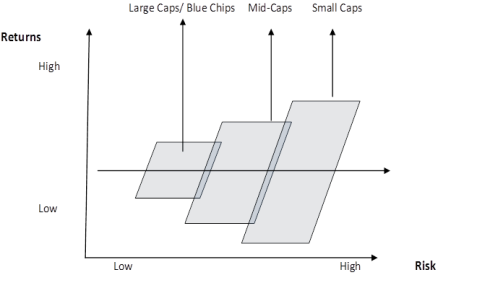
Equity Risk

My opinion on Retirement Planning:

  • Its not important to retire. Instead its important to be able to make work and lifestyle choices where you are free from financial pressures.
  • Free yourself from financial pressures by building your own financial assets.
  • Assets owned by you depend not just on income earned, but also on your making the right investments.
  • Equity as an asset class is highly recommended for long term wealth and asset building, and retirement planning.

Sign up with JainMatrix Investments as a subscriber. Build and protect your capital through equities, and let the money set you free to pursue a passion, a hobby or a peaceful life.

JAINMATRIX KNOWLEDGE BASE

See other useful reports:

DISCLAIMER

This document has been prepared by JainMatrix Investments Bangalore (JM), and is meant for use by the recipient only as information and is not for circulation. This document is not to be reported or copied or made available to others without prior permission of JM. It should not be considered or taken as an offer to sell or a solicitation to buy or sell any security. The information contained in this report has been obtained from sources that are considered to be reliable. However, JM has not independently verified the accuracy or completeness of the same. Neither JM nor any of its affiliates, its directors or its employees accepts any responsibility of whatsoever nature for the information, statements and opinion given, made available or expressed herein or for any omission therein. Recipients of this report should be aware that past performance is not necessarily a guide to future performance and value of investments can go down as well. The suitability or otherwise of any investments will depend upon the recipient’s particular circumstances and, in case of doubt, advice should be sought from an independent expert/advisor. Either JM or its affiliates or its directors or its employees or its representatives or its clients or their relatives may have position(s), make market, act as principal or engage in transactions of securities of companies referred to in this report and they may have used the research material prior to publication. JM is voluntarily compliant with SEBI (Research Analysts) Regulations, 2014. Any questions should be directed to the director of JainMatrix Investments at punit.jain@jainmatrix.com

Equity Portfolio Thoughts – Control, Wealth and your Reflection

——————————————————————————————————-

Date 23rd March 2015  

Summary

  • An Indian investor is free to invest in any of 5000+ stocks listed on the exchanges.
  • He may have a range of needs in his equity portfolio, which we have captured in a hierarchy.
  • He may like to progress on this range and exercise his choices in a calibrated fashion

Introduction

I was speaking to an investor a few weeks ago. A busy executive, he had a medium size equity portfolio by value. But I was astonished to see that he had almost a hundred shares in his Demat account. And he looked at me and asked, “So what should I do with my portfolio?” I was of course on a tight time schedule, and ran through my 4-5 step standard template for portfolio discussions.

A little later, on reflecting on the above question, I realized that the answer to the above question can be very nuanced. And really there can be multiple approaches and answers to this question.

Let’s step back to the very basics of the question, what does a person need from his equity portfolio?

An Equity Portfolio – A Hierarchy of Needs

To answer this question, we need to draw parallels from the Maslow’s hierarchy of needs, and it is summarized below. Expressed simply, every human can have a number of needs, but at different times in his life, and in different situations, the needs change. Generally speaking, the needs follow a hierarchy.
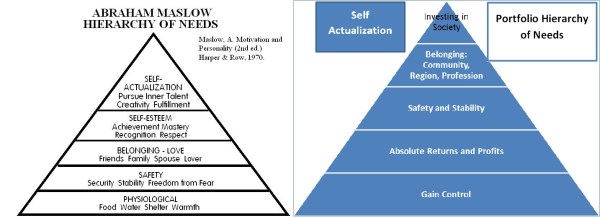
Portfolio hierarchy, JainMatrix Investments

An Equity Portfolio – A Hierarchy of Needs. Source: JainMatrix Investments. Click to enlarge.

In a similar way as Maslow’s needs hierarchy, a person’s equity portfolio reflects different needs in investing and his ability to focus efforts and achieve his personal needs and objectives. Here are the levels that I am able to present:

  1. Gain Control: I have seen many equity portfolios that are nothing more than a legacy of 15 years of sporadic investment enthusiasm. With funds available and a pep talk by anyone, individual investors may make a series of purchases. This may be followed by 6 months of watching the results unravel, followed by 4.5 years of inaction. All of which may be repeated again. As a result the shares may be an uncoordinated mass of choices from the past. Selling is more difficult than buying.
    • It may seem that ‘Do nothing’ is an option here. After all these stocks can sit in your portfolio for another 5 years, and your carrying cost is as less as Rs 1000/year. Wrong. If you are not in the right stocks for a ‘long only’ portfolio, chances are that over time your portfolio will decay in value rather than strengthen.
    • The task of the Investor (along with his portfolio adviser) would be to try and gain control of this portfolio. The basic issues here are –
      • 1. What’s the objective and primary need of this portfolio?
      • 2. How many shares are we comfortable with?
      • 3. Whats the risk appetite and profile of the investor?
      • 4. How do we achieve these 1, 2 & 3, and in what time frame?
    • Also essential to Gain Control, is the need to identify and exit the low potential stocks.
    • In my opinion even stable long term (example – avg. holding of 10 years) investment portfolios should be reviewed once a year to align with macro/ sector events and to evaluate opportunities.
  2. Absolute Returns and Profits: Typically equity trading has a very clear objective, of maximizing returns from any trade. Similarly we obviously invest money with the plan of gaining profits and building wealth. The question here is, over what time span? One hour? One week? One year? A decade? New investors are typically looking for a simple quick absolute return.
    • For an investor, the portfolio strategy here is to simply find the shares that have a high confidence rating of highest upside potential. To find such shares is an ongoing exercise. Many successful finds for example may achieve their potential and may not be investment worthy any longer. Others may continue appreciating for decades. However this exercise is also fraught with risks. Many highly rated shares may fail. Or a sector may be affected by an unexpected event.
    • Its critical here to not just understand a target investment firm for its financials, management and business assets, but also the sector and macro context of this firm.
  3. Safety and Stability: Very soon a trader/ investor may realize that just desire for profits and available funds is not enough. One has to approach investing with a safety plan, and temper high profit expectations with realistic back up plans and a safety net. Am I taking too high a risk, with the possibility of a big loss? What’s my worst case scenario? What risk am I comfortable with? And for how much of my portfolio? With some experience, an investor is able to balance the profit expectation with an understanding of risk, and build his checks and balances.
    • For some thoughts on Risk v/s asset classes see LINK.
    • Every asset class has an associated risk. And a good fundamental researcher can assess and understand this risk well. So for a long term equity investor to have a 100% returns per annum expectation is asking for too much. He may actually get it but only once or twice in a decade. And this may soon be followed by a hurtful loss, equally unexpected.
    • A good equity Portfolio should be able to limit equity holdings within individual firms and within a sector, and also align the market cap focus with risk profile such as Safety – large caps, Higher risk – mid caps and Aggressive – small caps.
    • Embed from Getty Images
  4. Belonging: Community, Region, Profession, etc: At another level of the investment hierarchy, a wealthy investor may start thinking of his investments not just as a means to grow wealth, but as an expression of his place in society. This means the person is focusing a part of his funds towards the things that are important to him, an extension of his personality.
    • This could perhaps mean that for a Bangalore based person like me, I could invest in firms like Titan, Brittania Industries, BF Utilities, Mindtree, etc. which are local firms. I may get a feeling of pride to see these firms doing well, and even though a small shareholder, would be sharing a part of a big success.
    • Similarly as a former software executive, I may like to invest in a few software small caps that I not just understand well but also hope that my ownership in a small way can contribute to its success. It’s more about encouragement and support than just returns.
    • In terms of an exclusion list, a lot of people may be uncomfortable about investing in sectors such as cigarettes and liquor/alcohol. Its really upto the investor to be comfortable with his investments, right?
  5. Self Actualization: A wealthy investor may actually decide to focus his funds towards doing real good, or addressing problems of society. In the past the only way one could do this was in making donations to NGOs, and Education or Religious Trusts. In today’s economy there are several listed corporates that address the needs of the weaker sections of society, or of the environment, and still have an objective of making profits for shareholders. I see no essential compromise in achieving both these objectives. There is, possibly, “A Fortune at the bottom of the Pyramid”.
    • I believe firms in sectors like education, environment, renewable energy and some NBFC’s in housing finance and micro-finance may be addressing and solving large problems of society.
    • Readers are invited to revert to me with their ideas or suggestions of such firms that they have come across.

In Conclusion

Different investors may have vastly different needs in their equity portfolio, and we have mapped these in the form of a simple hierarchy. Many of us could be frozen in inaction at Stage 1 of this hierarchy. Others may have progressed along the stages and gained control and solid wealth from it. Some may actually have a portfolio that expresses their hopes and dreams for their society. Its essential for an Investor to reflect objectively about his own portfolio and think about improvements.

So where are you in this hierarchy? Drop me an email to see if I can help you with aligning your Equity Portfolio to your own needs. See Portfolio Review for a short description of our services.

JainMatrix Knowledge Base:

See other useful reports

Disclaimer

This document has been prepared by JainMatrix Investments Bangalore (JM), and is meant for use by the recipient only as information and is not for circulation. This document is not to be reported or copied or made available to others without prior permission of JM. Many firms are mentioned in this report, and it should not be considered or taken as an offer to sell or a solicitation to buy or sell any security. The information contained in this report has been obtained from sources that are considered to be reliable. However, JM has not independently verified the accuracy or completeness of the same. Neither JM nor any of its affiliates, its directors or its employees accepts any responsibility of whatsoever nature for the information, statements and opinion given, made available or expressed herein or for any omission therein. Recipients of this report should be aware that past performance is not necessarily a guide to future performance and value of investments can go down as well. The suitability or otherwise of any investments will depend upon the recipient’s particular circumstances and, in case of doubt, advice should be sought from an independent expert/advisor. Either JM or its affiliates or its directors or its employees or its representatives or its clients or their relatives may have position(s), make market, act as principal or engage in transactions of securities of companies referred to in this report and they may have used the research material prior to publication. Any questions should be directed to the director of JainMatrix Investments at punit.jain@jainmatrix.com

Fundamental Thoughts – The Search for Stability

——————————————————————————————————–

Dear Investor,

One of the biggest challenges for investors is to find a few valuable firms out of the 5000+ listed companies on the Indian stock exchanges.

This search is not easy; it cannot be done very fast; I would say it is a multi-year process.

Many great investors have suggested and used many criteria, but one simple important one I have is STABILITY.

What does this mean and how does an investor implement this in his portfolio?

Embed from Getty Images

..

Stability for me means a firm that:

  1. Shows a steady pattern

    on its key financials such as Revenues, EBITDA and Net Profits. This does not mean micro level steadiness such as quarter to quarter improvements. I would be more concerned about year to year steadiness, and a sense of expected things happening.

  2. Does not dilute its Equity Share Capital much

    While 10-15% dilution every 3-4 years is ok, anything much more is a worry point. All dilutions affect older investors as EPS will fall to the extent of dilution. Dilutions by Rights issue are good for shareholders as they can participate in this corporate growth. Aggressive dilutions for new acquisitions or excessive ESOPs have to be assessed for stockholder benefits. PSUs typically have Share Capitals that do not change at all over the years. Banks are an exception to this rule as they are in the business of loans and the cheapest funds are available through equity dilutions.

  3. Has Low Debt

    For a firm, an important source of funds is debt. It does not involve equity dilution. However if things are going badly for the firm, it excesses on Debt, or is unable to repay. Sectors in India like Insurance, Telecom and Infrastructure (that are at an early stage of growth) suck in cash and need a lot of debt to develop their operations and may over-leverage and have to pay high finance charges that depress profits. Check the Debt Equity ratio for your target firm. A ratio higher than 2.0 for Infrastructure firms and over 1.5 for other sectors is a Red Flag. Unless its a rare turnaround situation.

  4. No Pledging of Shares

    Promoter stability is an essential to a good equity investment. A promoter that pledges his shares exposes his firm to a situation where a fall in share price (for any reason) will trigger a sale of his shares by the lender that will accelerate the fall of prices. The possibility of this happening may be low, but the consequences are bad, so investors should check the shareholding pattern of a firm before investing.

Remember as an investor, the advantage you have is you can walk away from a share investment if it does not meet your criteria. There are many fish in the sea. And Stability is an important concept in my search for great investment ideas.

Hope you liked the idea !!

Happy investing,

Punit Jain

Founder, JainMatrix Investments

JainMatrix Knowledge Base:

See other useful reports

Do you find this site useful?

  • Please share your opinion in the Reply box below.
  • Visit the SUBSCRIBE page to find how you can get more. Click LINK
  • Register Now to get our Free reports and much more, on the top right of this page, or by filling this Signup Form CLICK.

Disclaimer

See LINK

Cricket and Investing

—————————————————————————————————

At the start of a three nation one day international cricket series, a thought crossed my mind.
Picking stocks for Investing is like a ODI match in which the batsmen have to hit only five aggressive strokes all day long. But all these five need to go out of the park, they have to be sixers. The remaining 295 balls there’s nothing much to be done. You can only be dismissed if you mis-hit a ball.
Quite a different game, right?
Very boring for any viewer.
Very profitable for the batsman if he gets it right.
Cheers and happy investing.
Punit Jain

A Meetup organised by JainMatrix Investments

——————————————————————————————————–

Dec 13, 2014

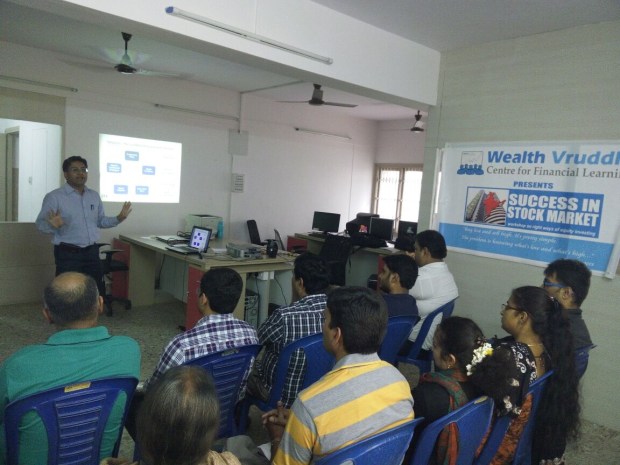
JainMatrix Investments organised a Meetup in Bangalore on 13th December 2014 entitled – “Financial Education and Wealth Creation – an open discussion.” The event focused on offering insights that helped in managing finances in today’s tough economy, and creating, building and sustaining wealth.

Event snap

During the event a presentation on the equity opportunity, current trends in the economy and a snapshot of the equity service by JainMatrix Investments were made by Mr. Punit Jain, the founder of JainMatrix Investments.

Various other topics like Wealth, Income, Finance, and Mobile based Education modules were also discussed by Mr. Mohan Krishna Rao in the event.

The event was well attended and there was a rich interaction and lively discussions on Finance, Wealth, Stock Markets, Inflation, etc.

See this link with photos of the event.                             LINK

If you want to be a part of these Meetups, future events, announcements and perhaps even live online interactions, feel free to write to us!! You are most welcome and we will be delighted to have your presence.

Regards,

Punit Jain

 JainMatrix is Social

Do you find this site useful?

  • Visit the Investment Service page to find how you can get more. Or Click LINK
  • Register Now to get our Free reports and much more, on the top right of this page, or by filling this Signup Form CLICK.