The Importance of Equity in India

————————————————————————–

Summary

Here’s a short article on the perception of equity, how to start if you are a beginner and my story. This article has also been published on Indiamanthan – LINK

Perceptions

Ask 10 persons about their opinion of the Indian share market, and you will get the following responses:

  • Gambling
  • Losses
  • Waste of time
  • Risky
  • Bad advice and analysts

Just a few may say something positive

  • Steady profits
  • Retirement fund
  • Right way to grow wealth
  • Fight inflation

India is a country that is seeing a lot of change. Its visible in our cities, in our communication networks, and most of all, in the attitudes and thinking of people.

About 300 years ago, India was the richest country in the world. Then came a few wars, the British and Europeans, and a post independence Socialist regime. Its only in the last 20 years that India is getting a taste of what it’s been missing.

Freedom to work, freedom to earn, to live on our terms, to take pride in what we have. The Rest of the World is not to be blindly admired and coveted. They had their time in the sun. Now is our chance to be as good or better.

The Reality

The Indian Equity market has been through many phases over the last 30 years. But without a doubt, I will say that today Indian equity market s and platforms are among the best in the world in terms of transparency, low manipulation, low costs of transactions and efficiency.

So today, they represent much better the Indian economy, the industry, enterprise and the aspirations of Indians.

People have been hurt and burned in the past. But its time to learn the important lessons. And realize that if handled properly, the equity market is the most important Wealth creation asset for Indians today.

I realized this in my 10 year journey from a novice to a professional equity and portfolio analyst.
It’s a lot like fire. It can harm and burn you. But if controlled and used with safeguards, it can help cook your food everyday.

Here’s my suggested path

  • Your journey in Equities has to start with signing up with a brokerage and opening a demat account.
  • Your first investing experience may be in equity Mutual Funds
  • Next re-look at the companies you know. Where did your dad or uncle work? Are these good companies? Which branded products do you like? Are the companies that made them listed?
  • Take a close look at these firms. Or other good firms you know of.
  • Invest small amounts in them. Money that you don’t mind losing if your experiment fails.
  • Watch the firms over months. Read about them in the papers. See their results. Try to understand them better.
  • Some equity investments will give you profits. Others losses. Always try to learn important lessons. Build on the successes. Exit losses if the firms do not perform over a period. Build your own investing confidence and sense slowly.
  • Try not to blindly believe everything you read or hear.
  • Success in your personal investments will follow.

My Experience

This is how I went about my learning curve. But in my case, I was able to not just get investing success, but actually developed a passion for it.

I now publish equity research on my website, www.jainmatrix.com, and provide portfolios for investors to buy. As an equity and portfolio adviser, my firm JainMatrix Investments supports investors through their learning and investment cycle.
Do you find this site useful?

  • Please share your opinion in the Reply box below.
  • Visit the SUBSCRIBE page to find how you can get more. Click LINK
  • Register Now to get our Free reports and much more, on the top right of this page, or by filling this Signup Form CLICK.

Balkrishna Industries – Nov 2014

——————————————————————————————————

Dear Investor,

I’m quite proud of my Sept 2013 report on Balkrishna Industries. (link) We found this interesting Small Cap stock early. The share price was Rs 238. It had all the ingredients we look for in our investment research.

Small cap. Undervalued. Unknown. In the right sector. Good management.

We made this report public on this very website.

On 12 Nov 2014, this share touched Rs 855.

And we were staring at a 259% gain in a mere 14 months.


As usual, Mr Market threw in a googly.

On 13 Nov, Balkrishna came out with its Q2FY15 results. Next day, the share plunged by 16%. One day later it dropped further. A total of 29% wiped out in 2 days.

Investors are nervous about this firm. Perhaps even panicking. Naturally. Who likes to lose 30% of one’s investment in 3 days? So should one exit quickly? Or buy more of Balkrishna? Or just do nothing?

Subscribers of JainMatrix Investments aren’t worried. They’ve just got our follow up report on Balkrishna Industries. They know what to do.


JainMatrix Investments is today one of India’s best Equity advisory Investment Services in terms of quality of research, track record and reasonable costs.

JainMatrix Investments is the essential service for the Indian equity investor. 


Subscribe now to navigate the profitable but tricky Indian equity markets.

But hurry. There are just a few more subscriptions available. Join this select group of informed investors. 


This is an opportunity for you.

Punit Jain

Founder, JainMatrix Investments

Do you find this site useful?

  • Please share your opinion in the Reply box below.
  • Visit the SUBSCRIBE page to find how you can get more. Click LINK
  • Register Now to get our Free reports and much more, on the top right of this page, or by filling this Signup Form CLICK.

High Risk and High Return in Equity

————————————————————————————————–

Here is a short article that re-examines the myth of High Risk and High Return in Equity.

What is Risk?

Risk defined by Investopedia is “The chance that an investment’s actual return will be different than expected. Risk includes the possibility of losing some or all of the original investment”.

One of the rules that is commonly believed is that ‘higher risk needs to be taken in order to earn higher returns’. This is intuitively obvious. The entrepreneur invests in a new business knowing that there is a probability of failure. The Venture Capitalist invests in a portfolio of businesses knowing that some may give him 30X returns and others may fail.

But lets review this in the context of Equity investments.

Asset Classes

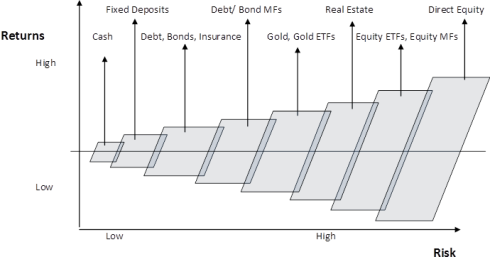
In investing, this risk-return rule is true across asset classes. The following graphic Fig 1 illustrates the Risk and Return rankings across different asset classes. Fig 1.

JainMatrix Investments

Fig 1 – Asset Classes (click to enlarge) JainMatrix Investments

  1. Here we can see that Cash is the safest asset.
  2. FDs come next, as they are of fixed duration and fixed returns, guaranteed by a Bank.
  3. Next come Debt, Bonds, and Endowment Life insurance. Insurance of course is a very high gestation investment product.
  4. Debt and Bond MFs are products packaged by the Mutual Fund industry into Units.
  5. Gold and Gold ETFs are another investment option.
  6. Real estate may come next. It of course varies by location, and commercial/ residential.
  7. Equity ETFs and Equity MFs.
  8. Direct equity is the highest risk investment product. It also provides potentially the highest returns of these asset classes.

Note that these are strictly the author’s personal views of the most likely scenarios, and these may vary under different circumstances. The graphic Fig 1 is only a conceptual map, and indicates relative values.

Risk in Equity

Direct Equity as an asset class has two types of Risk:

  1. Systemic risk is applicable across all sectors. A significant political event, for example, could affect your entire equity portfolio. It is virtually impossible to protect yourself against this type of risk.
  2. Unsystematic risk is sometimes referred to as “specific risk”. This kind of risk affects a few of the assets. An example is news of a sudden strike by employees, that can only affect a specific stock. Diversification is the only way to protect yourself from unsystematic risk.

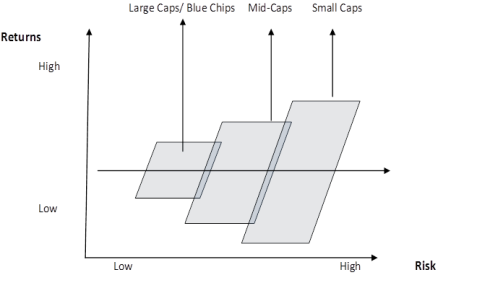
Even equity can be split into equity classes, where the risk profiles are different, see Fig 2. Speaking in general, Large Caps are most stable, and have lower risk, next are Mid-caps and next Small caps.

JainMatrix Investments, Equity Risk

Fig 2 – Equity Risk (click to enlarge) JainMatrix Investments

The Risk-Return Relationship

However, once we look at individual stocks for investing, higher risk may not give higher returns.

  1. The high performing firms in the stock exchange over longer periods are those that are more predictable in terms of growth, costs, investments, new projects and brand strength.
    • Example – HDFC Bank over the period of 2009-13 has given fairly predictable 30% YoY growth in profits. As a result investors gave it a superior valuation and it became the bank with the highest market capitalization, even though it was smaller than peers on other parameters.
  2. Sharp swings for a firm from profit to loss and the reverse too are not seen positively, especially if these happen unexpectedly.
  3. The ability of growth companies to execute on new initiatives is very important. Such firms need to launch in new markets, create new products or set up new manufacturing plants. Here the track record of such firms in these initiatives is important.
  4. Monopolies are seen as very positive situations for firms.
    • Example – ITC has for several decades dominated the Indian cigarette industry with 75-80% market share. This is a profitable and steady growth industry and so the ITC share has performed well over 10-15 years.
  5. Typically the fundamentals based approach to the stock market involves projecting financials for a company over 1-3 years, assigning target prices and identifying high potential investments.
  6. Warren Buffet has taken predictability to the extreme by investing in a bunch of consumer companies (Coca Cola, Procter & Gamble, Kraft Foods, Wal Mart, etc.) where these products are strong brands that are daily consumption habits and so growth is quite predictable over decades rather than years.

The Role of the Equity Researcher

It is the task of an equity researcher to identify, prioritize and assess the risks associated with an investment in a firm. Thus a good equity researcher is actually able to lower the ‘specific risk’ of making an investment, identify potential situations of a company’s future and increase the chance of profitable investments.

JainMatrix Investments approach to Investing

  1. The JainMatrix Investments approach to investing is to start with a top down approach to first identify the attractive sectors that are likely to outperform the next 1-3 year perspective.
  2. Next we drill down to the company level to analyse the fundamentals of firms and identify outstanding Large, Mid and Small cap firms. This research is published periodically.
  3. From this universe of good firms, a few are hand-picked and sorted into Model portfolios. By aligning the portfolios with their risk appetites, we help investors invest better.

Large Cap Model Portfolio

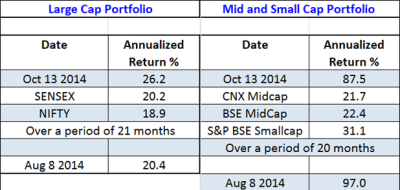
  • The objective of the LCMP is to outperform the Sensex and Nifty by 5-10%.
  • It consists of 7 large cap shares which are the current or future leaders from attractive sectors of the Indian economy.
  • This is a low risk portfolio.

Mid and Small Cap Model Portfolio

  • The objective of the MSCMP is to outperform the Mid and Small Cap indices by large margins.
  • It consists of 7 mid and small cap firms that are emerging out-performers from identified 3-5 high potential sectors.
  • This is a medium to high risk portfolio.

The performance of these portfolios over the last 20-21 months has been excellent –

JainMatrix Investments Model Portfolios

Fig 3 – JainMatrix Investments Model Portfolios

Sign up for the JainMatrix Investment services

  • Share your contacts in the Reply box below for help to sign up.
  • Visit the SUBSCRIBE page to find how you can get more. Click LINK
  • Register now to get Free alerts on new reports and articles. Register on the top right of this page, or fill this Signup Form CLICK.

JainMatrix Knowledge Base

See other useful reports:

Disclaimer

See LINK

Happy Diwali 2014

———————————————————–

Dear Readers,

Lets dream BIG in 2014 

JainMatrix Investments

Here’s wishing you a wonderful Diwali

and a very prosperous year ahead.

from

JainMatrix Investments

About the photo – The Marina Bay Sands Hotel in Singapore is the world’s most expensive building, at US$ 4.7 billion. This beautiful seafront hotel opened in 2010 and is a modern icon, and a result of dreaming BIG. 

JainMatrix reports on Indian Telecom

————————————————————————————————————————————-

  • Date: Oct 15, 2014
  • Sector: Telecom Services
  • Advice: The sector is recovering from several years of hyper-competition. Consolidation and M&As will reduce the number of players in the next 4-6 years. At the same time the survivors will win big.

The JainMatrix Investment Service is available for a subscription fee

..

Introduction

  • The Indian Telecom services industry was about Rs 2,38,000 crores ($ 39.1 billion) in size in 2013.
  • It directly contributes 3% of the Indian GDP. In addition there is a high indirect contribution through sectors like Retail (cellphones, accessories, prepaid recharge), hardware manufacture, trading, etc. where businesses are associated with Telecom sector. Fig 1.

Revenues, Telecom Sector, JainMatrix InvestmentsFig 1 – Revenues from Telecom Industry

  • Telecom works as a productivity enhancer due to BYOD, personal computing and availability.
  • The telecom sector provided about 28 lakh direct jobs and 70 lakh indirect jobs in 2013 (as per PwC).
  • The sector represents a wonderful story of progress in India where in two decades the sector has leapfrogged from obsolete, poor technology and lagging service standards to a contemporary, modern industry. Mobile penetration in India at an individual level is today superior to TVs.
  • The consumer has benefited as costs of voice and internet are among the lowest in the world.
  • The listed entities in this space are Idea Cellular, Reliance Infocomm, Bharti Airtel, MTNL and Tata Teleservices. It is possible that Vodaphone may list in India in a few years.

Industry News

  • There are 13 operators in India – see Fig 2. The top 5 have 79% of the Telecom Subscriber Shares.
  • Revenue market shares for Mar ’14 are Airtel 31.1%, Vodafone 23% and Idea 16.6%.

Revenues, Telecom Sector, JainMatrix InvestmentsFig 2 – Telecom Subscriber shares

  • The governance for Telecom involves TRAI, DoT, Ministry of Communication & IT and TDSAT for disputes.
  • The NTP-2012 has targeted 100% tele-density and 600 million broadband connections by 2020.
  • The total number of Indian subscribers of telecom services, wireless & wireline, is 93.6 cr. There has been a drop since companies are removing the inactive users from the subscriber base and hence focusing on revenue generating subscribers. The tele-density is 75.7%. Broadband penetration is at 7% (6.53 cr).
  • As of May 2014, the total Indian wireless subscriber base stood at 91.0 cr. There has been a monthly growth of 0.3% in the total wireless subscriber base from April-May 2014. In terms of net additions (April-May), Bharti led with 16.55 lakhs followed by Idea, Vodafone and Aircel with 11.61L, 9.82L and 9.42L resp.

The JainMatrix Investment Service is available for a subscription fee

..

  • In Feb 2012, the Supreme Court of India ordered the cancellation of 122 unified access service licenses issued in Jan 2008 by former telecom minister A Raja. Players were given the option of buying licenses in auctions. As a result, competition in the Indian telecom sector is reducing. While a few players exit the market (NTT Docomo is divesting stakes, Sistema and Uninor – partial exits), others are selling their operations.
  • In Dec 2015, 4 licenses of Airtel, 7 each of Idea Cellular and Reliance Telecom and 6 of Vodafone will complete their 20-year term and would require renewal. The next auction for spectrum will start from Feb 3, 2015.
  • Reliance Jio Infocomm is expected to launch telecom services in 2015. This Mukesh Ambani firm may be a fierce competitor due to aggression and large balance sheets and investment plans.
  • There is a proposal pending with government for reducing the number of telecom circles in India from the current 22. This will reduce the roaming charges and benefit consumers.
  • The 3G & 4G subscriber base was 4.19 cr. in Jan ’14, a good growth from 2 cr in 2012. Data traffic powered by 3G services grew at 146% in India in 2013, higher than the global average. About 0.3 cr. 3G connections were added during the last quarter Q1FY15.
  • The OTT (Over the Top) services like Skype, Whats app, etc. have been allowed by TRAI (in a case/ dispute) and current operators are able to monetize this in terms of data revenues.
  • A comparison of GSM and CDMA shows higher ARPU for GSM. Both technologies are seeing an improving revenue trend. MoU of GSM is higher, but CDMA is able to charge more RPM. See Fig 3.

ARPU, Telecom Sector, JainMatrix Investments

Fig 3 – ARPU, MoU and RPM for last 4 quarters (source: TRAI) 

Observations and Inferences

  • The near term outlook of the sector looks positive due to reduced costs of acquisitions, higher realized rates on voice calls, improved EBIDTA margins and increased data traffic.
  • Airtel, Idea Cellular and Vodafone India FY15 Q1 performance had been better than the rest.
  • Revenue from the voice segment will grow at a slower pace, while data traffic will grow faster.
  • National Mobile Number Portability is likely to be implemented by March ‘15.
  • GSM 3G/ 4G adoption will accelerate. In the longer run, CDMA usage may stagnate (or even be dropped) as the 3G/ 4G on GSM is better for data & smartphones.

Key Challenges in Telecom:

  1. Competition intensity in Industry: It was low till 2007, but went into hyper-competition levels with newer players in 2008. It is still high today but trending lower with reduction to 13 players, from 16 earlier.
    • The cancellation of licenses issued in 2008 by the government has affected several operators. As a result some foreign and Indian players are exiting, or scaling down their operating and growth plans.
    • There was a squeeze in profitability of telecom firms due to high competition. Profit margins declined, but are now seeing a rebound for larger players. For the first time in several years, the larger operators have been able to actually raise their telecom rates, and we can see a recovery in quarterly profits.
    • Call prices which were among the lowest in the world (and termed uneconomic for operators) are now on the rebound. Some pricing power is returning to operators.
    • Reliance Jio launch is expected in 2015. However it will take long for them to become a significant player.
  2. Regulatory uncertainty: This has reduced a lot since 2012. However there is still a severe shortage of spectrum affecting quality of services by current players.
    • The telecom sector regulatory troika of Indian Govt., TRAI and DoT (and Supreme Court) are slowly resolving issues faced by industry like spectrum and license fees, availability, excess spectrum charges, refarming of spectrum, sharing of 3G services among operators, etc.
    • A successful auction of spectrum happened in Feb 2014 and there has been a stable license regime, negating the effect of cancellation of 2008 licenses. We are seeing that consolidation in Indian telecom is being accelerated by the licenses cancellation. The telecom industry will also soon have new M&A norms which will allow it to consolidate and smaller players will be able to exit at reasonable valuations.
    • But allocation of spectrum won in the Feb 2014 auction has still not been done. And for several operators the 20-year license agreement for some circles expires very soon. So these firms are demanding compensation from DoT and extension of licenses to prevent any loss of service.
  3. Driving usage and utilization of 3G/ 4G assets: The purchase of 3G/4G spectrum and licenses by operators has initially looked like a very expensive buy, as adoption of these by consumers has been slow. It is a complex ecosystem play dependent on online content, applications, games, available hardware (mobile phones and devices) and network rollouts / availability. However the jigsaw puzzle is falling into place for 3G already. In parallel, usage of 4G is being accelerated by Airtel with the launch of data devices.

Embed from Getty Images

Risks

  • The regulatory risks continue to be high. The complex troika of Indian Govt., TRAI and DoT have slow decision making, and govt. acting as both regulator and operator (BSNL/ MTNL) are issues. They have mapped industry needs badly with failed spectrum auctions, many pending litigation/arbitration and delays in spectrum release.
  • The current expectation is that M&As and exits will reduce competitive intensity in the sector. If this does not happen, it will affect profitability and margins of current players.
  • Overpriced auctions and excessive government costs can affect the growth and profitability of this sector. Older players have mentioned a 5% revenue share payable to government, in addition to taxes and cess.

Industry Outlook

  • In infrastructure, success requires the setting up of capacities, achieving critical volumes and ensuring that the cash flows exceed required additional investments in the business. This is true of Telecom too. Many of the 12-13 Indian Telecom firms have not yet have hit sustainable volumes yet.
  • In the next 4-6 years, with consolidation and M&A, the number of mobile services operators may reduce to 6-7.
  • Industry revenues will now be driven by sector consolidation, price increases, mobile based governance, growth of data services, 3G/4G adoption, audio & video, internet and applications usage, rising affluence and small penetration increases.
  • With maturity, the telecom sector will develop FMCG type characteristics, reflecting personal affluence and usage habits.
  • Telecom will continue to be a powerhouse industry as it is consumed by individuals, IT, software and education sectors, and devices such as cellphones, computers and tablets, and in future, the internet of things.
  • We expect that the Telecom sector growth will accelerate from current 10.4% to 12-15% for the next 4 years, driven by an economic recovery in India, better regulations & governance, rising personal affluence and business/ corporate demand.

JainMatrix Knowledge Base:

See other useful reports from telecom, infra, etc. sectors.

  • Snowman Logistics IPO 
  • Bharti Airtel: This is a year of consolidation – LINK
  • Bharti Infratel IPO: Aggressive offering of Passive Infrastructure: Invest – LINK 
  • Telecom: Auctions speak louder than words – LINK 
  • Indian Telecom at Cross-Roads – LINK 
  • Motherson Sumi – Global Auto Ancillary Growth – LINK
  • Why is it that great investors are also good card player? See my thoughts
  • Mid Cap review – LINK
  • CPSE NFO
  • Engineers India FPO
  • When should you Sell your equity portfolio? See Article

Do you find this article useful?

  • Please share your opinion in the Reply box below.
  • Visit the SUBSCRIBE page to find how you can get more. Click LINK
  • Register Now to get our Free reports and much more, on the top right of this page, or by filling this Signup Form CLICK.

Disclosures and Disclaimer

  • This document has been prepared by JainMatrix Investments Bangalore (JM), and is meant for use by the recipient only as information and is not for circulation.
  • This document is not to be reported or copied or made available to others without prior permission of JM. It should not be considered or taken as an offer to sell or a solicitation to buy or sell any security.
  • The information contained in this report has been obtained from sources that are considered to be reliable. However, JM has not independently verified the accuracy or completeness of the same.
  • Neither JM nor any of its affiliates, its directors or its employees accepts any responsibility of whatsoever nature for the information, statements and opinion given, made available or expressed herein or for any omission therein.
  • Recipients of this report should be aware that past performance is not necessarily a guide to future performance and value of investments can go down as well. The suitability or otherwise of any investments will depend upon the recipient’s particular circumstances and, in case of doubt, advice should be sought from an independent expert/advisor.
  • JM has been providing equity research and portfolio advisory services commercially since Nov 2012.
  • Any questions should be directed to Punit Jain, the Director of JainMatrix Investments at punit.jain@jainmatrix.com ,
  • Also see: https://jainmatrix.wordpress.com/disclaimer/

—————————————————————————————————————————————

Shemaroo Entertainment IPO – Skip this movie

_____________________________________________________________________________

  • Price range: Rs 155 – 170
  • Date Sept 17, 2014 and IPO Period:  16-18 Sept 2014
  • Industry – Media & Entertainment
  • Small Cap with 457 cr. mkt cap
  • Advice: Avoid IPO

logo


Summary:

  • Shemaroo is engaged in entertainment media content aggregation and distribution.
  • It has a good library consisting of more than 2,900 titles.
  • While there is Growth in overall financials, we are concerned about rising debts, negative cash flows and a stressed balance sheet.
  • Funds from the IPO will be aimed more at working capital rather than growth opportunities.
  • Avoid this IPO. It may be better to revisit this company after a few quarters to see performance before investing. 

Here is a note on Shemaroo Entertainment Ltd (Shemaroo) IPO.

IPO Highlights

  • Shemaroo plans to raise 120-132 cr from the IPO market through an issue of new shares at a price range of 155 – 170. There are 77.4 lakh shares on offer. Period of offer is 16 – 18th Sept 2014.
  • Of these 50% is allocated to Institutions, 15% to non-Institutions and 35% to retail.
  • There is a 10% discount for retail investors, so their price band is Rs 139.5-153/ share.
  • Objects of the fundraising – Shemaroo will use 106 cr. for working capital and the rest for general corporate purposes. It plans to use 80 cr. in FY15 and Rs 26 cr. in FY16.
  • Valuation – the P/E range is 11.3-12.4 times its FY14 EPS, at the Lower-Upper of IPO price range.
  • Price to Book Value is at 1.8-1.9 times for FY14, which is fair.
  • Subscribers may bid for a minimum 85 shares or thereafter in multiples of 85 shares.
  • News – the company has raised 36 cr. from two anchor investors — Birla Mutual Fund and HDFC MF. Anchor investors were allotted 21.17 lakh shares at Rs 170 apiece.

Introduction

  • Shemaroo is a Mumbai based firm engaged in media content aggregation and distribution. It started as a book circulating library in 1962, then Video cassettes and DVDs, and has evolved into its current form over the last 52 years.
  • Revenues in FY14 were Rs 266 Crores with a net profit of 27.1 Cr.
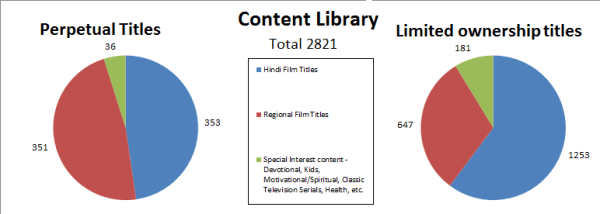
  • It has a content library of 2,900 titles with segments like Hindi Film Titles, Regional Film Titles and Special Interest Contents such as Kids documentary, devotional contents, etc. See Fig 1. This content is distributed and sold over TV, mobile, Internet, DTH, home entertainment and other media.
  • The leadership team is Buddhichand Maroo – Chairman and Raman Maroo – MD.
  • It has recently become a channel partner for Google’s You Tube and manages 32 channels.
JainMatrix Investments

Fig 1 – Content Library, JainMatrix Investments

Business and Industry Notes

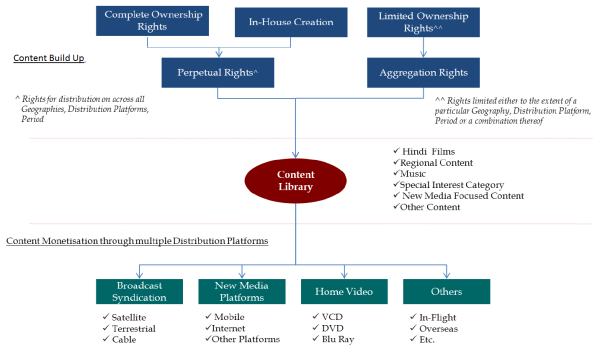
  • Shemaroo’s Media content library creation and distribution processes are mapped in Fig 2.
JainMatrix Investments

Fig 2 – Content Business Processes, JainMatrix Investments (source prospectus)

  • Shemaroo is engaged in aggregation, Production and Co-Production of Cinematograph Films, Dramas etc., and subsequently exploiting and distributing rights of Films, Dramas across the world through various medium such as television licensing, DVD and VCD release.
  • The company’s activities spans across content acquisition, value addition to content and content distribution. Apart from home video the company is providing content for partners such as –
    • Airtel digital television with an interactive devotional service, namely ‘iDarshan’
    • British Telecom’s (UK) IPTV service BT Vision for their South-Asian content pack and
    • Tata DOCOMO’s video platform for 3G services.
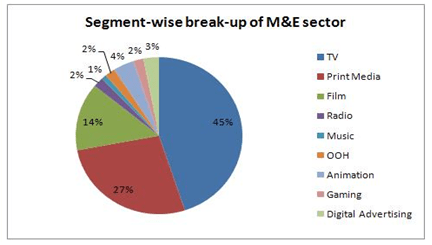
  • Industry Notes: The Indian Media and Entertainment (M&E) industry is one of the fastest growing industries in the country. The size of the Indian M&E sector increased to almost Rs 82,050 crore in 2012 from about Rs 72,840 crore in 2011, representing year-on-year growth of 12.6%.
  • This growth was driven by cable TV digitization, growth of regional media, continued strength of the filmed entertainment sector, fast increasing new media businesses and new levels of transparency.
  • The industry is projected to grow at a CAGR of 15% between 2012-17 to reach INR 1,66,100 crores.
  • The recent 74% FDI in broadcast may be a game-changer for M&E sector. Fig 3.
JainMatrix Investments

Fig 3 – M&E sector revenues in India, JainMatrix Investments   

Financials

  • The financials are described in Fig 4. We can see that it has grown rapidly in the last 5 years.
  • Revenues and EBITDA have grown 27% and 36% CAGR over last 5 years. But FY10 was a poor year for profits. In last 3 years Revenues, EBITDA, Profits and EPS are up by 19%, 13%, 12% & 14% CAGR.
  • The margins are fair with Operating and Profit margins at 24.7% and 10.2% for FY14.
  • The Cash Flow diagram Fig 5 shows that in the last two years, FCF has turned negative.
  • The company has been paying a token dividend of 5 percent since FY 2012.
JainMatrix Investments

Fig 4 – Financials, JainMatrix Investments

JainMatrix Investments

Fig 5 – Free Cash Flow, JainMatrix Investments  

Positives for the IPO and Shemaroo

  • M&E is one of the fastest growing industries in India. Demand is likely grow fast in the near future.
  • They say that in modern society, ‘Content is King’, and Shemaroo is a leader in content with its vast library of digital assets.
  • If Shemaroo is able to align with the right platforms and distribute its content well while keeping costs in check, there is a big demand for the uniquely Indian content with Indians, NRIs and Indophiles globally.
  • Shemaroo has grown at a good rate over the last 3-5 years.
  • Shemaroo’s tie up with Google Inc.’s You Tube puts it at the cutting edge of new technologies and quality distribution partners.
  • Their films like ‘Omkara’ and ‘Anuranan’ were awarded National Film Awards; the ‘Baghban’ DVD made by the company won the ‘Best DVD Creation for Telecine and Authoring Excellence’ award at the DVD Disc – Tech Awards.
  • Shemaroo is a good old Indian media brand and the firm has a fair reputation in the industry.
  • The equity market is doing well, and investor sentiments for IPOs are positive after the success of recent offering like Wonderla Holidays, Snowman Logistics and Sharda Cropchem.
  • Retail investors have been offered a 10% discount on the issue price.

Risks and Challenges

IP and legal issues:

  • The M&E industry has a lot of piracy and IP related challenges. Film related piracy is rampant with grey markets releasing movies very quickly after official launches. Numerous websites, and Peer-to-Peer content sharing sites like the Pirate Bay are rapidly distributing movies without charge, undermining the assets.
  • Shemaroo is an applicant for several trademarks, copyrights, and design patent applications, which are pending registration. A delay in, or failure to obtain, registration may result in company’s inability to adequately defend the Intellectual property rights (IPRs).
  • The legal and policing system are important for protection of Shemaroo assets. The legal system in India is slow and still has antiquated laws. This is a challenge for Shemaroo.
  • Criminal proceedings are pending against the Company. Any adverse order or direction in these cases could have adverse an impact on Company’s business and reputation.

Content Challenges: 

  • The revenues and profitability are linked to the growth and exploitation of the Content Library. Any failure to source new content could adversely affect profitability and business growth.
  • Every distribution platform /channel has to be evaluated for costs, revenues and security. Many platforms are avoided after such evaluation. Shemaroo can be adversely affected by rapid technological changes with respect to distribution platform.
  • Intensified competition may result in content cost escalation which may restrict company’s ability to access content at favorable terms. Direct competition in India is high from Hungama Digital and Moser Baer, which will limit Shemaroo’s ability to price its subscription higher.
  • Potential entry of Netflix into India. They are a very successful subscription model internet content provider successful in USA and elsewhere.
  • Changing consumer tastes can have the negative impact on the business of the company.

Financial Issues: 

  • Shemaroo’s inventories have risen to over ₹200 crore in 2013-14, which is a burden on the balance sheet. The piling inventories and high trade receivables have necessitated higher working-capital requirements for content acquisition.
  • Shemaroo has availed secured working capital / term loans of 101 cr and unsecured loans for 91 cr. This is a visible stress on the balance sheet of the company. Consolidated finance costs have ballooned to Rs 19.2 crores in FY14. This is high.
  • Shemaroo has not shared the revenue break up segments for last few years or growth rates of the same, in the Red Herring Prospectus.

Benchmarking

JainMatrix Investments

Fig 6 – Benchmarking, JainMatrix Investments

Shemaroo does not stand out from the peer group, and actually looks like it has low valuations.

Overall Opinion

  • We like the M&E industry and its potential, especially in new media. However the challenges here are tough with piracy, archaic laws and difficult implementation.
  • Shemaroo appears to have weak financials and balance sheet challenges.
  • Complexity of evaluating content assets and future costs and revenues of library.
  • Too many IP and legal issues as detailed earlier.
  • The IPO has been 0.28 times subscribed on the first day itself, mostly by Retail. This is not a very clear signal or sign of popularity.
  • Avoid this IPO.


Instead invest in the secondary market, where better information is available, with JainMatrix Investments that offers a high quality subscription based Investment service.

JainMatrix Knowledge Base:

See other useful reports. We have had wonderful success in our IPO/ FPO/ NFO reports.

Do you find this site useful?

  • Visit the SUBSCRIBE page to find how you can get more. Click LINK
  • Register Now to get our Free reports and much more, on the top right of this page, or by filling this Signup Form CLICK.

Disclaimer

This document has been prepared by JainMatrix Investments Bangalore (JM), and is meant for use by the recipient only as information and is not for circulation. This document is not to be reported or copied or made available to others without prior permission of JM. It should not be considered or taken as an offer to sell or a solicitation to buy or sell any security. The information contained in this report has been obtained from sources that are considered to be reliable. However, JM has not independently verified the accuracy or completeness of the same. Neither JM nor any of its affiliates, its directors or its employees accepts any responsibility of whatsoever nature for the information, statements and opinion given, made available or expressed herein or for any omission therein. Recipients of this report should be aware that past performance is not necessarily a guide to future performance and value of investments can go down as well. The suitability or otherwise of any investments will depend upon the recipient’s particular circumstances and, in case of doubt, advice should be sought from an independent expert/advisor. Either JM or its affiliates or its directors or its employees or its representatives or its clients or their relatives may have position(s), make market, act as principal or engage in transactions of securities of companies referred to in this report and they may have used the research material prior to publication. Any questions should be directed to the director of JainMatrix Investments at punit.jain@jainmatrix.com

JainMatrix Investments – September Updates

———————————————————————————————————-

Investment Notes

12th Sept 2014

Dear Investor,

The investment climate has certainly improved this quarter. At JainMatrix Investments, we can feel the changes, and our reports reflect this excitement:
  1. The IPO season has started; see our update on Snowman Logistics, An Update – Snowman in the Summer Sun?
  2. We have just created a research report on an exciting Mid Cap Consumer products firm. However this is subscriber restricted.
  3. We finally share our blockbuster report on Motherson Sumi Systems. If you had followed our advice on this, you would have gained 102% in 7 month. Here it is Motherson Sumi – Global Auto Ancillary GrowthLINK
  4. Do you play cards? Why is it that great investors are also good card player? See my thoughts
  5. Some excitement from the PM’s speech on I’day overflowed into the Mid Cap review – LINK
  6. We launched an Investor Rewards fortnight, with 7 quality reports, previously restricted to Subscribers – LINK
  7. We updated our Track Record on Aug 8th, to find our portfolios are doing very well, against their objectives –Report
  8. We shared our thoughts on The Real Estate Industry – LINK
  9. Everyone spends a lot of energy on a BUY decision, but when should you Sell your equity portfolio? See Article
Here’s hoping you learn a little bit, enjoy some more and profit a lot !!
Happy investing
Punit Jain

Do you find this site useful?

  • Visit the SUBSCRIBEpage to find how you can get more. Click LINK
  • Register Now to get our Free reports and much more, on the top right of this page, or by filling this Signup Form CLICK.
  • Visit and Like JainMatrix FB or Follow on JainMatrix Twitter for reports.

Disclosures and Disclaimer

  • This document has been prepared by JainMatrix Investments Bangalore (JM), and is meant for use by the recipient only as information and is not for circulation.
  • JM has been publishing equity research reports since Nov 2012.
  • This document is not to be reported or copied or made available to others without prior permission of JM. It should not be considered or taken as an offer to sell or a solicitation to buy or sell any security.
  • The information contained in this report has been obtained from sources that are considered to be reliable. However, JM has not independently verified the accuracy or completeness of the same.
  • Neither JM nor any of its affiliates, its directors or its employees accepts any responsibility of whatsoever nature for the information, statements and opinion given, made available or expressed herein or for any omission therein.
  • Recipients of this report should be aware that past performance is not necessarily a guide to future performance and value of investments can go down as well. The suitability or otherwise of any investments will depend upon the recipient’s particular circumstances and, in case of doubt, advice should be sought from an independent expert/advisor.
  • Any questions should be directed to the director of JainMatrix Investments at punit.jain@jainmatrix.com