Telecom: Auctions speak louder than words

The Indian Telecom sector these days is going through a couple of nerve racking events that I will call as ‘growing up pains’.

News Updates

  • 15thNov 2012: the Telecom 2G spectrum auctions closed, with 57% of spectrum unsold due to high minimum bid prices, poor industry conditions and availability of spectrum with the older players. An amount of Rs 9,400 crores were collected from 5 firms, against the target of 40,000 crores.  The winners were Vodaphone (14 circles), Idea (8), Telenor (6), Videocon (6) and Bharti Airtel (1).
  • 10th Oct 2012: The Parthasarathi Shome committee set up by the government said retrospective amendments in tax laws targeting overseas M&A of companies with assets in India, should be scrapped. The recommendation is expected to bring major relief to British telecom giant Vodafone in its dispute with the income-tax department.
  • 2nd Feb 2012: the Supreme Court cancelled the 122 licenses issued in Jan 2008 by former telecom minister A Raja. It also directed the TRAI to make fresh recommendations for the telecom spectrum auction in future.
  • 19th May 2010: The 3G auctions ends with resounding success. After intense bidding, the auction collected 68,000 crores from 7 private and 2 govt players, about double the initial target.

Analysis:

  • The limited success of the Nov’12 auctions will have a strong impact on telecom regulation in India. Hopefully the government/ regulators will turn their attention to improving the health of the industry, reducing friction, litigation and excessive controls and restrictions.
  • Auction will continue to be the method of handover of telecom licenses and spectrum in the future. The difference is that the reserve prices, and total income from auctions will reflect realistic telecom market conditions and industry health.
  • How the market has changed completely in the last 2.5 years. The sector has gone from:
Indian Telecom Industry - Stages, JainMatrix Investments

Indian Telecom Industry – Stages, JainMatrix Investments (Click to enlarge graphic)

Action Points:

  • Bharti Airtel, Idea, Tata Comm, Reliance Comm and MTNL are listed. Of the above five, we are positive on Bharti Airtel (find report) and Idea.
  • Vodaphone is likely to have an IPO in next 2-3 years.
  • Bharti Airtel may list a subsidiary, Bharti Infratel, which owns their telecom Towers.

JainMatrix Knowledge Base:

Other reports on Telecom

  • Bharti Airtel: This is a year of consolidation – REPORT
  • Indian Telecom at Cross-Roads – Article
  • Indian Equity – Winds of Change – Article

 Do you find this site useful? You can:

  1. Subscribe to be the first to receive new posts. Click on SUBSCRIBE
  2. Request for Email Updates. Enter your email on the ‘Email Updates’ box at the top right of this page.
  3. Or Click on this Signup Form CLICK
  4. Socialize with us – Like on Facebook or Visit on LinkedIn
  5. Add your comments/ queries below

Disclaimer:

These reports and documents have been prepared by JainMatrix Investments Ltd. They are not to be copied, reused or made available to others without prior permission of JainMatrix Investments. Any questions should be directed to the director of JainMatrix Investments at punit.jain@jainmatrix.com

Also see: https://jainmatrix.wordpress.com/disclaimer/

Hanung Toys – A Splashy Opportunity

_____________________________________________________________

Date: November 15, 2012                              

CMP: Rs 159                                     

Small Cap – Mkt Cap 399 crores

Hanung Toys & Textiles is a manufacturer / exporter of quality soft toys and home furnishings. With integrated facilities, an excellent clutch of customers and good brands, it has the ingredients for a great growth story.

But its been a volatile stock in the 6 years since the IPO. Is this a good time to invest in this stock?

To read this valuable report, you need to subscribe to JainMatrix Investments.

On this link, check the details and Subscribe to this website to receive valuable reports directly delivered to your Inbox.

This is an update of my report in Oct’11Hanung Toys – Look for the Rebound

Disclaimer

These reports and documents are prepared by JainMatrix Investments Ltd. They are not to be copied, reused or made available to others without prior permission of JainMatrix Investments. Any questions should be directed to the director of JainMatrix Investments at punit.jain@jainmatrix.com

Also see: https://jainmatrix.wordpress.com/disclaimer/

October report on ‘Bottom fishing in 2012’

——————————————————————————————————-

Date: 3-Oct-12

In Jan 2012, JainMatrix Investments published the report ‘Bottom fishing in 2012’. To read this now, click on LINK

The report indicated that: ‘A bottom is in place, and the price reversal has started‘; there is ‘a change in sentiment‘ and ‘a coordinated rise ’in the share prices. It suggested a portfolio of nine stocks for preferably SIP investment. They are Mid/ Small Caps with potential.

Nine months later, we will review this portfolio for investor gains – how has it performed?

Company

Report

Jan 17th

Review Feb 20th Gain/ Loss % Review

3rd Oct

Abs. Gain/ Loss % Sector Mkt Cap k Crores Find out more?
KEC International 49.1 61 24 72 47 Power M – 1.8 LINK
Yes Bank 285 364 28 398 40 Bank L – 14 LINK
Titan Industries 185 232 25 258 40 Consumer L – 23 LINK
BGR Energy Systems 229 339 48 279 22 Power M – 2.0 LINK
Binani Industries 121 124.1 2.5 132 9 Cement+ S – 0.4
Diamond Power Infra 111 138 24 119 7 Power S – 0.4
IRB Infrastructures 153 208 36 156 2 Infra M – 5.2 LINK
Hanung Toys & Textiles 128 140.6 10 124 -3 Consumer S – 0.3 LINK
Adani Port & SEZ 135 150.5 12 128 -5 Ports, SEZ L – 26 LINK
Average 23.2 17.5
NIFTY 4,967 5,564 12 5,722 15
Sensex 16,466 18,289 11 18,858 14
CNX Midcap 6,764 7,925 17.2 7,952 17.5 k – ‘000
BSE Small Cap 6,290 7,116 13.1 7,161 14 M-midcap

Observations:

  • Definitely the portfolio is up since Jan, and on average the shares have gained 17.5%!! It has outperformed all indices except the CNX Midcap, and is on par with this.
  • Investment in a SIP fashion from Jan’12, would give absolute gains of 10.4% so far, annualized to 16%.
  • Supporting this portfolio are new research reports for Adani Port and Yes Bank, included in above table.
  • The recent upturn in indices has helped as we bought earlier at lower levels. We continue to be optimistic of the prospects of this portfolio.

Suggestions and Risks:

  • This portfolio will appreciate, but invest with a minimum one year perspective.
  • This is an aggressive portfolio. Do not put all your eggs in one basket. Invest monthly in a SIP form.
  • Past performance is no indication of future results.

Additionally:

  • Some research reports are only available to Subscribers. Join up to receive actionable, high quality insights and recommendation for Equity investments. Boost your returns.
  • Spread the cheer. Share this letter with friends and fellow investors; invite them to also subscribe.
  • To subscribe, use this Signup Form CLICK or enter your email on the top right of this page.

Disclaimer:

These reports and documents are prepared by JainMatrix Investments Ltd. They are not to be copied, reused or made available to others without prior permissions; for any questions contact the director of JainMatrix Investments at punit.jain@jainmatrix.com. Also see: https://jainmatrix.wordpress.com/disclaimer/

Yes Bank: The Brave Warrior of Indian Banks

_____________________________________________________________

This report has been refreshed, read the latest April 2014 report Yes Bank – A Rediscovery

  • Date: September 12, 2012                               
  • CMP: Rs 333  Its a Large Cap with Mkt Cap Rs 11,833 cr               
  • Valuation: Today’s is Rs 414, available at 24% discount
  • Mar’14 target is 790 
  • Advice:  Buy now and systematically. 

Summary:

Key Reasons to Invest:

  • Aggressive growth (will continue in 35-45%), stable NIMs and profitablility
  • Investments in Retail and SME will provide next phase of expansion
  • Vision for 2015 is achievable and inspiring
  • The 14% fall since Mar ’12 gives an opportunity to invest at lower levels

Risks:

  • Global and India slowdown continues
  • Exposure to troubled sectors – Airlines, Power

This is an update of the Mar’12 Report by JainMatrix Investments – LINK

Yes Bank – Description and Profile

  • Yes Bank (YB) started in 2003, received the only New Bank license issued by RBI in 15 years.
  • Leaders are Rana Kapoor, Founder, MD & CEO and Aalok Gupta, EVP & Country Head- Retail
  • Promoter stake is 26%; other shareholders are FIIs 43%, MFs/ DII 14%, Individual – Retail /HNI 9.5%, Bodies Corporate/etc. 7.5%.
  • The firm has 4,875 employees; branches doubled in 1.5 years to 380 in 275 cities, with 650 ATMs.
  • Market cap is at 9,300 crores, putting it at #12 among Indian banks, and #7 in private sector.
Yes Bank - Growth Parameters, JainMatrix Investments

Fig 1 – Yes Bank – Growth Parameters, JainMatrix Investments (click any graphic to enlarge)

Superior Strategies and Execution

  • YB has a Vision 2015 (Version 2.0) which is an inspiring combination of soft and hard targets – “The Best Quality Bank of the World in India”; and 900 Branches, 12,750 employees, 2000 ATMs, Advances –`100,000 cr., Deposit base –`125,000 cr. and Balance Sheet –`150,000 cr. (as of now).
  • Seasoned, capable bankers in the Management team provide stability.
  • The focus is on Retail and SME banking involves growth in branches and investments in Sales and retail products. Recent deregulation of Savings Account interest rates allowed YB to introduce highest rates of 7%. The CASA is up from 10% in March ‘10 to15% by March ’12. Fig 1,
  • The firm rapidly enters high potential sectors for advisory, loan and banking services, with a Knowledge based approach to lending. Advances grew 45% CAGR in 4 years (industry growth 22%). With this approach, YB is pretty much The Brave Warrior of Indian Banks.
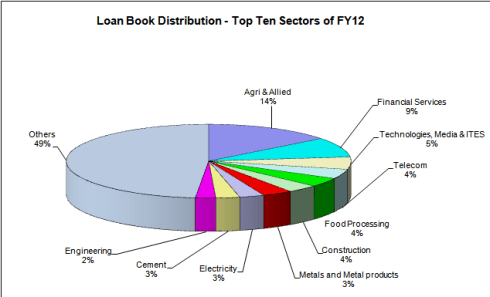
  • The Loan Book is well diversified, and the banks credit exposure to sensitive sector (due to asset price fluctuation) like capital markets, real estate, power, iron & steel and textiles are below the industry average. Here is a view of the top ten sectors as part of the Loan Book Distribution, Fig 2.
Yes Bank, Loan Book Distribution, JainMatrix Investments

Fig 2 – Yes Bank, Loan Book Distribution, JainMatrix Investments, (click any graphic to enlarge)


  •  In business development, mistakes are made, but YB learns from these, and exits fast (example – in 2007, the category of foreign exchange derivative products sold to SMEs turned loss making. There were litigations against YB (and several other banks too). These are now resolved.
  • Growth will be organic as executives feel that organic growth costs less compared to available assets


Industry Note

  • Scheduled Banks in India are Public Sector (27), Private Old (22), Private New (8) and Foreign (38).
  • Total number of (scheduled bank) savings accounts was 12.1 crore in 2011. But 80% are inactive, giving 2.4 cr. active accounts. The gross penetration is 10%, and active accounts penetration is 2%. Thus India is underbanked. (RBI data).
  • The FY12 credit growth of Indian banks was in line with the RBI projection of 16%.
  • Market share in savings accounts of banks dropped – SBI/associates (30.3 to 29.2%), other nation-alized banks (49 to 47.8%), foreign (5.8 to 5.2%), but Private banks grew (14.9 to 17.8%) by FY12.
  • The global Basel III requirements require banks to hold top quality capital equal to 7% of their assets adjusted for risk, will be phased in between 2013 and 2019. Aimed at improving financial stability and avoiding a repeat of the crisis of 2008, they will increase the cost of capital for banks.
  • Channels: By 2011, there were 93,800 ATMs in India, about 70% of them in Metro/ urban locations. Mobile banking is also an important banking channel, due to penetration of smartphones and 3G.

Stock Evaluation, Performance and Returns

  • YB had its IPO in July’05 priced at Rs 45. It was 31 times oversubscribed. At CMP of Rs 333 today, the stock has given a 28.5% CAGR return since IPO.
Yes Bank, Price Trend, JainMatrix Investments

Fig 3 – Yes Bank, Price Trend, JainMatrix Investments

  • The share has risen well, but is volatile. After IPO, price rose to 277 in early 2008, fell to 41 in Mar ’09 and peaked at 389 in Mar ’12. Today, it is 14% below this peak price. See Fig 3.
  • EPS has grown at 59.5% CAGR over 5 years, Fig 4.
Yes Bank - Quarterly Income and EPS, JainMatrix Investments

Fig 4 – Yes Bank – Quarterly Income and EPS, JainMatrix Investments

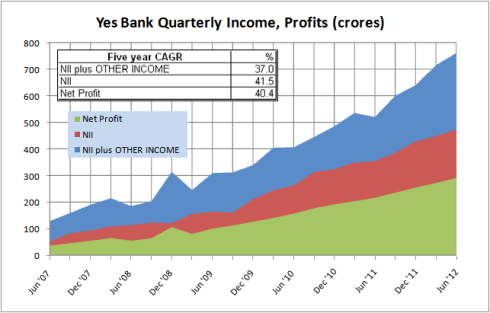
  • Quarterly Income and Profit too have grown rapidly (Fig 5), with NII + Other Income, NII and Net Profit growing at 46.5%, 57.4% and 59.6% CAGR over the last 5 years.
Yes Bank, Quarterly Income Profit, JainMatrix Investments

Fig 5 – Yes Bank, Quarterly Income Profit, JainMatrix Investments

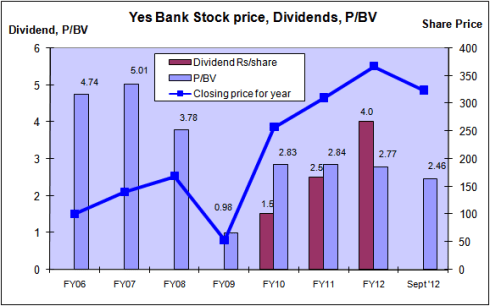
  • The maiden dividend of Rs 1.5 was paid in 2010. Thereafter dividend has shown a steady increase.
  • The P/B ratio has fallen over 6 years, in spite of price rise, due to rapid growth in Book Value, Fig 6.
Yes Bank - Price, Dividends, BookValue, JainMatrix Investments

Fig 6 – Yes Bank – Price, Dividends, BookValue, JainMatrix Investments

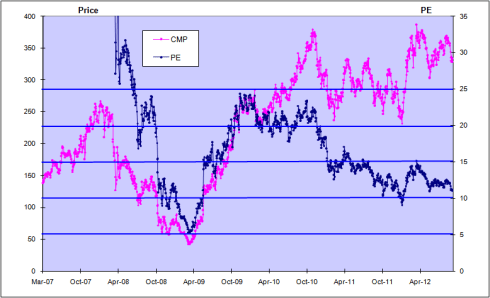
  • Price and PE chart Fig 7, shows that average PE has been 15, while the PE range has been between 5 and 25. PE today is 11.2 and clearly in the ‘below average’ quartile. This PE fall has happened in spite of earnings growth, Fig 8.
Yes Bank, Price and PE Chart, JainMatrix Investments

Fig 7 – Yes Bank, Price and PE Chart, JainMatrix Investments

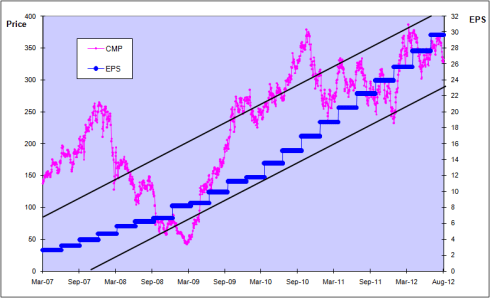
  • Price and EPS quarterly graph, Fig 8, shows that EPS growth has been improving. The Share Price has been roughly following EPS. We expect the EPS of YB to stay within the channel in Fig 8.
Yes Bank, Price and EPS Chart, JainMatrix Investments

Fig 8 – Yes Bank, Price and EPS Chart, JainMatrix Investments

  • NIM has been between 2.7-3.2% over the past 5 years. This is low by industry standards as CASA is low. Capital Adequacy is at 16.5%, which is good.
  • Gross & Net NPA are at 0.28% & 0.06%, among the lowest NPA levels in the industry.
  • ROE and RONW are between 20-24% in FY12, which is excellent.
  • Beta of the stock is 1.61 (Reuters) indicating high volatility.
  • PEG is at 0.33 – indicates safety and great value.

Benchmarking and Financial Projections

In a benchmarking exercise, we compare YB with 3 firms in the same or related industry, Table 9.

Yes Bank, Benchmarking Aanalysis, JainMatrix Investments

Table 9 – Yes Bank, Benchmarking Analysis, JainMatrix Investments

  • Conclusions: Compared to peer Banks, YB holds its own on most parameters. YB looks particularly strong on EBITDA and Profit per employee ratios indicating high productivity.
  • Bajaj Finance has the flexibility of an NBFC, and has performed better on many parameters. See Research Report on Bajaj Finance.

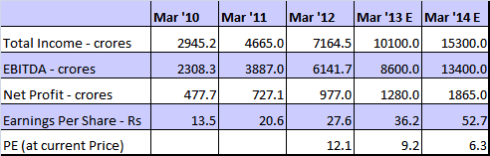
In a Financial projections exercise, we project YB financials till FY 2014, See table 10.

Yes Bank - Financial Projections, JainMatrix Investments

Table 10 – Yes Bank – Financial Projections, JainMatrix Investments

Risks:

  • Current Economic and Government data indicate a slowdown across industry, a rising govt fiscal deficit, current account deficit, and weak rupee. Further, oil prices are high and other commodity prices are falling. Decision-making is slowing in the government, as past decisions are being revisited in Telecom and Coal. These point to a slowdown that can affect YB.
    • YB will continue to lead on performance parameters. But if there is a sector slowdown, the performance will be affected. The poor Indian economic data if seen in the context of an international slowdown, suddenly looks better than many other countries. Currently the Indian market indices are holding up well due to FII confidence and fund inflows. So there may be a cushion to the fall in Indian Indices.
  • YB is an aggressive player that enters new potential sectors and can make mistakes that can affect the overall brand. These can impact sentiment and valuations.
  • Infrastructure woes: Ratio of Non-fund based exposure to Power Sector to net worth is high at 49% (Macquarie Research). This sector while critical for the India growth, is in a stressed condition, and awaiting government driven systemic improvements. Also exposure to troubled Airline sector. Airline companies owe RS 770 Cr to YB.
    • The Loan Book details in Fig 2 and the calibrated approach to loans exposure build confidence that YB has a safer approach than industry.

Opinion, Outlook and Recommendation

  • India is underbanked. There is potential for Banks to invest in new sectors and stimulate industry growth. In Retail, the consumption play is bank accounts, personal/housing loans, credit cards, etc.
  • The banking industry is also a proxy to the overall economy, and one can expect, as a thumb rule, the industry to grow at 2-3 times the GDP growth. The Indian economy is well placed to grow at 6-9% per annum over the next decade. Basis this, the Banking sector will grow at 15-24% p.a.
  • YB is well placed to exploit the trend of Private sector growing faster than PSBs, and its own growth rate will be superior to the peers. The strategies followed and good execution means that the growth will continue to be in the 35-45% range for the next 3 years.
  • The recent price fall of 14% since the peak in Mar ’12 provides an opportunity to invest in YB.
  • The share price is currently poised at its 200 DMA of 333. The expectation is that it will take support at these levels before rising higher.
  • The valuation and projection/ targets for YB are:
    • Current valuation is of 414, indicating it is available at a 24% discount at CMP
    • The target for March ‘14 is 790 (a 137% appreciation)
  • YB will continue on the path of solid stock performance and dividends over the next decade. Invest now and systematically to gain for the long-term.

JainMatrix Knowledge Base

See other useful reports

Disclosure: It is safe to assume that if the JainMatrix website recommends a stock, the researcher has already invested in it.

Do you find this site useful? You can:

  1. Subscribe to be the first to receive new posts. Click on SUBSCRIBE
  2. Request for Email Updates. Enter your email on the ‘Email Updates’ box at the top right of this page.
  3. Or Click on this Signup Form CLICK
  4. Socialize with us – Like on Facebook or Visit on LinkedIn

Disclaimer:

These reports and documents have been prepared by JainMatrix Investments Ltd. They are not to be copied, reused or made available to others without prior permission of JainMatrix Investments. Any questions should be directed to the director of JainMatrix Investments at punit.j@jainmatrix.com .  Also see: https://jainmatrix.wordpress.com/disclaimer/

Consult your financial planner for deciding about your investment funds.

Gold, Apple and a Coal Monopoly

————————————————————————————————————

Gold is all charged up ….. again !! 

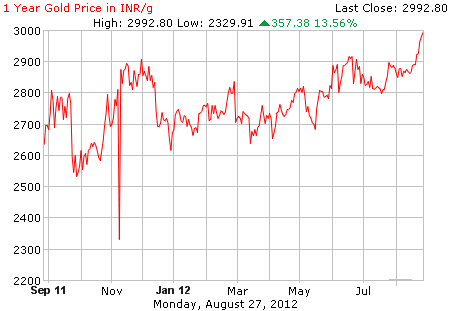
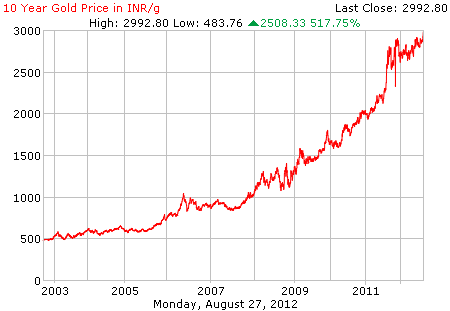
  • After some steadiness in the last 6 months, Gold prices are rising sharply once again, see graphs:
Gold Prices, 1 year, JainMatrix Investments

Fig 1 – Gold Prices, 1 year, JainMatrix Investments

  • The Gold Price has broken above 2900 after several attempts.
  • Over the last 10 years, the price path is an accelerating rise.
Gold Prices, 10 year, JainMatrix Investments

Fig 2 – Gold Prices, 10 year, JainMatrix Investments

  • Fundamental strength in Gold comes from worldwide demand by Consumers, Central Banks and investors. Supply will only increase 4% in 2012.
  • Reports claim that demand in India has fallen, and Indian gold imports in Q2 2012 plunged 56% to 131 tonnes (source World Gold Council). However, this is official data, and news reports on customs hauls indicate that of late unofficial import channels (smuggling) is up.
  • Part of the gold appreciation in India has been due to INR weakening against the USD. Its possible that the big INR slide of 2012 can be arrested if inflation and current account deficits are tamed over the next one-year.
  • Having said this, the economic/ debt troubles of USA and Europe are still at large. This strengthens the gold case.
  • Gold prices may rise sharply in the next 1-2 years, I feel. Then the global economy may truly start recovery, and there will be better avenues for cash, so price graphs may flatten or even fall.
  • You can read an article of mine – Gold as an Investment
  • My preferred investment mode is Gold ETFs. Selling is easier and cheaper.

Apple V/s Rest of World

  • Apple’s just won a case in the US courts over Samsung. The case was over copying of patented technologies, shape, size and user navigation aspects. Both Apple and Samsung accused each other of infringements.
  • Apple won, and was awarded over $1 billion in damages. More importantly, Samsung may be restricted in selling its products in some regions. Samsung is also a proxy for Google and its Android operating system. So the loss may have wider ramifications for other Android based producers of mobile phones. Of course, Samsung is appealing in the Supreme Court.
  • It’s an amazingly complex subject, IP and patents protection. But somewhere in these legal battles, common sense is being lost. How can a consumer design aspect be patented? It is only technologies that can be either open source or patented. So any unique new technology that Apple’s R&D has created – wireless, software code, application, sync tool, etc. should not be copied or built upon, competition has to redevelop in order to match features.
  • But a shape, color, design or navigation feature that is consumer and visible to all may be popular, and can become a standard and be copied. As long as Samsung sells the product by prominently branding it as Samsung, it cannot be mistaken as an Apple. In consumer products, the product developer only has the advantage of being first in the market, nothing more.
  • Lets see if better sense prevails, or Apple wins again and gobbles up the global mobile phone market :-)

Coal India and the Coal Monopoly

  • India’s rapid economic strides in recent times are attributed to the opening up of the economy and dismantling of the license and permit Raj. Conversely, the negative effects of this Raj, even today, are apparent in a sector not yet opened up, of Coal.
  • Ever since coal nationalization in 1973, Coal India has a monopoly over mining of coal. It also lords over India’s coal riches, and with estimated reserves of over 200 billion tons, India has the world’s third-largest reserves.
  • What have we actually got from this monopoly?
    • A 5% per annum growth in Coal production over the last decade. At a time when power demand is galloping at 10-12 %. The result is expensive Coal imports and stressed power production assets working below capacity. See graph 3.
    • Coalgate – an issue that is rocking Parliament as of now, as political parties blame each other for essentially the inefficiencies of Coal India.
Coal Production in India, JainMatrix Investments

Fig 3 – Coal Production in India, JainMatrix Investments

  • In today’s times, the monopoly of Coal India has outlived its usefulness. Coal mines and mining in India are no longer an issue of national importance to be protected by PSU ring fencing. In fact they are an inefficient and poor utiliser of these assets.
  • Private firms are quite capable of mining coal. Many have already been allotted mines.
  • Coal India needs to be broken up, perhaps like the breakup of the telegraph giant in USA AT&T into Baby Bells. This ushered in a telecom revolution in USA over decades after 1984.
  • The breakup of CIL should be followed by a lifting of monopoly, opening up to the private sector and a re-listing of the breakup Coal PSUs.
  • This will be easier as CIL is a holding company with seven coal producing subsidiaries and a mine planning and consultancy company.
  • Coal pricing should be based on open market and eAuctions mode. Let the real aspects like coal quality, logistics, demand and supply decide coal prices. Market forces will provide answers, and drive improvements.
  • A Coal sector regulator needs to be set up that oversees the CIL breakup, pricing deregulation, opening up to the private sector, R&D and technology improvements in the sector and environmental oversight.

JainMatrix Knowledge Base:

See other useful reports

Hindalco – a Freshly Wrapped Opportunity

Date: June 12, 2012      CMP: 121      Mkt Cap: 23,300 crore      P/E: 8.44 times

Hindalco has built a substantial integrated global business in Aluminium and Copper. Consolidated Revenues, EBITDA and PAT have gained by 38%, 22% and 14.4% CAGR over 7 years. Debt has been reduced; the share price is reversing now from a 15-month fall. The P/E is at the lower end of a 7-year range. Copper business is profitable and Aluminium is on a recovery. Advice: Invest for the long term

Hindalco (HC), the flagship of the Aditya Birla group, makes Aluminium (Al) & Copper (Cu).

Business Snapshot:

  • The consolidated turnover is 71k cr, profits 2,900 cr (FY11). Promoters hold 41.8%.
  • Subsidiaries are Novelis Inc., USA, Birla Copper and Aditya Birla Minerals; just 33% revenues are from standalone HC. It has 19,000 employees, and a global footprint in 13 countries.
  • Most products are B2B, and the brands include Freshwrapp aluminium foil, Everlast aluminium roofing sheets, Freshpakk semi-rigid containers
  • Al operations extend across bauxite mining, metal production (alumina refining, Al smelting) rolling, extrusions, foils (value added products), recycling, plus captive power plants and coal mines. The Cu unit produces copper cathodes, rods and by-products such as gold, silver and DAP fertilizers.

Lets do a quick analysis of this stock to see where it’s heading.

Pricing Snapshot

Hindalco Share Price, JainMatrix Investments

Fig1 – Hindalco Share Price, JainMatrix Investments

A 7-year view of the share price of HC shows us:

  • Share price has risen by 1% CAGR over the last 7 years – so it is mostly flat.
  • The share has been very volatile, as from a high of 221 in May ‘06; it fell to 38 in March ’09 to an all time high of 251 in Jan 2011. Today’s price is 121. HC has a Beta of 1.59 (per BSE), so on average a fall in Sensex results in a 60% greater fall in HC; conversely a rise will see HC rise more.

Commodities Pricing

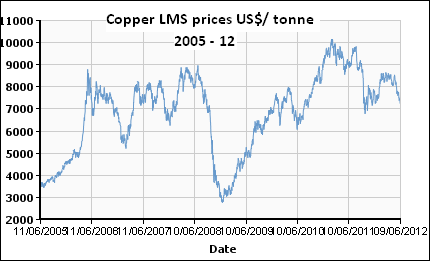
  • Al and Cu are global commodities, and prices are set by LME. See prices range in Table. Al and Cu businesses are cyclical in nature, so the industries go through periods of booms and busts.
  • For HC, the Al business is dependant on LME price while Cu is quite independent, as it is a ‘pass through LME’ business. So, the businesses complement each other and reduce overall volatility.
  • The Al market expert opinion is that at $2000/tonne, the LME price matches the global average cost of production. If price falls below this, many units will stop production, squeezing supply and soon raising prices. So this may be a floor on the price.
Copper Prices, JainMatrix Investments

Fig 2 – Copper prices, 2005-12 Aluminium prices, JainMatrix InvestmentsFig3 – Aluminium prices, 2005-12

Opportunities and Concerns

Opportunities

  • The ’07 acquisition of Novelis involved substantial debt. However good cash flow and prudent debt handling means that DE has fallen from 1.9 in ’08 to 0.95 in ’11.
  • Al consumption in India is 1/10 the global average, and is expected to grow rapidly.
  • In Jan‘12, Novelis renewed an agreement with Coca-Cola Bottlers’ Company for supply of aluminium can sheet for the latter’s beverage can producers in North America. This is very positive as previous litigations are resolved, the pricing is linked to LME and substantial revenues are visible.
Concerns
  • Rising Coal prices, particularly due to price increases from Coal India.
    • To some extent, the coal prices in India will rise, as they are broadly lower than global prices
  • The share price of HC has fallen in 15 months from a high in Jan ’11, by 52%.
    • However the share price fell to 105 by May 23 ‘12. From this level price has recovered by 15% till today, and risen past the 20 and 50 DMA. (200 DMA is at 131).
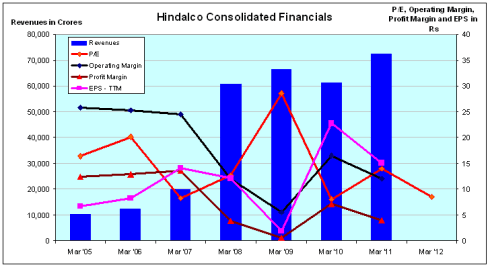
Hindalco Consolidated Financials, JainMatrix Investments

Fig4 – Hindalco Consolidated Financials, JainMatrix Investments

Financial Snapshot

  • Consolidated Revenues, EBITDA and EPS have gained by 38%, 22% and 14.4% CAGR over 7 years. See Fig 4.
  • P/E has moved in a range of 8-29 times in this period, and is currently at 8.4 times, near lower end.
  • Dividend has been steady at 150% or Rs 1.5, indicating a dividend yields of 1.24%.
  • PEG is at 0.59 – indicates an undervalued stock.

Conclusions

  • HC is a buy at these levels, as:
    • There is substantial growth in revenue and profits. Cu business is profitable. Al business appears to have bottomed out.
    • The Price appears to be recovering from an excessive fall over 15 months.
  • Cautious Investors can watch out for June 27 HC Consolidated FY12 results to confirm bullish expectations. Also watch for a price rise above 131 to move to bullish territory.

JainMatrix Knowledge Base:

See other useful reports


Do you find this site useful?

Visit the SUBSCRIBE  page to find how you can get more. Click LINK

Add your comments/ queries below

Disclaimer:

These reports and documents have been prepared by JainMatrix Investments Ltd. They are not to be copied, reused or made available to others without prior permission of JainMatrix Investments. Any questions should be directed to the director of JainMatrix Investments at punit.jain@jainmatrix.com
Also see: https://jainmatrix.wordpress.com/disclaimer/

Consumer Sector – Who leads the FMCG pack?

Date: June 7, 2012

The comparison of four leading FMCG / Consumer stocks, ITC, HUL, Godrej Consumer and Asian Paints throws up some interesting insights. ITC is keeping up excellent margins while investing in 4-5 newer areas beyond cigarettes. HUL has the best brands, but is seeing growth constraints. Asian Paints is a dominator in Paints and has good international presence. But the surprise packet is from the smallest player. Godrej Consumer is growing through acquisitions and international business, and has the best financials. 

Introduction

This research looks at four firms from the FMCG sector and finds out the best for the long-term investor. In this report, we research two blue chips, Hindustan Unilever, the FMCG bellwether, and ITC, which is a conglomerate, but mostly a cigarette firm. And also two large caps, Godrej Consumer and Asian Paints.  (They will be referred to as HUL, ITC, GC and AP).

Five Year Snapshot of Key Financials

Let us first look at a 5-year snapshot of financials of the firms. This can give us good visual feel of the relative and absolute financials of the firms.

Hindustan Unilever:

Business Snapshot:

  • The Indian subsidiary of Unilever is 52.5% owned by parent firm.
  • Business can be classified as Foods, Personal care and Home care. Major Brands include Lux, Lifebuoy, Surf, Rin, Wheel, Fair & Lovely, Pond’s, Lakmé, Pepsodent, Closeup, Axe, Brooke Bond, etc.
  • The 16,000 Indian employees manage 2,000 suppliers and 2,900 stockists to ensure product distribution and direct coverage of 15 lakh Retail outlets and indirect coverage of another 64 lakh.
  • Business is a function of population penetration and affluence and is growing faster in rural areas.
HUL Financials, JainMatrix Investments

Fig 1 – HUL Financials, JainMatrix Investments, Click to enlarge image

Financial Snapshot

  • Revenues, EBITDA and PAT have gained by 8%, 26% and 7% CAGR over 5 years.
  • P/E has moved in a range of 17-33 times. Current P/E is at 32.4 times.
  • Operating margins are excellent at 27%. Profit margins are flat at 12%.
  • Dividend has been increased to 750%, or Rs 7.5, indicating a dividend yield of 1.8%.
  • PEG is at 4.1 – indicates clearly overvalued status.

ITC Ltd

Business Snapshot:

  • The firm is owned by Indian Institutions, who hold 52% of the firm.
  • Business segments in ’11 were Cigarettes 44%, FMCG 18%, Agri 20%, Paper/ Packaging 14% and hotels 4%.
  • Dominates Indian Cigarettes market, with a reach of 2 million outlets.
  • Attempting to diversify from cigarettes into other segments.
ITC Financials, JainMatrix Investments

Fig 2 – ITC Financials, JainMatrix Investments, Click to enlarge image

Financial Snapshot

  • Revenues, EBITDA and PAT have gained by 15%, 22% and 19% CAGR over 5 years.
  • P/E has moved in a range of 15-31 times. Current P/E is at 29 times.
  • Operating margins and Profit margins are superior at 43% and 23%.
  • Dividend has been increased to 450%, or Rs 4.5, indicating a dividend yield of 1.9%.
  • PEG is at 1.54 – indicates somewhat overvalued status.

Godrej Consumer 

Business Snapshot:

  • The promoter group Godrej owns 64% of GC.
  • It has Household and Personal Care Products brands like Good Knight, Cinthol, Godrej No1, etc.
  • The revenues by categories are Personal Wash 22%, Hair Care 19%, Home care 47% and Others 12%.
  • Growth has been organic, as well as by acquisition, in India as well as Internationally. GC has international operations in Europe, Australia, Canada, Africa and the Middle East.
Fig 3 - GodrejConsumer Financials, JainMatrix Investments

Fig 3 – GodrejConsumer Financials, JainMatrix Investments

Financial Snapshot

  • Revenues, EBITDA and PAT have gained by 45%, 55% and 47% CAGR over 5 years.
  • P/E has moved in a range of 20-27 times. Current P/E is at 26 times.
  • Operating margins and Profit margins are good at 26% and 15%.
  • Dividend has been increased to 475%, or Rs 4.75, indicating a dividend yield of 0.82%.
  • PEG is at 0.55 – indicates attractive undervalued status.

Asian Paints:

Business Snapshot:

  • The promoter group of Choksi, Dani, etc. own 53% of AP.
  • Group operations are in 17 countries with consumers in 65, through JVs and subsidiaries.
  • Major Product Segments are Automotive, Home, Industrial and Paint related Services.
Asian Paints Financials, JainMatrix Investments

Fig 4 – Asian Paints Financials, JainMatrix Investments

Detailed Comparison

Next we will look at a detailed comparison of the firms in terms of valuation, growth characteristics, debt, shareholding pattern, etc.

Comparison Table, JainMatrix Investments

Fig 5 – Comparison Table, JainMatrix Investments

We can see from this analysis that on 5 important parameters:

  • Valuation – ITC is the cheapest, AP the most expensive
  • Growth – GC leads on Sales and Profits
  • Management effectiveness – HUL leads
  • Solvency and Margins – ITC clearly leads, as debt is low across the sector.
  • Market performance – AP and GC split the honors

The Decision Table:

We compare the 5-year CAGR growth across key parameters: (Price, PE and Mkt Cap are of June 6, ‘12)

Sector Decision Table, JainMatrix Investments

Fig 6 – Sector Decision Table, JainMatrix Investments

Conclusions:

1.       Among Large Caps, ITC is better

  • ITC leads HUL, as ITC has superior Operating and profit margins. In terms of valuation, ITC is cheaper. Also on margins, it is better. HUL is superior on Management effectiveness.
  • ITC leads on the 5-year growth on financials.
  • ITC dominates cigarettes and commands great margins here. It has been using this to invest in an array of new growth sectors, this is bearing fruit and will drive future performance.

2.       Among the mid-large caps Godrej Consumer is better

  • GC leads over AP because: While GC and AP share honors for market performance, but on all other parameters, GC leads AP – Operating & Profit Margins, Lower valuations and Revenue, EBITDA, PAT & EPS growth.
  • GC has a smaller market cap than AP, about half. GC is present in many more product categories, and has far more room to grow.

JainMatrix Knowledge Base:

See other useful reports

Disclosure: It is safe to assume that if the JainMatrix website recommends a stock, the researcher has already invested in it.

Do you find this site useful? You can:

  1. Visit the SUBSCRIBE  page to find how you can get more. Click LINK
  2. Add your comments/ queries below