Adani Port: Infra play at good valuations V2

See the Sept 2012 update called ‘Adani Port – The Great Australian Adventure’ at LINK

  •  Date: May 30, 2012. Price: Rs 118, Large Cap with market cap of 23,600 crores
  • Advice: Medium Risk, High Gain stock at attractive entry point. Buy systematically.
  • JainMatrix valuation for Adani Port is 147, a 25% discount to CMP. Target: 181 by 04/13, and 231 by 04/14

Adani’s Mundra Port is the #1 private and #4 overall port in India. Growth has been rapid, with Sales up by 32%, Profits 53% and EPS 49% CAGR over 5 years. Debt Equity is 1.18 times. The recent $2b acquisition of Abbot Point Port Australia will double the scope of operations. While uncertainty exists about the viability and returns from this, it facilitates coal imports into India, demand for which is expected to soar. A recent dip in price makes valuations attractive. Investors can hold on and even look at this fall as an opportunity to invest.  

Adani Port – Description and Profile

  • Adani Port and SEZ (APSEZ), formerly Mundra, is a Gujarat based firm with FY12 revenues of 2500cr and PAT 1177cr (standalone).  Consolidated revenue is 3209cr.
  • Promoted by Adani Group, its businesses include Mundra, India’s largest private port with volumes of 64 MT (FY12), several Ports operating contracts, Australian operations and an SEZ area adjacent to the port, which is being developed on an area around 18,000 acres. Market share of APSEZ increased to 16.4% (FY12) from 14%.
  • APSEZ trades in a broad range of products, implying lower business risks. Fig 1.
  • It is # 4 among all Indian ports, and #1 in terms of private ports in India.
Adani Port Product Profile - JainMatrix Investments

Fig 1 – Adani Port Product Profile – JainMatrix Investments – Click to enlarge

  • Being a private port, APSEZ is free to price its services, unlike PSU ports in India.
  • It has ‘take or pay’ arrangements with many of the customers. This protects APSEZ from sudden drops in demand.
  • Connectivity and logistical facilities connect the Port, berthing and storage facilities to Roads, Rail, Airstrip and Pipelines for goods transportation.
APSEZ Port Cargo Volumes - JainMatrix Investments

Fig 2 – Cargo Volumes – JainMatrix Investments

  • The port has added a specialized passenger car exporting facility. A Power plant being set up by Adani group will cater to internal demand.
  • The SEZ facility enjoys a series of Indirect and Direct Tax benefits designed to encourage industrialization by the Gujarat Government.
  • The Shareholding pattern is Promoter group 77.5%, MFs/ DII 4.9%, FIIs 10.2%, Individuals retail & HNI 3.7% and Bodies Corporate + others 3.7%.
  • It’s good that Promoter holding is high. But as per delisting norms, they may need to reduce to 75% in the next year or so.
  • Adani group has cross-holdings in Adani Power, Adani Enterprises and APSEZ.
  • The SEZ area is organized into clusters to cater to different Industrial groups.

Events, News and Strategies executed

  • The port has rapidly increased business throughput over the last 5 years, venturing into new categories of goods, and working closely with importers and exporters to improve infrastructure.
APSEZ - Sales and Profits - JainMatrix Investments

Fig 3 – APSEZ – Sales and Profits – JainMatrix Investments – Click to enlarge

  • Over the last 5 years growth has been rapid, with Sales by 32%, Profits 53% and EPS 49% CAGR.
  • The margins have been steady, see Fig 3 – Operating Margins (70%) and PAT Margins (50%).
  • APSEZ and Adani group bought the Abbot Point coal terminal in May last year for $2 billion. It is synergistic with Adani’s purchase of Linc Energy’s Galilee coal project for $2.7bn in August 2010. The coal terminal, of capacity 50 MT a year, will facilitate the transport of coal from Australian mines to India.
  • It is also developing ports at Hazira, Mormugao, Visakhapatnam and Kandla in India and Dudgeon Point in Australia, in terms of terminal creation or port operator.
  • Vision – to increase the annual cargo handling capacity to 200 MMT by 2020.

Industry Note:

  • Seaports are critical to India’s growth and development, as over 80% of imports/ exports have to take this route. The 6-9% GDP growth in India is now testing the capacities of Indian ports. Also govt. ports so far have been unable to scale up and expand much, due to vision and execution constraints.
  • Major competition to APSEZ is from Kandla, JNPT and Pipavav on the Western shores. Mundra is able to provide port access to Gujarat, Maharashtra and North India based industry.
  • Kandla, JNPT and other govt. ports have not invested sufficiently in infrastructure due to government constraints. Pipavav is at an early stage of development. Also it is in South Gujarat and logistically more remote.
Mundra Port and SEZ

Chart 4 – Map of Mundra, Kandla and Pipavav Ports

  • Pipavav Port in Gujarat is owned by A.P. Moller-Maersk Group, is one of the largest container terminal operators in the world. Over the next few years, APM Terminals will transfer a lot of India business from other ports to Pipavav, and also build good infrastructure here.

Stock Valuation, Performance and Returns

  • The IPO in Nov 2007 was very successful. It was oversubscribed 115 times, and provided listing gains. However it was aggressively priced.
APSEZ - Investment and Dividends - JainMatrix Investments

Fig 5 – APSEZ – Investment and Dividends – JainMatrix Investments

  • The share price has fallen from a post IPO high of 264 to a low of 50 in Nov 2008, a recent high of 185 in Oct 2010, to today’s 118.
  • IPO investors have seen a 5% CAGR return in price in 5 years, see Fig 5.
  • The Dividend too has increased steadily, till the current 50% – Re 1 on FV Rs 2.
  • Debt-equity is 1.18 on Mar’12 (down from 2.7 at IPO time). This is good, for an infra company.
  • For an infra company, cash is critical. APSEZ has improved Cash flow from operations at 44% and EPS (adjusted) 48% CAGR in recent years, see Fig 6.
APSEZ - Cash Flow, EPS, DE - JainMatrix Investments

Fig 6 – APSEZ – Cash Flow, EPS, D/E – JainMatrix Investments – Click to enlarge

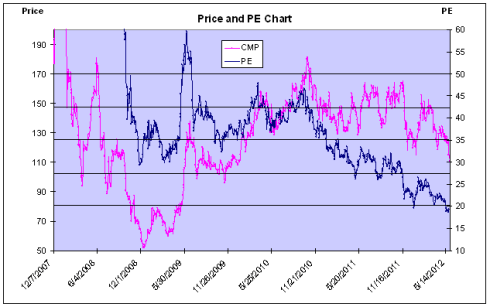
  • The PE range has been 20-50 times over the last 5 years. Current PE of 21 is at the low end of this range.
APSEZ - Price and PE Chart - JainMatrix Investments

Fig 7 – APSEZ – Price and PE Chart – JainMatrix Investments – Click to enlarge

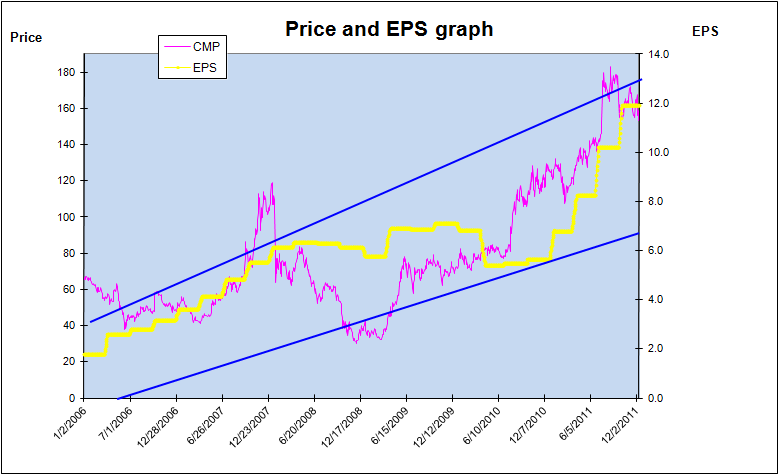
  • Fig 8 plots the market price against the adjusted EPS over a 5-year period.
  • EPS shows us a steady quarterly increase indicating stable business performance.
APSEZ - Price and EPS Chart - JainMatrix Investments

Fig 8 – APSEZ – Price and EPS Chart – JainMatrix Investments

  • Healthy return Ratios – Return on Capital employed, ROCE is 14.6%; Return on Equity, ROE is 23%
  • PEG is in the range of 0.43, indicating indicates safety and undervalued status

Peer Benchmarking and Financial Projections

We have compared APSEZ with leading listed Peers:

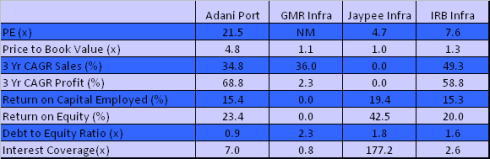
APSEZ - Benchmarking - JainMatrix Investments

Chart 8 – APSEZ – Benchmarking – JainMatrix Investments

APSEZ leads on Profitability, and Debt parameters. It also commands a premium Pricing.

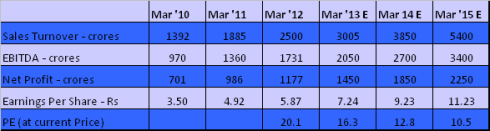
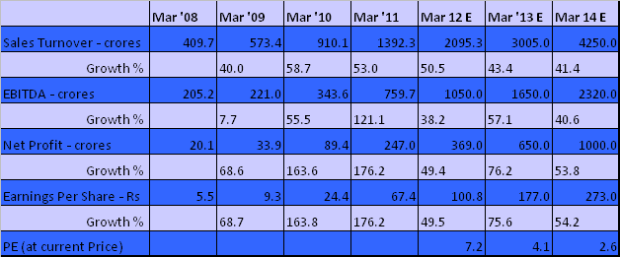
The Financial projections for APSEZ below are not inclusive of new acquisition of Abbot Point Port, about which we do not have sufficient detail.

APSEZ - Financial Projections - JainMatrix Investments

Chart 9 – APSEZ – Financial Projections – JainMatrix Investments

Risks

  • Falling exports: The Indian exports have been affected by the ban on Iron ore exports, changes in govt stance on agri exports and falling demand in Europe.
    • APSEZ will be able to grow market share of exports, but depends on economic conditions to sustain volume growth. Imports are expected to be quite resilient, e.g. Coal.
  • Gujarat High court in May 2012  has stayed development work at APSEZ due to no environmental clearance
    • This may delay additional construction for the SEZ area. Central environmental clearances are notoriously difficult and get delayed. This is an unknown.
  • The Abbot Point Port in Australia was acquired for $2 billion. While this has a good synergy with current operations, there is insufficient clarity on returns and funding /repayment schedule of loans.
  • International business uncertainties, such as: 1) new taxes by Australian govt. on the profits of international companies engaged in mining operations in Australia and 2) and a fall in international Coal Prices that have fallen 21% since 1stJan 2012.
    • These may not directly affect APSEZ. However the returns from Australian investments may be affected.
  • Recent rumours against Adani Group were that it has powerful political linkages, and interests in illegal mining in Karnataka/ Andhra Pradesh. These rumors affected investor sentiment in Adani Industries. This could also affect APSEZ in the future. However APSEZ is a different business, and the possibilities of this are remote.

Opinion, Outlook and Recommendation

  • APSEZ will capture market share due to good connectivity, spare capacity, better access and good facilities. The spare capacities with APSEZ will be rapidly commissioned in next few years.
  • EPS may slow to 40-50% growth range over the next 3 years due to higher base effect. But this is also high.
  • PE has fallen to very low and attractive levels, and combined with robust business performance makes this an attractive entry point.
  • SEZ revenues are lumpy, driven by sale of land to industries. However the infrastructure provided and industrialization will drive this business.
  • It is the nature of markets that sentiment makes share prices fall far below or appreciate far above the fundamental value. APSEZ is underpriced at these levels. In a falling interest rate scenario, APSEZ will continue to outperform as it lowers its cost of debt and delivers on projects.
  • APSEZ is a Medium Risk, High Gain stock. At these levels and in this trajectory, it is a BUY.
  • Price Projections:
    • Our valuation prices the share at 147. Thus today it is available at a 25% discount.
    • By Apr ’13, the price projection is 181, a 53% appreciation from CMP
    • By Apr ’14, the price projection is 231, a 96% appreciation from CMP

JainMatrix Knowledge Base:

Additional Infrastructure sector reports from JainMatrix Investments:

  • KEC InternationalLINK
  • BGR Energy SystemsLINK
  • IRB Infrastructure Developers – LINK

Disclosure: It is safe to assume that if the JainMatrix website recommends a stock, the researcher has already invested in it.

Do you find this site useful? You can:

  1. Check back on this website www.jainmatrix.com for updates.
  2. Subscribe to be the first to receive new posts. Enter your email on the ‘Subscribe’ box at the top right of this page
  3. Or Click on this Signup Form CLICK
  4. Socialize with us – Like on Facebook or Follow on Twitter
  5. Be sure to add punit.jain@jainmatrix.com to your address book or safe sender list so our emails get to your inbox.
  6. Add your comments/ queries below

Disclaimer:

These reports and documents have been prepared by JainMatrix Investments Ltd. They are not to be copied, reused or made available to others without prior permission of JainMatrix Investments. Any questions should be directed to the director of JainMatrix Investments at punit.jain@jainmatrix.com

Also see: https://jainmatrix.wordpress.com/disclaimer/

Hero MotoCorp – A Splendid Core Holding

  • Date: May 16, 2012. Price: Rs 1893, Large Cap – Market Cap 36,800 crores
  • Advice: Low Risk, Medium Gain. Buy now and systematically.
  • Current valuation is Rs. 2025. It is available at a 7% discount.
  • Target: Rs. 3320 by April 2014, a 75% appreciation.

Subscribers received this report on 17th May 2012. 

Hero MotoCorp is the #1 two-wheeler manufacturer in the world. For a large company, the growth figures are impressive: Sales is up 19%, EBITDA 24% and Net Profit 23% CAGR over the last 5 years. Ranked #28 by market cap, it is a truly Indian blue chip. Post the split with Honda, Hero MotoCorp focus is on exports, capacity growth and premium segment offerings. Domestic competition is set to intensify, but the international potential is tremendous. Market leadership, good financial management and a recent fall in price give us a good entry point. 

Hero MotoCorp – Description and Profile

  • Hero MotoCorp (HM), formerly Hero Honda Motors is the world’s #1 maker of two wheelers, from fuel-efficient scooters to powerful motorcycles.
  • The revenues for FY12 were 23,900 crores, with PAT at 2,380 crores. It sold 6.2 m two wheelers in FY12; against capacity of 6.6 m. Manufacturing is at Gurgaon & Dharuhera (Haryana) and Haridwar (Uttrakhand). It employs 5,257 personnel.
  • It is New Delhi based. Listed since 1984, HM today is #28 in Indian Market Cap rankings at 36,800 crores.
  • HM dominates In India with 45% market share. The brands include Splendor, Passion, CBZ, Hunk, Karizma, Glamour, Achiever, Impulse and CD-Dawn/Delux. Splendor sells more than 1m per year. HM has a customer loyalty program since 2000, called the HM Goodlife programme. Exports comprise 3.4% of revenues.
  • HM has 4,500+ consumer touch points, including 800 dealers, Parts distributors and Auth. Service Centers. HM has run the successful ‘Desh ki Dhadkan’ campaign. It sponsors many sporting events, including cricket.
  • Shareholding pattern is: Promoters – Individual/Corporate 52.2%, MFs/ DII 5.3%; FIIs 33.8%, Bodies Corporate plus others 1.7%, Individuals retail & HNI 7%. Thus Promoters hold majority stake – a good sign.
  • Executives: Chairman Brijmohan Lall Munjal, MD /CEO Pawan Munjal, Directors Pradeep Dinodia and VP Malik

Strategies Executed and Updates

  • In June 2010, the Munjal family split the Hero group among themselves. Each family got ownership of the business they were already managing. Hero Honda continues with the Brijmohan Lall Munjal family.
  • In Dec 2010, the 25-year partnership between Hero Group and Honda Motors Japan was terminated. Hero Group bought Honda’s stake through an undisclosed payment and relaunched as HM in Aug’11. HM, the new entity can use the Honda brand name till 2014.  Royalty payments will also cease in ’14.
  • HM has tied up with an engine developer, AVL (Austria), to develop technology for 100 /110 cc models; for the high end products it has signing a technology-sharing deal with US m’cycle firm Erik Buell Racing (EBR). The R&D setup at Daruhera will also become a full-fledged design and engineering center with EBR.
  • Vision (5-7 Years): HM has targeted revenues of $10b and volumes of 10m by ‘16-17, with exports 10% of this.
  • HM will invest 4,500 cr. over 5 years in 2 factories (South & West India) and a global parts center (Rajasthan). Exports will expand from Bangladesh, Nepal and Sri Lanka, to Africa & Latin America, with 100-125cc bikes.
  • In Auto Expo 2012, HM showcased a hybrid scooter. The commercial launch is however some time away. In Nov’11 HM launched an Off Road Bike, Hero Impulse, creating a new category; it has been received well.

Product Classification

The two wheeler market is classified as:

  • Economy/Entry segment vehicles are priced < than 40,000, and engine 100-110cc. This segment makes up 16% of market. HM has a strong presence with 40% share. Products include CD Dawn and CD Delux.
  • Executive segment bikes are in 40-50,000 range, with engine 110-135cc. This segment has 60% of the market. HM is very strong with 71% share, with Glamour/Pro, Passion Pro, Splendor+/NXG/Pro/Super
  • Premium segment bikes have price > 50,000 and engine 150-225cc. This segment has 19% of the market. HM is weak in this segment with 13% share, with Achiever, Hunk, CBZ Xtreme, Impulse, Karizma/ ZMR.
  • Power (250cc plus) segment. This segment makes up 5% of the market. HM has no presence here.

Customer Experience: A visit to a Hero MotoCorp dealership is a revelation. The visibility and feel was good, but a lot of bikes were just lined up as if for storage, eating up the otherwise roomy showroom space. The dealership is geared to handle a lot of customers, and the noise and interactions gave a feeling of an enclosed bazaar, busy but comfortable. The salespersons were courteous and helpful. The process included a pamphlet with products, features, photos and prices, and a Test ride. The overall feel was functional, but not special.

Industry Analysis

The players in the two-wheeler space include HM, Honda, Bajaj, TVS, Suzuki, Mahindra and Yamaha.

Two Wheeler Industry Market Shares, Hero MotoCorp, JainMatrix Investments

Fig 1 – Two Wheeler Industry Market Shares (Click graphic to expand)

  • The biggest gainers in this five year  period have been HM and Honda
Two Wheeler – Domestic Sales, Hero MotoCorp, JainMatrix Investments

Fig 2 – Two Wheeler – Domestic Sales, JainMatrix Investments (Click)

  • The industry has grown at 11.7% CAGR over the last 7 years

Stock valuation, Performance and Returns

HM has been listed for a long time. For our analysis purpose, we will consider the period from 2003-12.

Hero MotoCorp, Share Price, JainMatrix Investments

Fig 3 – Hero MotoCorp Share Price

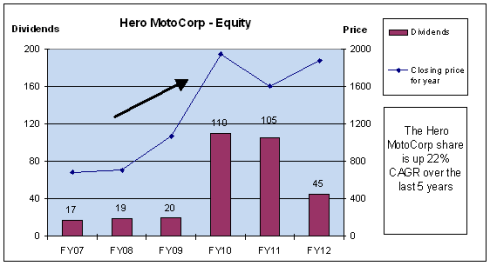
  • The Hero MotoCorp share is up 22% CAGR over the last 5 years. The all time peak was at 2279, achieved recently on May 2, 2012. It is today at 17% below this.
  • This sharp recent fall may be partially due to a lower Dividend announcement as we can see in Fig 5. The lower Dividend was to conserve cash for upcoming investments in new capacities, new products and exports.
Quarterly Sales and Profits, Hero MotoCorp, JainMatrix Investments

Fig 4 – Quarterly Sales and Profits, JainMatrix Investments

  • The growth numbers are excellent with Sales up 19%, EBITDA 24% and Net Profit 23% CAGR over 5 years.
  • Margins are not high, but have held up well in current inflationary conditions.
Five year Price and Dividend details, Hero MotoCorp, JainMatrix Investments

Fig 5 – Five year Price and Dividend details, JainMatrix Investments

  • Dividend is 2250%, which gives a yield of 2.4%.
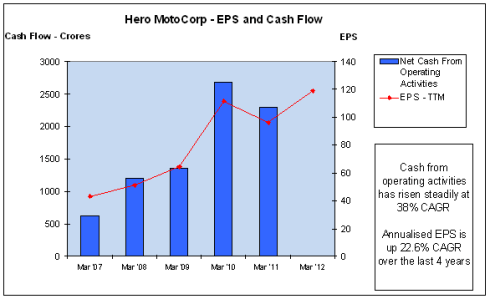
Fig 6 – Cash Flow and EPS, Hero MotoCorp, JainMatrix Investments

Fig 6 – Cash Flow and EPS, JainMatrix Investments

  • Cash from operations has risen steadily at 38.3% CAGR
  • EPS is up 22.6% CAGR over the last 4 years.
  • ROCE was 52% in 2011, and between 42-75% in 5 years before that. One of the reasons for this is that the Equity Capital has been 40 crores for the last 10 years. This is excellent, a sign of good capital stability.
Price and PE Trend, Hero MotoCorp, JainMatrix Investments

Fig 7 – Price and PE Trend, JainMatrix Investments

  • The Price and PE Chart of HM, Fig7, indicates that in the last 6 years, the average PE has been 17. Current PE of 15.9 indicates below average valuations and a possible entry point.
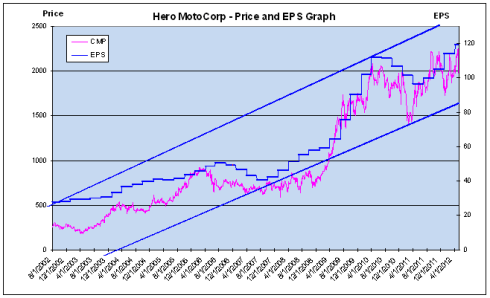
Price and EPS Trend, Hero MotoCorp, JainMatrix Investments

Fig 8 – Price and EPS Trend, JainMatrix Investments

  • The view of the EPS charts in Fig 8 shows that EPS grew very rapidly in end ‘07- early ‘10 period, then fell in the 2010. The recovery has come in 2011, so that EPS is today at all time highs currently.
  • The EPS of HM is expected to stay in the channel as per Fig 8.
  • The Beta is 0.56. This indicates lower volatility than the Sensex.
  • PEG is at 0.7 – indicates undervalued status

Peer Benchmarking and Financial Projections

In a Benchmarking exercise, we have compared HM to other two-wheeler companies.

Peer Benchmarking, Hero MotoCorp, JainMatrix Investments

Exhibit 9 – Peer Benchmarking, JainMatrix Investments

Bajaj Auto rates highly on several parameters. This is because they have an established exports business. HM has been priced lower due to recent dramatic changes like split with Honda. However, HM should be able to execute on plans and command premium valuations soon.

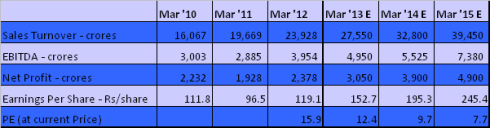
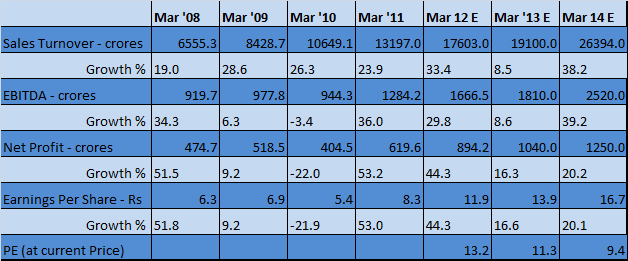
The financials and PE of HM have been projected for the next 3 years. See Exhibit 10.

Financial Projections, Hero MotoCorp, JainMatrix Investments

Exhibit 10 – Financial Projections, JainMatrix Investments

Risks

  • Competition in India is intensifying: Honda is launching new products, and planning Chinese model imports and new manufacturing capacity. Bajaj, Yamaha and even Ducati, and Harley Davidson are launching high-end bikes in India.
    • New partnerships with AVL and EBR (detailed above) will strengthen products. New capacity is planned.
  • HM is strong on the lower end products, Economy and Executive. However these are lower margin products. While HM has some products in the Premium (and none in Power), it is a weakness.
    • As a volume leader, HM is best placed to get profits from Economy and Executive segments.
    • HM certainly needs to strengthen offerings in the profitable upper end segments and launch an attractive Power segment product. One way to do this is to open higher end focused dealer outlets.
  • HM is close to 100% capacity utilization at its plants. This makes the firm sensitive to any production disruption. Also the firm may not be able to respond to any surge in demand, if it happens.
    • HM is an experienced market player, and will be able to respond to market demands profitably.
    • By 2012, HM plans a capacity of 10m units, an almost 40% growth.
  • Macro economic risks like hike in interest rates, high inflation, petrol prices and Retail and GDP slowdown.
    • To some extend these above are already playing out in India. However two wheelers are the main means of personal transportation for the vast majority of middle and lower middle class Indians, and demand may remain robust. Also above economic headwinds should clear in 6-9 months
  • The acquisition of Honda stake in 2011 by promoters was for an undisclosed sum, which was never revealed to public. Estimates vary from 5,000 to 9,500 crores. It is a liability taken by promoters, so there is no compulsion to go public with this, but it would have been a good example of corporate governance and transparency if this were done.
  • Labour: HM is a large employer at its factories. It is critical to have good staff relations, not just in HM itself, but also in the ancillary complex of suppliers to HM. There have been strikes at suppliers like Exide (Mar 2010) and Rico Auto (Oct 2009).
    • So far Labour relations has been a positive for HM. The last public report of a strike at HM is in April 2006 (5 days at Gurgaon).

Opinion, Outlook and Recommendations

  • Two wheeler sales in India reflect of the state of the economy, perhaps better than four wheelers. The Indian economy today is at a demand inflection point, due to a combination of ‘demographic dividend’, increased per capita wealth and lifestyle aspirations. HM is well placed to take advantage of these economic conditions.
  • In the next 5 years, India will establish itself as an accepted manufacturing and export base for Automobiles, particularly smaller cars and two wheelers. HM will be able to exploit this trend.
  • HM has for long dominated the Indian two-wheeler market. This will continue. Additionally, free of restrictions from the Honda JV, HM should enter a new phase of technology independence and export led growth.
  • Consumers have accepted the Honda JV split and HM has outperformed in 2012. This is a fine stability signal.
  • The 5-year financial review has revealed good growth, high profitability, excellent ROCE and low debt.
  • A recent dip in the shares of 17% makes for a good entry point for investors.
  • HM is a Blue Chip, Low Risk, Medium Gain stock with a good dividend. It can be a Core holding for Long Term & Retirement investments. At these levels and in this trajectory, it is a BUY.
    • Our valuation prices the share at Rs. 2025. Thus today it is available at a 7% discount.
    • By Mar ’14, our projected price is Rs. 3320, a 75% appreciation
    • By Mar ’15, our projected price is Rs. 4171, a 120% appreciation
  • Invest regularly in a SIP fashion to reduce the risk of market volatility.

JainMatrix Knowledge Base:

See other useful reports

 Disclosure: It is safe to assume that if the JainMatrix website recommends a stock, the researcher has already invested in it.

Do you find this site useful? You can:

  1. Check back on this website www.jainmatrix.com for updates.
  2. Subscribe to be the first to receive new posts. Enter your email on the ‘Subscribe’ box at the top right of this page
  3. Or Click on this Signup Form CLICK
  4. Socialize with us – Like on Facebook or Follow on Twitter
  5. Be sure to add punit.jain@jainmatrix.com to your address book or safe sender list so our emails get to your inbox.
  6. Add your comments/ queries below

Disclaimer:

These reports and documents have been prepared by JainMatrix Investments Ltd. They are not to be copied, reused or made available to others without prior permission of JainMatrix Investments. Any questions should be directed to the director of JainMatrix Investments at punit.jain@jainmatrix.com

Also see: https://jainmatrix.wordpress.com/disclaimer/

IRB Infrastructure Developers – A Rising Road Star

Viewers may like to see the May 2012 update of this report at LINK

  • Date: March 15, 2012. Price: Rs 199, Mid Cap with a market cap of 6617 crores
  • JainMatrix valuation for IRB is 271. It is available at 36% discount.
  • Target: 352 by 03/13, and 432 by 03/14. Advice:  Buy now and systematically

IRB Infrastructure is a leading mid-sized roads & highway focused construction firm. It has a very good portfolio of legacy and current projects. Tight internal financial controls and a 5-year CAGR growth in Sales (58%), EBITDA (51%), Net Profit (76%) and EPS (69%) make this an attractive business to buy into. Poor market sentiment in 2011 drove the price down. The recovery has begun, but IRB is still available at attractive valuations. 

Subscribers exclusively received this report around 15 Mar ’12. 

IRB Infrastructure Developers – Description and Profile

  • IRB is focused on the fast growing Indian road and highways sector. The revenues for FY11 were 2,502 crores, with PAT at 464 crores.
  • Road projects by IRB involve first the Construction of Highways; then Operation and Maintenance (BOT) of this for a ‘concession’ period (of 15-30 years) while collecting toll, before handing it back to the government.
  • The key business & income segments are Construction (69%)and BOT (31%). IRB has one of the largest BOT portfolios in the country, a total length of around 6,446 Lane-kms, with a market share of 11.1% on the Golden Quadrilateral. This portfolio includes remunerative projects like the Mumbai-Pune expressway, Surat-Dahisar, etc. As a result, IRB earns a high daily gross toll collection today, which is expected to double in 3 years.

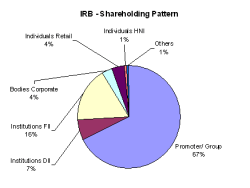
IRB Infra, JainMatrix Investments

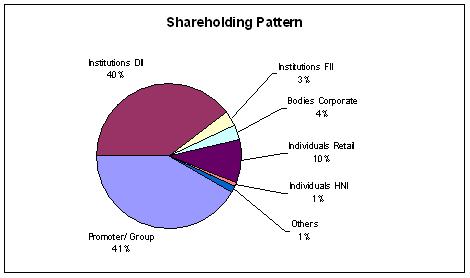
  • The Shareholding pattern depicted in Fig 1 shows Promoters hold a significant stake – a good sign
  • In addition to Toll, the Construction part of the business may be paid in terms of milestones achieved in the project execution, so revenues tend to be lumpy. In fact newer projects involve upfront payment of premium to government, so revenues may start only once Toll collection starts, while all construction work may have to be internally funded.
  • IRB has strong in-house integrated execution capabilities, which give it a better control on execution and project costs . Experienced personnel, expertise and high end equipment are the main resources of this firm.
  • The force behind IRB is the CMD, Virendra Mhaiskar, an experienced construction engineer.

Strategies executed by IRB

  • Competition is intense. To counter this, IRB is now bidding for larger ticket projects. With its excellent portfolio of BOT projects, this is a good strategy.
  • A recent achievement was the Feb’12 financial closure of the 4,880 crore Ahmedabad-Vadodara road project. It is the first ever Ultra Mega project of NHAI on BOT basis & DBFOT pattern. The project involves 6-laning of a 2-lane highway, road length 196 km & construction cost of ~3,600 crores, with concession period of 25 years. IRB mobilized debt of Rs 3,300 crore, incl. Rs 1,100 crore of foreign currency borrowings, at a cost of 10.5%.
  • Strong financial record and relationship with leading financial institutions – helps it get loans on tap. Also the firm is careful about the profitability/ IRR of projects it bids for. In 2010, it slowed down on bidding for new projects due to a higher interest rates in the economy.
  • Structurally, IRB is a holding company, and each new project is floated as a separate company. There are about 20 subsidiaries. This structure gives IRB flexibility in financing and executing projects.
  • IRB has diversified into related areas – Airport and Realty.
    • The Realty project is Real estate development alongside the Mumbai – Pune Expressway. Land acquisition of approximately 1200 acres has been completed for township development.
    • It will develop a Greenfield Airport in Sindhudurg District, Maharashtra, adjacent to Goa
  • IRB prefers to own the road construction machinery and plants/ units required on projects.
  • From a dominant Maharashtra operation, it has consciously gained a pan-India presence with recent wins in Karnataka, Gujarat and North India.

Industry Note:

  • Out of the recently identified critical Infrastructure sectors of Power, Airport, Roads, Oil, Ports and Rail, the Roads sector has done the best in growth, new projects bid out and performance. Unlike in Telecom, Ports or Power, Governance scores high in Roads & Highways. Bidding out has happened in a transparent manner. Outperformance in project delivery is rewarded with better returns.
  • Competitors of IRB include over 50 Listed firms. Plus there are diversifieds and unlisted firms. These includes Reliance Infra, Jaypee Infra, IL&FS Transp., GMR Infra, Lanco Infra, L&T, IVRCL, Ashoka Buildcon, etc. About 90 companies are pre-qualified for National Highways Authority of India projects.
  • My quick estimate is that IRB has about 4-6% market share, by revenues. In terms of quality of projects and proven expertise, IRB definitely falls in the top 5.
  • Earlier the Highway projects were awarded to the lowest bidder, and the Govt. would then pay the developers to make the projects viable. Today the new economics are that projects are awarded to the bidder that pays the highest premium. This is a result of high competition for bids and higher traffic volume projections on Highways. Govt. also is able to bid out more projects and earn revenues :-)
  • There is a huge demand for Road construction. For Road projects built under National Highways Development Project (NHDP), the flagship road-building program of the Transport Ministry, the plan is for upgradation of about 50,000 km of roads, at a rate of 7,300 km of roads every year. Also the budget shortfalls in the government will not restrict this work, as bids are now generating a Premium for the government.

Stock valuation, performance and returns

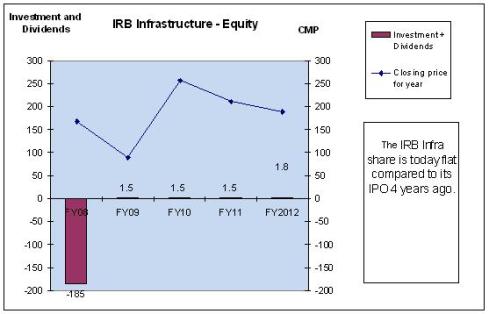
  • IRB had its IPO in early Jan 2008. The subscription was fair at 4.3 times. Pricing was at 185, the lower end of the range. Luckily the IPO was before Reliance Power, and listing was before the crash of ‘08.
  • From its IPO price of 185, it fell in the 2008 crash to 65, later peaked in Aug 2010 at 312, and is now in the 190 range. See Fig 2. Thus IPO investors have seen barely 3-4% gains in 3 years.
  • Dividend is 15%, gives a yield of only 0.76%, but a steady increase indicates good financial health.
IRB Price, JainMatrix Investments

Fig2 – IRB – Investment and Returns, , click on image to expand

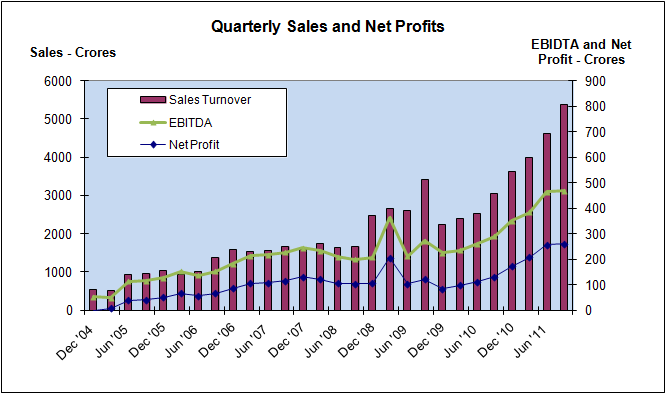
  • As compared to share price, Income, EBITDA and Net Profit show a wonderful growth path in Fig 3. Note that Q1 & Q4 of every year have higher numbers due to end of year and seasonal factors.
  • For a 5-year period the growth figures are Sales (58%), EBITDA (51%), Net Profit (76%) CAGR. These are astonishing numbers, and we are seeing the rapid rise of a very competent Roads Mid Cap stock.
JainMatrix Investments

Fig3 – IRB – Quarterly Sales and Profits, , click on image to expand

  • We can see from the Consolidated EPS and Cash Flow – Fig 4, there has been a rapid growth in Cash from Operating activities. Steady Cash flow is coming from several BOT stage projects.
  • Consolidated EPS has risen by a super 69% CAGR through this period, though this is from a low base.
JainMatrix Investments

Fig 4 – IRB – EPS and Cash Flow, click on image to expand

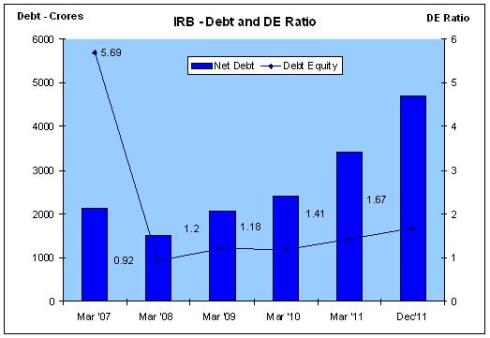
  • While the Cash Flow is good, in fact IRB is in a very cash intensive business. Net Debt has been rising at 33% CAGR since FY08 (Fig 5). Seen along with other business data presented above, this is safe and sustainable.
  • Debt-Equity is 1.67, below the infra firm warning level of 2.0. Fall in DE in Mar08 was due to IPO funds usage.
JainMatrix Investments

Fig5 – IRB – Debt and DE ratios, click on image to expand

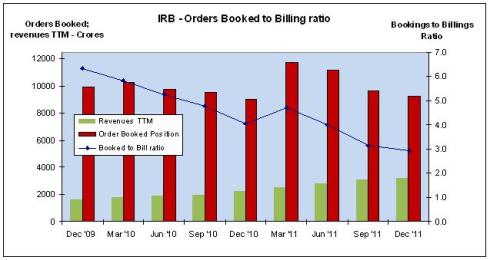
  • Current Order Booked position at IRB is 9258 crores, which is about 3 years of business, at current runrates.
  • An important ratio for IRB is the Orders Booked to Billings ratio (BTB). This has shown a falling trend, but even so is quite comfortable, see Fig 6. This trend is due to IRB strategy to look for profitable and stable new business from larger and more prestigious projects.
  • Thus we can see that IRB has enjoyed good growth patterns, while at the same time has managed its finances well, particularly debt, so far.
JainMatrix Investments

Fig 6 – IRB – Booked to Billings Ratios, click on image to expand

  • The Price and PE Chart of IRB, Fig 7, indicates that IPO of IRB in 2008 happened at aggressive valuations. However IRB has justified this over the last 5 years with excellent business performance.
  • Today the PE of IRB is 13 times, below the industry average of 15.6. In fig 7 we can see that the average PE in the last 3 years has been 25. CMP is now at the lower end of the valuation range.
JainMatrix Investments

Fig 7 – IRB – Price and PE trend, click on image to expand

  • The view of the EPS charts in Fig 8 shows that EPS grew very rapidly in 08-11 periods, then flattened in the high interest rate situation of 2011. The expectation is that the interest rate cycle has peaked today, and with fall in interest rates, the EPS will resume the upward march.
  • The EPS of IRB is expected to stay in the Trend line range as per Fig 8.
  • ROCE is 13.3% and RONW is 18.6%, these are good ratios.
  • PEG is at 0.188 – indicates undervalued status
JainMatrix Investments

Fig 8 – IRB – Price and EPS trend

Peer benchmarking and Financial Estimates till FY14

In a Benchmarking exercise, find a comparison of infra firms is in Exhibit 9

JainMatrix Investments

The conclusion we come to is that on a combination of high growth, low valuations and good financial controls, IRB is a better all round player.

The financials and PE of IRB have been projected for the next 3 years. See Exhibit 10

JainMatrix Investments

Risks:

  • Industry: Roads sector has done well and a lot of new entrants have driven up competition in the sector.
    • However, high competition has driven infra firms to bid aggressively. Many firms in this sector may have overstretched their balance sheets and may even default on payments/ need restructure debt.
    • This sector is dependant on the government for a lot of key inputs. Risks here include environmental clearance, handover of land by government for Road construction as well as roadside land for development (wherever applicable), procurement of land by government and political / R&R issues.
    • There may be resistance from Road users/ consumers to Toll charges.
  •  Interest rates increases in the Indian economy are certainly impacting the balance Sheet of IRB
  • IRB: The focus in IRB has shifted to execution quality. The firm needs to maintain its standards and quality of construction even with a 50% growth in project volumes. This requires astute project management, scaling up of operations and hiring and development of talent within the organization.
  • IRB needs to develop a second rung of management and leadership to take it to the next level of growth. It seems now to be a one-man show of current CMD.
  • One way for IRB to deal with the high debt situation is to monetize its toll road assets by a securitization process. I am not sure if this is permitted for a non-NBFC. However if permitted, the low risk future revenues of the Toll roads can be encashed today, which can reduce debts and improve finances.

Opinion, Outlook and Recommendation

  • IRB has a great portfolio of Road projects. Its strategy of bidding for larger and more prestigious projects will succeed and sustain its leadership profile. The 3-year review of financials shows that the company is in good shape.
  • In 2012, the sentiment has improved in the markets. IRB price too has gained, from a low of 121 on 3rd Jan’12 to current 199 levels (a 64% gain in 2 months). Past peak is 312 around Aug ’10.
  • It is the nature of markets that sentiment makes share prices fall far below or appreciate far above the fundamental value. IRB is underpriced at these levels. In a falling interest rate scenario, IRB will continue to outperform as it lowers its cost of debt and delivers on projects.
  • IRB is a Medium Risk, High Gain stock. At these levels and in this trajectory, it is a BUY.
    • Our valuation prices the share at 271. Thus today it is available at a 36% discount.
    • By Mar ’13, our projected price is 352, a 77% appreciation from CMP
    • By Mar ’14, the price projected is 432, a 117% appreciation from CMP
Additional Infrastructure sector reports from JainMatrix Investments:
KEC International – LINK
BGR Energy Systems – LINK
Adani Port and SEZ – LINK

Disclosure: It is safe to assume that if the JainMatrix website recommends a stock, the researcher has already invested in it.

Do you find this site useful? You can:

  1. Check back on this website www.jainmatrix.com for updates.
  2. Subscribe to be the first to receive new posts. Enter your email on the ‘Subscribe’ box at the top right of this page
  3. Or Click on this Signup Form CLICK
  4. Socialize with us – Like on Facebook or Follow on Twitter
  5. Be sure to add punit.jain@jainmatrix.com to your address book or safe sender list so our emails get to your inbox.
  6. Add your comments/ queries below

Disclaimer:

These reports and documents have been prepared by JainMatrix Investments Ltd. They are not to be copied, reused or made available to others without prior permission of JainMatrix Investments. Any questions should be directed to the director of JainMatrix Investments at punit.jain@jainmatrix.com

Also see: https://jainmatrix.wordpress.com/disclaimer/

KEC International is a Modern Powerhouse

  • Date: February 16, 2012
  • CMP: Rs 60.6
  • Advice:  Firm is valued at Rs 82; available today at 37% discount
  • Target:   March 2014 target of 245

KEC International is the second largest transmission tower manufacturer in the world. It delivers such projects in 45 countries. Synergistic diversifications into Power Systems, Telecom, Water and Railways have de-risked the business. The SAE Towers acquisition (USA) in 2010 was also successful. The Order Book is at 2.2 times FY11 sales. In the last 6 years, Price has barely increased by 1% while the EPS growth is 30% CAGR. The steep price fall of 2011 is done with, and the recovery has started. The KEC share is available at a 37% discount to valuations. Invest for long term in this ‘modern powerhouse’.

Subscribers have received this report around 16th Feb or later on subscribing

KEC International – Description and Profile

  • KEC International is an Engineering Procurement and Construction (EPC) company focused on Power Transmission. It is the largest transmission tower manufacturing company in the world.
  • It is the 3,900 crores (FY11) flagship company of the RPG group. Current Market Cap is 1609 crores.
  • In addition to Power transmission, it has diversified into related areas like Power Systems, Cables, and new verticals like Railways, Telecom and Water. 90% of customers are Government firms.
  • Beyond India, it has supplied power infrastructure to 45 countries globally. In addition, in Sept ‘10, KEC took over SAE Towers, a US based lattice transmission towers manufacturer, for $95m giving it a strong North & Latin American footprint. The acquisition / integration has been successful.
  • Manufacturing plants are in India – Nagpur (Mah.), Jabalpur (MP) and Jaipur (Rajasthan); Americas – Monterrey (Mexico), Belo Horizonte (Brazil). Total tower manufacturing capacity is 251,000 MTs.
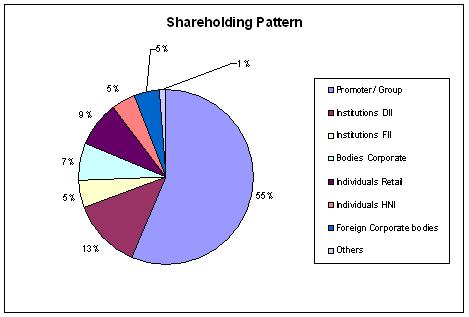
  • The shareholding pattern, indicates wide ownership with Indian Institutions (good) and medium Promoter ownership (fair)
JainMatrix Investments

Fig 1 – Shareholding Pattern of KEC – Click to expand

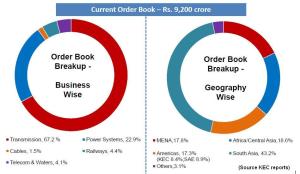
  • Employees number over 4200; Order Book is Rs.9,200 cr, giving about 2.2 years of visibility (@FY11).

Business Model and Strategy:

  • The core capability of KEC is its ability to deliver power transmission lines to Utilities, from design, to materials procurement, to execution, involving Project Management, Design & Engineering skills.
  • In a form of evolution and growth in related areas, KEC has expanded by:
  1. Backward integrated into Cables – manufacture and implementing cabling solution
  2. Forward integration – into Power Systems, designing and constructing substations (range of 220 to 1150 kV substations) and Electrical Balance of Plant (E- BOP) delivery services.
  • Looking beyond the Power industry, KEC has been able to reposition its EPC and manufacturing for:
  1. Telecom industry – telecom towers, cabling, installation and commissioning
  2. Railways EPC work (an acquisition, Jay Railway Signaling undertakes the railway infra projects)
  • Civil infrastructure – bridges, tunnels, workshop modernization, building of stations
  • Tracks related – new track laying/ improve old tracks, electrification /power systems.
  • Signaling and telecommunication network.

3. Water – this includes Irrigation and Hydroelectric construction, Embankment and Flood Control, Sewage and industrial effluent treatment and Potable water treatment and distribution

  • KEC is successfully diversifying its business, thus de-risking the overall business portfolio. See Fig 2.
JainMatrix Investments

Fig 2 – Order Book Breakup of KEC – Click to expand

Industry Note:

  • Classification: Power Industry is broadly classified into Generation, Transmission and Distribution.
  • The Indian power sector faces huge demand growth. But the government’s power capacity Plan v Achievement has been as low as 51.5% in the 10th Plan. (We are in 11th Plan now). The shortfall of peak power has been 8-12% in the last decade. Over 40% of Indian population still doesn’t have access to electricity. Many have access to poor quality power.
  • The Public sector dominates the industry, owning 70-80% of current assets. However the government is opening up to the Private sector. In future, 50% of investments are expected to be from the Private sector.
  • Power Generation has grabbed a lot of interest, but focus in India is now shifting to Transmission, as in 2-3 projects, even after generation and fuel linkages were in place, the Power Evacuation facilities were not ready and all stakeholders are suffering due to the delay.
  • Key players in the Power Transmission EPC are Areva T&D, Kalpatru Power, Jyoti Structures, Alstom Projects, etc. It’s a crowded market, and competition includes infra diversifieds like L&T, GMR and Reliance. A quick analysis shows among the listed focused firms, KEC has a 10-15% mkt share.
  • The Transmission industry bidding norms have changed recently to ‘Tarriff Based Competitive bidding’, where the Service Providers like KEC are responsible for Build, Own, Operate and Transfer of power lines. TSPs earn in the form of Transmission Charges payable by long-term customers.
  • Also see reports on other related firms – BGR Energy Systems; Bottom Fishing and Winds of Change

Unique strengths of KEC

  • Diversification of KEC beyond the Transmission EPC sector is good, as diverse businesses follow different cyclical patterns. Businesses set up in the last 3 years account for 30% of Orders Booked.
  • KEC has good presence beyond India, with 55% of current Orders Booked from other regions. In the present power cyclical down phase in India, KEC is focusing on business in other geographies.
  • As the flagship RPG Group firm, KEC enjoys good management focus for its initiatives. Established in 1945 as Kamani Engineering Company, the firm has a rich past, and has again reinvented itself into a modern powerhouse. Ramesh Chandak, the MD & CEO is a CA and has lead KEC for the last 10 years.
  • Following the ‘10 SAE towers deal, KEC is now looking at additional acquisitions to accelerate growth

Stock valuation, performance and returns

  • KEC has shown a fine growth pattern (Fig 3) with Sales growing 18% CAGR over the last 6 years.
JainMatrix Investments

Fig 3 – Quarterly Sales and Profits at KEC

  • Net profit has grown very well at 24% CAGR.
  • Share price however has been volatile, moving to an all time high (in 2008) and low (in 2009).
JainMatrix Investments

Fig 4 – Price and dividends at KEC

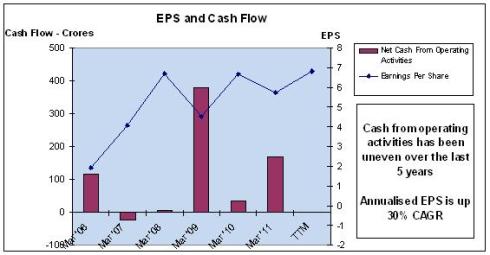
  • EPS has been growing rapidly at 30% CAGR. Cash Flow however has been uneven.
JainMatrix Investments

Fig 5 – KEC – EPS and Cash Flow

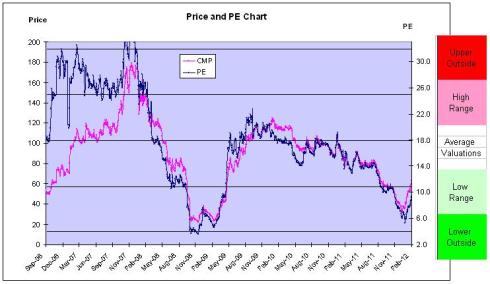
  • Current PE at 9.3 is lower than current Industry average of 17.
  • The Price and PE chart – Fig 6 – indicates that current valuations are in the bottom quarter of 6-year historical charts. Definitely indicates undervalued status. This is in spite of the 90% surge from 20th Dec ’11 low of 32.
JainMatrix Investments

Fig 6 – Price and PE Chart of KEC

  • Price and EPS graph, Fig 7, shows that EPS accelerated till ‘08, then has been in the 5.5 – 7 range for next 3 years. The EPS should see an upside breakout from this range in the next few quarters. My expectation is that EPS will grow in the sector drawn in this chart.
JainMatrix Investments

Fig 7 – Price and EPS Chart

  • Debt equity at 1.51 (FY11) is very comfortable for an infrastructure firm.
  • Orders Booked to Billings, Fig 8, shows an improvement over the last two years.
Orders Booked to Billings Ratio for KEC International, JainMatrix Investments

Fig 8 – Orders Booked to Billings Ratio for KEC

  • Return on Capital Employed, ROCE, has been in a 22-40% range for the last 6 years.
  • Return On Net Worth, RoNW, also has been at 17-38% range. These are good numbers.
  • Operating margins have been hovering around 10% for last 3-4 years. This year’s high competition and entry into new sectors pushed it to around 8%. We expect this to revert to 10+ levels from FY13.
  • Cash and Cash equivalents are at 800 crores. Plus with a low DE ratio, KEC has access to a healthy war chest of internal cash plus debt with which they can look at new acquisitions.
  • PEG is at 0.4 – indicates safety and undervalued status

Financial Projections, with FY14 estimates

The consolidated financials and PE of KEC have been projected for the next 3 years.

Key Financials and Projections (Source: JainMatrix Investments)

Fig 9 – Key Financials and Projections (Source: JainMatrix Investments)

Risks:

  • Domestic interest rates unpredictability. This will affect the growth projections.
  • Hyper competition. Orders booked in the last 12-18 months in India have been at lower margins due to high competition. The projections assume an easing up of this in India.
  • Indian Power sector challenges. The key current issues are (1) financial stress among Utilities, particularly State Electricity Boards that are facing Tariff inflexibility and Collection issues, (2) Power Plants facing issues with fuel linkages and a shortage of Coal & Natural Gas, and (3) project execution delays due to government clearances like environmental, land acquisition, etc. This has affected the investment climate in this sector. The projects under execution by KEC are also affected, and execution/commissioning may be delayed.
  • Business uncertainty in MENA region – already a part of the order book is affected due to unrest.
  • Unpredictable events like a European sovereign default, some new media issue/ bad publicity or any governmental charge sheet, etc. can occur that can mar equity performance for short periods.
  • Past performance is no indication of future results

Opinion, Outlook and Recommendation

  • India has a surging growth in electricity demand, yet there is a 9-13% power deficit today. This will widen in the next few years.
  • Globally the thumb rule is that every rupee invested in generation must match an equal investment in T&D; however, in India it has been 1:0.5. There is now a huge opportunity for T&D players.
  • As a leading transmission EPC Company, KEC’s fortunes are linked to the regulatory environment and overall industrial climate of the Indian power sector. In a stable / improving environment, KEC should perform excellently based on the current manufacturing and execution capacities.
  • In 6 years, share price (adjusted) has increased by 1% while the EPS growth is 30% (CAGR). Other metrics like Sales, Orders Booked, Debt, etc too are favorable. The share is definitely under-priced.
  • Current price is low due to poor sentiment/ pessimism in the Indian markets around the Power sector. However KEC is well diversified across geographies as well as business segments.
  • From the steep fall of 2011, the share has bottomed out and risen rapidly of late, and is now at the key 200 DMA levels. Price should rise above this key level, and stay above for a fair period of time.
  • Near term positives include the weakening of the INR against the USD that should boost KEC revenues and profitability. It is an exporter of services, but most of its costs are in INR.
  • In FY12 end, and next few quarters, a lot of pending Power transmission projects are to be bid out, and KEC will win a fair share of new business.
  • The JainMatrix Investments valuation study prices the company at Rs 82, and so the share is today available at a 37% discount to this valuation 
  • March 2014 target of 245, giving a 300% appreciation.


For a pdf copy of this report, mail punit.jain@jainmatrix.com

…………………….

Disclosure: It is safe to assume that if the JainMatrix website recommends a stock, the researcher has already invested in it.

Do you find this site useful? You can:

1.      Check back on this website www.jainmatrix.com for updates.

2.       Subscribe to be the first to receive new posts. Enter your email on the ‘Subscribe’ box at the top right of this page

3.       Or Click on this Signup Form CLICK

4.       Socialize with us – Like on Facebook or Follow on Twitter

5.      Be sure to add punit.jain@jainmatrix.com to your address book or safe sender list so our emails get to your inbox.

6.       Add your comments/ queries below

Disclaimer:

These reports and documents have been prepared by JainMatrix Investments Ltd. They are not to be copied, reused or made available to others without prior permission of JainMatrix Investments. Any questions should be directed to the director of JainMatrix Investments at punit.jain@jainmatrix.com

Also see: https://jainmatrix.wordpress.com/disclaimer/

Bajaj Finance, Auto-matic Growth

___________________________________________________________________

This report was updated on 23rd Jan 2014, find the new report on Link.

  • Date: 31st Jan 2012
  • CMP: Rs 723                     Mid Cap with Market Cap Rs 2534 crores
  • Advice: Invest                  Target: 1750 by 03/13 and 2700 by 03/14

Bajaj Finance is an NBFC on a growth path. It is a leader in auto and consumer durables loans, but customers are spread across Retail 60% and SME/ Corporate 40%. Key strengths are all India reach; strong ‘Bajaj’ brand and rapid entry into new growth segments. Revenue, NII, Net Profit and EPS have grown at 28-41% CAGR over 7 years, and performance did not slow in 2011. Gains can accelerate in a falling interest rate scenario. Invest in this potential multi bagger.

JainMatrix Investments published this report to Subscribers (31/01) and all readers (1/03)

Bajaj Finance – Description and Profile

  • Bajaj Finance (BF) is a NBFC promoted by Bajaj Auto over 23 years ago. Post a 2008 restructuring, Sanjiv Bajaj is handling the financial services business of Bajaj Auto group, including Bajaj Finance.
  • BF was set up as a captive financier of Bajaj Auto’s 2 & 3 wheelers. It has now expanded to related areas such as loans for Consumer Durables, Against Property, Small Business, Construction Equipment, Against Securities, Personal Loans, and Insurance Services, see Fig 1.
JainMatrix Investments

Fig 1 – Bajaj Finance – Business Segments (click to enlarge)

  • About 60% of its business is consumer oriented – B2C, while rest is B2B, with a SME focus. The largest Segments are Consumer durable and 2/3 wheelers. BF is diversified across customer segments and geographies; this de-risks operations and inspires a confidence in continued growth.
  • BF has a network of 4000 distribution partners/ dealers and 225 points of presence. It has 5 million customers across the country.
  • In 2011, BF added 603 permanent employees, taking total employees to 1657. This is a sign of business confidence and investments in expected growth.
  • Funds sourcing – CRISIL has rated it at FAAA/Stable for FDs, indicating a high safety with regard to timely payment of interest and principal.
  • The company has just launched a new loan product specially designed for SMEs, called “flexisaver”. This could be an excellent offering for this segment.
  • BF has a capital adequacy ratio at 17.5%. This is good. Even so, to fund rapid growth, BF is expected to raise Rs 750 crores in 2013 through a QIP or Private equity route.
  • Management intends to raise its equity holding to 75% from the current levels. This indicates high ownership, which is good. See Fig2.
JainMatrix Investments

Fig 2 – Bajaj Finance – Shareholding Pattern (click)

  • Another positive is the stake holding from Mutual Funds, FIIs and DIIs.

Industry Note

  • There are a large number of NBFCs in India (>10,000). These are relatively unregulated companies, unlike Banks that are governed by RBI. In this fragmented market, there is tremendous opportunity to offer Loans and Financial services in a fast growing economy of India, to Individuals (Retail), SME and Corporates.
  • RBI has projected a 16% growth in loans for Banks; NBFCs should have higher industry growth rates.
  • Current projections – of fall of interest rate cycle, and lower inflation, is positive for this sector. See article on this Trend.

Unique strengths:

  • Strong ‘Bajaj’ brand; BF also shares in the growth of Bajaj Auto through the Auto loans service. Also a leader in Consumer Electronics/ durables loans with presence in showrooms of top Retail chains.
  • With Sanjiv Bajaj at the helm, there is clarity in management succession. He is also a talented and ambitious finance professional and promoter.
  • A strong distribution network, spread nationally with presence across customer segments, industries and geographies. The BF strategy is to diversify loans with a 30% segment cap. This will provide a de-risked business model.
  • The group financial services ambitions and new initiatives are going to be routed through BF.

Stock Evaluation, Performance and Returns

  • Listed long back, BF has shown excellent performance over the last 5-7 years, as seen in the charts.
  • The Net Profit, Net Interest Income and NII plus Other Income have grown at 28-38% CAGR over 7 years. Growth has really accelerated since 2008. See Fig3.
JainMatrix Investments

Fig 3 – Chart with Quarterly Net Income, Profit

  • Revenues rose over a 7 year period at 41% CAGR; and EPS at 28% CAGR, see Fig 4.
  • The share has appreciated by 22% CAGR over 7 years. However, post the 2009 fall, the appreciation has been very steep at 112% CAGR.
JainMatrix Investments

Fig 4 – Chart with Quarterly Income, EPS

  • In 3 years, Share Price & dividends have appreciated (Fig 5); P/BV is not too high
JainMatrix Investments

Fig 5 – Chart with Price, Dividends, P/BV

  • Price and PE chart shows that PE is currently at all time lows even though the Price has risen to 700+ levels. It seems the full effect of the Earnings improvement is not yet reflected in the Price, see Fig 6.
JainMatrix Investments

Fig 6 – Price and PE Chart

  • ROCE is 12% and ROE is 19.7%, these are good ratios.
  • The EPS growth has accelerated since 2008, (Fig 7). This is an excellent chart of the firm’s growth.
  • Its asset under management stood at Rs 11,919 crore as in Dec’11; as against Rs 6,868 crore a year back (up 74% YoY). The overall credit growth of the company is significant at a time when the entire industry is experiencing a slower credit off-take.
JainMatrix Investments

Fig 7 – Price and EPS Chart

  • Of late, BF has improved asset quality. Its net non-performing asset (NPA) ratio stood at 0.25% in FY12 Q3 as against 0.33% in Q2. Current net NPA is the lowest for the company in the last five years.
  • PEG is at 0.29 – indicates undervalued status

Peer Benchmarking and Financial Estimates till FY14

  • BF in this comparison shows better growth characteristics. See Exhibit 8.

JainMatrix Investments

  • BF is also superior due to multiple customer segments – a de-risked business model.
  • Three-year projections of BF financials indicate a robust ramp up of revenues and profits, Exhibit 9.

JainMatrix Investments

Risks:

  • Interest rates unpredictability. This will affect our growth projections for BF.
  • Hyper competition.  An excessive ramp up/new entrants of NBFCs & Banks can affect BF performance
  • Promoter driven consolidation. Bajaj group has financial firms like Bajaj Allianz (Insurance), Bajaj Financial Solutions (Wealth mgt) and Bajaj Finserv (Holding Co). Consolidation will change the outlook.
  • Unpredictable events like a European sovereign default, some new media issue/ bad publicity or any governmental charge sheet, etc. can occur that can mar equity performance for short periods.
  • Past performance is no indication of future results

Opinion, Outlook and Recommendation

  • Indian market is underserved for loans and financial services. Quick calculations show BF has 5-7% market share among listed Indian NBFCs (non Bank). While small, this indicates a big market for BF to grow.
  • In the last three years, BF has embarked on a business trajectory that, if sustained, can make it a top 3 NBFC in 4-6 years. In essence it may move from mid-cap to large-cap, and shareholders could be holding on to a ten bagger.
  • Invest now and systematically for long-term out-performance.

The projection/ targets for Bajaj Finance are

  • March 2013   –  1750  –  140% appreciation
  • March 2014  –  2700  – 270% appreciation

 Disclaimer:

Do you find this site useful? You can:

  1. Subscribe to be the first to receive new posts by filling the ‘Subscribe’ box on the top right of this page;
  2. Or Click on this Signup Form CLICK
  3. Socialize with us – Like my post on Facebook
  4. Follow on Twitter
  5. Add your comments/ queries below

Petronet LNG – entering a new Orbit

This report has been updated in June 2012 – see Petronet LNG – A Solid Gas Company

  • Date: 19 December, 2011
  • CMP: Rs 157, Large Cap with Market Cap Rs 11,883 crores
  • Advice: Invest, Target: Mar 2013 – 250 and Mar`14 – 301

Petronet LNG is doubling capacities in the next two years. It provides a clean fuel, Liquefied Natural Gas to an energy starved country. Being a PSU JV, business risks are lower. The operational performance and capacity addition projects in the last few years have been excellent. It is a gem of a stock that will continue to give equity investors safe and high returns for the next few years.

Petronet LNG – Description and Profile

  • Petronet LNG imports, processes and sells LNG in India, and is a JV of GAIL, ONGC, Indian Oil & BPCL.
  • Turnover in 2011 was Rs 13,197 crores with PAT at 620 crores. PLNG owns and operates a LNG terminal at Dahej, Gujarat that imports 10 mmtpa (Million Metric Tonne Per Annum) of LNG.
  • LNG is sourced through long term contracts (with 7.5 mmtpa from RasGas-Qatar, 1.44 mmtpa from Exxon Mobil-Australia and 2.5 mmtpa from Gazprom) and also spot cargoes (sourcing 0.6MT in ’12 from Gaz De France) that boost volumes and utilize capacity. These contracts indicate stable supplies.
  • Imported LNG is regassified and supplied to customers in pipelines – generally operated by GAIL and GSPL. The customer base includes power plants, household and commercial piped gas, fertilizer plants, Industrial boiler fuel, etc. Most sales are through GAIL, IOCL & BPCL
  • Operational performance was excellent, with the FY11 LNG volumes at 11 mmtpa, a 110% capacity utilization at Dahej.
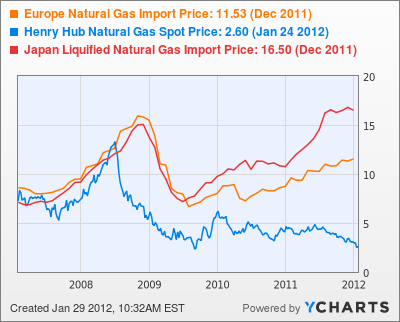
  • The global prices of LNG have been rising. It depends on location, and today varies from  4$/mmbtu in USA to 15$/mmbtu in Japan. However, PLNG is protected from these prices, as it ensures back to back buying arrangements with customers. It earns a Rupee denominated marketing margin.

The current projects include:

  • PLNG is 26% promoter of a JV with Adani Enterprises, called Adani Petronet (Dahej) Port Pvt Ltd.  This is a bulk Solid Cargo Port of capacity 12 mmtpa that has started operations this year at Dahej.
  • Construction has started of an additional LNG jetty at Dahej which will take the terminal capacity from 10 to 15 mmtpa by Sept ’13.
  • Construction of a new LNG terminal at Kochi, Kerala of 5 mmtpa, which will start by Sept 2012.
  • Started LNG Supply in Cryogenic road Vehicles – for supply to isolated customers without pipelines
  • Direct Marketing of LNG  in coastal & industrial areas, will develop the market /boost demand

 Future Plans

  • Plan for forward integration into a power plant of 1200 MW capacity at Dahej using LNG fuel.
  • A plan for building a LNG Terminal on the east coast of India. Location to be decided.
  • Once the Kochi terminal is ready, PLNG may also invest in a power plant here, using LNG fuel.
  • By FY16, total capacity could increase to 25 mmtpa, which is 2.5 times current capacity.

Industry Note:

  • Gas is a cleaner fuel than Coal and Oil. It burns completely. Usage of Gas is better environmentally than other fuels.
  • Gas consumption in India is low compared to global patterns. PLNG is a pioneer that is creating the infrastructure that will improve gas usage and meet demand.
JainMatrix Investments

Fig 1 – Energy consumption – World and India – Click to expand

  • Today India is energy hungry, and raw fuel deficit, with supply issues:
  1. Coal – while there are enough Coal reserves, Coal India has not been able to meet production targets. Their constraints are environmental clearances, logistic challenges, recent heavy rains in mining areas and labor issues. Other mine owners in India are also not producing enough; so many customers need to import coal. Also Coal is a dirty fuel.
  2. India is a crude oil importer and 70% of demand comes from this route. Oil prices are high.
  3. Nuclear energy has suffered a setback in India due to the Japan disaster. New plant construction is a political hot potato. Hydro and Renewables have a high cost of capacity setup.
  • Indian gas demand is expected to reach 381 mscmd by 2015, compared with a current supply trajectory of 202.9 mscmd. There is definitely a huge demand for gas.
  • Domestic supply of Natural gas from Reliance (Krishna Godavari), ONGC and Oil India wells has not scaled up and will not be able to meet above demand.
  • Other LNG terminals are Hazira (Shell owned, 3.5 mmtpa) and Dabhol (GAIL/NTPC, ready by 2012).
  • GAIL also procures LNG in long term contracts, and used the available terminal capacity (including PLNG) to import this.

Stock evaluation, performance and returns

  • PLNG had its IPO in March 2004 priced at Rs 15. It was oversubscribed 4.2 times.
  • The maiden dividend of Rs 1.3 on FV Rs 10 was paid in 2007. Thereafter dividend has shown a steady to increasing trend (See Figure 2)
  • At CMP of Rs 157 today, the stock has shown a 42% annualized return over the last 8 years!
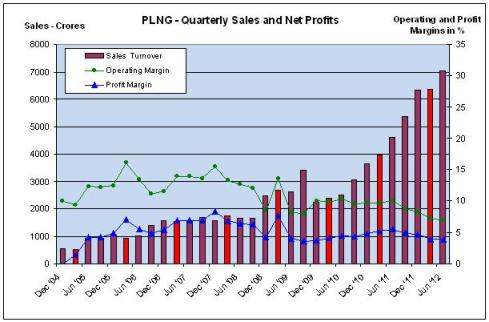
  • Revenues have grown steadily at 37% CAGR, (Fig 3), along with EBITDA – 35% and Profits 29%.
JainMatrix Investments

Fig 2 – Petronet LNG stock performance – Click to expand

JainMatrix Investments

Fig 3 – Quarterly revenues have grown steadily

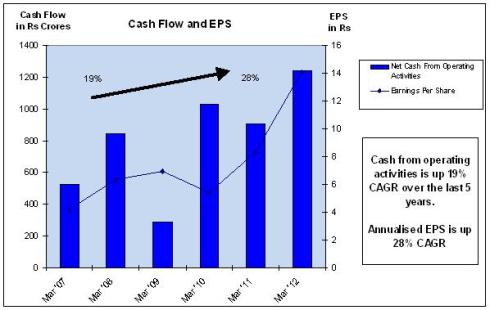
  • Cash flow and EPS are showing a robust growth rate – see Fig 4. A dip in 2010 was temporary, with a substantial recovery in 2011.
  • With the excellent capacity utilization in 2011, PLNG has partially repaid debt and D/E ratio is 1.0
JainMatrix Investments

Fig 4 – Cash Flow and EPS have grown substantially

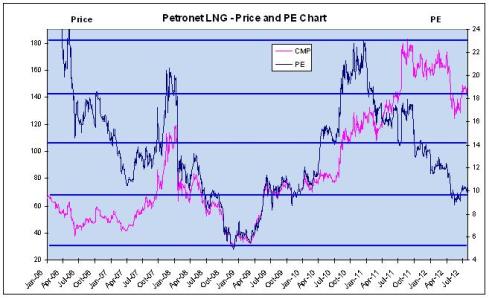
  • Price and PE chart shows that PE has fallen recently close to the 5 year mean of 14 times. (Fig 5). PE today is 13.3 and has fallen 43% from 23 levels. During this fall, the price has only fallen 14% from the recent peak of 183 in Aug 2011. The rest of the fall comes from EPS growth, see fig 6.
JainMatrix Investments

Fig 5 – Price and PE Graph

JainMatrix Investments

Fig 6 – Price and EPS Graph

  • Price and EPS quarterly graph shows that EPS growth has accelerated in recent quarters. This elevated EPS will stabilize in 2012, and any further gains will come from interest cost reductions. Volume growth will happen in 2013 with additional capacity coming on stream in Kochi and Dahej.
  • ROCE is between 15 – 25%
  • PEG is at 0.46 – indicates safety and undervalued status

Financial Projections, with FY14 estimates

JainMatrix Investments

Exhibit 7: Financial Projections – (Click to expand)

Risks:

  • A global recession, perhaps involving a European country debt default, will depress the equity market overall, and PLNG also. But this even if it happens, will be a temporary condition.
  • There has been a recent spurt in spot LNG price. This was largely due to the March 11 Japan earthquake and nuclear disaster; Japan has started idling their nuclear plants, and turned to LNG in a big way. In India, LNG demand is high, but may drop if prices exceed 18$/ mmbtu. However, spot prices in USA are at <4 $/mmbtu, so this is unlikely. US has low prices as they have started producing LNG from non conventional sources.
  • Pipeline infrastructure from Dahej to customers is a constraint. However this is being aggressively addressed by GAIL and GSPL. Similarly pipelines to demand centers around Kochi have to be set up to evacuate gas. This being addressed by Kerala Government and GAIL
  • Currently, LNG charges regasification tariffs are not under the purview of the regulator. Any policy decision to regulate the tariff may affect the valuation of the stock.

Opinion, Outlook and Recommendation

  • PLNG has an excellent track record of investing in LNG assets and utilizing/ operating them well.
  • In the last 8 years, all performance metrics of revenues, profits and EPS have improved to a new orbit every time capacity was added. Imminent capacity addition will replay this characteristic.
  • Demand is huge in India, and as of now, all LNG import for the next 6 months are booked by customers.
  • My opinion is that Petronet will continue down the path of solid stock performance and dividends over the next decade .
  • Invest now and systematically for long term outperformance
  • The projection/ targets for PLNG are
    • March 13 target is 250 (a 60% appreciation from current levels)
    • March 14 is 301 (a 92% appreciation)
  • The projections are based on PE expectations of 18 times.

:-)

This report is an update on a Feb 2011 report I had shared, available on Link

  • Socialize with us  Like on Facebook
  • Check back on the website www.jainmatrix.com for updates.
  • Do you find this site useful? Please comment below. You can also subscribe for my posts by filling the ‘Sign me up’ box on top right of this page.

Disclaimer:

These reports and documents have been prepared by JainMatrix Investments Ltd. They are not to be copied, reused or made available to others without prior permission of JainMatrix Investments. Any questions should be directed to the director of JainMatrix Investments at punit.jain@jainmatrix.com .  Also see: https://jainmatrix.wordpress.com/disclaimer/

BGR Energy Systems – Time to Re-energize

  • Date: December 2, 2011
  • CMP: Rs 269; Small Cap – Market Cap 1952 crores
  • Advice:  Invest at lower levels. Target – Rs 800 in 24 months.

BGR Energy is a leader in the Power Plant EPC space. However the industry headwinds have pulled down the business performance. BGR shares have fallen sharply to current under priced levels, and may stay around these level for 2 quarters. Thereafter the stock is expected to rise and recover lost ground.

Warning – Extreme volatility – this stock is not for the faint hearted.

BGR Energy – Description and Profile

  • ‘Water water everywhere, but not a drop to drink’. For BGR, the line needs to be – electricity shortages everywhere, but no orders for generation :-)
  • BGR Energy is primarily a Power Sector focused Engineering- Procurement- Construction (EPC) company. It builds Power plants for Utility companies and commissions and hands over the plant. It is Chennai based, with 2010-11 revenues of 4747 crores; market cap 1894 crores and 2200 employees.
  • Power Plant work can be in a Turnkey EPC mode, responsible for entire plant, or BoP (Balance of Plant) other than the BTG (Boiler Turbine Generator), or only BTG.
  • BGR has domain capabilities in power, and the ability to plan, design, procure/ build, execute and commission projects. Thus experienced personnel are the main resource of this firm.
  • Shareholding pattern is: Promoters – Individual and Corporate: 81.1%, DII 5.1%; Bodies Corporate 1.9%; Individuals – retail plus others 11.9%. Thus Promoters hold significant stake – a good sign.
  • By nature, the firm is paid in terms of milestones achieved in the project execution, so revenues tend to be lumpy. Also the Orders booked for this firm as a proportion of current revenues indicates the safety and visibility of the current business.

Strategies executed by BGR

  • BGR has extended its offerings to other verticals like Oil & Gas, Electrical projects (substations), environmental engineering projects and air fin coolers.
  • In recent years, it has diversified into manufacture of BTG as well as key technology components with partners/ JVs, thus capturing a larger share of the Turnkey project budget. This also gives it an edge in terms of cost and timely execution of projects.   It has set up a number of collaborations, subsidiaries and JVs to assemble the Plants and machinery:
  1. With Hitachi, it has Turbine and Boiler JVs. These two firms are setting up manufacturing facilities in Tamil Nadu, near Chennai
  2. Group companies with GEA Energietechnik of Germany give access to Cooling systems technologies and specialized tube cleaning systems
  3. Other group companies – Progen Systems – focuses on Design and manufacture capability for Process equipments. Also Cuddalore Powergen Corp Ltd is setting up a Power Plant.
  • It can be seen that BGR is over time going to straddle the entire Power Generation lifecycle, from BoP to EPC to BTG/ key components manufacture, to the Plant Operator (Generation) and the Utility play.

Industry Note:

Classification of Indian Industry players

  • Power Industry is at a high level divided into Generation, Transmission and Distribution. The Public sector dominates the industry, owning 70-80% of current assets. However the government is opening up to the Private sector. In future, 50% of investments are expected to be from Private investments
  • The key players in the Power Plant EPC market are NTPC, BHEL, L&T, and AIA Engineering. But it is a crowded market. The competition also includes Reliance Infra and Tatas.
  • Sub-segments are BoP and BTG manufacturers. Chinese manufacturers of BTG have a price advantage in India compared to locals. This anomaly should soon be corrected by the government.
  • The government has just come out with an order compelling open access, in line with the Electricity Act, 2003. This will allow all consumers of >1 MW freedom to choose the supplier, and only inform their current distributor. This will be a game changer for the Power industry if correctly implemented.

Stock valuation, performance and returns

  • BGR Energy had its IPO in Dec 2007. In a blockbuster offering, it was oversubscribed 119 times. Hoping to generate 438 crores, they attracted 52,000 crores.
  • However, from its IPO price of 480, it has now fallen to 269 a fall of 14% per year. See Fig 1.
BGR Energy, JainMatrix Investments

Fig 1 – Investment and Returns

  • As compared to share price, we can see that in the last 4 years, sales have grown at an average of 57% CAGR. See Fig 2 – Quarterly Sales and Profits.
  • Both EBITDA (53%) and Net Profits (69%) are growing rapidly.
BGR Energy, JainMatrix Investments

Fig 2 – Quarterly Sales and Profits

  • We can see from EPS and Cash Flow – Fig 3, the unevenness of the business model of BGR. Cash flow is unpredictable and lumpy.
  • EPS however is growing fast at 57% CAGR. Again this is a good data, but from a low base.
BGR Energy, JainMatrix Investments

Fig 3 – EPS and Cash Flow

BGR Energy, JainMatrix Investments

Fig 4 – Gross Debt

  • Debt is the big issue with BGR. It has increased significantly in the recent past. Gross Debt also stems from two sources – Net working capital and Debtors.
  • Working capital increased from 103 days (end FY11) to 206 days (end 2QFY12). This could be due to execution delays across the ongoing projects.
  • Debtors went up from 243 days (end FY11) to 341 days (end 2QFY12). This was due to a sharp rise in Retention Money, which was 1300 crores (end 2QFY12). Of this 900 crores is due to projects under execution and 400 crores against completed projects v/s 1100 crores (end FY11).
  • Retention Money is generally Bank deposits/guarantees for performance on projects. The completed project Debtors is certainly payment issues faced from some customers, possibly State Electricity Boards that are themselves in financial stress.
  • BGR expects debt to fall from 2300 crore (see Fig 4) to 2000 crores by the end of FY12 as the retention money is realized. And Debt equity is expected to increase from 1.4 (FY11) to 2.0 (FY12 Estd).
  • An important ratio for BGR analysis is the Orders booked to Revenues ratio (BTB). This has shown a cyclical nature, and by indications, is on an upswing now.
BGR Energy, JainMatrix Investments

Fig 5 – Orders Booked and Billings

Financial Projections, with FY14 estimates

The financials and PE of BGR has been projected for the next 3 years. See Exhibit 6.

JainMatrix Investments

Exhibit 6 – Key Financials and Projections

  • The current PE of BGR Energy is 6.7, below the industry average of 9.9. The average PE in the last 4 years has been 17.5. Certainly today BGR is at the lower end of the pricing range.
  • The Price and PE chart Fig 7 – shows that the successful IPO gave big valuations, but this fell rapidly in the 2008-09 global financial crisis. The view of the EPS chart – Fig 8 shows that EPS continued its rise thereafter, and the share price smartly recovered, only to fall again in this current situation. Certainly the fall in share price is very steep compared to EPS, so the share is today underpriced.
BGR Energy, JainMatrix Investments

Fig 7 – Price and PE trends

  • The EPS of BGR is on a growth path, and is expected to stay in the defined Trend line range.
BGR Energy, JainMatrix Investments

Fig 8 – Price and EPS trend

Risks:

  • Industry: 3-4 years ago the Electricity sector was the darling of Entrepreneurs and Investors. The yawning gap between demand and supply gave a demand assurance. Investors believed that they will be able to sell power at Merchant rates, and planned for large generation addition. Government too encouraged this with the Electricity Act, 2003 that threw open the sector to Private investors.
  1. Today systemic flaws are appearing in the sector. There is financial stress among Utilities, particularly State Electricity Boards that are facing Tariff inflexibility and Collection issues.
  2. Power Plants in India are facing an issue with fuel linkages and a shortage of Coal/ Natural Gas. This has affected the investment climate in this sector. The projects under execution by BGR may also be affected, and execution/commissioning may be delayed. See Notes on Petronet LNG and Bharat Forge.
  3. Project execution delays due to government clearances like environmental, land acquisition, etc.
  • Interest rates increases in the Indian economy are certainly impacting the balance Sheet of BGR
  • BGR: BGR is certainly facing a shortfall in Order Bookings due to this environment.  However, as seen in Fig 5 this is reversing, and we expect recovery in the next 6-12 months.
  • Vertical focus Risk, as revenues are essentially from the Power Gen. vertical. However, this is being addressed by BGR extending its EPC, manufacturing and technology strengths to other verticals.
  • BGR share has fallen by 67% from 843 in Sept 2010 to today’s 270. This is massive value destruction. It is partly because BGR has also been in the news for all the wrong reasons in the last 12 months:
  1. In Nov10, BGR was in the news for a Finance bribery scam. The company clarified that it has no dealings with LICHF and Money Matters, and cooperated with the authorities.
  2. In Oct 2011, BGR received a notice from the Central Excise Department, for tax evasion of Rs 107 crore. The company is confident that it has not evaded taxes, and will clear these charges.

Opinion, Outlook and Recommendation

  • India has a surging growth in electricity demand, and there is a 9-13% power deficit today. This will widen in the next few years.
  • As a leading EPC company, BGR’s fortunes are closely linked to the improvements in the regulatory environment and overall industrial climate of the Indian power sector. In a stable environment, BGR should perform excellently based on current skill sets and manufacturing and execution capacities.
  • The core undeniable strengths of BGR will take around 2 quarters to emerge in the form of business metrics like Orders booked, billings, profitability and EPS, as the government addresses industry systemic issues.  BGR also needs to repair the Balance Sheet and manage the debt levels. A good sign is that Merchant power rates are now on the upswing in India.
  • FY2011 was an excellent year, and BGR will not be able to show any significant improvements in FY12. However the demand gap will catch up, and FY13 will be a good year for BGR.
  • BGR is a High Risk, High Gain stock. Share may even fall from current levels. Investors with a risk appetite and a 2-3 year time horizon can accumulate BGR at 220-270 levels over next 6 months.
  • The 24-month projection (Sept 2013), for BGR is Rs 800, a 310% appreciation from CMP.
  • Socialize with us  Like on Facebook
  • Check back on the website www.jainmatrix.com for updates.
  • Do you find this site useful? Please comment below. You can also subscribe for my posts by filling the ‘Sign me up’ box on top right of this page.

Disclaimer:

These reports and documents are prepared by JainMatrix Investments Ltd. They are not to be copied, reused or made available to others without prior permission of JainMatrix Investments. Any questions should be directed to the director of JainMatrix Investments at punit.jain@jainmatrix.com
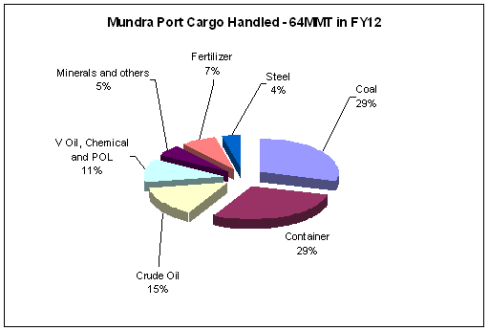
Also see: https://jainmatrix.wordpress.com/disclaimer/