The Importance of Equity in India

————————————————————————–

Summary

Here’s a short article on the perception of equity, how to start if you are a beginner and my story. This article has also been published on Indiamanthan – LINK

Perceptions

Ask 10 persons about their opinion of the Indian share market, and you will get the following responses:

  • Gambling
  • Losses
  • Waste of time
  • Risky
  • Bad advice and analysts

Just a few may say something positive

  • Steady profits
  • Retirement fund
  • Right way to grow wealth
  • Fight inflation

India is a country that is seeing a lot of change. Its visible in our cities, in our communication networks, and most of all, in the attitudes and thinking of people.

About 300 years ago, India was the richest country in the world. Then came a few wars, the British and Europeans, and a post independence Socialist regime. Its only in the last 20 years that India is getting a taste of what it’s been missing.

Freedom to work, freedom to earn, to live on our terms, to take pride in what we have. The Rest of the World is not to be blindly admired and coveted. They had their time in the sun. Now is our chance to be as good or better.

The Reality

The Indian Equity market has been through many phases over the last 30 years. But without a doubt, I will say that today Indian equity market s and platforms are among the best in the world in terms of transparency, low manipulation, low costs of transactions and efficiency.

So today, they represent much better the Indian economy, the industry, enterprise and the aspirations of Indians.

People have been hurt and burned in the past. But its time to learn the important lessons. And realize that if handled properly, the equity market is the most important Wealth creation asset for Indians today.

I realized this in my 10 year journey from a novice to a professional equity and portfolio analyst.
It’s a lot like fire. It can harm and burn you. But if controlled and used with safeguards, it can help cook your food everyday.

Here’s my suggested path

  • Your journey in Equities has to start with signing up with a brokerage and opening a demat account.
  • Your first investing experience may be in equity Mutual Funds
  • Next re-look at the companies you know. Where did your dad or uncle work? Are these good companies? Which branded products do you like? Are the companies that made them listed?
  • Take a close look at these firms. Or other good firms you know of.
  • Invest small amounts in them. Money that you don’t mind losing if your experiment fails.
  • Watch the firms over months. Read about them in the papers. See their results. Try to understand them better.
  • Some equity investments will give you profits. Others losses. Always try to learn important lessons. Build on the successes. Exit losses if the firms do not perform over a period. Build your own investing confidence and sense slowly.
  • Try not to blindly believe everything you read or hear.
  • Success in your personal investments will follow.

My Experience

This is how I went about my learning curve. But in my case, I was able to not just get investing success, but actually developed a passion for it.

I now publish equity research on my website, www.jainmatrix.com, and provide portfolios for investors to buy. As an equity and portfolio adviser, my firm JainMatrix Investments supports investors through their learning and investment cycle.

Do you find this site useful?

  • Please share your opinion in the Reply box below.
  • Visit the SUBSCRIBE page to find how you can get more. Click LINK
  • Register Now to get our Free reports and much more, on the top right of this page, or by filling this Signup Form CLICK.

Great investors and playing cards…

—————————————————————

On another platform, someone asked the question, Why are many great investors also great card players? It could be Bridge, Blackjack or even Poker.

Here are my thoughts on this subject. Investing is similar to card games because:

  • In both you are given a hand (or an investment idea) that can be quite random – it can be terrible sometimes, or very good at other times.
  • Both involve dealing with massive uncertainty. You need to be able to process and organize all the uncertainty and take decisions.
  • Uncertainty has to be converted into probability of expected events, and your investment (and card) calls have to be based on events you feel as most likely or very likely to happen.
  • In both investing and cards, players have to be defensive (inactive) and aggressive, depending on the situation. Not just from game to game, but even within a game, circumstances can change fast and acting decisively and boldly is required for success.
  • In both, people need to go beyond the obvious to succeed, and build a sense, or a gut feel of the situation. Their subconscious has been trained to help them decide, over years of practice. The most successful players get the available information and then just take the call. Getting a rational explanation from them for their decisions may be difficult, even if they wanted to tell you.

Cheers and happy investing. And playing cards.

Punit Jain, JainMatrix Investments

————————————————————-

Do you find this site useful?

  • Visit the SUBSCRIBE page to find how you can get more. Click LINK
  • Register Now to get our Free reports and much more, on the top right of this page, or by filling this Signup Form CLICK.

The Rationale behind a SELL decision

————————————————————————————————————————–

With the Indian markets pushing to new highs over the last 6 months, its time to ask a loaded, important, yet difficult question.

When should you SELL your stock?

I assume here that you are a long term investor. You are growing your equity portfolio from a minimum 3 year perspective and want to see it meet your big life goals.

Of late you would have looked at your nest egg with a glad eye. In the last 6 months, chances are you have been surprised at the excellent performance of these stocks. It is in these very happy times that you should note the importance of a Sell decision. After all it is very difficult to Time the Market. In stocks it is important to think contrarian. It makes more sense to decide for yourself on your sell decision, execute on it and be satisfied with it.

On a personal note, my favorite holding period for a stock is forever. This is a wisdom gained from the greats of investing. However there are some practical and real situations that we can face. The Indian market is more volatile than the ones the greats live in. These are the situations where you need to think of the Sell decision, and take a call. Here they are:

1. You need the Cash urgently 

The best of well laid out plans can get interrupted. It could be a medical condition. Or education admissions time. Or it could be a desired asset that has become available. Go ahead, and sell. You have earned the luxury of encashing your Demat balance.

Embed from Getty Images

2. Maintain your asset allocation 

Asset classes are varied such as Direct Equity, equity mutual funds, debt/ bond mutual funds, Gold ETFs, real estate, fixed deposits, insurance and cash. You may in consultation with your ‘Investment Adviser’ have agreed to maintain your asset classes in a certain proportion. So when the time comes to re-allocate, its possible that selling of Equity is the call by the agreed formula. This is good, and can help you align your portfolio risk with your personal risk appetite and objectives.

3. Switch to a stronger share 

For a long term investment portfolio, your objective should be to enter into investments with a chosen set of stocks. Read up and track them. And always be on the lookout for a better investment idea. If one comes by and you are convinced, make a switch from a weaker stock to a stronger one. It could be from the same industry. Or even an industry change. You now have a stronger stock portfolio.

Embed from Getty Images

4. Tax considerations 

In India any listed stock investment when sold at a profit after holding for one year constitutes a Long Term Capital Gain, which is not taxed. The one year period should be noted & considered before deciding to Sell.

Sophisticated investors may also consider the converse situation. A Short Term Capital (STC) Loss can be declared in case a loss is booked in an equity investment for a period less than one year. This can then be set off against a STC Gain, in the same year or (by carry forward) in the next few tax years. Speak to your Chartered Accountant before using this strategy.

5. Exceptional gains from a stock 

If you are invested for the long term in a number of stocks, you may be witness to a lot of stock specific activity that can be quite interesting. If your stock has recorded massive recent gains, which are difficult to justify on the basis of fundamentals, it may be time to book partial or even full gains in the stock. Things happen. Shares can appreciate suddenly and unexpectedly. This is a good problem to have. Greed may stop you from doing this. This is where good advice from your Equity Service can be useful.

(JainMatrix Investments is an Equity Service that tracks 3 portfolios for its subscribers, the Large Cap Portfolio 2014, the Mid Cap Portfolio 2014 and the Post Elections Investment Seven)

6. Business has deteriorated (but does not reflect yet in the price) 

You got some good equity research, assessed an opportunity and the risk, and decided that XYZ stock was a great investment. Six months later, something unexpected happened. Maybe one of your investment assumptions went wrong, or an industry specific regulation change, or such. And the future doesn’t look so good for XYZ now. Review the situation with inputs from your Equity Service. Bite the bullet. If justified, take the Sell call. Don’t get married to your stocks. You have to be solid yet nimble in your long term investment decisions. Get out quickly to minimize your losses.

Embed from Getty Images

7. The share price has fallen sharply 

Markets, and shares, by nature are volatile. If the share you hold has seen a sharp fall in price recently, this needs to be analysed. If the fall is due to temporary reasons, like some bad publicity over a minor issue, a temporary technical correction or such reason, then it can be ignored. It may even be a good point to accumulate more shares. But if the reason for the fall is found to be due to a ‘fundamental’ deterioration, then again it may be time to exit.

8. The market changes direction for the worse 

Sometimes the market reaches an inflection point and changes direction. If it is positive like the recent elections schedule announcement then its good for your portfolio. But if it is negative then it may be time to exit, at least partially. This is a tough call to predict. Here again, you can review the situation with inputs from your Equity Service.

Having said all this, it is in the nature of stocks to see long periods of both under and over performance. The market is very very inefficient, and this gives good value and growth investors in India lots of opportunities.

The Converse, a few reasons why you should NOT Sell your stocks in these times:

  1. You can get 10 baggers only if you leave your high potential appreciating stocks alone and let them fly.
  2. If the Modi government delivers on their potential, promise and visibly bold approach, the party for Indian investors has just begun.
  3. For a long term investor, a short term correction of say 10% is not something to worry about. Markets move in a ripple or zig-zag fashion in the short term, but pan to the multi year view, and the Indian indices haven’t looked so bullish since 2004-05.
  4. Valuations for the Indian indicies are just above the average. If the investment cycle is kick starting again, aided by a Modi government, earnings will accelerate and valuations may stay just above average even if the Indices forge ahead sharply.
  5. Indian Retail, hurt by the dull period of 2008-12 and big damaging overpriced IPOs, is just about starting to join this market rally, if MF numbers are anything to go by. Picture abhi baki hai mere dost.

Overall Opinion

  • Stay positive.
  • Book partial gains in some stocks.
  • Temper future expectations from Indian Indices after the recent run up.
  • Watch for cues from the budget.

But as usual there are no easy answers.

Happy Investing,

Punit Jain, JainMatrix Investments

Do you find this site useful?

  • Visit the SUBSCRIBE page to find how you can get more. Click LINK
  • Register Now to get our Free reports and much more, on the top right of this page, or by filling this Signup Form CLICK.

Disclaimer

This document has been prepared by JainMatrix Investments Bangalore (JM), and is meant for use by the recipient only as information and is not for circulation. This document is not to be reported or copied or made available to others without prior permission of JM. It should not be considered or taken as an offer to sell or a solicitation to buy or sell any security. The information contained in this report has been obtained from sources that are considered to be reliable. However, JM has not independently verified the accuracy or completeness of the same. Neither JM nor any of its affiliates, its directors or its employees accepts any responsibility of whatsoever nature for the information, statements and opinion given, made available or expressed herein or for any omission therein. Recipients of this report should be aware that past performance is not necessarily a guide to future performance and value of investments can go down as well. The suitability or otherwise of any investments will depend upon the recipient’s particular circumstances and, in case of doubt, advice should be sought from an independent Financial Expert/Advisor. Either JM or its affiliates or its directors or its employees or its representatives or its clients or their relatives may have position(s), make market, act as principal or engage in transactions of securities of companies referred to in this report and they may have used the research material prior to publication. Any questions should be directed to the director of JainMatrix Investments at punit.jain@jainmatrix.com
How many mutual funds should I hold?

——————————————————————————————————————————– I came across the question on an online forum, and wanted to answer this …..

How many mutual funds should I hold?

Let me try to answer your question from several perspectives.

Answer from perspective 1: A mutual fund is a collection of direct stock investments with an overall theme and structure. The theme usually is

  • Large Cap/ Mid/ Small equity, or
  • a sector equity, or
  • a debt or bond fund, or
  • a mix of above.

The structure will be a diversified number of stocks/ bonds with an upper limit for any single investment. It can also limit sector concentration, etc. There are also norms of Risk and Churn which are to be followed. Having noted this, I would argue that if we understand the perspective of the investor, just one MF would be sufficient. This choice would incorporate the risk profile of the person –

  • Conservative (debt, bond, ETF or safe Large Cap equity MF)
  • Aggressive (Mid Cap, Small Cap or sector fund) and
  • Balanced (diversified equity plus debt).

There may also be a mutual fund house performance risk, so at best a second fund may be added from another MF house.

Answer from perspective 2:

For equity investments, None.

I am personally of the view that once a new investor has experienced equity MF investing for a few years (or even earlier), he is mature enough to both –

  1. do some of his own research and
  2. realize some of the negatives of MFs.

And he may be ready for Direct Equity investments on his own. Let me elaborate. MFs are good instruments for the beginner investor. But there are a couple of negatives of MFs

  1. Annual management expense are fixed costs of up to 2.5% of portfolio.
  2. Variable performance of MFs. Many have underperformed the benchmarks over extended periods of time.
  3. No success incentives. There is no element of success profit share with investor, so there is no incentive to outperform the indices, except a higher position on the rating charts.
  4. Mis-selling of MFs by intermediaries can cause high MF churn, not allowing investors to wait for gains.

In this scenario the investor may realize that investing directly in equity with some guidance is the lowest cost and maximum gain scenario, for long-term investment gains. This is what we do at JainMatrix Investments.

  • The investor can use his own demat and trading account for share purchases
  • The investment service recommends investments into direct equity and monitors them to ensure performance
  • After the fixed costs of the Investment service, and the demat and share purchase costs, the investor gets to keep his entire portfolio profits, effectively maximizing gains
  • Critical here is the quality of the investment service, which they should ensure

JainMatrix Investments has a great track record, check for yourself. LINK

Disclaimer

This document has been prepared by JainMatrix Investments Bangalore (JM), and is meant for use by the recipient only as information and is not for circulation. This document is not to be reported or copied or made available to others without prior permission of JM. It should not be considered or taken as an offer to sell or a solicitation to buy or sell any security. The information contained in this report has been obtained from sources that are considered to be reliable. However, JM has not independently verified the accuracy or completeness of the same. Neither JM nor any of its affiliates, its directors or its employees accepts any responsibility of whatsoever nature for the information, statements and opinion given, made available or expressed herein or for any omission therein. Recipients of this report should be aware that past performance is not necessarily a guide to future performance and value of investments can go down as well. The suitability or otherwise of any investments will depend upon the recipient’s particular circumstances and, in case of doubt, advice should be sought from an independent expert/advisor. Either JM or its affiliates or its directors or its employees or its representatives or its clients or their relatives may have position(s), make market, act as principal or engage in transactions of securities of companies referred to in this report and they may have used the research material prior to publication. Any questions should be directed to the director of JainMatrix Investments at punit.jain@jainmatrix.com

How The Economic Machine Works

Dear Reader,

Normally I send you a note, ask you to open your wallet and invest in a firm.
Today I am going to ask you to invest something more valuable …. your time.
This is a beautiful video showing How The Economic Machine Works, takes 30 minutes but very watchable. By Ray Dalio, a great American Fund manager.
It will show how Economic cycles affect our lives. I also believe that long term investments aligned with Economic Cycles can maximise investor returns.
Its worth your time.

Wishes and riches,
Punit Jain
JainMatrix Investments

JainMatrix Knowledge Base:

See other useful reports

Do you find this site useful?

  • Visit the SUBSCRIBE page to find how you can get more. Click LINK
  • Register Now to get our Free reports and much more, on the top right of this page, or by filling this Signup Form CLICK.

Disclaimer:

These reports and documents have been prepared by JainMatrix Investments Ltd. They are not to be copied, reused or made available to others without prior permission of JainMatrix Investments. Any questions should be directed to the director of JainMatrix Investments at punit.jain@jainmatrix.com

Also see: https://jainmatrix.wordpress.com/disclaimer/

Make Equity Investing less tricky: the JainMatrix Eleven

I’ve been through a cycle of Education, Corporate life, Jobs and Investing long enough for me to understand the importance of starting Equity Investing early. Once you start earning, and ‘roti, kapda, makaan’ are doing ok, you need to take care of ‘long term wealth creation’.

I know that a lot of people wince when told about the ‘share bazaar’ and recount deep losses of their own or a close friend or family member. But Investing if done with some care and control can certainly build you good assets and a lifetime of gains.

There are ways for an Indian investor to make Investing a profitable process. Here are my top eleven tips.

The first five, for those new to Investing:

#1 – Make a Plan: Before you take any investing decision, run your numbers. If salaried, you need to pay your monthly rent or Loan EMIs. Next your food and utilities (electricity, internet, telephones and fuel) payments. And money for the family back home. After your essentials, the available funds are for entertainment, gifts, vacations and savings/ investing. Some professional planners recommend 10% of take home set aside for long-term investments like equity. Others work backwards from your future expenditures and commitments like children’s education, retirement, etc., incorporate inflation and a simplified return rate, and come up with a monthly amount you should set aside. Take any approach. Come up with a monthly investable amount.

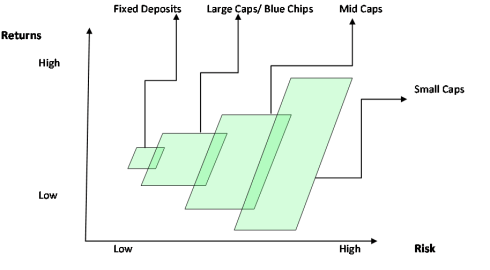
#2 – Understand Risk, and Set your expectations: Understand that by nature Equity investing is far more volatile than a Fixed Deposit. There will be bad years. A 30% fall in Indices can happen once in 5 years. But most other years will be flat or positive. Gains can be as high as 50% in good years. An expectation of 20% gain per year over the next 4-5 years starting today, is a reasonable target to set. See Fig 1.

Risk and Returns, JainMatrix Investments

Fig 1 – Risk and Returns, JainMatrix Investments, Click image to expand

#3 – Get a Demat account, and Invest through SIPs: Today a Demat account is to investments what a savings bank account is to finances. Pretty essential. The choice for this can be based on convenience. Can your current Bank offer you a linked demat facility? The cash transfer would then be easy. Or you need to find a good broker. If you are internet savvy, go for an online trading account, linked to the demat and savings accounts. Systematic Investment Plans normally involve investing a monthly sum of money into a chosen basket of investments, like MFs or a group of stocks through Direct Equity. The SIP approach helps as in times of bear markets, the investor accumulates a larger number of shares (or MF units). And in bull market periods, he can gain from the appreciation of his portfolio.

#4 – Start with Equity Mutual Funds: The entry point, and safest initial experiences with equity can be MFs. Typically a MF consists of a portfolio or a group of shares chosen by an equity analyst/ Portfolio manager.  This group can be chosen by company size and market capitalization (Large Cap, Mid cap and Small cap) or vertical (Banking, Pharma, Consumer, Auto, etc.) or ownership (PSU, MNC, etc.) or an Index (Sensex, Nifty, etc.; these MFs are known as ETF – Exchange Traded Funds) or some other theme.

#5 – Move to Direct Equity: Direct Equity is a lower cost, more powerful way to invest in Equity. The MFs also may not be the best vehicle for investing if you want better returns at lower costs. They charge a management expense that eats into your gains. And performance varies widely from year to year, rarely providing consistent gains (with a few exceptions). Instead take inputs from professional Investment Advisory Services (like my firm, JainMatrix Investments). Such services focus investments from the very broad portfolios of MFs to a smaller focused group of stocks.

The next six for experienced investors:

#6 – Have patience …… and review your portfolio periodically: In long-term investing, returns come with time. The important thing is to get your portfolio right up front with some research and discussion. Then stick with it for a decent period of time, measured usually in years. Annual reviews are definitely required. A subscription with an Investment Advisory Service (such as JainMatrix Investments) can also give you more frequent monthly inputs that can reinforce your choices.

#7 – Exit your laggards, reinforce your winners: A good Portfolio Manager is able to make successful share picks only 6 out of 10 times. So it’s no big deal if some of your picks give losses. Some stocks just do not go as planned or expected. Once you have given the share a fair amount of time, and the fundamentals are just not looking up, and it remains loss making, exit. You are saving yourself from extended losses. Doing this is difficult with shares that have in the past given you great returns, but are now looking flat or weak for a long time. Unless there is a good explanation for the under-performance, and a convincing reason that these conditions are going to change in the future, it’s better to exit the stock. If required, get advice from your Investment manager.

#8 – Don’t transact very often: Every purchase and sale of shares or MFs costs you 1-2% of your asset. An investor should not do too many trades. Note that many Brokers, Portfolio managers and MF distributors may be compensated (partially or fully) from every transaction you do. It is in your interest to reduce the number of transactions, and examine such advice closely.

#9 – Taxation is important but not critical for portfolio decisions: The current Indian taxes on securities are pegged at your personal Income tax rate for Short Term Capital Gains (STCG) or gains in a holding period of less than 1 year. Taxes are zero for Long term Capital Gains (LTCG). It helps if every gain is a LTCG. But if there is an unusual gain in the short-term, unlikely to extend, by all means, book your gains. From a taxation point of view STCG and STCL – losses – can cancel each other out in the same financial year.

#10 – A Note on Trading, as different from Investing: I will quite simply call Trading as an equity purchase made with the intention to profit from price movements rather than from an appreciation of the value of the underlying business. Typically trading in India involves a holding period varying from a few hours to less than 2 months. Lets be clear that in Fig 1, Trading is on the right hand side, beyond and larger than Small Caps in terms of Risk and Returns. Trading for many is a profession that requires many years of learning before you get profits. Beginners are advised to have adequate preparation before trying to trade. I’ve seen rich grown men lose their life savings due to the addictive attraction of quick gains from trading. If you just want to gamble, go find a Casino. At least you will enjoy the ambiance while losing your money!!

#11 – Humility and Continuous improvement: Learning is an ongoing requirement. Change is constant in our lives. There are new companies, new sectors, new government regulations and increasing international influences. Like in any other sphere in your life, be open to new ideas, study and learning, and engaging in discussions with even those with opposite views. Something valuable may come out of it!!

I just read an article by Richard Branson called ‘Make Travel less tricky” and liked the concept so much, it gave me idea for an article on investing. Thanks Richard Branson, thanks Mint :-) 

JainMatrix Investment Advisory Service is available for a small annual Subscription.

SUBSCRIBE NOW

See Offering

Contact

  • Ask for a call back by filling FORM
  • Register Now to get our Free reports and much more, on the top right of this page, or by filling this Signup Form CLICK.

JainMatrix Knowledge Base:

See other useful reports

  •  JainMatrix Track Record – LINK
  • An Investor’s Checklist – LINK
  • For Long term investments start a direct market SIP – LINK
  • Bharti Infratel IPO: Aggressive offering of Passive Infrastructure LINK

Disclosure: It is safe to assume that if the JainMatrix website recommends a stock, the researcher has already invested in it.

Do you find this site useful? You can:

  1. Subscribe to be the first to receive new posts. Click on SUBSCRIBE
  2. Request for Email Updates. Enter your email on the ‘Email Updates’ box at the top right of this page.
  3. Or Click on this Signup Form CLICK
  4. Socialize with us – Like on Facebook or Visit on LinkedIn
  5. Add your comments/ queries below

Disclaimer:

These reports and documents have been prepared by JainMatrix Investments Ltd. They are not to be copied, reused or made available to others without prior permission of JainMatrix Investments. Any questions should be directed to the director of JainMatrix Investments at punit.jain@jainmatrix.com

Also see: https://jainmatrix.wordpress.com/disclaimer/

Investing needs Discipline

I came across an article that was interesting. While the tone is a bit aggressive, it’s worthwhile to read this ……..
See Eco times article on LINK

Do you find this site useful?

  • Visit the SUBSCRIBE page to find how you can get more. Click LINK
  • Register Now to get our Free reports and much more, on the top right of this page, or by filling this Signup Form CLICK.