Should you Invest or Prepay your Home loan? – Jan 2025

Introduction

Last month, my conversation with an investor went like this –

Rahul (not his real name): I have a home loan of ₹ 75 lakhs, of 20 years duration, and am paying an EMI every month. Right now I have cash available with me of ₹ 10 Lakhs. I have already been an investor in Equity markets for 10 years. Should I use this amount to repay my Home loan, or should I add it to my investments in the markets?

The rest of the conversation, I share below in a formal manner:

Approach – Review Rahul’s Profile:

Deciding whether to use cash savings to pay off the home loan or invest in equity depends on several factors, including Rahul’s financial goals, loan terms, risk profile and the potential returns on investment. Here’s how to think through this:

1. Consider his Home Loan Details

  • Interest Rate: Is Rahul’s home loan interest rate high (above 10-11%)? For Rahul it was 10%.
  • Loan Tenure Remaining: If he is in the early years of the home loan, paying off part of the principal can save more in interest, than in the latter half of the repayment period.
  • Tax Benefits: If he is availing tax deductions on interest (Section 24(b)) and principal repayment (Section 80C in India), consider how much benefit he is getting. The real post tax cost of Home loan may be lower, so from a 10% Home Loan rate, he may be actually paying about 6-7%.

2. Evaluate his Market Investment Details

  • Equity Returns: Historically, equity markets have offered average returns of 12-13% over the long term per the Sensex. However, the returns can vary depending upon Rahul’s actual market instruments – Equity Mutual Funds, Direct Equity Portfolio or ETFs. For Rahul it was 15% compounded on average over the last 7 years.
  • Rahul’s Risk Tolerance: Is he comfortable with short-term investment fluctuations? Equity investments certainly face market risks and volatility.
  • Time Horizon: Equity Investments generally perform better over a longer horizon (3+ years). If Rahul has a shorter time horizon for his equity investments, adding to these may not be a good idea.

3. Assess his Financial Situation

  • Emergency Fund: Rahul must ensure he has 6-12 months of expenses saved in a liquid emergency fund before considering his options.
  • Other Debts: High-interest debts (e.g., credit cards, personal loans) should be prioritized for repayment before addressing the home loan.
  • Working years: Are Rahul’s working years before retirement more than the Home Loan Tenure?
  • Retirement Goal: Is he on track for retirement savings? Equity investing might help achieve these if the Time Horizon is larger.

Calculate Two Data Points for Rahul

  • Tax adjusted cost of Home Loan: let’s assume that for Rahul from (1) that it is 7%.
  • Rahul’s expected Equity market returns: The past is apparent, while the future is unpredictable. However we can be conservative and project lesser returns in future than in the past. As noted in (2) Rahul got 15% returns compounded from his mix of Equity MFs and Direct equity. Let’s project future returns from these instruments at a lower 12%. Tax here is difficult to project but if fair tax planning is happening, capital gains can be within annual zero tax limits.

With the above data points it becomes obvious that for Rahul, Equity gives higher returns of 12% than the cost of Home Loan (7%).

Conclusion

  • The immediate conclusion would be that Rahul should use the 10 L funds in Equity investments and continue to repay the Home Loan as per the original plan. Here Rahul should be able to grow his incremental savings of ₹10 L by (12 – 7) = 5% annual average over the duration of the Home Loan.  

However several caveats and conditions can color or even change this conclusion:

  • The Home Loan repayment is an almost fixed commitment of monthly payments. There can, of course, be some interest rate resets, but otherwise, EMI and tenure are fixed. On the other hand, the Equity market returns can be volatile and unpredictable in the short term. So Rahul has to be comfortable with taking on these uncertainties and both commitments together.
  • If the Home Loan tenure is longer than expected working years of Rahul, it may be wiser to repay the Home Loan partly with the Rs 10 L, reduce the tenure, and plan for an EMI-free retirement
  • If the returns that Rahul projects to get from Equity markets are on average 9% or less, then the benefit is lower, and it may be better to repay the Home Loan than to invest in equity.
  • If Rahul’s job or business future cash flows are uncertain or constrained, early repayment of Home Loan again might be the prudent choice.

Liked the article? Like and comment on this website, and on LinkedIn, Twitter & Facebook below.

Disclaimers

  • Investors new to our Research Analyst service can look at our OFFERINGS, and sign up using the PRICING AND PAYMENT OPTIONS link, to grow their Direct Equity investment portfolios.
  • This note has been prepared by JMI, and is meant for use by the recipient only as information and is not for circulation. This document is not to be reported or copied or made available to others without prior permission of JMI. This report should not be considered or taken as an offer to sell or a solicitation to buy or sell any security. The information contained in this report has been obtained from sources that are considered to be reliable. However, JMI has not independently verified the accuracy or completeness of the same. Neither JMI nor any of its affiliates, its directors or its employees accepts any responsibility of whatsoever nature for the information, statements and opinion given, made available or expressed herein or for any omission therein.
  • Investments in the securities market are subject to market risks. Read all the related documents carefully before investing. The suitability or otherwise of any investments will depend upon the recipient’s particular circumstances and, in case of doubt, advice should be sought from a financial planner or RIA Registered Investment Advisor.
  • JMI has been an equity investment adviser commercially since Nov 2012, and a SEBI certified and registered Research Analyst since 2016, under SEBI (Research Analysts) Regulations. Registration granted by SEBI, and certification from NISM in no way guarantee the performance of the Research Analyst or provide any assurance of returns to investors.
  • Any questions should be directed to punit.jain@jainmatrix.com. Name of the RA as registered with SEBI – Punit Jain, SEBI Registration No. INH200002747. Logos / brand name –

Repco Home – A Fortune at the bottom of the Pyramid

_________________________________________________________________

  • 06-Jan-2014
  • CMP: Rs 340
  • Mid Cap – Mkt Cap 2120 crores
  • Advice: Buy
  • Target: 660 by March 2016

Here is a note on Repco Home Finance (RHF). Download the report using the Link – REPCO home finance_JainMatrix Investments_Jan2014

Summary

Repco Home Finance is a Chennai based NBFC. The average loan ticket size is small, and aimed at self-employed and weaker sections of society. Even so, it’s a well-managed firm with Total income, NII and Net Profit growing at 42.6%, 39.7% and 39.6% CAGR over the last 6 years. After the May 2013 IPO the share price has appreciated 98% already. RHF is addressing “the Bottom of the Pyramid” and still doing so with low NPAs and a good NIM. Invest in this firm not just for the growth or profits or share price appreciation, but for the immeasurable social benefits it provides.

Business Profile

  • Repatriates Cooperative Finance and Development Bank, (REPCO BANK) a Govt. of India firm was set up for supporting the rehabilitation of repatriates from neighboring countries mainly Sri Lanka and Burma. Chennai based Repco Home Finance, (RHF) was promoted by REPCO bank in 2000.
  • Total Income in FY13 was 406 cr and Profits 80 cr. Its asset under management are at Rs 4035 crore.
  • RHF focuses on relatively under-penetrated markets, see their business profile in Fig 1.
  • RHF has 82 branches and 20 satellite centers, majorly in South India, with 64% of loan book from TN. The plan is to grow to 100 branches with new branches in Mah, Gujarat, Orissa and West Bengal.  
  • The M.D of Repco Group including RHF is Mr R. Varadarajan, a career Banker.
  • Consumer – The average home loan size is Rs 9.8 lakhs given to lower-income self-employed people. The total construction value may be Rs 15 lakhs, for a 1000 sq. ft house. (JainMatrix estimates).

Fig 1 - Business Overview, JainMatrix Investments

Fig 1 – Business Overview, JainMatrix Investments

  • RHF follows a lean and efficient business model, with small branches having 2-4 employees with local knowledge, a centralized loan process, no DSA sourcing and totally only 398 employees.
  • Good ratings post IPO with ICRA (upgraded) AA- and CARE (assigned) AA- rating for RHF long term loans.
  • Current shareholdings are Promoters 37.4%, FII 6.3%, DII 15.9%, NRIs/Foreign Individuals/Non Resident companies 35.8%, others 4.8%.

Industry Note

  • There are a large number of NBFCs in India (>10,000). This fragmented market offers big growth opportunities for Home Loans. RBI has projected a 14% growth in loans for Banks; NBFCs should have higher industry growth rates of around 24% for the next five years. (ICRA/ industry experts).
  • Housing finance companies account for 40% of the retail home loan market. The home loan portfolios of mortgage NBFCs have also grown faster than commercial banks in the last few years.
  • The top 4-5 companies will have close to 85-90% share of the retail home loans. These firms are HDFC Ltd, LIC Housing Finance, Dewan Housing Finance Corporation and Indiabulls Housing Finance.
  • RHF addresses a market segment that is underserved, and only addressed by a few micro-finance NBFCs. This is a large and unaddressed, high potential sector.
  • Inflation and Interest rates are at highs as of now, which is difficult for the sector. However the 2 year outlook is a slow fall in both, even as the investment cycle recovers in India.

jainmatrix investments, repco home finance

Fig 1 – Business Overview

Unique Strengths

  • Since RHF is promoted by REPCO Bank (a PSU Bank), it should get state govt. support. Repco Bank is part owned by Govt. of India, and TN, AP, Kerala and Karnataka governments.
  • RHF reaches to the underserved, weaker sections of the society, offering small ticket home loans to self-employed persons. It addresses a segment which is underserved and has high growth potential.
  • RHF has a strong local presence in Tamil Nadu, and is extending operations to neighboring states.
  • With a healthy 4% NIM, RHF is profitable while growing fast.
  • With its lean branches and its presence in Tier 2 and 3 cities, and periphery of Tier 1 cities, RHF has an organisation structure well geared to addressing its current customer segment. RHF shares branches with Repco Bank, thus reducing the cost of operations and having synergies.
  • Cost of capital was stable for the last 2 years, and loan rates for customers have not been increased.
  • RHF has conservative lending metrics: LTV (Loan to Value) 65% and IRR 50%. This is a strength.
  • A personal visit by the researcher to a Repco Bank/ RHF branch indicated courteous service and discussions, a competitive home loan rate and simple but efficient branch environment.  

Stock Evaluation, Performance and Returns

  • RHF was listed recently in April 2013, with an IPO pricing of Rs 172. The Rs 270 crore IPO was a success with 1.62 times over-subscription. It has already appreciated 98% since to date.
  • RHF has shown very good performance over the last few years, with Total income, NII (Net Interest Income) and Net Profit growing at 42.6%, 39.7% and 39.6% CAGR over the last 6 years. See Fig 2.
  • A fall in NII% indicates an increase in cost of loans. PAT margins too have fallen from 27% to 20%. However in the backdrop of surging Total Income, this is not worrying.

Fig 2 - Business Financials, JainMatrix Investments

Fig 2 – Business Financials, JainMatrix Investments

  • The loan book grew at 38% CAGR from FY-09 to FY-13.
  • The cost of borrowing of the company is 9.3% which is quite low. The dividend yield is 0.31%.

Fig 3 - Financial Metrics, JainMatrix Investments

Fig 3 – Financial Metrics, JainMatrix Investments

  • From the chart we can see that the NIM ranges between 4-5%. See Fig 3. NIM may have fallen recently, but it is high at 4% levels. It may rise again post IPO.
  • Gross and Net NPA are within comfort levels at 1.48% and 0.99%.
  • Post IPO the capital adequacy ratio (CAR) is at very good level of 25.6% which is well above 12% level specified for the sector. RHF has room for loans growth for several years with current capital.

Fig 4 - Price and PE Chart, JainMatrix Investments

Fig 4 – Price and PE Chart, JainMatrix Investments

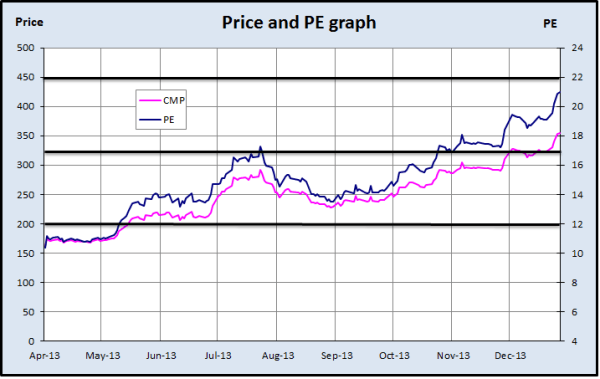
  • Price and PE chart shows that Share Price and PE are fairly in sync. We can see that PE has risen rapidly post IPO from 12 to 22 times and the mean level stands at 17 times. See Fig 4.
  • ROCE is 11.6% and Return on net worth is 12.6%, these are good ratios.
  • Its asset under management stood at Rs 4035 crore by H1 FY14, a growth of 30% in 1 year.
  • PEG is at 0.7 – indicates undervalued status, below the norm of 1.

Peer Benchmarking and Financial Projections

In a benchmarking exercise, we compare RHF with its peers.

Benchmarking

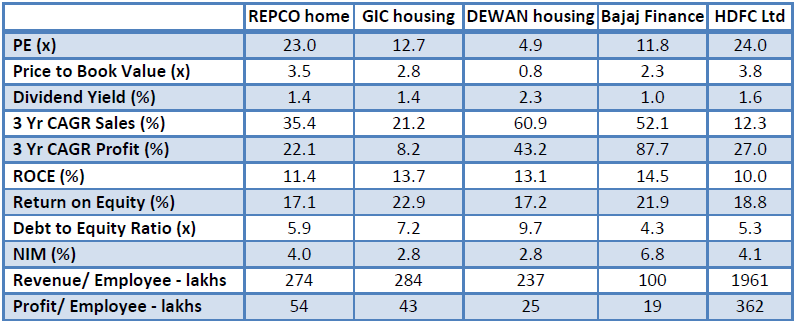
  • It appears that RHF is overpriced and closer to HDFC Ltd on valuations. However we can see that RHF has good NIMs and lower D/E ratios.
  • Also on productivity metrics, RHF scores high. This indicates that in the short term, growth can be accelerated by means of hiring.
  • RHF by virtue of its small size, growth and lack of competition looks well placed.
  • Bajaj Finance also shows good metrics. See a research report on the same. LINK

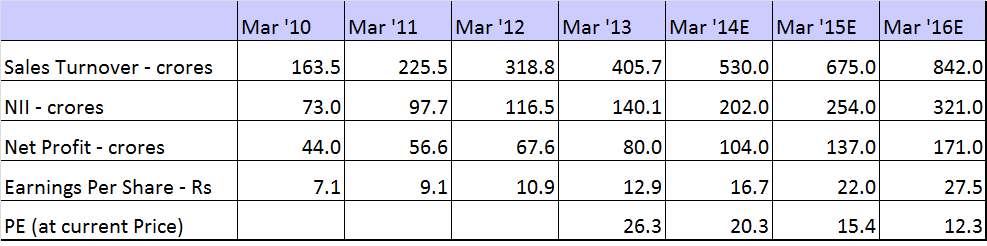
Find projections of RHF financials in Exhibit 6.

Projections

Opinion, Outlook and Recommendation

  • Indian market is underserved for loans and financial services. This is more so in the poorer sections and self-employed of society. RHF has little competition in this segment.
  • Indications are that RHF will continue to grow its business well. The exit of some Private equity investors post IPO should actually accelerate the profits due to lower costs.
  • RHF is not just doing a Social Service, but doing so at a healthy profit. In his famous book, “The Fortune at the bottom of the Pyramid” the respected author C K Prahalad turned attention to firms that can do this. We feel RHF is one such company.
  • RHF has had its IPO only 9 months ago. As the company becomes better known and understood, we feel investors will understand the Social achievements of RHF.
  • Invest in RHF not just for the growth or profits or share price appreciation, but for the immeasurable social benefits it provides. Invest systematically for long-term out-performance.
  • Advice: Buy with a Target of Rs 660 by March 2016
SUBSCRIBE NOW. Click on See Offering

JainMatrix Knowledge Base:

See other useful reports

Disclosure: It is safe to assume that if the JainMatrix website recommends a stock, the researcher has already invested in it.

Do you find this site useful?

  • Visit the SUBSCRIBE page to find how you can get more. Click LINK
  • Register Now to get our Free reports and much more, on the top right of this page, or by filling this Signup Form CLICK.

Disclaimer:

These reports and documents have been prepared by JainMatrix Investments Ltd. They are not to be copied, reused or made available to others without prior permission of JainMatrix Investments. Any questions should be directed to the director of JainMatrix Investments at punit.jain@jainmatrix.com

Also see: https://jainmatrix.wordpress.com/disclaimer/