Titan Industries – The Jewel in the Crown

——————————————————————————————————————————————

  • Date: November 9, 2012
  • CMP: Rs 294
  • Large Cap – Mkt Cap 26,000 crores
  • Advice:  Buy systematically

Titan Industries is a power brand and runs the largest specialty retail chain in India. Following the pioneering success in watches and jewellery, it is now building the eyewear, precision components and accessories businesses. The FY12 turnover of Rs 8791 and profit Rs 600 crore reflect a 5 year CAGR of 34% & 45% resp. Titan is at a very early stage of revenue and profit growth. Invest.

This is an update of my June 2011 report, A Titan for the Long Term.

Titan Industries – Description and Profile

  • Titan Industries is a Bangalore based Tata group company selling watches, jewellery, eye wear and precision components. It has built strong brands and India’s largest specialty retail network.
  • It started in 1984 with a JV between the Tatas and Tamil Nadu Industrial Development Corporation for watches, later expanded in 1995 into jewellery and in 2007 into eye wear.
  • Turnover in FY12 was 8971crores and PAT 600 cr. Sales have grown 34% CAGR over the last 5 years. Market Cap is 26,000 cr, making it about #55 in India.
  • The 6,000+ employees manage over 879 retail stores (India) with area 10 lakh sq.ft., two design studios for watches and jewellery and 9 manufacturing units.
  • Shareholding pattern is: Indian Promoters – 53.4%, MFs/ DII 4.5%; FIIs 15%, Bodies Corporate plus others 2.4%, General Public 24.7%. Rakesh Jhunjhunwala, a big investor, owns 11% of Titan.
  • Key Executives are: Bhaskar Bhat, MD and C K Venkataraman, CEO, Jewellery.
  • The FY2015 target is $3 billion (Rs 15,000 cr.) as per the MD.

Business Notes

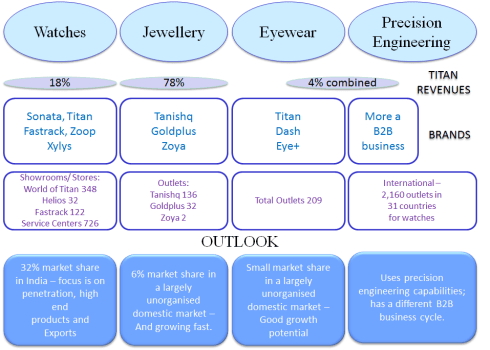
  • The Jewellery division is the largest in Titan, accounting for 78% of revenues. The next are Watches, Eyewear and precision parts.
  • Overall growth YoY has been 36% for the firm.  
Titan Business Segments, JainMatrix Investments

Fig 1 – Titan Segment Revenues, JainMatrix Investments

  •  For exports, Titan has been cautious. It sells only watches and only in Asia and the Middle East. It sells through 1,850 overseas outlets, with more than 1,000 in the Middle East.
  • Overall exports make up less than 5% of total revenue

Titan’s Brands and Industry Notes

  • Titan products are linked to consumer disposable incomes and straddle multiple segments.
  • Titan operates 85% of its stores through franchisees, allowing scalability and low cost expansion.
  • In the Annual Survey for the Top 100 Brands-2009 conducted by Economic Times, both Titan (#4) and Sonata (#86) were featured. Titan was also ranked #1 in the consumer durables category.
  • Here is a graphic Fig 2 of Titan’s products, distribution, brands and future growth drivers.
Titan’s Business Segments, JainMatrix Investments

Fig 2 – Titan’s Business Segments, JainMatrix Investments

Watches

  • Titan’s own brands are Titan, Fastrack, Xylys, Zoop, and Sonata. High end licensed watch brands include Tommy Hilfiger, FCUK, Hugo Boss and Helios, and Retail formats include World of Titan – 348 showrooms, Fastrack – 122 stores/ kiosks and Helios – 32 stores. There are 726 Service centers.
  • Competition includes Citizen, Swatch, HMT, Timex, and (high end) Tissot, Seiko, Rolex, Tag Heuer.
  • The market size is estimated at 5000 cr., of which around 45% is organized sector. It is one of the most organised retail categories in the country. Titan dominates this organized sector in India with 32% share of total market (around 70% of organized sector).
  • Industry body Assocham has in a study predicted the market will grow 3 times – 15,000 cr by 2020.
  • Watch parts which were sourced from China, are now being produced in house in India. This gives Titan better prices, greater control over the supply chain and quality control.
  • The average selling price per watch in FY12 was Rs 1234.

Jewellery

  • Titan has less than a 6% market share in the $30 billion (Rs 1,50,000cr) gems and jewelry market. The unorganised sector accounts for 90% of retail market in India, according to (CRISIL Research),
  • Major Brands are Tanishq, GoldPlus and Zoya; sub-brands are Mia, and FQ teen diamonds.
  • Manufacturing facilities in Hosur (Tamil Nadu), Dehradun and Pantnagar (Uttarakhand)
  • Tanishq brand has 136 retail stores including 2 Zoya stores; GoldPlus has 32 stores
  • Most of the competition is from unorganized sector – local jewelers.
  • Organised sector players include Reliance Retail, Damas Jewellery, Gitanjali Gems, Swarovski, Diamond Trading Company, Tribhovandas Bhimji Zaveri, Vardhaman Developers, Dubai-based Joy Alukkas, Viswa and Devji Diamonds and Gold Souk India.

Eyewear

  • In eye wear, the three in-house brands are Titan, Eye+ and Dash, while the international and luxury brands include Gucci, D&G, Armani, BOSS, Esprit, Daniel Swarowski and Mont Blanc. Titan Eye Plus retails eyewear brands such as Tommy Hilfiger, Hugo Boss, Cabana, Switchers, Flexx, Vybes and Versace, and in-house brands.
  • The organized sector accounts for about 25% of the overall domestic eyewear industry with a share of over Rs 5,200 cr. of a market size around 21,000 cr.
  • Titan operates India’s largest optical retail chain with 209 retail outlets across 78 towns. The management has guided breakeven for this segment in 4QFY13.

Recent Events and Strategies

  • Gold prices rose in CY12, as a result, jewellery sales volumes fell. With some recent stability and even a fall in prices, Titan now expects demand to increase. The third quarter every year is also the traditional festival and marriage season and this should also help to boost volumes.
  • Titan has expanded its accessories division by launching belts and wallets under men’s apparels, in addition to wristwatches. Soon it will offer Belts and handbags for ladies.
  • Titan Eye Plus recently launched Vision Check – a self-administered online vision test facility. It accurately establishes the need for vision correction if required. To take the test, participants have to visit the Titan Eye Plus website at www.titaneyeplus.com.The jewellery site is www.tanishq.co.in
  • Titan recently launched the Titan Edge watch collection, a slimmer high end product.
  • Titan has appointed VikramKapur, principal secretary of Tamil Nadu state’s industries department, as its chairman and a director on the board of the company.
  • Titan is planning to expand into 400 second-tier cities with populations of 200,000 or more.

Stock Evaluation, Performance and Returns

The Price and Dividend history of Titan is detailed in Fig 3.

Price history, JainMatrix Investments

Fig 3 – Titan Price History, JainMatrix Investments

  • The Titan share had a low of 33 in Mar 2009, in the banking crisis aftermath, but today is near all-time highs of 297. See Fig 3 – Price History
  • The share has given investors a 39% CAGR return over the last 5 years.
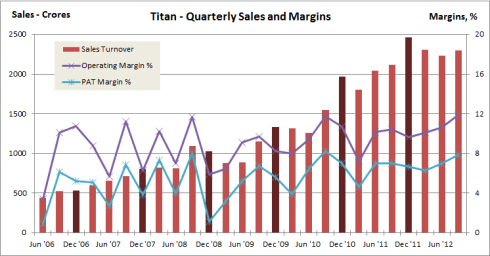
  • Revenues have grown at 34% CAGR over the last 5 years. See Fig 4 – Quarterly Sales & Profits.
  • Operating and Profit Margins have improved to 12% and 8% respectively in FY12.
Quarterly Sales and Margins, JainMatrix Investments

Fig 4 – Quarterly Sales and Margins, JainMatrix Investments

EPS Cash Flow and Dividend, JainMatrix Investments

Fig 5 – EPS Cash Flow and Dividend, JainMatrix Investments

  • Over the same period, EPS has grown 45%, a remarkable performance.
  • Dividend payments have improved steadily, giving a yield today of 0.6%.
  • However, cash from operating activities improved until FY12, where it fell. This is because Titan is investing in the retail chain as well as in the manufacturing facilities.
Titan Price and PE, JainMatrix Investments

Fig 6 – Titan Price and PE, JainMatrix Investments

  • The Price and PE graph Fig 6, shows that the 5 year average PE is 40 times. Investors seem to have always expected more from Titan.
  • Today it is at this average level, indicating that there is substantial upside potential.
  • Over 5 years, EPS has increased, barring 08-09 when the economy had slowed, by about 45% CAGR.
Titan Price and EPS, JainMatrix Investments

Fig 7 – Titan Price and EPS, JainMatrix Investments

  • Fig 7 shows that Price and EPS seem to be fairly correlated, and in fact if anything EPS has accelerated ahead of Price. The channel indicates the likely trajectory of EPS
  • EBITDA and Net Profit have also grown at 38% and 45% respectively.
  • ROCE has accelerated to an amazing 60% in FY2012. RONW is at a very healthy 41%.
  • PEG is at 0.89 – indicates safety and undervalued status.
  • Negligible debt, and good cash position indicates strength in the balance sheet.
  • Putting these together, Titan continues on its path of a multi-year business acceleration.

Benchmarking of Financials

In a Benchmarking exercise, we have compared Titan to Whirlpool, TTK Prestige (both consumer durables) and Pantaloon Retail (a retail leader). See Exhibit 8

Benchmarking of Financials, JainMatrix Investments

Exhibit 8 – Benchmarking of Financials, JainMatrix Investments

  • Titan appears overpriced, until one sees a higher dividend, higher ROCE and good ROE.
  • TTK certainly appears interesting with its good growth and higher Inventory turnover ratios.
  • Pantaloon seems weighed down by a debt burden

Risks

  • Volatility in Gold prices affects Titan. A rise can dampen demand, while a sharp fall can affect Titan’s inventory value. Titan is consciously expanding beyond Gold jewellery to Diamond and Platinum.
  • Competition in India is intense with a host of jewellery and eye wear brands challenging Titan.
  • There is an entry of foreign brands and possibly retail networks after FDI being allowed in Retail.
  • A slump in the economy will affect demand at Titan, as discretionary funds will dry up.
  • With Titan’s Watch, Jewellery and Eye-Care initiatives in place, Titan needs to plan to enter into new businesses that fall in its sweet spot of- winning business from unorganized sector, precision manufacturing and consumer pull, where its strong brands can be redeployed. If it does not, business in India can taper off in the next 5-6 years. Strong candidates can be fashion accessories, leather products (non-shoes), etc.

Opinion, Outlook and Recommendation

  • In India the ‘demographic dividend’ and GDP growth have pulled the per capita income to over Rs 61,000. Experts expect consumption to accelerate now, as consumers have more discretionary spending power, and spend less of total income on food. Titan’s watch, jewellery and eye care categories will ride this consumption wave.
  • Titan has enjoyed premium valuations. It may have to do with its Tata roots, or its pioneering retail story, or its leadership in watch/ jewellery categories, or even the strong brands.
  • In Jewellery and eye care, Titan is addressing a relatively unorganized sector market. By developing brands and a national distribution network, it has attracted new consumers and built loyalty.This is a sustainable model, and Titan enjoys a first mover advantage.
  • Titan has built capabilities in branding, design and manufacturing that are strong core competencies.
  • In the last 2 years, share price has appreciated 54%. For new investors, it may appear that the share has run up too much and will fall soon. However, this stock is expected to continue to perform strongly for several years to come.
  • Buy Titan systematically.

This is an update of my June 2011 report, A Titan for the long term.

Do you find this site useful?

  • Visit the SUBSCRIBE page to find how you can get more. Click LINK
  • Register Now to get our Free reports and much more, on the top right of this page, or by filling this Signup Form CLICK.

JainMatrix Knowledge Base

See other useful reports

Disclaimer:

This document has been prepared by JainMatrix Investments Bangalore (JM), and is meant for use by the recipient only as information and is not for circulation. This document is not to be reported or copied or made available to others without prior permission of JM. It should not be considered or taken as an offer to sell or a solicitation to buy or sell any security. The information contained in this report has been obtained from sources that are considered to be reliable. However, JM has not independently verified the accuracy or completeness of the same. Neither JM nor any of its affiliates, its directors or its employees accepts any responsibility of whatsoever nature for the information, statements and opinion given, made available or expressed herein or for any omission therein. Recipients of this report should be aware that past performance is not necessarily a guide to future performance and value of investments can go down as well. The suitability or otherwise of any investments will depend upon the recipient’s particular circumstances and, in case of doubt, advice should be sought from an independent Financial Expert/Advisor. Either JM or its affiliates or its directors or its employees or its representatives or its clients or their relatives may have position(s), make market, act as principal or engage in transactions of securities of companies referred to in this report and they may have used the research material prior to publication. Any questions should be directed to the director of JainMatrix Investments at punit.jain@jainmatrix.com

Disclosure: It is safe to assume that if the JainMatrix website recommends a stock, the researcher has already invested in it.

Also see: https://jainmatrix.wordpress.com/disclaimer/

Adani Port – The Great Australian Adventure

————————————————————————————————-

  • Date: 20-Sep-12.        CMP: Rs 115           Large Cap – Market Cap 23,450 crores
  • Firm is valued at Rs 136 (18% over CMP)    
  • Price Target is Rs 215 by Apr 2014, an 84% appreciation.                         
  • Advice:  Medium Risk, High Gain stock. BUY with a 2 yr perspective

Executive Summary

Key Reasons to Invest:

  • Adani Port’s Mundra Port & Indian operations are excellent infra assets with Sales, Profits and EPS up by 36, 42 and 44% CAGR over 5 years.
  • Govt dominated Indian Port sector is overall constrained on capacity, speed and pricing.
  • The large Australian Abbot Point acquisition comes from a conviction that the next phase of Port services growth will come from Australian Coal and Mining exports.

Risks:

  • Additional debt of 9000 cr on the books, Australian currency and interest rates risk
  • Full success of the Australian investment needs many things to fall in place – Coal mining by Adani Enterprises to start by 2014, PPA negotiations in Gujarat and capacity additions at Abbott Port.
  • Environmental and Security clearances by Govt. of India

This report is an update of the May 30th 2012 report called Adani Port: Infra play at good valuations V2 by JainMatrix Investments.  

Adani Port – Description and Profile

  • Adani Port and SEZ – (APSEZ) is Gujarat based with FY12 revenues 3269 cr and PAT 1093 cr (consolidated).
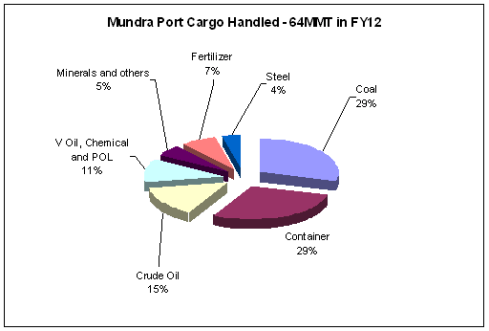
  • APSEZ businesses include Mundra, the largest private port (64 MT in FY12), several Port-operating contracts, an SEZ area adjacent to Mundra port (6,500-hectare) and Abbot Point Port, Australia.
  • Market share in India grew in FY12 to 11% from 10% in one year. It is #2 among all Indian ports, and #1 in terms of private ports in India. Promoted by Adani Group, APSEZ trades in a broad range of products, implying lower business risks. See Fig 1.
Fig 1 - Business Segments in FY12, JainMatrix Investments

Fig 1 – Business Segments, JainMatrix Investments (Click any chart to expand)

  • It is also developing/operating terminals at Hazira, Mormugao and Vizag in India and Abbot Point in Australia. APSEZ as an operator now has a presence in six ports in India. Through these facilities APSEZ has increased its domestic market share in container handling to 18%, up by 3% in FY12.
  • Being a private port, APSEZ is free to price its services, unlike PSU ports in India. It has ‘take or pay’ arrangements with many of the customers. This protects APSEZ from sudden drops in demand.
  • Connectivity and logistical facilities connect the Port, berthing and storage facilities to Roads, Rail, Airstrip and Pipelines for goods transportation. Growth in Cargo was 49% in FY12. Table 2.
Table 2 - Port Operations Growth, JainMatrix Investments

Table 2 – Port Operations Growth, JainMatrix Investments

  • The port has in place a dedicated automobile terminal for exports, currently being used by Maruti.
  • The SEZ area is organized into a number of clusters to cater to different needs of Industrial groups.
  • APSEZ enjoys Indirect and Direct Tax benefits designed to encourage infrastructure growth.
  • The Shareholding pattern is Promoter group 77.5%, MFs/ DII 4.9%, FIIs 10.2%, Individuals retail/ HNI 3.7% and Bodies Corporate etc 3.7%. As per delisting norms, Promoter holding needs to reduce to 75% in a year.
  • Adani Enterprises is the holding company with cross-holdings in Adani Power and APSEZ. The group has ambitions across Coal, Logistics and Power generation, and these 3 firms execute on this plan.

Events, News and Strategies

  • Abbot Point coal terminal, Australia: APSEZ bought the Abbot Point Port in May 2011 in cash for A$1.8 billion (9000 cr). This coal terminal, of capacity 50 MMT with capacity increase provisions, will help transport coal from Australian mines to India. This purchase is expensive, but funded by lower cost Australian finance (6.5%). Refinancing of the loan was done with long-term loans of an AUD1.1bn and US$0.8bn loan. At the same time, a massive loan has been taken, that changes the financials and balance sheet of this company.
    • There is synergy with Adani Enterprise’s purchase of Linc Energy’s Galilee coal project, close to Abbot Point in Australia for $2.7bn in August 2010. This is expected to start producing coal by 2014. Also there is ample growth opportunity in the region, as the local government is mapping out a decade long plan to grow port terminals capacity to 385 MMT from the current 50.
  • Coal demand in India is due to Power capacity increase. Domestic supply has not been able to keep up. So Coal imports have increased rapidly, projected at 185 MT by 2017 (99MT today), by the Planning Commission.
  • APSEZ recently won a project for development of a dry bulk terminal at Kandla Port, Gujarat. With an investment of Rs 1200 cr., the terminal will have capacity 20 MMT and take 24 months construct.
  • The 9MT HPCL‐Mittal Energy refinery in Bhatinda, was fully operationalized in Mar’12. Crude will be imported through Mundra and transported through the 1,017 km pipeline to the refinery.
  • Mundra also expects higher coal volumes on account of the commissioning of additional phases at Tata UMPP and Adani’sMundra Power plants.
  • Adani Group is exploring a listing of holding company Adani Enterprise on an overseas bourse, to raise cash and help reduce debt at a group level. If this succeeds, it will trigger a price appreciation.
  • APSEZ vision is to have an annual cargo handling capacity of 200 MMT by 2020 (current 78MMT).

Industry Note:

  • 95% of India’s international trade is done through the Sea Ports. Traffic projections for next 8 years are 11% growth CAGR (Shipping Ministry). As Imports and Exports grow rapidly, the constraint will be Port capacities.
  • Mundra is able to provide port access to industries in Gujarat, Maharashtra and North Indian regions. Local competition to APSEZ is from Kandla, JNPT and Pipavav on the Western shores. But Kandla, JNPT and other govt. ports have not invested sufficiently in infrastructure due to government constraints.
  • Pipavav Port is at an early stage of development. Also it is in South Gujarat and logistically more remote. Pipavav Port in Gujarat is owned by A.P. Moller-Maersk Group, is one of the largest container terminal operators in the world. Over the next few years, APM Terminals will transfer a lot of India business from other ports to Pipavav, and also build good infrastructure here.

Stock Valuation, Performance and Returns

  • The IPO in Nov 2007 was very successful. It was oversubscribed 115 times, and provided listing gains. However it was aggressively priced, at 88 (Rs, adjusted). See Fig 3
Fig 3 – Share Price and Dividend, JainMatrix Investments

Fig 3 – Share Price and Dividend, JainMatrix Investments

  • Volatile Prices – Share price rose post IPO to 264, fell to 50 in Nov’08, rose again to a high of 185 in Oct’10, before dropping to today’s 115. This last fall of 38% over 2 years was painful for investors.
Fig 4 – Mundra Port Sales, Margins, JainMatrix Investments

Fig 4 – Mundra Port Sales, Margins, JainMatrix Investments

  • The port has rapidly increased business throughput over the last 5 years, venturing into new categories of goods, and working closely with importers and exporters to improve infrastructure.
  • Over the last 5 years growth has been rapid, with Sales, Profits and EPS  up by 36, 42 and 44% CAGR. However, we notice a slowing down of these numbers in the last 4 quarters. However the margins have been steady, with Operating Margins at 70% and PAT Margins at 50%, for APSEZ standalone, Fig 4.
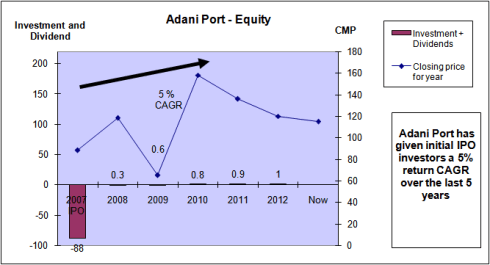
  • IPO investors have seen a 4.5% CAGR return in price in five years since listing, see Fig 5. The Dividend has increased steadily, till the current 50%, i.e. Re 1 on FV Rs 2.
Fig 5 – Share Price and Dividend, JainMatrix Investments

Fig 5 – Share Price and Dividend, JainMatrix Investments

Fig 6 – Cash Flow, EPS and DE, JainMatrix Investments

Fig 6 – Cash Flow, EPS and DE, JainMatrix Investments

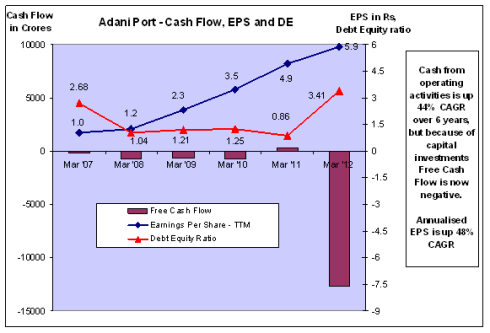
  •  Debt-equity is 3.41 (sharply up due to Abbot Point purchase). This is high for an infra company, Fig 6.
  • For infra sector, cash is critical. APSEZ has a poor free Cash flow due to high investments in operations and the Abbot Point purchase. EPS (adjusted) is up 48% CAGR in recent years.
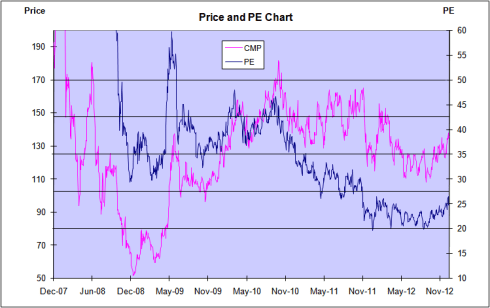
  • The PE has been in a range of 20-50 over 4 years. But current PE of 19.8 is at low end of this range. Fig 7.
Fig 7 – Price and PE Chart, JainMatrix Investments

Fig 7 – Price and PE Chart, JainMatrix Investments

Fig 8 – Price and EPS Chart, JainMatrix Investments

Fig 8 – Price and EPS Chart, JainMatrix Investments

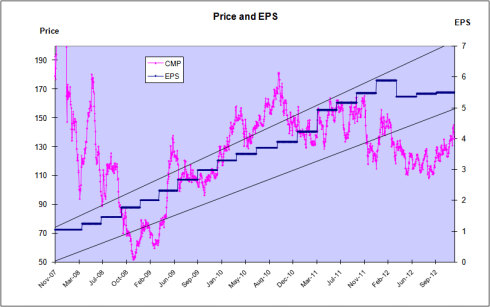
  • The chart (Fig 8) plots the market price against the adjusted EPS over a 5-year period.  EPS shows us a steady quarterly increase indicating stable business performance, but flattening after Dec 2011.
  • Return Ratios are deteriorating – ROCE is 7.8% (14% in FY11) while RONW has stayed at 22%.
  • With EPS growth slowing, the PEG (3Yr) is now at 0.55, indicates undervalued status.

Peer Benchmarking and Financial Projections

We have compared APSEZ with leading listed Peers, Chart 9:

Chart 9 – Peer Benchmarking, JainMatrix Investments

Chart 9 – Peer Benchmarking, JainMatrix Investments

APSEZ has high valuations. It has good ROE, but a high DE ratio, and does not stand out on any other parameters.

The Financial forecasts, Chart 10, are now inclusive of Abbot Point Port operations.

Chart 10 – APSEZ Financial forecasts, JainMatrix Investments

Chart 10 – APSEZ Financial forecasts, JainMatrix Investments

The Abbot Point projections embedded above indicate that by 2014, the project will start contributing to the bottomline. Repayment of loans will certainly take longer.

Risks

  • The purchase of Abbot Point Australia is a massive bet on an Australian Port, and mining related exports from the region. A debt of Rs 9000 cr has been added to the balance sheet through the new subsidiary. The Coal mines by Adani Enterprises need to start producing coal by 2014. And Adani Power and Mega power plants in Gujarat need to import coal (involving renegotiation of their PPA agreements price with the Gujarat Government, as imported coal is costlier). Further there is Australian currency risk for the loan. Recently global coal prices fell, so some of the demand at Abbot Point may have fallen.
    • India is facing a massive power supply shortage, and Adani’s Coal and Port assets address fuel linkages needed for Power generation. In 2-3 years, the Abbot Point port should be working at full capacity (80-100MMT), feeding coal to Indian power plants. In the process, all these investments will bear fruit. In effect, Adani has set out on The Great Australian Adventure.
  • EX-IM slowdown: With a global slowdown, the exports-imports from India have slowed over the last few quarters. This has been aggravated by events such as ban on Iron ore exports and USD appreciation resulting in some fall in Imports.
    • APSEZ will be able to grow domestic market share of exports, but depends on economic conditions to sustain volume growth. Energy imports may be resilient, e.g. Coal, crude.
  • Gujarat High court in a May 2012 court order has stayed development work at APSEZ due to unauthorized construction over a 1,840-hectare enclave that was not vacant, and had no Central environmental clearance – this may delay additional construction for the SEZ area. It is also possible that Adani has been very aggressive in the growth and development execution.
    • Central environmental clearances are notoriously difficult to get in time. This is an unknown.
  • In Aug’12 it was reported that India’s home ministry has barred APSEZ from participating in two major port project bids because of security concerns. This report has yet to be confirmed.

Opinion, Outlook and Recommendation

  • Seaports are critical to India’s growth, as over 95% of imports and exports have to be transported by this route. The 6-9% GDP growth in India is now testing the capacities of Indian Ports. Also Govt. ports so far have been constrained in terms of capacity, speed of execution and pricing.
  • APSEZ’s Mundra Port and Indian operations are excellent. APSEZ will capture market share due to spare capacity, good connectivity, excellent facilities and proximity to demand centers.
  • It’s almost become routine in India that well established Corporates shake up the status quo and take up a large international acquisition. This invariably has a 3-5 year gestation period. Quarterly profits dry up and Investors see a drop in share prices. But Enterprises see this as part of a larger global strategy. (eg Tata Motors, Bharti Airtel, Hindalco, Suzlon, Renuka Sugar, Tata Steel, etc, etc). Some succeed and some fail.
  • Similarly the Abbott Point acquisition is a large investment, which will soak cash for the next 2 years in terms of additional investments and interest. There are also associated business risks. But the plan appears to be well thought out, and investors with a Medium Risk appetite should BUY this stock with a minimum 2-year perspective. Investors with expectations of a quicker and steeper appreciation may be disappointed.
  • EPS growth may slow to ~ 40% in the next 3 years.
  • PE has fallen to new lows. The premium valuations commanded by APSEZ due to its pioneer status may only be regained over this Medium term.
  • Price Projections:
    • Our valuation prices the share at 136. Thus today it is available at a 18% discount to CMP.
    • By Apr ’14, the price projection is 215, a 84% appreciation from CMP 

JainMatrix Knowledge Base:

Additional related research reports from JainMatrix Investments:

Disclosure: It is safe to assume that if the JainMatrix website recommends a stock, the researcher has already invested in it.

Subscribe to JainMatrix Investments, to receive such Investment Reports. SUBSCRIBE NOW See Offering

Disclaimer:

These reports and documents have been prepared by JainMatrix Investments Ltd. They are not to be copied, reused or made available to others without prior permission of JainMatrix Investments. Any questions should be directed to the director of JainMatrix Investments at punit.jain@jainmatrix.com
Also see: https://jainmatrix.wordpress.com/disclaimer/

Bharti Airtel: This is a year of consolidation

_____________________________________________________________

  • Date: 19 August 2012
  • Large Cap – Mkt Cap Rs 99,115 crores
  • CMP: Rs 261
  • Advice:  Accumulate in FY13 through SIP
  • Target:  Mar ’14 target of 421

Summary

  • We have seen a fall of share prices by 39% this year. There’s no doubt that Bharti Airtel has lost its status as a safe long-term investment and Blue Chip for investors. The reasons are obvious to mobile users – low consumer prices, intense competition, poor telecom governance, and the 2G scam. Also Airtel invested in Africa, and paid heavily for 3G & 4G licenses. 
  • But Airtel remains the market share leader in Indian telecom and #5 by consumers worldwide.
  • Launch of 3G, 4G and mCommerce (Airtel Money) means it has comprehensive service offerings.
  • Businesses like Digital TV, fixed line, broadband, Enterprise telecom services and Passive Infra services all have synergies with the telecom core and also leadership in their niches.
  • The investments in 3G, 4G and Africa operations will in time propel Airtel into a profitable global telecom business as a low cost leader with a factory approach to call volumes. 

What to do now: The period FY2013 will be a year of consolidation.

  • The near term positive triggers include listing (IPO) of BhartiInfratel, exits by 4-5 competitors, auction of 2G licenses and refarming/ sale of spectrum. Airtel will see a return of Pricing power. 
  • Share price fall to current levels is a market excess, and offers investors an attractive entry point.
  • Long-term investors with a medium risk appetite can accumulate Airtel this year for a price target of 421 by August 2014.

Bharti Airtel – Description and Profile

  • Airtel is the market leader in the Indian telecom sector. Incorporated in 1995, it is a global telecom operator ranked #5 today in terms of customers.
  • Consolidated revenues are 71,505 crores (FY’12), and mkt cap is 99,115 cr. ranks it #13 in India.  Operations are spread over 20 countries and Airtel has an aggregate of 26.1 cr. customers. Of these, 20 cr. are in India itself.
  • Businesses are classified as B2C – consumer and B2B – Business. The B2C are Mobile, Telemedia (IPTV, broadband and fixed line), Digital TV (DTH) and MCommerce. Africa is essentially a mobile market, and is B2C.
Airtel - Business Segments, JainMatrix Investments

Fig 1 – Airtel – Business Segments, JainMatrix Investments

  • Market shares are 19% by subscribers and 29% by revenue, indicating a superior ARPU profile.
  • B2B services are Airtel Business (end to end telecom services) and Passive Infrastructure Services (towers)
  • Shareholding pattern is: Promoters Indian 45.7% and Foreign 22.8%; FIIs 16.9%; DII 8.1%; Bodies Corporate 4.6 %; Individuals – retail & HNI 1.5 and Other non institutions 0.4%.

Industry Note

  • The 2004-09 period with 2G and only 5-7 competitors looks like a happy phase from the distant past.
    • The controversial 2008 Telecom licenses brought in new players, intense competition and over Rs 50k crores of fresh investment into Indian Telecom.
    • The auction of 3G in May 2010 saw major players spend $13b (Rs 67,000 cr.). In retrospect they may have overpaid for this, as 3G adoptions has been slow after the launch.
    • Compared to this, the 4G licenses auction in 2010 raised $7.5b (Rs 38,000 cr.).
  • The governance for Telecom involves TRAI, DoT, Ministry of Comm./IT and TDSAT for disputes.
  • Per minute call tariff rates are among the lowest in the world. And the network expansion and 3G/4G rollouts are an ongoing capital-intensive requirement for many players.
Telecom Market shares in March 2012, JainMatrix Investments

Fig 2 – Telecom Market shares in Mar’12, JainMatrix Investments (Click to enlarge)

  • There are 15 operators in India – see Fig 2 for Subscriber Market Shares. Revenue market shares for Mar ’12 are Airtel 29%, Vodaphone 23% and Idea 15%.
  • Most operators are not able to make operating profits. And the market is reaching a subscriber saturation point. Reports are that consolidation has started, as of these, three (Etisalat, Videocon, STel) may exit fully, and Uninor and SSTL may exit partially (Fitch).
  • The total number of Indian subscribers of telecom services– wireless & wire line – is 95.1 cr. The tele-density is 78.5%. Broadband penetration is low at 1.1% (1.38 cr.).
  • In Feb’12, 122 telecom licenses issued by govt. in 2008 were cancelled by the Supreme Court. Many of the players, especially newer ones, are hit as their future is uncertain, and an expensive public auction process may be used to reissue the licenses.  Airtel however is not affected directly.
  • In the Mar’12 quarter, the total wireless subscriber base grew 2.83% to 91.9 cr. In terms of net additions, Idea led with 63.4 lakh followed by Uninor, Airtel and Vodafone with 61.3L, 55.8L and 27.4L respectively.
  • Nearly 18 months after launch of 3G, there are merely 1.5-2 cr. subscribers, less than 2% of the GSM subscriber base of 91.9 cr. Of these Airtel has 80 lakh and Idea 26 lakh. 3G ARPU may be 90-100 Rs/ month.

Key Challenges and Strategic Responses:

1) Intense competition in Indian market due to 15 players.

  • The Airtel strategic direction has changed from profitability to defending market share. This will help maintain overall revenue and growth, but signals lower profitability for a few quarters.
  • Marketing & Sales activities include aggressive brand building, sports sponsorships and marketing campaigns in media.
  • Bundling of Airtel’s consumer services is an opportunity. Currently this is being tapped through single payment mechanism with Airtel Money. If other synergies are tapped, this can improve product stickiness

2) Regulatory uncertainty in Telecom due to cancellation of 2008 licenses, separation of spectrum and licenses and non sharing of 3G customers among operators and a host of such issues

  • Many ground rules are changing in this industry due to the initiatives by troika of Indian Govt., TRAI and DoT. This includes higher service charges, potential new charges like spectrum and license fees, excess spectrum charge, refarming of spectrum, non-sharing of 3G services among operators and restrictions in voice and internet ‘combi packs’ by TRAI.
  • Airtel has joined other telecom players to vigorously defend its stance at TDSAT /Indian Courts.
  • In a perverse situation, consolidation in Indian telecom is being accelerated by the licenses cancellation.

3) Heavy Investments: Airtel won a number of 3G licenses (2010) and in important circles, but at a high price. It also won 4G licenses, which it launched in 2012.

  • 3G services have not initially taken off in the market as expected. Having spent large sums in the 3G auctions, Airtel is leading the push in 3G services with investments in m-Heath, m-Education, m-Commerce, e-governance, etc. and generating trials among current subscribers.
  • Airtel has already launched 4G services (essentially for data) in Bangalore and Kolkata. It will launch soon in Delhi, Mumbai and Kerala.

4) Airtel acquired the African telecom assets of Zain in 2010, for USD $9 billion (Rs 49,500 cr.) in cash.

  • This purchase provided entry into a high potential market and allows Airtel to start a second phase of corporate growth. (As per Airtel estimates), Africa will eventually overtake India and China as a telecom market – as population of Africa will peak at 1.8 – 2.0 billion.
  • By leveraging their balance sheet and with sound financial engineering, Airtel was able to service this loan for only $200 m (Rs 1100cr.) per year in ‘10. The ‘13 revenue target for Africa is $5 billion (27.5k crores).
  • However this market requires a couple of years of investments in markets for regulatory approvals, 3G rollout, network investments and marketing & sales to raise the profile of Airtel.

5) High debt due to purchase of Zain Africa, 3G and 4G, and network upgradation and expansion in all regions

  • Airtel continues to be an outsourcing leader with partners for networks, IT, and support services.
  • Airtel is planning on an IPO for its telecom tower unit BhartiInfratel Ltd. (BIL). This independent firm manages towers for any operator and listing this asset will help pare down debt.

6) Mobile Number Portability was perceived as a threat for Airtel. However, the first year of experience of this facility shows that Airtel is the second highest beneficiary of MNP.

Stock Valuation, Performance and Returns

  • CMP is 261. In the last 8 years, the market price has appreciated at 12% per annum CAGR.  However, the share has fallen from a high of 565 in Oct ‘07 by 54%, and within last 1 year by 39% to today’s CMP. See Fig 3.
  • Particularly worrying is the share price fall in August 2012, where after the Q1FY13 results on Aug 8th, the share fell by 14% in 3 days.
  • The maiden dividend of 20% declared in FY09 has been kept steady at this rate for next two years.
Price 5 year Trend, JainMatrix Investments

Fig 3 – Price 5 year Trend, JainMatrix Investments

Quarterly Sales and Margins

Fig 4 – Quarterly Sales and Margins

  • The quarterly sales and margins data, Fig 4, for the last 5 years is revealing:
    • The growth in Revenues is 31.1% and EBITDA too is up 25.7% CAGR over this period.
    • However Net Profit is flat, and the Profit margin has fallen in last 2 years from over 20% to 5% range.
  • The EPS, Cash flow and Investments Chart – Fig 5 – shows that Cash Flow has increased 21.6% CAGR over the last 5 years. But the investments required by the business has consumed a lot of this cash.
  • EPS peaked in 2010, and has fallen sharply thereafter.
EPS, Cash Flow and Capital Investments

Fig 5 – EPS, Cash Flow and Capital Investments

  • RoCE has fallen from 25% levels to 8.9% – a poor statistic; RoNW is 4.4%; Price/Book is 1.96.
  • Debt / Equity is 1.36 for the consolidated entity, indicating fair leverage.
Airtel - Price and PE chart, TTM

Fig 6 – Airtel – Price and PE chart, TTM

  • The Price and PE Chart – Fig 6 – show that the average PE over last 5 years is 22.5.
  • Current PE at 25.4 is in the Upper Quartile, at high levels, in spite of recent price fall.
Price and EPS Chart TTM, JainMatrix Investments

Fig 7 – Price and EPS Chart TTM, JainMatrix Investments

  • The Price and EPS chart – Fig 7 – clearly shows the EPS drop post April 2010.
  • The key question is, when will this fall in EPS be arrested and resume its growth path?

Benchmarking and Financial Projections

In a benchmarking exercise, we compare Airtel with 3 other firms, Table 8.

Benchmarking Analysis, JainMatrix Investments

Table 8 – Benchmarking Analysis, JainMatrix Investments

  • Airtel has healthy Sales growth, while Asset Turnover and EBITDA margins are excellent.
  • The ROCE is low, and profit erosion and price fall are signs of weakness for Airtel.
  • D/E is high but within the 2.0 times comfort zone
  • The Airtel consolidated Financials are projected till FY 2015, Table 9.
Financial Projections, JainMatrix Investments

Table 9 – Financial Projections, JainMatrix Investments

Risks:

  • Indian Telecom Regulatory and legal overhang.
  • Revenue pressures from the Indian government. The govt. is looking to bridge deficits with larger revenues from Telecom industry.
  • The current expectation is that M&As and exits will reduce competitive intensity in the sector. If this does not happen, it will affect profitability and margins.
  • The interest rates have risen in India, increasing debt-servicing costs. Our expectations are that rates have peaked in India, and should fall going forward. Any change in this affects financial projections.

Opinion, Outlook and Recommendation

  • The Telecom sector in India has achieved deep penetration, and voice services have been a language independent enabler of productivity, efficiency and knowledge. The success of Apple’s iPhone is an indication of future data services consumption, assuming the Indian market follows the developed markets trends.
  • In future the sector revenues will be driven by volume and price increases, value added services, 3G adoption, internet and application usage, 4G and incremental penetration. With maturity, the telecom sector revenues will be a Consumer play, reflecting personal income growth and habits.
  • Airtel is a volume leader in India, and is perceived as a technology leader with cutting edge offerings and the best network.  In Africa, the brand is slowly getting established.
  • The current financial performance is a trough due to a combination of Indian telecom governance challenges, intense competition, high interest rates and investments in Indian 3G/ 4G networks and African operations.
  • But FY2013 will see Airtel consolidating its leadership position in India & many African countries. In India about 6-7 players will exit or merge with other players due to investment/ profit pressures. After this, mobile call prices will rise, due to a return of pricing power. In FY14, the financial recovery will be swift & comprehensive.
  • The June 2010 bottom for the Airtel share was Rs 255, has held firm so far till August 2012. There may be more consolidation at these levels in rest of FY13.
  • The Mar 2014 target for Airtel is 421 based on a P/E target of 25 times and projections of financials. This is a 61% appreciation from current price levels. 

_____________________________________________________________

The author can be contacted over email at punit.jain@jainmatrix.com or on www.jainmatrix.com

JainMatrix Knowledge Base:

Other reports on Telecom

  • Telecom: Auctions speak louder than words – Article
  • Indian Telecom at Cross-Roads – Article
  • Indian Equity – Winds of Change – Article

Disclosure: It is safe to assume that if the JainMatrix website recommends a stock, the researcher has already invested in it.

Do you find this site useful? You can:

  1. Subscribe to be the first to receive new posts. Click on SUBSCRIBE
  2. Request for Email Updates. Enter your email on the ‘Email Updates’ box at the top right of this page.
  3. Or Click on this Signup Form CLICK
  4. Socialize with us – Like on Facebook or Visit on LinkedIn
  5. Add your comments/ queries below

Disclaimer:

These reports and documents have been prepared by JainMatrix Investments Ltd. They are not to be copied, reused or made available to others without prior permission of JainMatrix Investments. Any questions should be directed to the director of JainMatrix Investments at punit.jain@jainmatrix.com

Also see: https://jainmatrix.wordpress.com/disclaimer/

Subscribe to JainMatrix Investments portal, to receive such Investment Reports immediately on publication.

Enter your email in the ‘Email Updates from JainMatrix’ box on the top right of this page. Click the verification link in your email. As simple as that. New subscribers will receive the report within 2-3 days of  Subscribing.

Current Subscribers are invited to share their comments.

Bata India has Happy Feet

—————————————————————————————————————————————

  • Date: July 27, 2012
  • CMP: Rs 895
  • Large Cap – Market Cap 5,750 crores
  • Advice:  Buy systematically
  • Target:  2 year target of 1258

Bata India is the largest manufacturer and marketer of footwear products in India. Riding the ‘consumption’ theme, the growth figures are impressive as FY11 sales at 1659 crores are up 15%, EBITDA 31%, and Net Profit 30% CAGR over the last 5 years. Bata is investing in new stores, manufacturing improvements and branding. Domestic competition is set to intensify, but Bata is a deeply embedded brand, that is just starting to discover it’s rightful place in the Indian market.  Buy systematically with a 2-year target of Rs. 1258. 

Bata India – Description and Profile

  • Bata India is a large Calcutta based retailer and manufacturer of footwear in India since 80 years. It is part of the Bata Shoe Organization with HQ in Switzerland. The FY12 revenues were 1659 crores and PAT 152 cr.
  • Manufacturing is located at Batanagar-WB, Bataganj- Bihar, Faridabad-Haryana, Peenya- Karnataka and Hosur- Tamil Nadu. It employs 6,800 personnel. Listed since 1973, Bata today has a market Cap of 5682 cr.
  • Bata has a market share of 35%. The brands include Hush Puppies, Dr Scholls, Weinbrenner, North Star, Power, Marie Claire, Bubblegummers, Ambassador, Comfit, QUOVADIS and Wind India.
  • Bata sells through 1300 retail stores spread across 500 cities/towns. It also operates a non-retail distribution network through its urban wholesale division and caters to customers through over 30,000 dealers.
  • Bata won the ‘Consumer Awards 2010’ as ‘India’s Most Preferred Retailer’ given by CNBC Awaaz.
  • Shareholding pattern is: Foreign Corporate Promoters – 52%, MFs/ DII 12.8%; FIIs 18.6%, Bodies Corporate plus others 2.8%, Individuals retail /HNI 13.8%. We can see that the shareholding is well distributed.
  • Key Executives are: Uday Khanna – Chairman, R Gopalakrishnan – MD and Ranjit Mathur, Director – Finance.
  • ICRA has reaffirmed a rating of [ICRA] A1+ to Bata India for its CP programme, the highest for short-term debt.

Recent Events and Strategies executed by Bata

  • Bata straddles the entire range of footwear – from value to premium. With a current slowdown, it is currently focusing on value/ volume. It has the flexibility to switch to a premium focus in a short period, if required.
  •  The Bata group through a Singapore firm provides guidance and managerial support in functions like store layout, marketing, shoe line, up gradation of factories, manager training and guidance from senior managers.
  • Growth is excellent. In 2011, Bata opened 146 stores, (compared to 69 in 2009 and 108 in 2010) with average floor size >3,000 sq.ft. and also remodeled 30 small stores into the larger format stores. Some unviable small stores, which could not display the variety of footwear collections, are being shut down.
  • Through retail, Bata sells over 5 cr pairs of footwear annually, serving 1,50,000 customers every day. The wholesale division operates with a network of 275 distributors and 20,000 independent shoe dealers. Industrial division caters to the safety footwear needs of various industries. Export sales in 2011 were about 3 million pairs worth Rs 16.9 crores compared to Rs.11.8 cr in 2010.
  • Bata is seeing store expansions in Tier II and III cities, higher same store sales growth and higher realizations due to increasing share of leather shoes in overall sales (about 70%).
  • The Bata website www.bata.in has been set up for online search, shopping and home delivery.

Product notes

  • The Bata brands include
  1. Hush Puppies range of footwear in the premium segment and dress comfort segment brands Comfit, Ambassador and Mocassino.
  2. In theladies segment, the trendy Marie Claire range.
  3. The youth focused brand North Star and specialty outdoor brand Weinbrenner.
  4. For children Bubblegummers offers lightweight all-weather footwear and Naughty Boy is a school shoe.
  5. A new retail concept, FOOTIN, offers affordable fashion and trendy styles.
  6. The CHIARA shoes Collection (with elastic tape upper) has been launched here after international success.
  • For Bata, the opportunities include the low penetration of organized footwear retail (40%) and large presence of unorganised players in the women footwear market (86%).
  • Bata India was selected as a POWERBRAND in the POWERBRANDS 2010. The selection is done after an extensive pan India research conducted by Indian Council for Marketing Research.

Industry Note:

  • India’s per capita shoe consumption or the number of footwear (shoes, chappals, sandals) worn by an individual has gone up from 1.4 shoes a year in 2004 to 2.2 shoes per year in 2010. (Government report).
  • Footwear is the second most organized retail category in India, next only to watches.
  • Today, about 220 cr pairs of shoes are made in the organised and unorganised sector. India is the second largest footwear manufacturer in the world, next only to China. The Indian footwear market is currently estimated to be Rs 15-20,000 crore, growing at 12% per year. Of this, 40% is organized, with rural India accounting for 75% of the consumption.
  • This retail market is classified:
    • Men’s Footwear accounts for 48% and is the largest segment.
    • Women’s Footwear accounts for 41%. Growth rate is highest here.
    • Children’s Footwear accounts for 11%.
  • The competitors for Bata are Liberty, Red Tape, Woodland, Khadim and Metro.
  • Retailers are highly sensitive to regional preferences with wide variations in styles, festivals and consumers.

Stock Valuation, Performance and Returns

  • Bata has been listed for a long time. For our analysis purpose, we will consider the period from 2007-12.
Bata Price Chart, JainMatrix Investments

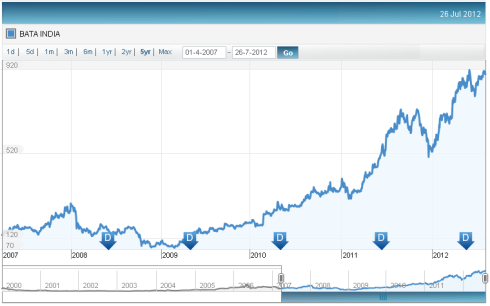
Fig 1 –  Bata Share Price over 5 years,  JainMatrix Investments, Click to Enlarge

The Bata share is up 41% CAGR over the last 5 years. The all time peak of 922 was achieved recently on May 29, ‘12. It is today within 3% of this.

Quarterly Sales and Profits, JainMatrix Investments

Fig 2 – Quarterly Sales and Profits, JainMatrix Investments,  Click to Enlarge

  • The growth numbers are excellent with Sales up 15%, EBITDA 31% and Net Profit 30% CAGR over 5 years.
  • Profit margins have improved steadily, and are at 10.4%. Operating margins are at 15% this quarter.
Bata - Dividend and Price movement, JainMatrix Investments

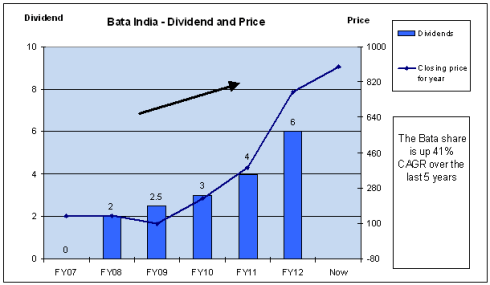
Fig 3 – Bata – Dividend and Price movement, JainMatrix Investments

This rapid business growth is also accompanied by an increase in dividend. See Fig 3. The dividend at 60% gives a dividend yield of only 0.7%.

EPS and Cash Flow, JainMatrix Investments

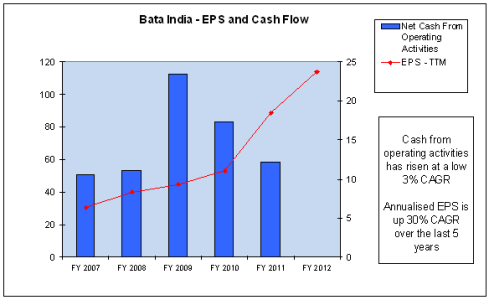
Fig 4 – EPS and Cash Flow, JainMatrix Investments

  • The annualised EPS is up a very healthy 30% CAGR over the last 5 years. However, cash from operations peaked in 2009, and has reduced due to investments into new stores and manufacturing improvements.
  • ROCE and RONW are in the 40-41% range. The Equity Capital has been steady at 64.3 crores for the last 7 years. This is a sign of good capital stability.
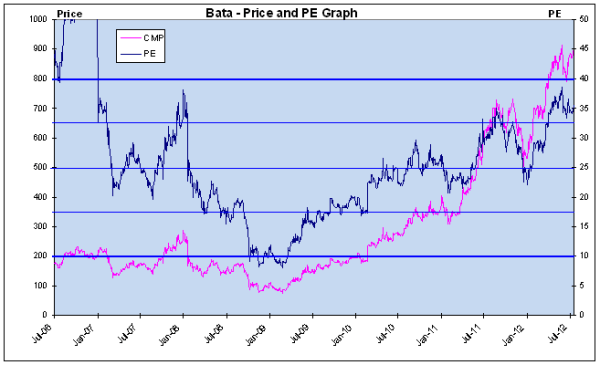
Price and PE Graph, JainMatrix Investments

Fig 5 – Price and PE Graph, JainMatrix Investments

Price and PE Chart, Fig 5, indicates that in 6 years, the average PE has been 25 times. Current PE of 35.6 times (TTM, trailing 12 months) indicates market acceptance of the consumption & growth prospects of Bata.

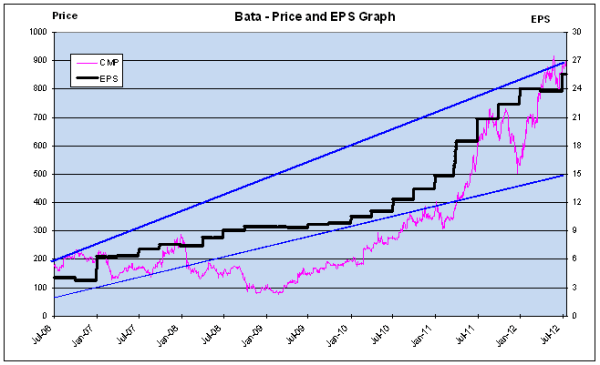
Price and EPS Graph, JainMatrix Investments

Fig 6 – Price and EPS Graph, JainMatrix Investments

  • The view of the EPS charts in Fig 6 shows that EPS growth has accelerated after 2009.
  • The EPS is today at all time high of 25.53 TTM, including Apr-June quarter 2012.
  • The EPS of Bata is expected to stay in the channel as per Fig 6.
  • PEG is at 1.2 – indicates fairly valued status.  

Benchmarking and Financial Estimates till FY15

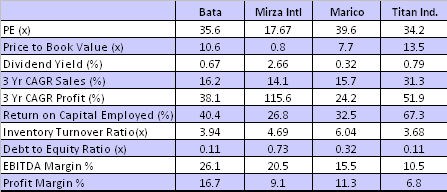
In a Benchmarking exercise, we have compared Bata to Mirza International (a Peer), Titan Industries and Marico (two consumer oriented firms with retail presence), see Exhibit 7.

Peer Comparison, JainMatrix Investments

Fig 7 – Peer Comparison, JainMatrix Investments

All the firms with strong brands have high PEs. Bata seems to be a bit overpriced. But it scores high on many parameters, and excels in terms of margins.

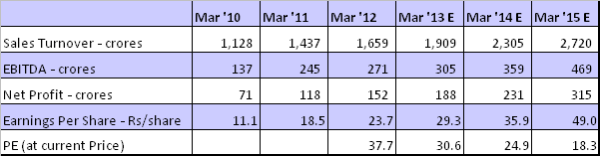
The financials and PE of Bata have been projected for the next 3 years. See Exhibit 8.

Financial Projections, JainMatrix Investments

Fig 8 – Financial Projections, JainMatrix Investments

Risks:

  • Intense competition at the higher end of footwear market from Gucci, Jimmy Choo, and other global brands.
  • The unorganized and small scale sector still own 60% of the Indian market. While Bata will be a first stop for an upgrade by these consumers, the competition from lower price points is intense.
  • The Government of India has allowed 100 per cent FDI in single-brand retailing in India and has plans to allow upto 51 per cent FDI in multi-brand retailing in the near future.
  • Rapidly evolving footwear market – Bata will need to be sensitive to new tastes.
  • The Bata brand itself while strong, has an ageing appeal, and needs to be refreshed, recharged and replaced where necessary to keep winning in this market.

Opinion, Outlook and Recommendation

  • Footwear is an exploding category in India, and Bata remains one of the best plays in India, on the basis of favorable demographics, retail presence, manufacturing improvements and good marketing/ branding.
  • Significant opportunities stem from growth against the unorganized sector, in upgrading current customers and in dominating the domestic market. Exports too are an opportunity given Bata’s global presence.
  • At CMP of 895, Bata is at high valuations of 35.6 times TTM. In difficult equity market conditions, the ‘safety in consumption’ theme is playing out, where such firms all have PE valuations in the 30s.
  • We expect Bata to continue at these high valuations for the next 2 years. Business performance will also continue on the growth and profitability path we have seen in the last 2 years.
  • Buy Bata systematically for a 2-year target of 1258, a 40% appreciation from current levels.

JainMatrix Knowledge Base:

See other useful reports

Disclosure: It is safe to assume that if the JainMatrix website recommends a stock, the researcher has already invested in it.

Do you find this site useful? You can:

  1. Check back on this website www.jainmatrix.com for updates.
  2. Subscribe to be the first to receive new posts. Enter your email on the ‘Subscribe’ box at the top right of this page
  3. Or Click on this Signup Form CLICK
  4. Socialize with us – Like on Facebook or Follow on Twitter
  5. Be sure to add punit.jain@jainmatrix.com to your address book or safe sender list so our emails get to your inbox.
  6. Add your comments/ queries below

Disclaimer:

These reports and documents have been prepared by JainMatrix Investments Ltd. They are not to be copied, reused or made available to others without prior permission of JainMatrix Investments. Any questions should be directed to the director of JainMatrix Investments at punit.jain@jainmatrix.com
Also see: https://jainmatrix.wordpress.com/disclaimer/

BF Utilities – This can be a NICE buy

Date: July 6, 2012                CMP: 444               Mkt Cap: 1,674 crore

P/E: 488 times                Advice:  A high risk high gain Investment with 3 year horizon

BF Utilities, a part of the Bharat Forge group, is engaged in developing the Bangalore – Mysore Infrastructure Corridor. The high potential project has been stuck for over a decade due to land handover issues, and the firm is making losses.

However recent reports indicate that it may be close to resolving legal disputes, and is raising a second round of PE funds for project execution. The share has recently crossed its 200 DMA. Investment in BF Utilities is an act of faith in the management, an understanding of how badly this project is needed, and a confidence that the risk return balance is tilted in favor of investors at this price. Investors with a High Risk, High Gain appetite may look to invest now for a 3-year horizon. 

BF Utilities (BU) is part of the Pune based Bharat Forge Group, and is focused on Roads and Power projects. Lets analyse this stock to see where it’s heading.

Business Snapshot:

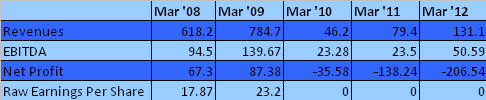
  • Turnover in year ending March ‘12 was Rs 131 crores, and losses Rs 206 cr.
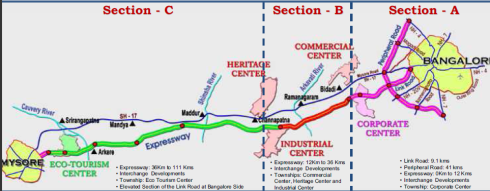
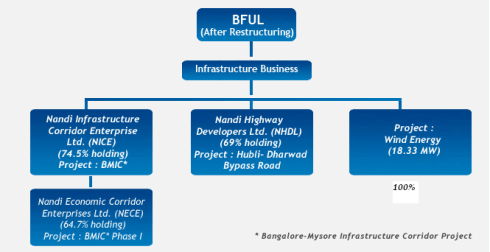
  • The key asset of BU is the Bangalore Mysore Infrastructure Corridor (BMIC) also called NICE, a 164 km tolled expressway to connect the cities, that includes a peripheral road in Bangalore, 5 New Townships along the Expressway (the first Section A involves 7,290 acres land), a Town Planning Authority status, and a Concession period for the toll of 40 years. The BMIC is 75% owned by BU.
  • The Hubli Dharwar bypass in Karnataka is a 30 km road on NH4 that lets highway traffic bypass the two cities, speeding up traffic. NH4 connects Mumbai/ Pune with Bangalore/ Chennai. Traffic has grown at 14% CAGR over 5+ years. Operational since 2000, this is 70% owned by BU.
  • A windmill farm of 18.33 MW power over 300 acres in Satara, Mah. is 100% owned
  • Shareholding pattern of BU is: Promoters 66.1%, MFs/ DII 0.5%; FIIs 2.7%, Bodies Corporate plus others 12.2%, Individuals retail & HNI 18.5%. So promoters hold majority stake – a good sign. Also, almost no shares have been pledged for loans.
  • Ashok Kheny, the MD of NICE is an expert on engineering, design and construction of  projects for transportation and infrastructure.
  • The BMIC project is divided into Sections A, B and C. While the toll road in Section A is 95% complete, handover of land is pending. Fig 1.
The BMIC project Sections, JainMatrix Investments

Fig 1 – The BMIC project Sections, JainMatrix Investments, click image to expand

Details and Updates of the BMIC project

  • BU has invested 2,000 cr. in building the BMIC, which will cut travel time between the two cities by half. The project involves construction of the main highway, 5 new townships and mega infra and entertainment projects like the largest Cricket Stadium in India, a Sports Academy, the tallest residential building (88 floors), a racecourse, residential complexes, and utilities like power & water.
  • A 56-km peripheral road project is conceived as a Bangalore bypass for the busy NH 4 and NH 7 traffic between Mumbai/ Pune and Chennai.
  • The project is partly operational, with rest held up due to pending handover of land by the Government of Karnataka (GoK). Of Section A, a total 4,188 acres out of 7,290 acres of total land has been and transferred by GoK, Fig 1. The BMIC project has been stuck for the last 7 years with snail like progress due to political opposition from the GoK for this project.
  • The recent update is that 574 cases that were filed against the BMIC project mostly related to land acquisition issues have been together dismissed by the HC and SC. In one of the cases the complainant’s case was adjudged frivolous, and a penalty of Rs 10 lakhs was imposed on him.
  • The specific orders by the courts to handover land to BMIC were ignored, and a Contempt of Court hearing is due in July 2012. The PWD and Commerce/ Industries Secretary of GoK have been asked to hand over the land to BU.
  • After a delay of nearly a year, the second round of PE fund raising by BU is close to being finalized, where a number of PE companies will invest in development of the townships and specific assets.
  • BU has had talks with Prestige Developers, a Bangalore based Real Estate construction firm for joint development of properties.
  • Anil Ambani in his personal capacity had invested in NICE several years ago. He recently exited and sold his 8% stake at a price that valued the project at 4000 crore. He exited with a 4-5 fold profit :-)

Ownership and structure:

BF Utilities Assets - Ownership, JainMatrix Investments

Fig 2 – BF Utilities Assets – Ownership, JainMatrix Investments, click image to expand

Pricing Snapshot

BU Price 5-year view. 

  • The share has fallen from a peak of 2,977 in July ’07 to a low of 259 in Dec ’11, Fig 3
  • The previous high price was based on success of all aspects of the project – an excellent peripheral road in Bangalore, and a world-class highway to Mysore, plus very lucrative land assets on the way, all completed on time. Plus a positive sentiment on infra.
  • The disappointment at the political and government/ legal hurdles sent the share price in a spiral, falling 85% in 5 years.
BF Utilities - Five year Price Chart, JainMatrix Investments

Fig 3 – BF Utilities – Five year Price Chart, JainMatrix Investments

BF Utilities Price 6-month view

  • From this recent low, the share has recovered 71% to CMP of 444, see Fig 4.
  • The 200 DMA was crossed last week with volumes, after 1.5 years, a bullish indication.
BF Utilities - Six month Price Chart, JainMatrix Investments

Fig 4 – BF Utilities – Six month Price Chart, JainMatrix Investments

Financial Snapshot

  • The company has been running into losses for the last 3 years.
BF Utilities - Financials, JainMatrix Investments

Fig 5 – BF Utilities – Financials, JainMatrix Investments

Opinion about BF Utilities

  • The two cities are developing economically on the lines of Mumbai-Pune, with excellent growth and synergies. The Mumbai Pune corridor is a highly industrialised affluent region, powered by an excellent Expressway. The 143 km BMIC distance is part of State Highway 17, and is a key connection from Bangalore to West Karnataka, North Kerala and north and west Tamil Nadu.
  • The Bangalore Mysore corridor has tremendous development potential. It is also badly required, for the necessary growth of South Bangalore and Mysore, as well as potentially the entire corridor.
  • Even though the BU financials are in negative, the business is well managed, and the expectation is that if the pending land is handed over to BF Utilities in the next quarter, it may be possible for the management to complete the highway and a fair proportion of the townships by end 2013.
  • On legal issues, it is likely that the GoK authorities have, under SC duress, no option but to handover the promised lands, and allow the BMIC executives to proceed on the infrastructure project. The current BJP government have not opposed it, unlike recent governments.
  • The current State highway has just two lanes each way and is quite congested with travel taking around 3-4 hours. Current data is about 1,00,000 vehicles take this route every day. This indicates that good demand/ potential exists for this new highway by itself. A ballpark estimate of 50% of this traffic attracted to the BMIC, paying a conservative 100 Rs each way indicates Rs 182 cr annual revenue.
  • Most good infra projects attract and stimulate growth. In addition the new townships as well as a new constructions planned will by themselves attract customers from Bangalore, and generate independent revenues and profits.

Risks:

  • This project has been in construction for almost 16 years, and its possible that social and political pressures may still delay or stall this project.
    • However these fears appear to be receding based upon impending Supreme Court action, as well as the company’s own speeding up of raising of funds for development works.
  • Valuation of the share is difficult. The traditional issue with land bank owners is the wide range between the cost of acquisition, the current market price and the possible value once access and infra development takes place. This is an unknown.

Advice and Recommendation for BF Utilities

  • Valuation of Real estate firms is difficult. The project has been valued in the past in a wide range, from as low as 4000 – 15,000 cr. But even this range is higher than current market cap of 1600 cr.
  • Much of the value is dependant upon a successful handover of committed lands, followed by execution, commissioning, launch and success of sub-projects.
  • But from a risk return perspective, we can see that at current market price, the share has been lower than this value for just 18% of the time in the last 5 years. This includes the ’08-09 fall. On the up side, the peak has been at 6.7 times the CMP, so there is a significant upside potential.
  • The fall in price of this stock appears complete, and it has risen 71% from this bottom.
  • Additionally, the project is showing signs of overcoming teething hurdles and progressing on legal, land acquisition and financial closure aspects.
  • The management believes in investing in roads assets as soon as they have clear titles, as construction costs today are lesser than those in the future. So many sections are already operational and revenue generating.
  • For the High Risk, High Gain investor, this investment can be looked at from a 3-year perspective for a gain of 200 – 300%.

JainMatrix Knowledge Base:

See other useful reports

Do you find this site useful?

Visit the SUBSCRIBE  page to find how you can get more. Click LINK

Add your comments/ queries below

Disclaimer:

These reports and documents have been prepared by JainMatrix Investments Ltd. They are not to be copied, reused or made available to others without prior permission of JainMatrix Investments. Any questions should be directed to the director of JainMatrix Investments at punit.jain@jainmatrix.com

Also see: https://jainmatrix.wordpress.com/disclaimer/

Ramky Infra – Clouded by Uncertainty

Date: June 26, 2012             CMP: Rs 90.3            Mid-Cap –  Market Cap 520 crores

Advice:  Sell on any rally, as stock is Risky                        Targets: Unpredictable

Ramky is a diversified infrastructure mid-cap firm. The focus areas are water solutions, sewage, roads, bridges, industrial parks, etc. FY12 revenues are 3884 cr. & PAT 260 cr.  The growth figures are Sales (40.3%), EBITDA (47.6%), Net Profit (46.4%) and EPS 46% over 5 years CAGR. Net Debt at 1840 cr (D/E 1.47) is within limits.

On the other hand, the share has performed very badly with an 80% fall since the IPO. The fall in the infrastructure sector over the last two years has had a disproportionate effect on this stock. A CBI investigation of Ramky Group about projects awarded during 2004-2009 by the AP Govt. and rumors of linkage to an AP politician have pulled down this stock to tragic levels.

Ramky is classified as a Risky stock, and Investors are advised to exit.

Ramky Infrastructure Ltd – Description and Profile

  • Ramky is an infra and construction firm with an environment focus.
  • FY12 consolidated revenues are 3884 cr. & PAT 260 cr. The 2,916 full-time employees are engaged in projects for Water (supply, storage, treatment), irrigation, Roads & Bridges, Buildings, Industrial parks and power distribution.
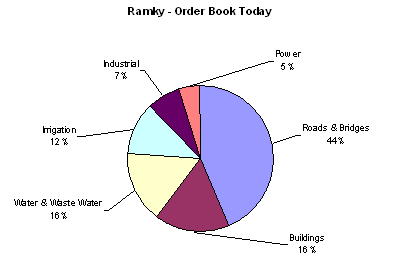
  • The order book of 13,703 cr (3.5 times revenue), is split by vertical as per Fig 1.
  • Customers are State Govt 59%, Private sector 29%, Central Govt 10% and PSU 2%
Ramky Order Book, JainMatrix Investments

Fig 1 – Ramky Order Book, JainMatrix Investments

Prestigious projects include:

  • Hyderabad Ring Road, a 150m road cum area development corridor with 8-lane controlled access expressway.
  • 80 MLD Sewage Treatment Plant at Airoli, Navi Mumbai, bagged an Urban Infrastructure Excellence Award given by CNBC TV18 & Essar Steel.
  • Construction of one of the Asia’s largest sewage treatment plants (172 MLD) with uplift an aerobic sludge blanket process, at Nagole Hyderabad.
  • Construction of Gandhi Medical College and Hospital Complex in Hyderabad.
  • Core strengths: 1) in-house design and engineering team that specializes in designing Water and Waste Water projects 2) Qualified / experienced employees and proven management
  • Shareholding pattern is: Promoters – Individual/Corporate 66.8%, MFs/ DII 7.2%; FIIs 2.1%, Individuals retail & HNI 6.7% and Bodies Corporate plus others 17.2%. Thus Promoters hold a clear majority stake – a good sign.
  • Many of the project payments are made at project execution milestones, so revenues are lumpy. Newer projects in Roads and Power transmission involve upfront payment of premium to government, so revenues start only once Toll collection starts, while construction is internally funded.
  • The Chairman / founder is AA Rami Reddy, and the MD is Y R Nagaraja.

Events, News and Strategies

  • Recent wins: Ramky was awarded two major projects under the NHDP. 1) Six laning of Agra – Etawah Bypass section of NH-2, to be executed as BOT (Toll) basis on DBFOT pattern. Concession period is 30 years, including construction of 910 days and cost is Rs.1207 Cr. 2) Four Laning of Hospet – Chitradurga section of NH-13 in Karnataka under NHDP on DBFOT/BOT basis. Concession period is 25 Years, including construction of 910 days, and cost is Rs 1033.65 Cr.
  • Promoters have been increasing shareholding in the past year as per BSE reports.
  • CBI is investigating Ramky Group and Ramky Estates and Farms about projects awarded during 2004-2009 by the AP Govt. The allegations include political clout used in awarding projects by former CM YSR and son JaganMohan Reddy. The share recently tanked following the arrest of Jagan Reddy in a disproportionate assets matter. Ramky is cooperating with the team in their investigation.
  • Rating: In April ’12, CRISIL revised its credit rating outlook on the long-term bank facilities to ”Negative” from ”Stable”, while reaffirming the rating at ”CRISIL A+”; the rating on the short-term bank facility has been reaffirmed at ”CRISIL A1”.
  • MF holdings have fallen from 3.1m shares (Dec’11) to 1.9m (Mar’12), a bad sign

Strategies executed:

Competition is intense across all business segments. To handle this, Ramky has executed the following strategies:

  • Bidding for high value projects in construction to benefit from economies of scale. Diversifying the construction business into more complex projects, with higher contract value and better margins.
  • Enhancing its project planning and design capabilities. Hiring – all employee adds are supervisory level and above.
  • Smart sourcing – subcontracting of low-end project work, strategic imports and also in house manufacture where appropriate.
  • Investments in equipment and fixed assets help achieve higher operating margins.
  • Structurally, Ramky executes projects either directly, or through SPVs created for specific Road or Infra project; so there are 19 subsidiaries.
  • Thrust on pan-India presence, with 5 Zonal and 3 Regional offices and UAE & West Africa, though international revenue is only 1%.

Industry Note:

  • There is a massive infra push by the Indian govt, envisaged in the 11th and 12th Plan, 30% of which is expected to be funded by private sector capital.
  • This is a crowded space. There are over 60 listed peers in the Construction & Contracting – Civil sector, not including conglomerates.
  • In roads, competition includes Reliance Infra, Jaypee Infra, IL&FS Transp., GMR Infra, Lanco Infra, L&T, IRB, IVRCL, Ashoka Buildcon, etc. Industry estimates are that 90 firms are pre-qualified for prestigious NHAI projects. Many more are present in buildings, Power – Transmission/Equipment, etc sectors.
  • Roads sector is now poised for a 2-3 year period of consolidation. High competition drove infra firms to bid aggressively for new projects. Many firms in this sector have overstretched their balance sheets and may default on payments/ restructure debt/ sell assets.
  • Ramky has entered into power transmission sector where there are many entrenched players in a market that is currently flat. Also Power sector suffers from systemic issues like weak finances of state electricity boards, and fuel linkage issues. As a result many plants are underutilized today. Margins will be stretched here.

 Stock Valuation, Performance and Returns

Ramky had its IPO in Sept’10, with pricing at Rs 450; subscription was fair at 2.9 times and collected 530 cr.

Ramky - Equity performance, JainMatrix Investments

Fig 2 – Ramky – Equity performance, JainMatrix Investments

  • From its IPO price of 450, the stock rose to 460, its all time high. Then the fall was continuous and the CMP of 90.3 is near the all time low of 88.5. The share has fallen 80% in these 21 months, causing tremendous value destruction, Fig 2.
Ramky, Quarterly Revenue and Profits, JainMatrix Investments

Fig 3 – Ramky, Quarterly Revenue and Profits, JainMatrix Investments

  • Dividend was 45% in 2011, at a dividend yield of 4.8%. However, this was a maiden dividend, so we do not have history of steady dividend distribution.
  • As compared to share price, for a 5-year period the growth figures are Sales (40.3%), EBITDA (47.6%), and Net Profit (46.4%) CAGR, see Fig 3. The Q4 of every year is higher due to government client customers.
  • We can see from the Consolidated EPS and Debt Equity – Fig 4, that EPS has grown steadily, at 46% CAGR. The Debt Equity has not risen beyond 1.52.
Ramky, EPS and DE ratio, JainMatrix Investments

Fig 4 – Ramky, EPS and DE ratio, JainMatrix Investments

  • Consolidate Cash Flow is available for the Financial periods after listing and is negative, while showing some improvement y-o-y. See table 5.
31-Mar-10 31-Mar-11
Net cash generated by/(used in) operating activities -169.93 -111.77
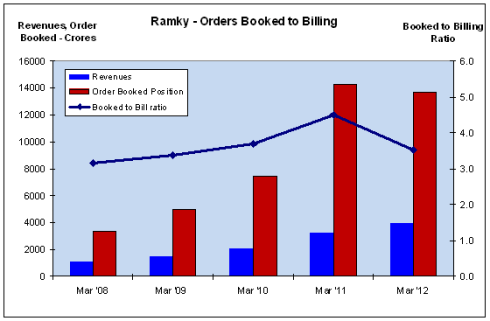
  •  An important ratio for Ramky is the Orders Booked to Billing ratio (BTB). This has fallen, but is still quite comfortable (Fig 6).  Order Booked position at Ramky is 13,703 cr, providing 3.5 years visibility.
Fig 5 - Ramky - Orders Booked to Billings, JainMatrix Investments

Fig 6 – Ramky – Orders Booked to Billings, JainMatrix Investments

  • The Price and PE Chart of Ramky, Fig 7, indicates that IPO in 2010 was at high valuations. Further, in the next 2 years, the share price has shown a disappointing downward trend. Today the PE of Ramky is 2.0 times, (based on Consolidated EPS), below the industry average of 12.5.
  • In Fig 7 we can see that the average PE in the last 2 years has been 7 times. PE has today fallen to very low levels in the valuation range.
Ramky - Price to PE ratio, JainMatrix Investments

Fig 7 – Ramky – Price to PE ratio, JainMatrix Investments

  • The EPS chart, Fig 8, shows that EPS has been flat to gently rising for 2 years.
  • The EPS of Ramky is expected to stay in the trend line range in Fig 8.
Ramky - Price and EPS Chart, JainMatrix Investments

Fig 8 – Ramky – Price and EPS Chart, JainMatrix Investments

  • The Infra sector has not done well recently, but a comparison with CNX Infra index, Fig 9, shows the index has fallen by just 15.7% while Ramky has fallen 80%.
Ramky and CNX Infra Index, JainMatrix Investments

Fig 9 – Ramky and CNX Infra Index, JainMatrix Investments

  • ROCE and RONW is 18-19%, these are good ratios.
  • PEG is at 0.17 – indicates undervalued status.

Risks:

  • Persistent rumours of political connections and investigation by CBI. The price has got hammered due to this news in the last 3 months. Detailed in section ‘Events, News, Strategies’.
  • Ramky states a business objective as ‘to build more complex and multi-disciplinary projects’. Complexity by itself is not a virtue, and makes understanding the Ramky business model more difficult for investors.
  • Diworsification: The firm is spreading itself thin across too many sectors – Water (supply, storage, treatment), irrigation, Roads & Bridges, Buildings, Industrial parks and power distribution, and recently Railway projects.
  • The sector is government dependent, for orders and payments.
  • High interest rates in India are certainly impacting the firm.

Opinion, Outlook and Recommendation

  • The Indian infra sector is critical to the GDP growth, and a lot of resources will be poured into development over the next few years. Ramky straddles this across a number of sectors. Ramky also appears to have good financials over the last 3-5 years.
  • However the consistent fall in share price is not explained by fundamentals, the overall market sentiment, or even the infrastructure sector performance. Current valuations are highly stressed, and the market is awaiting political and investigation outcomes rather than any business achievements.
  • Ramky is a Sell for the long-term investor due to the consistent fall in market prices and political cloud over the firm, all of which can extend or reverse unpredictably.
  • At some point in time, the share should start rising again, to achieve some reasonable valuations after the excessive fall, but this is neither predictable nor advisable for investors to aim for.

JainMatrix Knowledge Base:

See other useful reports

  • KEC International – LINK
  • BGR Energy Systems – LINK
  • IRB Infrastructure Developers – LINK
  • Adani Port: Infra play at good valuations – LINK

Disclosure: It is safe to assume that if the JainMatrix website recommends a stock, the researcher has already invested in it.

Do you find this site useful?

Visit the SUBSCRIBE  page to find how you can get more. Click LINK

Add your comments/ queries below

Disclaimer:

These reports and documents have been prepared by JainMatrix Investments Ltd. They are not to be copied, reused or made available to others without prior permission of JainMatrix Investments. Any questions should be directed to the director of JainMatrix Investments at punit.jain@jainmatrix.com

Also see: https://jainmatrix.wordpress.com/disclaimer/

Petronet LNG – A Solid Gas Company

——————————————————————-

The latest report on Petronet LNG – A Recovery in Kochi, created in May 2014 is available for your reading. Petronet LNG – A Recovery in Kochi

Date: June 15, 2012        CMP: Rs 132        Large Cap with Market Cap Rs 11,883 crores Advice:  Buy now and systematically              Target:  Mar’13 – 269 and Mar’14 – 361

Executive Summary

Overview:  Petronet LNG has a unique status as a private sector player promoted by PSUs. It supplies LNG, a clean fuel, to the energy & gas deficit country. It has a great record of creation and operation of LNG import facilities. Revenues have grown at a CAGR of 33%, EBITDA 23%, Profits 28% and Cash Flow 19% over 5 years.

Why Buy Now: The key constraint is capacity, as capacity utilization has been 112%. Petronet LNG is doubling capacities in the next two years. The share price has had an unusual fall of 29% in the last 10 months due to news flow, market conditions and a flat Q4FY12. This fall is a market excess, and offers investors an attractive entry point.

This is a revision of a Dec’11 Report by JainMatrix Investments – LINK

Petronet LNG – Description and Profile

  • Petronet LNG (PLNG) has a 20% market share in gas supply in India. It’s objective is to import, regassify and sell LNG in India. It is a JV of GAIL, ONGC, Indian Oil & BPCL, yet is a private sector firm.
  • Turnover in ’12 was 22,695 crores (up 72%) and PAT 1058 cr. (up 71%). PLNG owns and operates a LNG terminal at Dahej, Gujarat with capacity of 10 Million Metric Tonne Per Annum (mmtpa) of LNG.
  • Long-term contracts are in place for LNG supply from RasGas-Qatar (7.5 MMTPA) and Exxon Mobil-Australia (1.44 MMTPA). PLNG also takes spot cargoes to boost volumes and utilize capacity. It recently signed with Gaz De France for 0.6MT supply starting soon.
  • Operational excellence with FY12 LNG volumes of 11.2 mmtpa, a 112% capacity utilization at Dahej.
  • The price of LNG sourced rose recently from 3-4$/mmbtu a few years ago, to 16$/mmbtu last year in the Asian market. However, PLNG is protected from these prices due to back-to-back contracts with customers. Sales of the long-term contracted gas are through GAIL, IOCL & BPCL, where PLNG keeps a regassification margin. For spot cargoes, PLNG earns both marketing and regassification margins.
  • Imported LNG is regassified and supplied in pipelines or Cryogenic road Vehicles. The customers include power plants, household & commercial piped gas, fertilizer plants, Industrial boiler fuel, etc.
  • PLNG has a 26% JV called Adani Petronet Port, for bulk Solid Cargo capacity 15 mmtpa, since 2011.
  • Shareholding pattern: Promoter – Govt./ PSU 50%, MFs/ DII 7.1%, FIIs 14.3%, Individuals retail / HNI 14.2% Bodies Corporate etc 14.4%. The Private company status gives PLNG operational flexibility.
  • Executives: Dr. A. K. Balyan, MD & CEO and Shri C. S. Mani Director (Technical).
  • The vision is to grow capacity from current 10 to 25 mmtpa by FY17.

Current projects

  • A new LNG terminal at Kochi, Kerala of 5 mmtpa, which will be commissioned by Sept ‘12.
  • An additional LNG jetty at Dahej will take the capacity from 10 to 15 mmtpa by Oct ’13.
  • Direct Marketing of LNG in Western region, coastal & industrial areas, in a 800 km radius.

Future Plans

  • Kochi terminal complex: PLNG may also invest in a power plant in Kochi that will run on LNG. It is also likely to pick up stake in a LNG shipping venture for transporting LNG to Kochi.
  • The term sheet has been signed for a LNG Terminal at Gangavaram Port, Andhra Pradesh, of 5 mmtpa capacity. To be commissioned by 2016, the project involves an investment of 4,500 crores.

Industry Note:

  • Gas consumption in India is low compared to global patterns, see Fig 1. PLNG is a pioneer that is creating the infrastructure for gas access and supply, to change consumption patterns and demand.
Primary Energy consumption – World and India, JainMatrix Investments

Fig 1 – Primary Energy consumption – World and India, click to enlarge image

  • Gas is a better fuel than Coal, Oil and Nuclear. It burns completely. Gas is the cleanest fossil fuel.
  • Today India is energy and raw fuel deficit, with supply issues and growing demand.
  • LNG prices: We have seen a rise in spot LNG prices, particularly in Asia after the Japanese nuclear disaster. LNG demand is high, but price has peaked around 16$/mmbtu, and may fall as spot prices in USA are 2$/mmbtu and it starts exporting. Also Japan will soon restart its nuclear plants as it has modern, safe plants and large unused capacity.
  • Also PLNG is not directly affected by high prices, in fact it earns higher margins on high prices, but overall demand will be affected.
Natural Gas Prices, JainMatrix Investments

Fig 2 – Natural Gas Prices

  • Coal – it is a dirty fuel. There are substantial Coal reserves, but monopoly producer Coal India has not met production targets. Their constraints are environmental clearances, logistics, heavy rains, insurgency and labour issues. Other captive mine owners are not producing enough, so imports have increased.
  • India is a crude oil importer and 70% of supply comes from this route. Oil prices are high.
  • Nuclear energy globally has suffered a setback due to the Japan disaster. New plant construction is a political hot potato. Hydropower capacity has growth constraints. Alternative energy sources are yet to become commercially comparable to fossil fuels.
  • Indian gas demand is expected to reach 434 mscmd by 2015, compared with a supply of 203 mscmd. There is definitely a huge demand for gas.
  • Domestic supply of Natural gas from Reliance (Krishna Godavari), ONGC and Oil India wells has not scaled up and may not be able to meet above demand.
  • Other LNG terminals present are Hazira (Shell owned, 3.6 mmtpa) and Dabhol (GAIL/NTPC, will be ready mid 2012, 5 mmtpa).  PLNG is thus a pioneer and industry leader.

Stock evaluation, Performance and Returns

  • PLNG had its IPO in March 2004 priced at Rs 15, and was oversubscribed 4.2 times. The price rose to 120 in Jan’08, in the financial crisis fell to 30 in Nov’08; the all time high was 186 in Aug’11. Fig 3.
Petronet LNG Price Chart

Fig 3 – Petronet LNG Price Chart, JainMatrix Investments

  • Petronet LNG at CMP of 132, has given IPO investors a 34% return CAGR in 8 years, Fig 4. The maiden dividend of Rs 1.3 was paid in 2007. Thereafter dividend has shown a steady increase.
Petronet LNG stock performance, JainMatrix Investments

Fig 4 – Petronet LNG stock performance, JainMatrix Investments, click to enlarge

  • The Quarterly Sales and Margins (Fig 5) show that the fall in margins from early years is compensated by volumes growth. Revenues have grown at 33% CAGR, EBITDA 23% and Profits 28%.
Quarterly Sales and Margins, JainMatrix Investments

Fig 5 – Quarterly Sales and Margins, JainMatrix Investments

  •  Cash flow and EPS have a robust growth rate Fig 6. After the 2010 dip, we saw substantial recovery in 2012.  The Cash flow is up 19% CAGR and annualized EPS is up 28% CAGR over last 5 years.
  • With good capacity utilization in ‘11 & ‘12, PLNG has partially repaid debt and D/E has fallen to 0.86.
Cash Flow and EPS, JainMatrix Investments

Fig 6 – Cash Flow and EPS, JainMatrix Investments, , click to enlarge image

  • Price and PE chart Fig 7, shows that PE has fallen below the historical mean of 14 times. PE today is 9.4 and clearly in the underpriced quartile.
  • This price fall has happened in spite of earnings growth, Fig 8.
Price and PE Chart, JainMatrix Investments

Fig 7 – Price and PE Chart, JainMatrix Investments

Price and EPS Chart, JainMatrix Investments

Fig 8 – Price and EPS Chart, JainMatrix Investments, , click to enlarge image

  • Price and EPS quarterly graph, Fig 8, shows that EPS growth has flattened in 2012. This was expected as the company is running at 112% capacity utilization. The next boost to earnings is in 2nd half FY12 when the Kochi terminal is launched, and then 2nd half of ’13 when the additional capacity in Dahej is commissioned.
  • The investments for these projects will involve a debt increase in future.
  • We expect the EPS of PLNG to stay within the channel in the Fig 8 graphic.
  • ROCE and RONW are between 27-30% in FY12, which is excellent.
  • Beta of the stock is 1.08 (Reuters) and this indicates volatility is similar to that of the Sensex.
  • PEG is at 0.34 – indicates safety and great value

 Benchmarking and Financial Projections

  • In a benchmarking exercise, we compare PLNG with 3 firms in the same or related industry
Benchmarking, JainMatrix Investments

Fig 9 – Benchmarking, JainMatrix Investments

  • Conclusions: Compared to peers, PLNG is not overpriced. It has good Sales and Profits growth. Debt looks high but this is an investment phase for PLNG. Price appreciation is good.
  • (Gujarat Gas looks good on many parameters. Perhaps we will research this stock in depth soon.)
  • In a Financial projections exercise, we project PLNG financials till FY 2015.
  • Readers of my Dec ’11 report on PLNG (LINK) may note that the firm exceeded my FY12 projections by 15-28%, another sign of exceptional performance.
Financial Projections, JainMatrix Investments

Fig 10 – Financial Projections, JainMatrix Investments

Risks:

A spate of bad news recently has sent PLNG price down. These are:

  • The Petroleum Natural Gas Regulatory Board PNGRB recently passed an order against Indraprastha Gas retrospectively cutting the network tariff and compression charges, affecting IGL & PLNG prices.
    • However the High court soon quashed this ruling as ‘illegal’ and that PNGRB was not empowered to take such calls. However until the role of PNGRB is clarified/ resolved, uncertainty will loom over the sector. PLNG management is also confident that PNGRB does not have a mandate to review margins for PLNG.
  • PLNG reported excellent results in Q1, Q2 and Q3 of FY12, but flat results in Q4 (compared to Q3). The investing community was disappointed and the share price fell sharply.
    • With capacity utilization of 112%, better results cannot be expected until capacity is added.
  • Current market weakness has affected the PLNG price, but expect recovery and solid performance.

Opinion, Outlook and Recommendation

  • The equity base of PLNG has remained stable at 750 crores through 8 years of 12-fold revenue growth. This indicates stable and conservative capital management.
  • PLNG is doubling expanding capacities in two years. It has a good track record of investing in LNG assets and utilizing/ operating them. The Cochin facility will supply the energy deficit Kerala region.
  • PLNG share price has had an unusual fall of 29% due to news flow and market conditions discussed above. These are temporary, and the stock specific effects should reverse in the next 3-6 months.
  • The valuation and projection/ targets for PLNG are
    • Current valuation is of 197, indicating it is available at a 49% discount
    • March 13 target is 269 (a 104% appreciation from current levels)
    • March 14 is 361 (a 173% appreciation)
  • PLNG will continue on the path of solid stock performance and dividends over the next decade. Invest now and systematically to gain for the long-term.

JainMatrix Knowledge Base:

Additional Infrastructure sector reports from JainMatrix Investments:

  • Adani Ports and SEZ – LINK
  • IRB Infrastructure Developers – LINK
  • KEC International – LINK
  • Ramky Infrastructure – LINK
  • BGR Energy Systems – LINK 

Disclosure: It is safe to assume that if the JainMatrix website recommends a stock, the researcher has already invested in it.

Do you find this site useful?

Visit the SUBSCRIBE  page to find how you can get more. Click LINK

Add your comments/ queries below

Disclaimer:

These reports and documents have been prepared by JainMatrix Investments Ltd. They are not to be copied, reused or made available to others without prior permission of JainMatrix Investments. Any questions should be directed to the director of JainMatrix Investments at punit.jain@jainmatrix.com

Also see: https://jainmatrix.wordpress.com/disclaimer/