Have you achieved Escape Velocity on your wealth?

In this note, Research Analyst Punit Jain shares his thoughts around Financial Freedom, a case study on Financial Goal based investing, and finally the concept of Escape Velocity on wealth.

Financial Freedom We used to call it Retirement, but now it is referred to as Financial Freedom. During our working careers we need to track our wealth, and have Financial Freedom as the Goal.

Its possible that Financial Freedom can be achieved before 60. And it need not be imposed on you by your employer, but achieved by you based on your earnings, lifestyle, planning and wealth management. Here are more details.

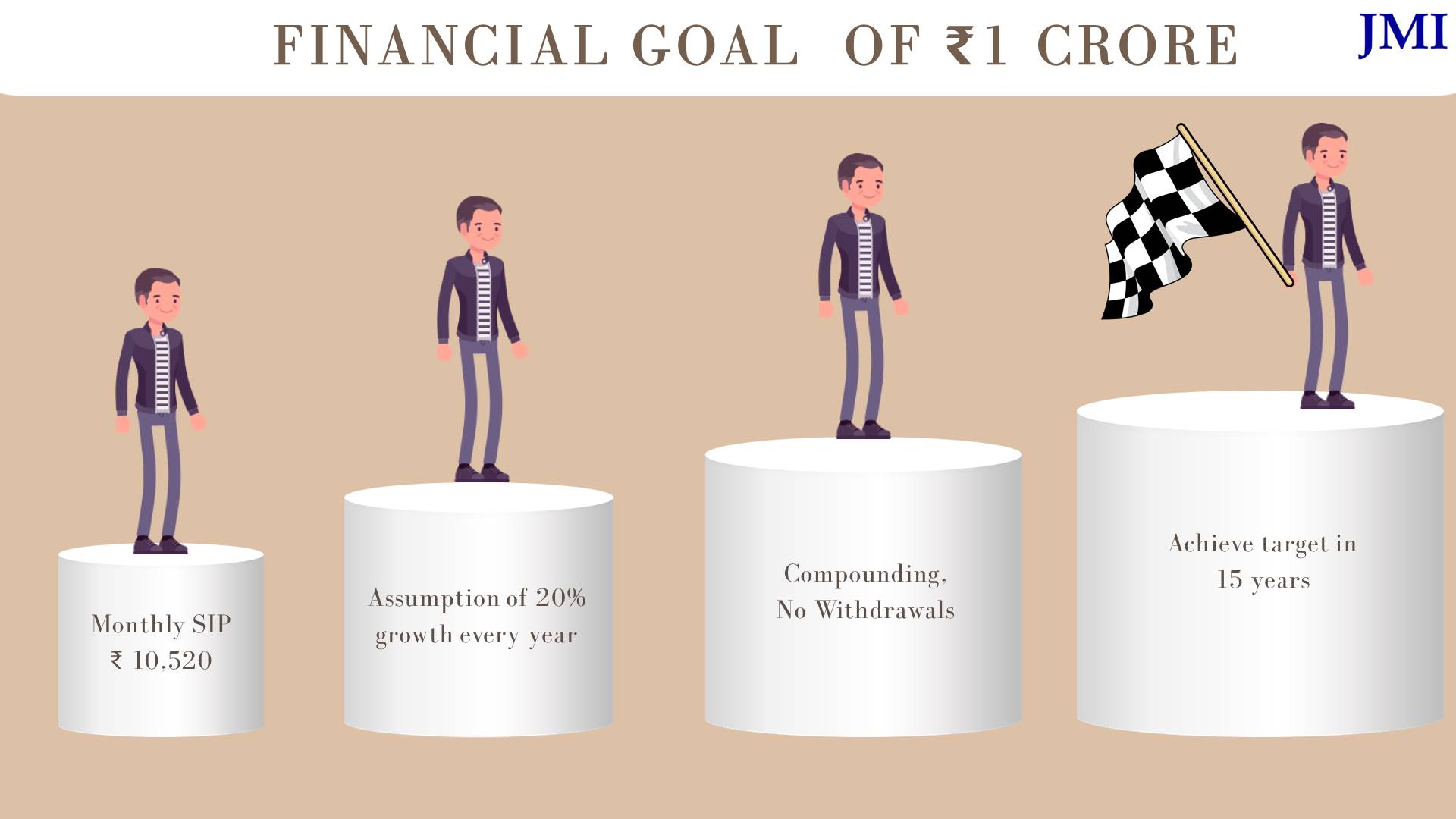
Case for Financial Goals: Being a primarily Equity focused professional, I have come up with a Case for Goals based investing. Its targeted at young working executives early in their career. Here it is –

This case has many assumptions, including ones stated above, and 1) This is for an equity investor starting off his journey 2) this is a primarily direct equity investment that can possibly give a 20% compounded return over the long term 3) By no means is 20% return a guarantee or even a promise, but just an achievable possibility, and real annual results can vary widely depending on the markets and the actual investments made by the investor. Also this case can be customized for different goals.

Escape Velocity in the context of space is the speed at which a rocket has to travel away from earth in order to escape its gravity force and enter space. For those so interested, it is 11.2 km per sec (6.96 miles).

Escape Velocity in the context of Financial Freedom is where your wealth and investments are large enough that the average annual gains from them exceed your average annual expenses. For this its required that your wealth grows faster than your expenses. To achieve this, most people need both good investments and good discipline.

A very simplified example. Lets say you have achieved a wealth corpus in equity of 30 lakhs. It is growing by 20% average a year, so this year by 6 lakhs. Your expenses however are 40,000 a month, or 4.8 lakhs a year. If your returns and expenses remain in this range, and you stay invested, you should be able to grow your corpus every year. You have already achieved Financial Escape Velocity !!

Direct Equity investments can help you achieve this Escape Velocity earlier, and better.

If you are an individual investor, we at JainMatrix Investments, as a SEBI registered Research Analyst firm can help with your wealth building. Sign up for our services, or to find out more reach out to us.

Do keep in mind that equity is a volatile asset class, and returns can vary widely from year to year.

Pricing and Payment Options

Also see our recently updated

Track Record

Regards, Punit Jain

Comment, leave a reply below, and like and share this post with your friends.

DISCLAIMER

This document has been prepared by JainMatrix Investments Bangalore (JM), and is meant for use by the recipient only as information and is not for circulation. This document is not to be reported or copied or made available to others without prior permission of JM. It should not be considered or taken as an offer to sell or a solicitation to buy or sell any security. The information contained in this report has been obtained from sources that are considered to be reliable. However, JM has not independently verified the accuracy or completeness of the same. This is a blog and marketing collateral. The securities quoted here, if any, are for illustration only and are not recommendatory. Neither JM nor any of its affiliates, its directors or its employees accepts any responsibility of whatsoever nature for the information, statements and opinion given, made available or expressed herein or for any omission therein. Recipients of this report should be aware that past performance is not necessarily a guide to future performance and value of investments can go down as well. The suitability or otherwise of any investments will depend upon the recipient’s particular circumstances and, in case of doubt, advice should be sought from an Investment Advisor. Investment in securities market are subject to market risks. Read all the related documents carefully before investing. Punit Jain is a registered Research Analyst under SEBI (Research Analysts) Regulations, 2014. Registration granted by SEBI, and certification from NISM in no way guarantee performance of the RA or provide any assurance of returns to investors. JM has been publishing equity research reports since Nov 2012. Any questions should be directed to the director of JainMatrix Investments at punit.jain@jainmatrix.com. Name of the RA as registered with SEBI – Punit Jain, SEBI Registration No. INH200002747.

Rule#7 Pitfalls – If you want to invest in Indian markets, start NOW

Dear Investor,

One of the most difficult skills in investing is called Timing the Markets. My experiments with this have pushed me to the conclusion – most of the time, we should just avoid timing the markets. More important than this is Time in the Markets. Start right away and allow the markets to grow your wealth. We can earn average and even above average returns by just investing in good companies for longer periods.

Markets work in waves or cycles, that are quite unpredictable. And in fact the hype and enthusiasm to invest in the markets peaks around the time they are at new highs. A large number of new investors are then disappointed at their immediate returns and shy away from it.

Many well informed potentials also promise themselves, and their advisors, that they will start investing when the markets bottom out, when everything is cheap. This really never happens. At such times, fear is highest, and most people are worried about (notional) and real losses. Time flies, and that window of opportunity slips by.

Instead, it makes more sense to start now, yet keep some funds available (dry powder) for additional investments if the market falls. Or if a great new opportunity presents itself.

Most of the time, I find myself fully invested, and if a great opportunity presents itself, I sell the lower potential stock to buy the higher potential one. Thus improving my portfolio.

Outlook: Today India is the fastest growing large economy in the world. We are on the cusp of many years of good GDP growth and the economy is both producing and consuming more and better. Investments in infrastructure are bearing fruit. There are few shortages to be seen. At a Nifty PE of 21.6 times TTM, valuations are just above the long term median of 20.6 times. I am quite optimistic.

If you are an individual investor, we at JainMatrix Investments, as a SEBI registered Research Analyst firm can help with your wealth building. Sign up for our services, and to find out more reach out to us on

CONTACT US

Or explore on this website

OFFERINGS

Comment, leave a reply below, and like and share this post with your friends.

Regards, Punit Jain

DISCLAIMER

This document has been prepared by JainMatrix Investments Bangalore (JM), and is meant for use by the recipient only as information and is not for circulation. This document is not to be reported or copied or made available to others without prior permission of JM. It should not be considered or taken as an offer to sell or a solicitation to buy or sell any security. The information contained in this report has been obtained from sources that are considered to be reliable. However, JM has not independently verified the accuracy or completeness of the same. This is a marketing collateral. The securities quoted here, if any, are for illustration only and are not recommendatory. Neither JM nor any of its affiliates, its directors or its employees accepts any responsibility of whatsoever nature for the information, statements and opinion given, made available or expressed herein or for any omission therein. Recipients of this report should be aware that past performance is not necessarily a guide to future performance and value of investments can go down as well. The suitability or otherwise of any investments will depend upon the recipient’s particular circumstances and, in case of doubt, advice should be sought from an Investment Advisor. Investment in securities market are subject to market risks. Read all the related documents carefully before investing. Punit Jain is a registered Research Analyst under SEBI (Research Analysts) Regulations, 2014. Registration granted by SEBI, and certification from NISM in no way guarantee performance of the RA or provide any assurance of returns to investors. JM has been publishing equity research reports since Nov 2012. Any questions should be directed to the director of JainMatrix Investments at punit.jain@jainmatrix.com. Name of the RA as registered with SEBI – Punit Jain, SEBI Registration No. INH200002747.

Lessons from 10 years, and Pitfalls in Investing

Dear Investor,

At JainMatrix Investments, I am happy to announce we have completed 10 years as a Research Analyst company. (we did get the RA certification in 2016, when the norms kicked in, but were practicing from earlier).

On this occasion, the best thing I can share with you, dear investor, are my learnings from the profession. Just like any equity investor in India, over the last decade we have seen upcycles and downcycles. The USA real estate crash of 2008 and the 2014 euphoria of Indian elections. Demonetization of 2016. The covid collapse of 2020 and the IT sector excitement of 2021. Add to this company and industry specific up and down cycles.

Survival and even success through these periods has been based on learnings of what to do, and also not do on our investment portfolio. The latter can be called as Pitfalls.

In this campaign, we will share with you the Pitfalls you must avoid in order to succeed as an investor. These are the rules I thought of, realized were required, experimented with and against, and finally established as a Gold Standard Rule. I would recommend every single individual investor to follow these, to get a better chance of success.

In wealth management as well as in Direct Equity investments, these Rules must be followed.

Pitfalls and Lessons

Rule #1 – Overinvesting in a single stock.

Rule #2 – Long Term Equity Investments must not be funded by loans

Rule #3 Investing timeframes

Rule #4 – To Win Big in Investing, you have to Deal with Losses

Rule #5 Pitfalls – Do you have too many stocks in your equity Portfolio?

Rule #6 Pitfalls – To be a good investor, do things differently

Rule#7 Pitfalls – If you want to invest in Indian markets, start NOW

Here’s to your profitable investing.

Regards, Punit Jain

DISCLAIMER

This document has been prepared by JainMatrix Investments Bangalore (JM), and is meant for use by the recipient only as information and is not for circulation. This document is not to be reported or copied or made available to others without prior permission of JM. It should not be considered or taken as an offer to sell or a solicitation to buy or sell any security. The information contained in this report has been obtained from sources that are considered to be reliable. However, JM has not independently verified the accuracy or completeness of the same. This is a marketing collateral, and there is no stock mentioned here, no price target here, or even a recommendation of BUY / HOLD / SELL. Neither JM nor any of its affiliates, its directors or its employees accepts any responsibility of whatsoever nature for the information, statements and opinion given, made available or expressed herein or for any omission therein. Recipients of this report should be aware that past performance is not necessarily a guide to future performance and value of investments can go down as well. The suitability or otherwise of any investments will depend upon the recipient’s particular circumstances and, in case of doubt, advice should be sought from an Investment Advisor. Investment in securities market are subject to market risks. Read all the related documents carefully before investing. Punit Jain is a registered Research Analyst under SEBI (Research Analysts) Regulations, 2014. Registration granted by SEBI, and certification from NISM in no way guarantee performance of the RA or provide any assurance of returns to investors. JM has been publishing equity research reports since Nov 2012. Any questions should be directed to the director of JainMatrix Investments at punit.jain@jainmatrix.com. Name of the RA as registered with SEBI – Punit Jain, SEBI Registration No. INH200002747.

IRCTC – Equity Research Report from JainMatrix Investments

Here is a small video from Punit Jain of JainMatrix Investments.

We have published a report on IRCTC. Its a valuable report, with a discussion around revenue segments, outlook, 3 year financial projections and a May 2025 Price Target.

Disclaimer

This document has been prepared by JainMatrix Investments Bangalore (JM), and is meant for use by the recipient only as information and is not for circulation. This document is not to be reported or copied or made available to others without prior permission of JM. It should not be considered or taken as an offer to sell or a solicitation to buy or sell any security. The information contained in this report has been obtained from sources that are considered to be reliable. However, JM has not independently verified the accuracy or completeness of the same.

This is a marketing collateral, and there is no price target here, or even a recommendation of BUY / HOLD / SELL.

Neither JM nor any of its affiliates, its directors or its employees accepts any responsibility of whatsoever nature for the information, statements and opinion given, made available or expressed herein or for any omission therein. Recipients of this report should be aware that past performance is not necessarily a guide to future performance and value of investments can go down as well. The suitability or otherwise of any investments will depend upon the recipient’s particular circumstances and, in case of doubt, advice should be sought from an Investment Advisor. Investment in securities market are subject to market risks. Read all the related documents carefully before investing. Punit Jain is a registered Research Analyst under SEBI (Research Analysts) Regulations, 2014. Registration granted by SEBI, and certification from NISM in no way guarantee performance of the RA or provide any assurance of returns to investors. JM has been publishing equity research reports since Nov 2012. Any questions should be directed to the director of JainMatrix Investments at punit.jain@jainmatrix.com. Name of the RA as registered with SEBI – Punit Jain, SEBI Registration No. INH200002747.

Real Estate v/s Equity for personal wealth creation

10th Apr 2023

Lets evaluate several publicly available asset classes and try to answer this question. In addition, we will have a face off among two of the largest asset classes – Real Estate and Equity. This will help investors to build clarity and help choose among these assets.

Wealth Options and Components

In this Wealth chart Fig 1, we can see various Wealth Options and Components publicly available to investors.

  • The old classic asset is Real Estate (RE), in the form of apartments, land, commercial property, etc.
  • Equity markets are a rising star asset class as the digitization processes have made it transparent and accessible. Equity subcategories are also listed. AIF funds and PMS services are also available now.
  • Debt, Jewellery (and Gold and precious metals) and Alternative assets are also available.
  • Insurance is a wealth protection asset, helping cover some risks.
  • Loans are a part of your wealth, however they can be taken for Appreciating or Depreciating Assets (AA/DA). Loans are better used to buy an AA like house or education, than for DAs like furniture, cars and holidays.

Fig 1 Wealth Options

Choosing among the Asset Classes

Here is a chart of Average Returns versus Risk for each of these assets, Fig 2.

  • Returns for each asset class vary by subclass and by time periods. Here we try to take the multi-year average for each class over 5-6 years period of time.
  • Equity ETFs and MFs returns are simplified as the Nifty index.
  • Direct equity assumes blended returns across market caps.

Fig 2 Wealth and Risk

 Hence the broad principle is – You need to take a higher risk to get a higher return.

  • There are perhaps higher risk asset classes such as F&O and Private equity. Several Wealth Options are not seen here. Its seen that results and returns vary widely among Classes and so results cannot be generalized.
  • All asset classes are probabilistic in terms of returns and risks. This means that while the average returns for RE (for example) may be 8-10% per year, there can be a particular year where this may be 15-20% on the high side and (-10%) on the low side.

The choice among these assets depends upon risk appetite, comfort level and nature of the investor.

  • However the chart points to Equity as a higher returns asset, if we are able to manage the higher risk.
  • Having seen all this, the suggestion to the new investor is to try some of these asset options in small quantities to get a better understanding. Here RE is difficult as it is a big ticket item, but the others can be bought for small sums.
  • A Bank savings account and a Stock broking account would be required to try out these (non RE) assets.

Real Estate versus Equity

In this section we delve deeper into the two most common asset classes – Real Estate and Equity.

Assumptions

Let’s simplify Real Estate to an apartment purchase in the person’s place of work. For own use, and as an upgrade from paying rent. Other Real Estate options such as a second house for investing or a plot for investment or commercial property are not being considered here.

Also Equity will also be simplified as Nifty index investments. Specific products such as MFs, PMS, and Direct Equity investment services such as that offered by JainMatrix Investments will not be considered here.

Comparison

In the following table we compare the Real Estate and Equity asset classes across key parameters. (Table 3)

CriteriaReal Estate – ApartmentEquity – Nifty
Ticket sizeRanges from ₹ 25 lakhs to crores depending on city and location. However if you buy with a loan, you need to pay 20% as down payment.Generally speaking the Nifty ETF products start with ₹ 5000, and go to any number. Direct equity has no minimum.
Source for buying and sellingNew apartments can be bought directly from builders. Second sale or older are from known people or with the help of real estate brokers. Aggregator websites also help with real estate information and brokers.Buying Platform – You will need a Stock Broking account for direct equity purchase. Products like MFs and ETFs can also be bought from Bank account – investment channels. And also directly from Fund website or MF distributors.
Rating for Identifying and buyingThis can be HARD and complex. Here the buyer has to identify the location, size of property, new v/s old, builder, etc. The process involves visiting potential properties, finalizing criteria, rating them, and closing the purchase, followed by registering the property. If you decide to invest in the Nifty, it’s EASY and a simple choice of Nifty ETFs. Otherwise the rating is MEDIUM. There are 5000+ listed firms in India, but homing in to a purchase decision of 5-10-20 shares needs reading, and decisions. JainMatrix Investments provides this advisory service. Similarly choosing among MFs or PMSs.
Time and costs for TransactionsThis can take anything from 2 months to a year. The cost over and above property cost may be Stamp Duty and Registration Tax for new properties, but may also include brokerage depending upon the agent or services used.With digitalization, time to buy is very less, 1-2 days, once the buying platform is in place. Brokerage costs vary from 0.75% of purchase for full service brokers to very low for discount brokers. Other taxes are less than 0.1% except Capital Gains tax.
Selling; and Time and costSelling is also HARD. From a decision to sell, to actual transaction it can take from 2-6 months. Brokers, websites or personal network can help. The cost can be 1-2% of property value. There are payment risks so one has to be disciplined in the process.Selling is EASY. The transaction happens at market rates, and funds are transferred in 1-2 days. Brokerage and other costs are similar as buying.
Total cycle timeSo one can see that the total cycle time for Real Estate is long. It includes Buying time, holding period and selling time.Varies by approach. The Nifty ETF or other equity assets can be held till the cash is required or a better investment has been found. At JainMatrix, we suggest Long Term Investments in quality companies, which allow the money to compound. However periodic pruning of a Direct Equity portfolio can be done every 6 months, to let the winners ride and exit underperformers.
UtilityAn apartment in use by the owner is useful, saves rent and provides pride of ownership.Equity investments appreciate and earn dividend. We must save for a rainy day!!
Capital GainsLong Term Capital Gains kick in at a holding of over 2 years. Typically from buy to sell may be 8-12 years on average.Long Term Capital Gains holding period is over 1 year.
Returns from Investing  A house to stay is a good choice in terms of stability and rootedness rather than just monetary returns. It saves on rent. Having said that, an apartment asset can give 8-10% returns on average. Fig 2.The Nifty has given 12-14% CAGR returns over the past decade. Returns are estimated higher for Direct Equity. See Fig 2.

Real Estate versus Equity Opinion by JainMatrix

In fact both Real Estate and Equities are asset classes that can complement each other. Investments should be started early in the working life, salaried or business. These can be in Equity, as the minimum is a small ticket size. In a few years as this asset grows, and the need arises, it can help to initiate a real estate purchase.

Finally Pros and Cons of Equity

Pros

  • High average returns. Rising asset class.
  • Indian equity markets have achieved a global size, volumes and transparency.
  • Flexible – minimum ticket size is small, but it can scale for larger investments.
  • Fast yet robust – digital enablement now allows a stock broking account to be as easy and convenient to handle as a savings bank account. Buying, selling and dividend transactions also happen digitally. Websites and mobile applications have also improved access and ease of navigation.
  • Tax friendly – the tax rules are encouraging for equity with just 1 year for Long Term Capital Gains, LTCG not being taxed until it crosses a certain sum, and ability to set off losses one year with gains in another year.
  • Several equity products like Direct Equity access, MFs, PMS, small case and advisory services allow flexible access to all kinds of investors. See Fig 4.

Cons

  • Equity investors are exposed to market risks, and also industry and company specific risks like fraud, global events, war, weather, currency, etc.
  • Fear and Greed are driving forces in equity markets, and equities can alternate between expensive (excessively high valuations) and cheap (too low valuations).
  • Patience is a virtue, and expecting quick returns can be detrimental for investors.
  • Short term Trading versus Long Term Investing is also a difficult choice for those new to equity markets.

Conclusion

Equity penetration in India is low due to lack of access to stock brokers, pre existing fears of stock markets, inertia and invisible nature of equity assets. However a look at developed markets shows that penetration is as high as 50% compared to India’s 5-6%. Further, financialization of Indians’ assets has begun, with We expect steady growth of equity penetration and

Glossary

  • AIF – Alternative Investment Funds are SEBI regulated and pools of funds from specific investors as per a previously defined investment policy. Next version of Mutual Funds
  • PMS – Portfolio Management Service.
  • MF – Mutual Fund
  • ETF – Exchange Traded Fund – a type of MF which is passively managed, and usually shadows a well-known Index or commodity. It typically has lower management fees compared to actively managed MFs.

My Standard Disclaimer

Investment in securities market are subject to market risks. Read all the related documents carefully before investing. This document has been prepared by JainMatrix Investments Bangalore (JM), and is meant for use by the recipient only as information and is not for circulation. This document is not to be reported or copied or made available to others without prior permission of JM. It should not be considered or taken as an offer to sell or a solicitation to buy or sell any security. The information contained in this report has been obtained from sources that are considered to be reliable. However, JM has not independently verified the accuracy or completeness of the same. Neither JM nor any of its affiliates, its directors or its employees accepts any responsibility of whatsoever nature for the information, statements and opinion given, made available or expressed herein or for any omission therein. The suitability or otherwise of any investments will depend upon the recipient’s particular circumstances and, in case of doubt, advice should be sought from a RIA – Registered Investment Advisor.

Punit Jain is a registered Research Analyst under SEBI (Research Analysts) Regulations, 2014. JM has been publishing equity research reports since Nov 2012. Any questions should be directed to the director of JainMatrix Investments at punit.jain@jainmatrix.com

Corporate Transformation: From Cost to Time

Growing up in a middle class home, I have pretty much got used to worrying about cost. Going on a holiday? What’s the best deal you can find? Buying a coffee table? What’s the best price you can find for that size and quality?

In recent years, there has been a new challenge. On getting overworked, and with budgets not a big issue, the issue was, how can I plan that holiday within that limited time? How can I buy that furniture fast and right? Can I do all this today, and still get a good night’s sleep?

Optimize for Time: That’s when the thought struck me. Rather than optimizing for Cost, I need to optimize for Time. Productivity is more important. Speed and accuracy may cost more, but are a better option.

This needs a radical rethink of the way we make decisions. One way to do this is the digital tools available. E-commerce for buying? Check. Travel websites for holidays? Check. Doing everything yourself? No, no. Outsourcing of design and execution? Check. The other way is outside expertise.

In corporate environments too, a more precious commodity than budgets, is the time of the workforce. How can we do this work within this time constraint? Planning and project management tools? Check. Portals, collaboration tools and email for employee collaboration? Check.

An example that comes to mind is the Bangalore Metro – BMRCL. Eleven years after it was set up, the firm has recently bid out for Project Management software that can capture the complexity of its work, help tie the loose ends and do work on time.

Corporate Objectives: Business or Group Leaders with large teams in place have instinctively moved to Time optimization for their teams. The team is fixed (in the medium term) and everyone is on a salary so the objective is for the team is to work better together, and do more. The workload should also be well spread across the team rather than a few getting overworked even as others are relatively free.

What’s changed is the tools, and outsourcing and digital options we have to do this in practice.

Software versus Jobs: Another mental constraint some of us struggle with – is the use of software going to result in the loss of jobs? Is there a trade off between use of software versus number of jobs and employees? This may be true of some legacy bloated PSU firms where employee collaboration is by physical files and paperwork. Collaboration software surely helps teams work better and faster with fewer people. But many of the non collaboration digital tools that we now have access to are just outsourcing the work to another organization that can do it more efficiently. This organization does the work, and grows, while your firm becomes more focused. In effect, total employment may not be affected, but productivity improves.

Example – Second Generation PSUs: The second generation PSUs in India have been set up without legacy workforces and are super focused on their core competencies. Petronet LNG, IRCTC and CONCOR come to mind. They have their own employees handling senior management functions and the core work. Non core work like security, facilities management, recruitment, routine procurement, travel, logistics, canteens, etc. can and are being outsourced to competent agencies. Keeping the core staff low.

The ‘L1’ dilemma: Indian PSU procurement and tendering is famous for awarding projects to the ‘L1’ bidder. Looking back at the performance of projects bid out, perhaps the L2 or L3 bidder would have been a better choice if the primary criteria was not just price, but also Speed, reliability and Quality of work. So many projects flounder on execution after the bidder realizes he is in losses or is unable to handle project challenges. The Total Cost of a Project includes Project bid value, real costs of project, time of project and maintenance for the life of project. So here also for better success rates and performance, the tendering process needs to be ‘L1’ for Total Cost of Project, incorporating a probability of timely completion and penalties and counter guarantees. This is harder to judge, but its time our decision making advances, and gets better results.

Cheers and success to you. Comment on this article if you find it interesting.

Punit Jain

DISCLAIMER

This document has been prepared by JainMatrix Investments Bangalore (JM), and is meant for use by the recipient only as information and is not for circulation. This document is not to be reported or copied or made available to others without prior permission of JM. It should not be considered or taken as an offer to sell or a solicitation to buy or sell any security. The information contained in this report has been obtained from sources that are considered to be reliable. However, JM has not independently verified the accuracy or completeness of the same. This is not an equity research or investment report. Any mention of companies in this report is to illustrate a point and we make no comment here on valuations or investment attractiveness. Neither JM nor any of its affiliates, its directors or its employees accepts any responsibility of whatsoever nature for the information, statements and opinion given, made available or expressed herein or for any omission therein. Punit Jain is a registered Research Analyst under SEBI (Research Analysts) Regulations, 2014. JM has been publishing equity research reports since Nov 2012. Any questions should be directed to the director of JainMatrix Investments at punit.jain@jainmatrix.com.

LIC IPO – Buy the Family Silver

JainMatrix Investments presents an Investment Report on RACL Geartech Ltd.

  • 03rd May 2022
  • Sector – Life Insurance
  • IPO Opens 4-9th May
  • Price range ₹902-949 /share; discount for policyholders is ₹60, and for employees is ₹45
  • Large Cap: ₹ 6,00,000 crore Mkt cap

Summary

  • Positives: 1) High life insurance market share 2) massive Assets Under Management and equity market ownership 3) LIC is a solid brand  4) low operating cost 5) good all India sales presence 6) the IPO can be transformative to make LIC more flexible, competitive and profitable.
  • Risks: 1) govt. initiatives and directives that are unprofitable 2) capital and profit ratio restructuring makes financials unpredictable 3) competition from private players and falling market share 4) High NPA ratio 5) attrition in sales agents team 6) Periodic FPOs can subdue the share price.
  • Opinion: Conservative Investors can SUBSCRIBE to this IPO with a 2 year perspective.

Other related IPO reports

Here is a note on LIC IPO.

IPO highlights

  • LIC IPO will have a price band of ₹ 902-949 and will open from May 2 for anchor investors and May 4-9 ‘22 for others.
  • The firm will raise ₹ 21,000 cr. by selling 3.5% stake sale through Offer for Sale (OFS) by promoter. LIC market cap at this pricing is ₹ 6 lakh cr.
  • Promoters of LIC are the President of India, acting through the Ministry of Finance, Government of India. Currently GoI holds 100% stake and post-IPO this will come down to 96.5%.
  • The IPO quotas are: Policy Holders 10%, employees 0.7%, QIB 44.6%, Non Institutional 13.4% and retail 31.25%. The total number of shares in IPO are 22.14 crore shares. This discount for policyholders is ₹60, and for employees is ₹45.
  • Objects of the issue: GoI unloads stake to list LIC. Since it is an OFS, it will not receive any funds in IPO
  • The grey market premium (GMP) of LIC is ₹85 as of today. 
  • One lot is 15 shares and Face Value is ₹10. Retail investors can bid for 1 to 14 lots i.e. 210 shares.
  • The anchor investor portion of Life Insurance Corporation of India’s (LIC) initial public offering (IPO) was oversubscribed on Monday, raising around ₹5,620 crore from anchor investors.

Introduction to LIC

  • LIC is the largest public life insurance companies in India, and took its current form in 1956.
  • It has a 64.1% market share in Gross Written Premium (GWP) in FY21 (CRISIL). It is the #5 largest life insurer globally by GWP, see Fig 1b. LIC has a distribution network of 5,004 offices spread across 36 states and UTs, with 28 cr. policies served as on FY22. It has a workforce of 1,05,207 employees.
  • The proposed IPO will make it the biggest Indian IPO ever.
  • In India, LIC has the largest agent network of 13.5 lakh individuals in 2021, which is 55% of the total agent network in the country and was 7.2 times the number of agents of the second largest life insurer.
  • LIC is the largest asset manager in India (Dec’21) with AUM (includes policyholders’ investment, shareholders’ investment and assets held to cover linked liabilities) of ₹ 41 lakh crores, which was (i) 3.2 times the AUM of all private life insurers in India, (ii) 15.6 times the AUM of the #2 player in Indian life insurance industry in terms of AUM, (iii) 1.1 times the entire Indian MF industry AUM and (iv) 17% of India’s GDP for FY22. (CRISIL). LIC’s investments in listed equity represented 4% of the total market capitalisation of NSE as at that date. (CRISIL). See Fig 1a. Close to 25% of this is equity oriented, and they own more government bonds than the RBI. Thus it is a mega player that can dominate and profit from the growing Indian capital markets. Thus it is India’s Family Silver, which is made available in the IPO.
  • LIC is thus both a Life Insurance and an Asset Management firm.

The rest of the report is available as a download, see PDF –

Do read our insightful research, we attach the complete Investment report in PDF format here.

Disclaimer

This document has been prepared by JainMatrix Investments Bangalore (JM), and is meant for use by the recipient only as information and is not for circulation. This document is not to be reported or copied or made available to others without prior permission of JM. It should not be considered or taken as an offer to sell or a solicitation to buy or sell any security. The information contained in this report has been obtained from sources that are considered to be reliable. However, JM has not independently verified the accuracy or completeness of the same. JM has no stake ownership or financial interests in LIC or any group company. Punit Jain has been a retail – insurance and annuity customer of LIC for 20+ years. Punit Jain intends to apply for this IPO. Neither JM nor any of its affiliates, its directors or its employees accepts any responsibility of whatsoever nature for the information, statements and opinion given, made available or expressed herein or for any omission therein. Recipients of this report should be aware that past performance is not necessarily a guide to future performance and value of investments can go down as well. The suitability or otherwise of any investments will depend upon the recipient’s particular circumstances and, in case of doubt, advice should be sought from a RIA – Registered Investment Advisor. Punit Jain is a registered Research Analyst under SEBI (Research Analysts) Regulations, 2014. JM has been publishing equity research reports since Nov 2012. Any questions should be directed to the director of JainMatrix Investments at punit.jain@jainmatrix.com.