Save Vodafone Idea

jainmatrix investments

Preface / introduction

  • JainMatrix Investments has been tracking the Indian telecom sector, since the days of BSNL and MTNL monopoly, the go-go days of mobile introduction, the rise of Bharti Airtel and the entire sector over 2000-10 with 5-6 players, the high competition over 2010-14, the consolidation over 2013-18, and the rise of Reliance Jio.
  • The mobile sector is still under stress today, reduced to a 4 player industry, including a PSU. Telecom prices are among the lowest in the world, barely supporting their operations.
  • Post Covid, telecom services have enabled many people to Work From Home (WFH) and in general stay safe from infection worries. It is critical infrastructure.
  • Player #3 is Vodafone Idea (VIL) with a ₹25,000 crore market cap, revenues of ₹45,000 cr. but operating losses in FY20, a book value of ₹6,000 cr. and a CMP of ₹8.6. Mobile subscribers number 31.9 cr.
  • VIL has Adjusted Gross Revenue (AGR) dues to Govt. of India (GoI) of ₹50,399 cr. These are either to be paid immediately (impossible) or over a 20 year period (under negotiation and subjudice due to a running court case).
  • Let me start with the worst case scenario –

What if Vodafone Idea goes bankrupt:

  • The National Company Law Tribunal (NCLT) may have to be brought in to start a painful 2-3 year process of Insolvency and Bankruptcy Code (IBC).
  • The AGR dues to GoI of ₹ 50,399 cr. would be struck off.  GoI will get next to nothing back.
  • The debt of VIL of ₹ 112,520 cr. owed to banks and institutions will become almost worthless, taking down many lending Banks and funding agencies with it. This can be a worse and more painful disaster than the IL&FS collapse a few years ago.
  • Vendors are owed at least ₹ 4,000 cr. for equipment, and would start litigation to recover.
  • Subscribers numbering 31.9 crores would be affected. Their services will be disrupted and it will be difficult and time consuming to switch providers.
  • The 18,500 VIL employees would lose their jobs. A lot of working telecom assets would be damaged, destroyed or wasted.
  • India would lose face with the international business community. Another massive loss by a reputed MNC (Vodafone) in India would spoil our Ease of Doing Business ranks
  • The TRAI and Telecom department would become perhaps the worst Indian regulator, as along with our Justice system it has overseen the transition of a 14 player healthy telecom sector, to a monopolistic, damaged, in-reality 2 player industry, in a short 10 year period. The mobile penetration in India has also actually fallen in the last 1 year.
  • The sector would become a virtually 2 player monopoly with no competition. In such a market the price of mobile services can easily rise 2-5X within 2 years, as surviving telecom firms will have a free hand. TRAI and Dept. of Telecom will not be able to control the rise, just as they have been unable to control the fall of service prices in the last 5 years.

While its expected for some firms to fail in an open economy, VIL failing is clearly a disaster that should not happen.

Whats the solution?

  • This solution should be seen as an emergency one time effort, not a solution that can be repeated or generalized for other companies or sectors.
  • All AGR dues to GoI should be paid by VIL equally over a 20 year period, with interest.
  • The annual AGR dues should be collected by GoI every year in the form of fresh equity issued by VIL at the then value of market capital of the firm. Thus GoI becomes a stakeholder of VIL to the extent of its equity holdings in it and payments due.
  • GoI must have a 1 year lock in period for its VIL shareholding and is free to sell the stake thereafter.

Why this solution will work

There are 5-6 major forces at play in this industry.

  1. The telecom sector in India is at the cusp of recovery. Demand for services like calls and internet data are booming. Prices for mobile services have been depressed, but are on a recovery since Jan 2020. Further recovery will ensure operating health of current providers. If VIL can survive the next 1 year, it has a good chance of becoming financially healthy.
  2. GoI will get its AGR dues over a period of time. By not demanding AGR dues immediately, VIL may be able to survive. In fact if VIL does well, then GoI may be able to collect more money than the current owed ₹50,399 cr. as the VIL market cap grows. It also helps if GoI starts solving outstanding disputes with industry faster.
  3. VIL should be able to service its debts from operating revenues. Thus banks and funding agencies do not have to declare this as NPA. This will avert a disaster.
  4. Customers would be able to continue with VIL without disruption. They may have to pay more, but India cannot stay the cheapest place in the world for mobile services forever.
  5. Vendors, employees and business partners of VIL can continue unaffected.
  6. Corporates in India will gain in confidence. Even Reliance Jio and Bharti Airtel should be happy about VIL’s survival. There is ample room for all players to grow.

We have a precedence

Just a few months ago, the RBI stepped in to save Yes Bank from collapse. In an admirable and swift action, the failing bank was recapitalised and the new stake ownership was spread over several PSBs and other investing institutions.

In a similar manner, perhaps more urgently than Yes Bank as this industry has just 4 players, VIL needs to be saved, and given a chance to not just survive but hopefully prosper.

DISCLAIMER

  • This document has been prepared by JainMatrix Investments Bangalore (JM), out of public interest. This is our opinion only and we have not communicated with Vodafone Idea, Reliance Industries, Bharti Airtel, TRAI, Dept of Telecom or SC or any other party directly to come to these conclusions.
  • Punit Jain discloses that he has no equity ownership or known financial interests in Vodafone Idea Ltd, Reliance Industries or Bharti Airtel or any group company, to the best of his knowledge. He has shares in Yes Bank since 2005. Punit Jain does have a VIL mobile service subscription since over 10 years.
  • This report is for information purposes of recipients and not to be used for circulation.  This report should not be considered or taken as an offer to sell or a solicitation to buy or sell any security. The information contained in this report has been obtained from sources that are considered to be reliable. However, JM has not independently verified the accuracy or completeness of the same. Neither JM nor any of its affiliates, its directors or its employees accepts any responsibility of whatsoever nature for the information, statements and opinion given, made available or expressed herein or for any omission therein. Recipients of this report should be aware that past performance is not necessarily a guide to future performance and value of investments can go down as well. The suitability or otherwise of any investments will depend upon the recipient’s particular circumstances and, in case of doubt, advice should be sought from an Investment Advisor. Punit Jain is a registered Research Analyst under SEBI (Research Analysts) Regulations, 2014. JM has been publishing equity research reports since Nov 2012. Any questions should be directed to the director of JainMatrix Investments at punit.jain@jainmatrix.com.

Rossari Biotech IPO – Growth and Good Chemistry

  • Date 11th July; IPO Opens 13-15th July at ₹423-425/share
  • Small Cap: 2,200 Mkt cap
  • Sector – Specialty Chemicals
  • Valuations: P/E 30.7 times TTM, P/B 6.9 times (Post IPO)
  • Advice: SUBSCRIBE

jainmatrix investments, rossari

Summary

  • Overview: Rossari Biotech is a leading Indian textile and specialty chemical firm. Revenues, EBITDA and profit for FY20 were ₹ 603.8 cr., ₹ 105 cr. and ₹ 65 cr. resp., and grew at 32.3%, 67.6% and 66 % resp. over the last 3 years. Rossari has seen a rapid growth in recent times, and has a balanced product portfolio and a large number of domestic customers. Growth plans look promising with the planned Dahej plant. The debt is low, and balance sheet looks healthy with good return ratios. Expansion plans have been funded mostly from internal cash generation. The firm is small but looks nimble in terms of product formulations, R&D, new export markets, etc. At a P/E of 30.7 times FY20 earnings, the valuation is expensive. However the current growth rates justify this valuation.
  • Risks: 1) Valuations look expensive 2) delay in new Dahej plant could affect growth 3) Covid19 infection can affect Revenues. It can also affect manufacturing operations.
  • Opinion: Investors can SUBSCRIBE to this IPO with a 2 year perspective.

Here is a note on Indian Rossari Biotech (Rossari) IPO.

IPO highlights

  • The IPO opens: 13-15th July 2020 with the Price band ₹423-425 per share.
  • There is a Fresh issue of ₹ 50 crore, and an Offer for Sale of 10,500,000 shares by promoters. The FV is ₹ 2. The IPO in total will collect ₹ 500 cr.
  • The IPO share quotas for QIB, NII and retail are in ratio of 50:15:35.
  • The unofficial, grey market premium is ₹125-130 /share, indicating a 30% upside. This is a positive.

Introduction

  • Rossari Biotech is a leading Indian textile and specialty chemical firm with over a decade history of innovative, agile, and rapid growth. They provide customized solutions to industrial and production requirements of customers through a diversified chemical products portfolio. Building upon expertise in textiles sector, they have successfully diversified into the home, personal care, animal health and nutrition and performance chemicals markets.
  • Revenues, EBITDA and profit for FY20 were ₹ 603.8 cr., ₹ 105 cr. and ₹ 65 cr. resp.
  • It has 3,783 employees. The Silvassa (in UT of Dadra & Nagar Haveli) mfg. facility has a capacity of 120,000 MTPA. They have a dedicated team of 22 employees in R&D facilities situated at Silvassa mfg. facility and another one in Mumbai.
  • Rossari relevant market includes following Segments – Home Care, Personal Care, Textile Chemicals, Construction Chemicals, Paints & Coatings, and Water Treatment Chemicals.
  • Promoters of the company are Edward Menezes, 59, and Sunil Chari, 54. They started together in 2003, and are career technocrats having 45 years of experience cumulatively in specialty chemicals industry.
  • The two Promoters hold about 82% pre IPO and 62% shares post IPO and are the primary sellers.
  • On 10th July, Rossari raised Rs 149 cr. from anchor investors, with top 3 MFs as key investors.

Financials of Rossari

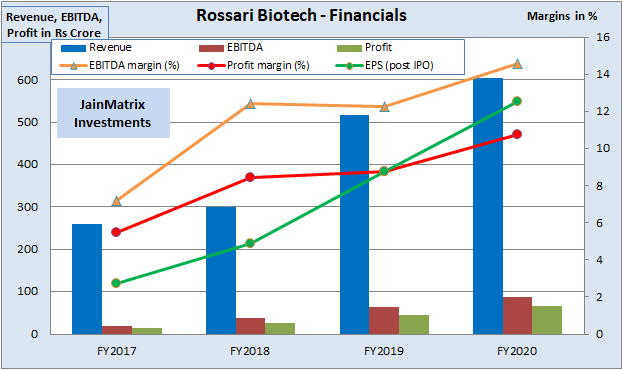
jainmatrix investments, rossari biotech IPOFig 1 – Financials

  • The 4 years financials shows rapid revenue growth, and improving EBITDA and profit margins. The Revenues, EBITDA and Profits grew at 32.3%, 67.6% and 66 % resp. See Fig 1.
  • The firm has grown Operating Profits sharply, but the working capital has grown in FY20, reducing the final Cash from Operations, see Fig 2. The firm is also making significant investments into a new manufacturing facility at Dahej, so the Free Cash Flow has turned negative in FY20.

jainmatrix investments, rossari biotech IPOFig 2 – Free Cash Flows

  • The firm has in recent years grown its offering in the Home, personal care and performance chemicals (HPPC) segment and this is 47% of its revenues, see Fig 3.
  • Per news reports, Rossari seized the opportunity after Covid19 to make Hand Sanitizers and Disinfectants, which saw a massive demand spurt in recent months.

jainmatrix investments, rossari biotech IPOFig 3 – Key Product Segments

  • The firm has also grown its exports pie and now exports to 18 countries including Vietnam, Bangladesh and Mauritius. It plans to grow the international business in future. See Fig 4.

jainmatrix investments, rossari biotech IPOFig 4 – Exports

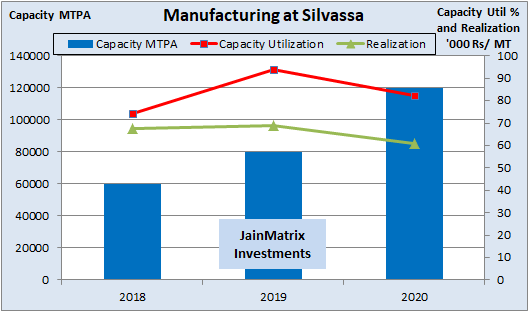
  • The firm has grown its manufacturing capacity steadily at the Silvassa plant, see Fig 5.
  • The Capacity utilization has been over 80% for the last 2 years.
  • Rossari is setting up a new plant at Dahej (Gujarat) of 1,32,000 MTPA. This is expected to go on stream in FY21. There is no expansion planned at Silvassa, as the plant area is saturated.
  • Funding for this plant has been from internal cash generation as well as loans.
  • The rapid revenue growth has come at the cost of slightly lower average realizations from products.

jainmatrix investments, rossari biotech IPOFig 5 – Manufacturing

Chemicals Industry Outlook in India

  • The outlook can be seen in Indian Specialty Chemicals Sector – A Spotlight. Do read this.
  • In brief, we are positive on Chemicals and particularly Specialty Chemicals sector. There are good opportunities around replacement of Chinese supply for domestic and global demand.

Benchmarking

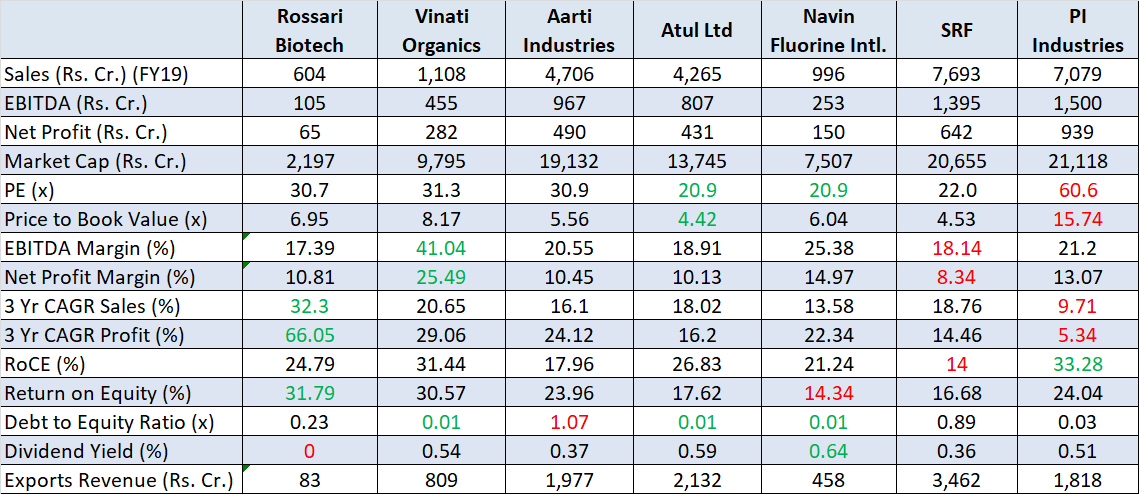
We compare Rossari to Chemical industry peers in India. See Fig 6.

jainmatrix investments, rossari biotech IPOFig 6 – Benchmarking

  • It’s the smallest firm by revenues in this group. In terms of valuations, ie P/E and P/B, it is on the higher side. The margins are also on the lower side, both Operating and Profit.
  • Growth numbers are leading, both Sales and Profits, indicating a good burst of recent success.
  • In terms of ROE it’s a leader, and on RoCE above average. Post IPO there is some 5% dilution to equity, so the number may be reduced to that extent.
  • The D/E looks healthy, even though the company is in expansion mode. This is good.
  • In a growth phase, one does not expect dividends from small cap firms, so its not an issue.
  • Plans are afoot around growing exports, and this should help Rossari improve revenues and realization.

Risks and Negatives for Rossari and the IPO

  • Valuations at PE 30.7 times of FY20 earnings looks expensive. However the PEG is 0.46, indicating undervalued levels.
  • Any delay in the Dahej plant in terms of commissioning and a start of production in FY21 will slow the revenue momentum at Rossari as the current plant is running close to capacity.
  • The IPO is primarily an offer to sell by promoters, so the firm gains only by Rs 50 crores of capital raised by fresh issue of shares. Conversely the equity capital will not be much diluted.
  • In FY20 domestic sales were 86% of revenues, a low ratio, so exports is an opportunity.
  • When we see a sharp burst of growth in financials in 2-3 years before an IPO, we worry that such growth may not be sustained in the next 5-10 years after a successful listing.
  • The promoter owned firm has not benefited from the oversight, partnership and approval of Private Equity or other investors, so future success of Rossari is highly dependent on them.
  • This is the first IPO after a pause of several months. It’s possible that demand from hurt investors for this IPO may be low. But this may be to the benefit of investors in this IPO.
  • Covid19 epidemic is still gathering momentum in India, and till we see a fall in infection numbers, both investors and overall demand in the economy may be subdued. However the firm has grabbed the opportunity by making Covid safety products such as d Sanitizers and Disinfectant liquids.
  • This is a B2B space, so verification and confirmation of customers, brands and quality is difficult.

Overall Opinion and Recommendation

  • Specialty Chemicals sector is a high potential growth sector.
  • Rossari Biotech has seen a rapid growth in recent times, and has a balanced product portfolio and a large number of domestic customers. Growth plans look promising with the planned Dahej plant.
  • The debt is low, and balance sheet looks healthy with good return ratios. Expansion plans have been funded mostly from internal cash generation.
  • The firm is small but looks nimble in terms of product formulations, R&D, new export markets, etc.
  • At a P/E of 30.7 times FY20 earnings, the valuation is expensive. However the current growth rates justify this valuation.
  • Risks: 1) Valuations look expensive 2) delay in new Dahej plant could affect growth 3) Covid19 infection can affect Revenues. It can also affect manufacturing operations.
  • Opinion: Investors can SUBSCRIBE to this IPO with a 2 year perspective.

Disclaimer

This document has been prepared by JainMatrix Investments Bangalore (JM), and is meant for use by the recipient only as information and is not for circulation. This document is not to be reported or copied or made available to others without prior permission of JM. It should not be considered or taken as an offer to sell or a solicitation to buy or sell any security. The information contained in this report has been obtained from sources that are considered to be reliable. However, JM has not independently verified the accuracy or completeness of the same. Punit Jain discloses that he has no stake ownership or known financial interests in Rossari Biotech or any group company. Punit Jain intends to apply for this IPO. Neither JM nor any of its affiliates, its directors or its employees accepts any responsibility of whatsoever nature for the information, statements and opinion given, made available or expressed herein or for any omission therein. Recipients of this report should be aware that past performance is not necessarily a guide to future performance and value of investments can go down as well. The suitability or otherwise of any investments will depend upon the recipient’s particular circumstances and, in case of doubt, advice should be sought from an Investment Advisor. Punit Jain is a registered Research Analyst under SEBI (Research Analysts) Regulations, 2014. JM has been publishing equity research reports since Nov 2012. Any questions should be directed to the director of JainMatrix Investments at punit.jain@jainmatrix.com.

How is India doing against COVID19 in 3 graphs

Its been 3 months since Covid infection hit India. I believe India has done well so far. But lets check out the facts using just 3 graphs in Logarithmic Scale. (click to expand image)

  1. India’s COVID-19 Curve, compared to other countries. (Source visualcapitalist.com)
  2. Total Coronavirus Cases in India (Source: worldometers.info)
  3. Total Coronavirus Deaths in India (Source: worldometers.info)

jainmatrix investments, India on Covid

Thoughts? Comments? Please share below.

Regards, Punit Jain

Colgate Palmolive (India) – A Shiny Idea

  • Date: 25th May 2020 ;  CMP: Rs 1,313 
  • Large Cap – Mkt Cap Rs. 35,700 and Industry: Consumer – FMCG 
  • Valuation: P/E at 37.3 
  • Advise: BUY 

jainmatrix investments, colgate palmolive

Summary

Overview: Colgate Palmolive (India) is the leader in India’s oral care market with a 49% share. Their range includes toothpastes, toothpowder, toothbrushes, mouthwashes and personal care products products under the Colgate and Palmolive brands. FY20 revenues were ₹ 4,574 crores, and profits ₹ 816 cr. CPL today has one of the widest distribution networks in India – a logistical marvel with 61 lakh retail outlets. Most of the products of CPL were part of the ‘Essential products’ that were allowed to be distributed even during lockdown. Also by May 4th, all CPL plants were allowed to open. Given all this, we feel that CPL will be less disrupted than most consumer firms through Q1 and Q2 FY21 due to the lockdown.

Key Risks: 1) Covid 19 lockdown in Q1FY20 will impact both mfg. and the demand as supply chains as well as outlets have been closed 2) strong competition 3) Indian preferences for natural and ayurvedic products

Advice: BUY with a May 2022 target of ₹ 1,555, a 18.5% gain

The entire report in PDF form is available hereJainMatrix Investments_Colgate Palmolive Ltd_May2020

Disclaimer and Disclosures 

  • Punit Jain has no holding in CPL. In addition, JM and its promoters/ employees have no financial interest in CPL and no known material conflict of interest as on date of publication of this report.
  • This document has been prepared by JainMatrix Investments Bangalore (JM), and is meant for use by the recipient only as information and is not for circulation. This document is not to be reported or copied or made available to others without prior permission of JM. It should not be considered or taken as an offer to sell or a solicitation to buy or sell any security. The information contained in this report has been obtained from sources that are considered to be reliable. However, JM has not independently verified the accuracy or completeness of the same. Neither JM nor any of its affiliates, its directors or its employees accepts any responsibility of whatsoever nature for the information, statements and opinion given, made available or expressed herein or for any omission therein. Recipients of this report should be aware that past performance is not necessarily a guide to future performance and value of investments can go down as well. The suitability or otherwise of any investments will depend upon the recipient’s particular circumstances and, in case of doubt, advice should be sought from an independent expert/advisor.
  • JM has been publishing equity research reports since Nov 2012, and is registered with SEBI as a Research Analyst since 2016. Any questions should be directed to the director of JainMatrix Investments at jain@jainmatrix.com

Indian Speciality Chemicals Sector – A Spotlight

The Indian economy has been hit by the Covid-19 epidemic. Even in this tough market, we find that the Indian Specialty Chemicals sector has the potential to not just survive, but actually grow rapidly.

Introduction

  • The Chemical sector constitutes a significant part of Indian economy. It’s a very diversified industrial sector, as chemicals cover over 70,000 commercial products. India is the 6th largest producer of chemicals globally and 3rd largest in Asia. Export were US$ 19.1 billion during the year 2018-19.
  • The Govt. of India allows 100% FDI in the chemical sector. The mfg. of most of the chemical products like organic/ inorganic, pesticides and dyestuffs is delicensed except hazardous products. It contributes 16% of the mfg. sector GDP.
  • Industry has 5 segments: basic chemicals, agrochem, specialty chem, pharma and consumer products. The specialty chemicals constitute 22% of total chemicals market in India.
  • Chemicals are the basic building blocks of a range of end-user products like drugs & pharmaceuticals, agrochemicals, paints, construction material, auto parts, textiles, and packaging, among others.
  • Specialty chemicals are value added chemicals, they are used towards specific end use applications They are performance or quality products, niche and high value. These provide a wide variety of functionality on which many other industry sectors rely.

Chemical Sector Notes

  • India is an attractive hub for chemical companies. The Indian chemical industry is a global outperformer in terms of Total Returns to Shareholders (TRS), source McKinsey & Co report. This has resulted in rapid growth for chemical industry of India. See Fig 1. It can be seen that The Indian Chemical industry enjoys superior returns.

jainmatrix investments, chemicalsFig 1. CAGR of TRS, source McKinsey & Co

  • China has implemented strict environmental norms, because of which many Chinese capacities are shutting down, which is benefitting large organised Indian players.The Ministry of Environment of China stated that 70% of companies inspected failed to meet the air pollution standards. Large global chemical supply chains may look at India as an alternative mfg. location.
  • The Coronavirus lockdown in China in Jan-Mar 2020 revealed and exposed global dependency on Chinese mfg. China is now seen to be an unreliable partner and many countries are actively looking at alternate manufacturing locations to de risk supply chain. Loss of China (37 % share) as a reliable partner and continued shifts from EU/Japan (16 %/4 % share) means share of India (3%) will rise. India will gain advantage because of availability of talent for mfg. and R&D.
  • Fig 2 represents share of countries in sales of global chemical industry.

jainmatrix investments, specialty chemicalsFig 2. Region wise sales of Chemicals

  • Today, India has a chemical trade deficit of $15 billion. There is a massive opportunity for import substitution – for Indian demand, as well as exports, of such products.
  • INR to Dollar is now Rs 75.5, it is weakening so imports are becoming expensive. So, import substitution for chemical products is attractive.
  • In India, during lockdown due to COVID, there was a disruption in supply chains and speciality chemicals also faced logistics (supply chain) and labour problems. But chemical industry is expected to be less impacted by COVID because most companies have fully or partially restarted their operations as it supplies chemicals to essential sectors like pharma, hygiene, personal health and agrochemicals.

Key Players

  • Fig 3 shows contribution of domestic and exports revenues to the total revenues of firms.

jainmatrix investments, speciality chemicalsFig 3. Revenue from exports

  • We have done a benchmarking exercise to compare the Chemical industry’s sector players. Fig. 4 depicts the comparison between different Indian companies on basis of vital parameters.

jainmatrix investments, specialty chemicalsFig. 4 Benchmarking

  • We can see that Vinati Organics has the highest contribution of export to revenues and Aarti the lowest.
  • In terms of size and scale SRF and Aarti lead.

jainmatrix investments, specialty chemicalsFig 5 – Relative Share Prices 

  • Over a 2 year period we can see the relative share prices.
  • Vinati and Navin have gained the most while Aarti and SRF the least among these firms.

Conclusion

  • Indian chemicals players will benefit from the expanding specialty chemicals market globally led by growing new applications alongside manufacturing shifts from China ― which has been battered by reliability and transparency woes; and EU, due to its ageing workforce; focus on innovation, and M&As.
  • There exists a good opportunity for Indian chemicals players to scale up and tap the opportunities for import substitution and exports.

Disclaimer

This document has been prepared by JainMatrix Investments Bangalore (JM), and is meant for use by the recipient only as information and is not for circulation. This document is not to be reported or copied or made available to others without prior permission of JM. It should not be considered or taken as an offer to sell or a solicitation to buy or sell any security. The information contained in this report has been obtained from sources that are considered to be reliable. However, JM has not independently verified the accuracy or completeness of the same. Punit Jain has no known financial interests in any firm mentioned here. Neither JM nor any of its affiliates, its directors or its employees accepts any responsibility of whatsoever nature for the information, statements and opinion given, made available or expressed herein or for any omission therein. Recipients of this report should be aware that past performance is not necessarily a guide to future performance and value of investments can go down as well. The suitability or otherwise of any investments will depend upon the recipient’s particular circumstances and, in case of doubt, advice should be sought from an Investment Advisor. Punit Jain is a registered Research Analyst under SEBI (Research Analysts) Regulations, 2014. JM has been publishing equity research reports since Nov 2012. Any questions should be directed to the director of JM at punit.jain@jainmatrix.com.

COVID 19 – Call in the Indian Army to Handle this Emergency

Dear Friends,

Let me start with the worst case scenario for India.

  • 60% of Indians get infected with Covid-19. Thats 78 crore people *
  • 5% of these are serious and need hospitalization. That’s 3.9 crore people. # We dont have so much healthcare capacity
  • 1% of the infected succumb to the infection. Thats 78 lakh people. #

However this is 2 months away from today, if it happens.

It is within our powers to prevent this from happening.

Even though the Indian govt. health dept. and administration is doing whatever it can to prevent this, it is grappling with several constraints:

  • Many people know Covid 19 by now, but they are not really changing behaviour to deal with it
  • The persons identified for isolation are not following orders and escaping / moving around freely, exposing others to the danger
  • At this stage the infection in India is at Stage 2 (local transmission – tracking and isolation of infected, contact tracing and isolation of potentials) and if not stopped, it moves to Stage 3 (community transmission – the virus is out of control and infects everyone who is not isolated) @
  • We also do not know the real number of infected people until we have sufficient Testing. My feeling is that people with symptoms are not being tested unless the govt. hospital doctor recommends this. And access to these doctors is not easy.

We suggest 2 solutions:

  • Call in the Indian Army with its 14 lakh highly trained people to inject discipline and boost Covid 19 administration in all states of India.
  • Start Testing for Covid 19 on a massive scale. All hospitals, private sector Diagnostic chains such as Dr Lal Pathlabs, Thyrocare, Metropolis Healthcare, etc may be allowed. I believe Health Ministry is enabling this, but can this be started today?

I’m hardly an expert on healthcare. But I understand compounding. The number of infected people are growing by compounding. I also understand probabilities. My estimate is that we now have a 50% probability of moving to Stage 3. Unless we do something about it NOW.

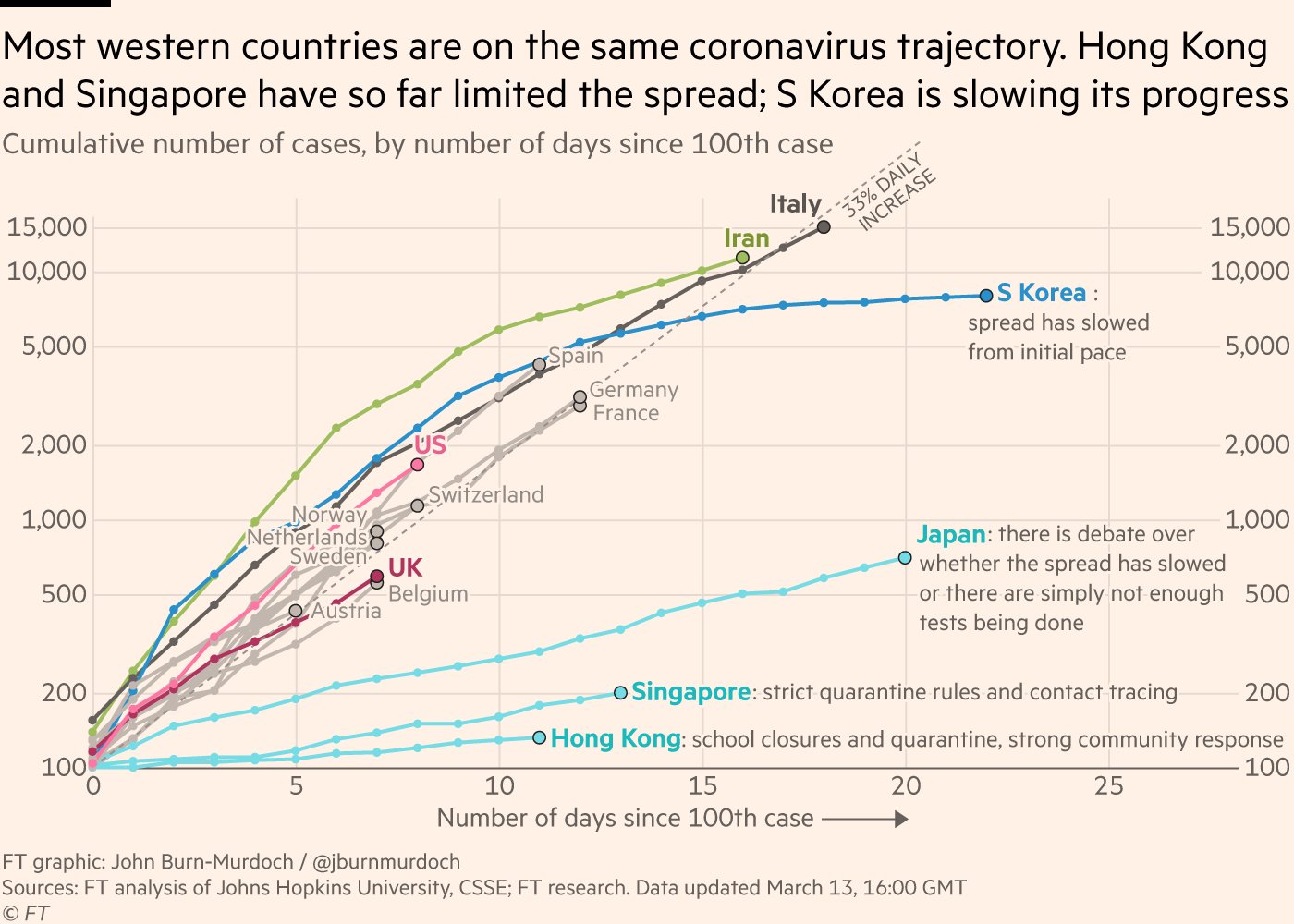
I also believe every country has the power to control this infection if it isolates itself and acts fast enough. South Korea, China, Japan, Hong Kong and Singapore moved fast and were able to flatten the Infection curve and stay in Stage 2. See fig 1.

jainmatrix investments

Fig 1 – Source John Hopkins Univ. India is not in this as it had just crossed 100 infections on 13th Mar.

We also saw that China was able to deal with Covid-19 over 2-3 months due to a very tough administration and hard measures, easier to do in a communist system. Here in India the administration does not have command and punitive powers. They are also not geared up to do this. The Indian Army needs to be deployed to do this.

The Indian Army needs to work with the Health ministry, govt. hospitals and local administration, to monitor the airport screening, contact tracing, isolation facilities and govt. hospitals. The Isolated and infected people logistics, people security and healthcare supply chains have to be supported and enforced.

We have to fight Covid 19 before it becomes a national calamity. Its better to over-react early and prevent the problem than to react late.

Stay safe and healthy,

Punit Jain

PS – this has nothing to do with investing. But it affects all of us. I write this not to alarm people (this is a known danger) but request an urgent solution to a visible problem.

  1. * Germany is in stage 3 and has projected that this proportion of its people may get infected
  2. # These are stats available from China and few other countries in public domain
  3. @ Eco Times Article on 18/03

DISCLAIMER

This document has been prepared by JainMatrix Investments Bangalore (JM), and is meant for use by the recipient only as information and is not for circulation. This document is not to be reported or copied or made available to others without prior permission of JM. It should not be considered or taken as an offer to sell or a solicitation to buy or sell any security. The information contained in this report has been obtained from sources that are considered to be reliable. However, JM has not independently verified the accuracy or completeness of the same. Punit Jain and JM has no ownership or known financial interests in any company mentioned in this note. Neither JM nor any of its affiliates, its directors or its employees accepts any responsibility of whatsoever nature for the information, statements and opinion given, made available or expressed herein or for any omission therein. Recipients of this report should be aware that past performance is not necessarily a guide to future performance and value of investments can go down as well. The suitability or otherwise of any investments will depend upon the recipient’s particular circumstances and, in case of doubt, advice should be sought from an Investment Advisor. Punit Jain is a registered Research Analyst under SEBI (Research Analysts) Regulations, 2014. JM has been publishing equity research reports since Nov 2012. Any questions should be directed to the director of JainMatrix Investments at punit.jain@jainmatrix.com.