NBFC Sector – Can a generational leap of Technology help dominate the Market?

Summary:

This report was published on 25nd Mar 2024, so all prices and news are dated accordingly. This is a research note on 3 leading Indian NBFC firms, Bajaj Finance, Jio Financial Services and L&T Finance Holdings. We profile the firms in terms of their structure, business segments, share price history and key financial parameters. Next we capture their key Qualitative Aspects and do a SWOT analysis of them, to help investors understand these firms better. This report is for educational purposes. We do not set any price targets nor make any company-specific recommendations.

Introduction

In this note, we examine three large players from the Indian Non-Banking Financial (NBFC) Industry.

Brief Profiles – Bajaj Finance Ltd.                      CMP ₹ 6,760                                             

  • Bajaj Finance (BFL) was started in 1987 as a vehicle financing firm and is now is one of the largest and most diversified loan NBFCs in India. BFL is mainly engaged in the business of lending, and has a portfolio across retail, SME and commercial customers with a presence in urban and rural India. It also accepts public and corporate deposits. BFL has two wholly owned subsidiaries, Bajaj Housing Finance and Bajaj Financial Securities, through which it offers home loans and brokerage services & lending.
  • Bajaj Finserv Ltd. is the holding company for the financial services businesses of the Bajaj group. It holds 51.42% stake in BFL. Bajaj Finserv offers general & life insurance, and advisory and investment planning services through subsidiaries Bajaj Allianz General Insurance & Bajaj Allianz Life Insurance. 
  • Leadership in BFL is Sanjiv Bajaj (Chairman), Rajeev Jain (MD&CEO) and Sandeep Jain (CFO).

Jio Financial Services                                             CMP ₹ 345                                                 

  • Jio Financial Services (JFS) started as Reliance Strategic Investments in 1999, but JFS was incorporated in Jul’23. It is a systemically important Non-Deposit taking NBFC (NBFC-ND-SI) registered with RBI. It is a holding company and operates through its consumer-facing subsidiaries namely Jio Finance Ltd., Jio Insurance Broking, Jio Payment Solutions and a JV, Jio Payments Bank. For its asset management business, JFS has entered into a JV with BlackRock with an initial investment of US$ 150 m.
  • JFS was demerged from Reliance Industries and listed in July’23. Shares were awarded in a ratio 1:1, so for every share held of Reliance, shareholders received one share of JFS. 
  • Management – KV Kamath (Chairman), Hitesh Kumar Sethia (MD&CEO), and Abhishek Pathak (CFO).

L&T Finance Holdings                                           CMP ₹ 155                                             

  • L&T Finance Holdings (LTF) offers a diverse range of financial products and services such as Farm equipment finance, Two-wheeler finance, Micro Loans, Consumer loans, home loans, Loans against property (LAP), Real estate finance, infra finance, Infra Debt Fund and other services.
  • It is registered with RBI as a Systemically Important Non-Deposit Accepting Core Investment Co (NBFC-CIC). LTF has an operational presence across India and is headquartered in Mumbai, Mah.
  • LTF is now in the process of changing its name from L&T Finance Holdings to L&T Finance.
  • The promoter is L&T Ltd. LTF successfully completed the merger of subsidiaries, L&T Finance, L&T Infra Credit and L&T Mutual Fund Trustee with itself. This will simplify operations and save costs.
  • Management – Sudipta Roy (MD&CEO), Sachinn Joshi (CFO) and S. N. Subrahmanyan (Chairperson).

This report can be downloaded as a PDF file using link below.

Disclaimer This document has been prepared by JainMatrix Investments Bangalore (JMI), and is meant for use by the recipient only as information and is not for circulation. This document is not to be reported or copied or made available to others without prior permission of JMI. It should not be considered or taken as an offer to sell or a solicitation to buy or sell any security. The information contained in this report has been obtained from sources that are considered to be reliable. However, JMI has not independently verified the accuracy or completeness of the same. Punit Jain discloses that he is an investor in Bajaj Finance Ltd (<1%) since April 2003. He has no positions in L&T Finance or Jio Financial Services, but owns shares in group companies Larsen & Toubro, L&T Technology Services and LTIM; and Reliance Industries (all <1%) as on date of this report. Neither JMI nor any of its affiliates, its directors or its employees accepts any responsibility of whatsoever nature for the information, statements and opinion given, made available or expressed herein or for any omission therein. Recipients of this report should be aware that past performance is not necessarily a guide to future performance and value of investments can go down as well. The suitability or otherwise of any investments will depend upon the recipient’s particular circumstances and, in case of doubt, advice should be sought from a RIA Registered Investment Advisor. Investment in securities market are subject to market risks. Read all the related documents carefully before investing. Punit Jain is a registered Research Analyst under SEBI (Research Analysts) Regulations, 2014. Registration granted by SEBI, and certification from NISM in no way guarantee performance of the RA or provide any assurance of returns to investors. JMI has been publishing equity research reports since Nov 2012. Any questions should be directed to the director of JainMatrix Investments at punit.jain@jainmatrix.com Name of the RA as registered with SEBI – Punit Jain, SEBI Registration No. INH200002747. Logo/brand name –

Large Caps, Mid Caps and Small Caps?

Did you know that the definition of a large-cap, mid-cap and small-cap in India changes every 6 months? This applies particularly for Indian Mutual Funds, so that as of now –

  1. Large-cap companies are those ranked from 1-100 in order of market capitalisation
    • Per the recent review, the large-cap threshold is now ₹ 67,000 cr., up from ₹ 49,700 cr. in Jun’23.
  2. Mid-cap companies are those ranked from 101 – 250 by market cap
    • The range for mid-caps is now ₹ 22,000 – 67,000 cr. The lower limit rose from ₹ 17,400 cr. earlier
  3. And small-caps are all firms with a market cap below 22,000 cr.

This is quite relevant for Mutual Funds, where many define their strategy as Large Caps or Small caps. This definition, and periodic reviews, ensures that MFs stick to their strategy.
For direct investors too, we can loosely follow this definition.

This also means that firms doing well by market cap may transition up from one group to another. Several firms may also transition down, given how sharply the limits have increased. This transition may mean that MFs may buy or exit from them, in order to retain their MF strategy.

JainMatrix Investments is a SEBI registered Research Analyst firm. We publish research recommendations grouped by 1) Large Cap, 2) Mid & Small Cap and 3) Satellite stocks, which is a mixed group. With these investors can invest directly in recommended equities for their Wealth building journey.

Source – Article – AMFI classification: Jio Financial makes it to largecap list, Tata Tech, IREDA midcaps https://www.moneycontrol.com/news/business/markets/amfi-classification-jio-financial-makes-it-to-largecap-list-tata-tech-ireda-midcaps-11996161.html

DISCLAIMER

This document has been prepared by JainMatrix Investments Bangalore (JM), and is meant for use by the recipient only as information and is not for circulation. This document is not to be reported or copied or made available to others without prior permission of JM. It should not be considered or taken as an offer to sell or a solicitation to buy or sell any security. The information contained in this report has been obtained from sources that are considered to be reliable. However, JM has not independently verified the accuracy or completeness of the same. Neither JM nor any of its affiliates, its directors or its employees accepts any responsibility of whatsoever nature for the information, statements and opinion given, made available or expressed herein or for any omission therein. Recipients of this report should be aware that past performance is not necessarily a guide to future performance and value of investments can go down as well. The suitability or otherwise of any investments will depend upon the recipient’s particular circumstances and, in case of doubt, advice should be sought from a RIA Registered Investment Advisor. Investment in securities market are subject to market risks. Read all the related documents carefully before investing. Punit Jain is a registered Research Analyst under SEBI (Research Analysts) Regulations, 2014. Registration granted by SEBI, and certification from NISM in no way guarantee performance of the RA or provide any assurance of returns to investors. JM has been publishing equity research reports since Nov 2012. Any questions should be directed to the director of JainMatrix Investments at punit.jain@jainmatrix.com. Name of the RA as registered with SEBI – Punit Jain, SEBI Registration No. INH200002747. Logo/brand name –

RP Tech – The ICT Distribution Leader – IPO

  • Also known as Rashi Peripherals Ltd.
  • 07th Feb, IPO Opens 7-9th Feb
  • Pricing range – ₹ 295-311/share
  • Valuations: P/E 16.6, EV/EBITDA – 2.07, P/B 2.6 times
  • Small Cap: ₹ 2,000 cr. Mkt cap
  • Sector – Technology

Summary

  • RP Tech distributes global technology brands in India. They specialize in ICT products and have a 9.5% market share in India sales. Part of the ICT global supply chain. The organization and structure set up looks good to handle the growth. At current pricing range, RP Tech looks fairly valued. We expect margin expansion after reduction in debt levels even as it grows rapidly in revenues. Once this happens, valuations will look reasonable.
  • Risks: 1) Thin operating margins, high working capital and high debt 3) Supplier Concentration – top eight brands accounted for 82% of revenue 4) Indirect Tax contingent liabilities.
  • Opinion: Medium rated. Aggressive Investors can SUBSCRIBE for short-term gains.

Here is a note on RP Tech IPO.

IPO highlights

  • The IPO opens from 7-9th Feb 2024 in a Price Band of ₹ 295-311 per share
  • It is a Fresh Issue of ₹ 600 cr. of 6.58 cr. shares, which is 36.6 % of the equity share capital.
  • The promoters are Choudhary & Pansari families that own 89.65% which will fall to 63.41% post-IPO.
  • The main objects of the IPO are 1) Repayment of debts of ₹ 326 cr. and 2) Funding working capital requirement ₹ 220 cr. 3) The remaining 50+ cr. is for general corporate purposes.
  • The lot size is 48 shares and Face Value ₹ 5 per share
  • The IPO share quotas are QIBs: Non-Institutional Investors: Retail is 50:15:35%.
  • The unofficial/ grey market premium of RP Tech is ₹ 70 /share over IPO price. This is a positive.
  • The IPO allotment is likely to be finalized on 12 Feb, refunds will be on 13 Feb, and also crediting of shares to eligible allottees. RP Tech shares will list on BSE and NSE, on 14 Feb.

Introduction

  • RP Tech distributes global technology brands in India. They specialize in products related to Information and Communication Technology (ICT). It has value-added services such as pre-sales, technical support, marketing services, credit solutions and warranty management services.
  • Revenue from operations grew at a CAGR of 26.32% from ₹ 5,930 cr. in FY’21 to ₹ 9,468 cr. in FY’23, PAT generated CAGR of -4.80% and EBITDA with CAGR of 11.38% over last three years.
  • RP Tech is the national distributor for 53 global technology brands and has 50 branches, and 63 warehouses across India, with 8,657 distributors across 680 locations in 28 States and UTs.
  • These 50 branches operated as sales & service centres and warehouses, and distributed and sold 10,508 SKUs and 34.38 million units in FY23. Exports are just 2.6% of the business, rest is domestic.
  • It had 1,433 employees, including 549 in Sales & Marketing and 64 in the technical support team.
  • The company has two business verticals –
  • Personal computing, Enterprise and Cloud Solutions (PES): This includes personal computing devices, enterprise solutions, embedded designs/products and cloud computing.
  • Lifestyle and IT essentials (LIT): This includes products such as (i) components such as graphics cards, central processing units (CPUs) and motherboards; (ii) storage and memory devices; (iii) lifestyle peripherals and accessories such as keyboards, mice, webcams, monitors, wearables, casting devices, fitness trackers and gaming accessories; (iv) power devices such as UPS and inverters; and (v) networking and mobility devices.
  • The Fig 1.1 below shows the Revenue By Vertical; and Fig 1.2 the Market Share by Product

Fig 1.1 – Revenues by Vertical and Fig 1.2 Market Shares

  • The company’s clients include ASUS Global., Dell International, HP India, Lenovo India, Logitech Asia Pacific, NVIDIA Corp, Intel Americas, Western Digital (UK), Schneider Electric IT Business, Eaton Power Quality Pvt. Ltd., ECS Industrial Computer Co. Ltd., Belkin Asia Pacific, TPV Technology India, LG Electronics India, and Toshiba Electronic Components, Taiwan Corporation, among others.
  • RP Tech has a good relationship with marquee customers for a very long time.
  • RP Tech differentiate itself by offering end-to-end services such as pre-sale activities, solutions design, technical support, marketing services, credit solutions and warranty management services.

Fig 1.3 Locations

Fig 1.4 – Distribution and 1.5 – Shareholding pattern

  • RP Tech distributes products through several channels or networks – General Trade (81%), e-commerce 13% and Modern trade 6%. Above Fig 1.4 shows the distribution network and channels.
  • See shareholding pattern pre-IPO in Fig 1.5.
  • Below Fig 1.6 – Strong Customer Relationships in years with prominent brands.

Fig 1.6 Clients

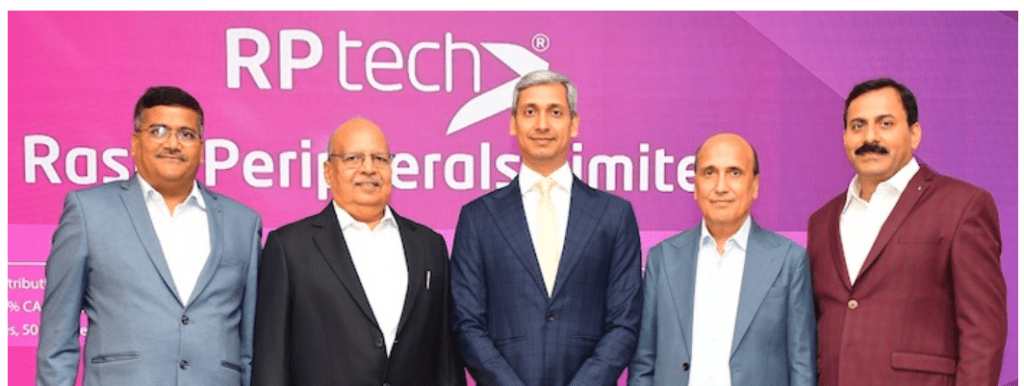
  • Fig 1.7 – Key leaders:
  • (L- R) Himanshu Kumar Shah CFO, Krishna Kumar Choudhary, Chairman, Kapal Pansari MD, Sureshkumar Pansari, Vice-Chairman and Rajesh Goenka, CEO.

News, Updates and Strategies

  • In a pre-IPO placement, ace investor Madhusudan Kela’s wife Madhuri Kela invested ₹ 50 cr. and Volrado Venture Partners Fund-III-BETA, a venture capital fund, invested ₹ 100 cr. and were allotted 48.23 lakh equity shares at an issue price of ₹ 311 apiece.
  • A day before the IPO, the firm made allotments to Anchor investors. It allotted 57.88 lakh shares to 18 funds at ₹ 311 per share, at the upper limit. The anchor investors who participated in the bidding process include prominent foreign and domestic institutions such as White Oak Capital, Ashoka India, ICICI Prudential MF, Volrado Venture Partners Fund, and Bajaj Alliance Life Insurance Company. Other notable participants in the bidding round were Aditya Birla Sun Life Insurance Company, SBI General Insurance Company, Singularity Growth Opportunity Fund, and Authum Investment and Infra.
  • Out of the total allocation of 57.88 lakh equity shares, domestic mutual funds were allotted 19.61 lakh equity shares through a total of 8 schemes, amounting to ₹ 61 crore.

Industry Outlook of ICT in India

  • India has a young population, and is a developing nation, so it has a faster growing market than developed nations such as USA, UK, and Canada in terms of retail consumption. They are better exposed to media and technology, which presents an opportunity for domestic consumption in the form of branded products and organized retail.
  • Govt. of India has an initiative of Make in India and is also promoting Electronic Mfg. Clusters throughout the country to provide world-class infrastructure and facilities.
  • The GoI is aiming to increase the production of electronic items to USD 300 billion by Fiscal 2026. The domestic consumption of products is expected to increase from USD 75 billion in Fiscal 2022 to USD 150- 180 billion by Fiscal 2026.
  • India’s ICT Industry size is about 1 lakh cr. now and is expected to reach ₹ 1,08,700 cr. by 2025.

Fig 2 – ICT Industry Size

  • Govt. of India’s Production-linked Incentive (“PLI”) scheme provides Incentives to boost domestic mfg. and attract large investments in IT Hardware value chain with target segments of laptops, tablets, all-in-one PCs, and servers, and boost the export market for the same. In electronic/technology products and telecom and network products, the approved financial outlay over the five years period is ₹ 12,200 cr.
  • We estimate that RP Tech has a Market Share of 9.5% of the Indian ICT distribution market.

Financials of RP Tech

  • RP Tech revenues, EBITDA and PAT over the years are in Fig 3a. Revenue, EBITDA & PAT grew by 26.36%, 11.38% and (4.80) % respectively.
  • Increase in interest costs is hurting their PAT.
  • In below Fig 3b Cash Flow we can see that the Free Cash Flow FCF is negative. The firm has made many investments in inventories, assets and payables that have made FCF negative.
  • EBITDA Margin is constant over 2.8-3.5% and PAT around 1.30-2.29% variation due to externalities. This is average industry margins.
  • Considering ₹ 326 cr. will used from IPO proceeds for repayment of Debt, the firm’s debt to equity will reduce from current pre-IPO 1.82 to 1.30 post IPO.

Fig 3a – Financials

Fig 3b Cash Flow

Benchmarking

We benchmark RP Tech against listed ICT distribution and mfg. firms, See Fig 3c below.

Fig 3c – Benchmarking

  • P/E currently at 15.74 looks priced overpriced. Its EV/EBITDA is 2.07, which looks reasonable. Thus the valuations of RP Tech looks mixed.
  • The 3 year Sales and Profits growth look low. There was a massive sales growth for RP Tech in FY21 and FY22 during covid, and that is now normalizing.
  • D/E ratio is high, but post IPO, debt should fall as a main object of IPO is to reduce debt.
  • Margins are on par with competitors.
  • Return on Equity and RoCE are fair and in line with industry.
  • Putting this together, we sense that RP Tech will return to steady industry plus growth now, and improve its financial parameters in the next 1-2 years.
  • The strong business relationships, wide distribution network and digital growth of the economy will reflect well on RP Tech.

Positives for RP Tech

  • Strong technical expertise of firm across a range of ICT products for sales, service and support.
  • Long term relationship with marquee global tech clients to ensure availability of products.
  • Reputation as Leading and fastest growing Indian distribution partner for ICT products.
  • Repeat orders constitute 70-80% of business, this showcases the stickiness and moat of RP Tech.
  • Diversified portfolio offering with 10,000+ SKU’s and value-added solutions.
  • Pan-India and multi-channel distribution footprint backed by dedicated in-house infrastructure.

Risks and Negatives

  • High dependency on various vendors, who are global technology brands, revenues generated from distribution of products mfg. by top eight global technology brands amounted to 82% of revenue from operations. Any delay or failure on part of such global technology brands to supply products may materially and adversely affect business, profitability and reputation.
  • Good relationships with Channel Partners and enterprise customers is important as if any of these parties change the terms of their arrangements business could be materially and adversely affected.
  • RP Tech is operating on thin margins, an increase in debt or interest rates can affect the financials. There has been an increase in Debt to equity from 1.23 in FY21 to 1.82 in six month ended Sep’23.
  • Reduction in EBITDA margin from 3.63% in FY21 to 2.83% in FY 23 was due to higher interest rates.
  • Continued negative cash flows can affect the financials of the business. RP Tech will certainly have to stabilize their working capital needs while handling growth.
  • Risk of liability claims. Failure to maintain quality of customer service and deal with customer complaints could materially and adversely affect business and operating results.
  • RP Tech has Contingent Liabilities of ₹ 592 cr. (RHP), of which for Indirect Tax is ₹ 281 cr.
  • A Subsidiary ZNet Technologies Pvt. Ltd., has incurred losses in the last three Fiscals. There is no visibility on profitability.

Overall Opinion and Recommendation

  • India has a large and growing software and Tech industry, and it is an exports leader. Many global firms are setting up Global Competence Centers here. Within India too, technology is permeating the population through devices and internet, at work and leisure.
  • RP Tech is an important player in the ICT industry. It has a strong grip and 9.5% market share in sales. We expect growth at RP Tech to be strong. RP Tech have strengths of stickiness of customer with 70-80% of business from repeat orders and strong relationship with brands. Company management and board looks solid with rich experience in this field.
  • RP Tech is well set and a solid growth prospect in future.
  • However the firm is just settling down from 2-3 years of an unusual post covid business situation. Financials are in a recovery process and may take a few quarters to stabilize. This IPO helps to rest some of the debt. The recovery process needs to continue by controlling the working capital.
  • We expect reduction in debt to equity after IPO even as it grows rapidly in revenue and offerings. Once this happens, RP Tech valuations will rise and this IPO entry price will look reasonable.
  • Risks: 1) Thin operating margins, high working capital and high debt 3) Supplier Concentration – top eight brands accounted for 82% of revenue 4) Indirect Tax contingent liabilities.
  • Opinion: Medium rated. Aggressive Investors can SUBSCRIBE for short-term gains.

Disclaimer

This document has been prepared by JainMatrix Investments Bangalore (JM), and is meant for use by the recipient only as information and is not for circulation. This document is not to be reported or copied or made available to others without prior permission of JM. It should not be considered or taken as an offer to sell or a solicitation to buy or sell any security. The information contained in this report has been obtained from sources that are considered to be reliable. However, JM has not independently verified the accuracy or completeness of the same. JM has no stake ownership or financial interests in RP tech or any group company. Punit Jain intends to apply for this IPO. Neither JM nor any of its affiliates, its directors or its employees accepts any responsibility of whatsoever nature for the information, statements and opinion given, made available or expressed herein or for any omission therein. Recipients of this report should be aware that past performance is not necessarily a guide to future performance and value of investments can go down as well. The suitability or otherwise of any investments will depend upon the recipient’s particular circumstances and, in case of doubt, advice should be sought from a RIA Registered Investment Advisor. Investment in securities market are subject to market risks. Read all the related documents carefully before investing. Punit Jain is a registered Research Analyst under SEBI (Research Analysts) Regulations, 2014. Registration granted by SEBI, and certification from NISM in no way guarantee performance of the RA or provide any assurance of returns to investors. JM has been publishing equity research reports since Nov 2012. Any questions should be directed to the director of JainMatrix Investments at punit.jain@jainmatrix.com. Name of the RA as registered with SEBI – Punit Jain, SEBI Registration No. INH200002747. Logo/brand name –

TCS – Share Buyback – Nov 2023

  • Date 21st Nov 2023
  • CMP: ₹ 3,530/share
  • Large Cap with ₹ 13,00,000 cr. Mkt cap
  • Buy Back price: ₹ 4,150/share; Record Date: 25th Nov

Introduction

TCS is a well-known Large Cap stock. TCS has announced a Buyback offer, here is a note on this. The offer is attractive.

About the Offer

  • TCS approved a buyback offer at ₹ 4,150 /share for the repurchase of 4 cr. shares comprising 1.1% of the share capital for up to ₹ 17,000 cr. It is at a premium of 18% to its current price of ₹ 3,530. The record date is 25th Nov.
  • Objective: The firm has offered to reward and return cash to shareholders. Post-buyback, the equity share capital will reduce, and so the ROE (Return on Equity) of TCS will rise.
  • This is a shareholder-friendly activity. The firm has a healthy balance sheet already, and so uses the fresh cash generated from the business, to buy back shares, as it is a better use of these funds. IT services is a high cash-generating business that has a low requirement of capex or fresh investments.
  • It’s the 4th buyback in 5 years.
  • SEBI has mandated TCS to reserve 15% of the buyback amount for Retail (small shareholders with holdings under  ₹ 200,000 of shares). Current shareholding pattern indicates TCS has 5% Public shareholders, so Retail may have this additional benefit in this buyback.
  • TCS is well-valued and is trading at a PE multiple of 29 times today, above the historical average of 25 times. Its Q2FY24 result was good. The share has however underperformed the Nifty since early 2022.

Opinion

  • If you do not hold TCS shares, you can Buy 48 shares of TCS now as retail, and Offer your shares through the buyback to TCS, and sell the rest soon after for short-term gains. Or sell the shares after 1 year for Long Term Capital gains.
  • There is a good probability that TCS share could rise to the buyback price ₹ 4,150 in a few months.
  • If you already hold TCS shares, then two options:
    • If you hold 48 or fewer shares (i.e. you are a Retail investor in TCS), offer your shares in the buyback, and purchase from the open market after record date 25th Nov to take advantage of the discount.
    • If you hold more than 48 shares, take part in the buyback to the full extent, and purchase shares from the market now to take advantage of the 18% discount, and average down on your holding cost.  
  • Investors can take advantage of tax benefits, as the income generated from this buyback of shares is tax-exempt.

Process of buyback

  • Investors holding Shares in Demat Form can tender shares through their Stock Broker. If you have online access, there will be a BUYBACK page option for TCS, once the offer opens. TCS will inform shareholders about this soon.
  • For more details, see FAQ from TCS on buyback attached.

Disclaimers and Disclosures

Punit Jain discloses that he is a long term investor (less than 1%) in TCS since 2012. Punit Jain was an employee of TCS from 1995 to 2001. He will also take part in this BUYBACK. Other than these, Punit Jain and JainMatrix Investments Bangalore (JMI) and its promoters/ employees have no direct or financial interest in TCS, and no known material conflict of interest as on date of publication of this report. This document has been prepared by JMI, and is meant for use by the recipient only as information and is not for circulation. This document is not to be reported or copied or made available to others without prior permission of JMI. It should not be considered or taken as an offer to sell or a solicitation to buy or sell any security. The information contained in this report has been obtained from sources that are considered to be reliable. However, JMI has not independently verified the accuracy or completeness of the same. Neither JMI nor any of its affiliates, its directors or its employees accepts any responsibility of whatsoever nature for the information, statements and opinion given, made available or expressed herein or for any omission therein. Recipients of this report should be aware that past performance is not necessarily a guide to future performance and value of investments can go down as well. The suitability or otherwise of any investments will depend upon the recipient’s particular circumstances and, in case of doubt, advice should be sought from a RIA Registered Investment Advisor. Investment in securities market are subject to market risks. Read all the related documents carefully before investing. Punit Jain is a registered Research Analyst under SEBI (Research Analysts) Regulations, 2014. Registration granted by SEBI, and certification from NISM in no way guarantee performance of the RA or provide any assurance of returns to investors. JMI has been publishing equity research reports since Nov 2012. Any questions should be directed to the director of JainMatrix Investments at punit.jain@jainmatrix.com. Name of the RA as registered with SEBI – Punit Jain, SEBI Registration No. INH200002747.

Who and what is a long-term investor?

A long-term Equity investor is one who
– is willing to wait even 10 years for his investment to achieve satisfactory returns
– is much greedier (I prefer the word Ambitious) than a trader, he wants a 5-20 times return from an investment compared to a 5-20% gain by a trader or other investors. Note – this does not always come through, but when it does, its awesome.
– is able to stay unaffected by notional loss situations, of 30-40%, many times over this journey. He may even use these falls to accumulate more.
– has a very patient and positive mindset. Time is on his side. He is a business owner rather than a trader. He does few transactions, but these are big in value.
– yet he is decisive when required, and has to separate the wheat from the chaff, when he sees it
– has no regrets over past decisions. He has to book real losses many times. He also can make mistakes of smaller allocation. But the future is always very hazy, and the past, crystal clear.
– but he learns continuously. Every decision he makes has to be better than the ones made before. His insights can come from many sources. Mistakes should not be repeated. Only learned from.

This is my mindset as the independent Research Analyst at JainMatrix Investments.

Of course, some of these are difficult to really do, not just for an individual investor, but also for a professional. Join us at JainMatrix for an exciting and profitable journey if you wish to be a long-term equity investor.

PRICING AND PAYMENT OPTIONS

DISCLAIMER

JainMatrix Investments based in Bangalore (hereinafter referred as ‘JMI’) is an independent equity research firm started by Punit Jain. Content in this website should not be considered or taken as an offer to sell or a solicitation to buy or sell any security. The information contained has been obtained from sources that are considered to be reliable. However, JMI has not independently verified the accuracy or completeness of the same. Neither JMI nor any of its affiliates, its directors, or its employees accepts any responsibility of whatsoever nature for the information, statements and opinion given, made available, or expressed herein or for any omission therein. Recipients of this report should be aware that past performance is not necessarily a guide to future performance and the value of investments can go down as well. The suitability or otherwise of any investments will depend upon the recipient’s particular circumstances and, in case of doubt, advice should be sought from an Investment Advisor. Investments in securities market are subject to market risks. Read all the related documents carefully before investing. The suitability or otherwise of any investments will depend upon the recipient’s particular circumstances and, in case of doubt, advice should be sought from a certified Investment Adviser. JM has been an equity investment adviser commercially since Nov 2012. Punit Jain is a SEBI-certified and registered Research Analyst under SEBI (Research Analysts) Regulations, 2014. Registration granted by SEBI, and certification from NISM in no way guarantee the performance of the Research Analyst or provide any assurance of returns to investors. Any questions should be directed to him at punit.jain@jainmatrix.com

Rule#7 Pitfalls – If you want to invest in Indian markets, start NOW

Dear Investor,

One of the most difficult skills in investing is called Timing the Markets. My experiments with this have pushed me to the conclusion – most of the time, we should just avoid timing the markets. More important than this is Time in the Markets. Start right away and allow the markets to grow your wealth. We can earn average and even above average returns by just investing in good companies for longer periods.

Markets work in waves or cycles, that are quite unpredictable. And in fact the hype and enthusiasm to invest in the markets peaks around the time they are at new highs. A large number of new investors are then disappointed at their immediate returns and shy away from it.

Many well informed potentials also promise themselves, and their advisors, that they will start investing when the markets bottom out, when everything is cheap. This really never happens. At such times, fear is highest, and most people are worried about (notional) and real losses. Time flies, and that window of opportunity slips by.

Instead, it makes more sense to start now, yet keep some funds available (dry powder) for additional investments if the market falls. Or if a great new opportunity presents itself.

Most of the time, I find myself fully invested, and if a great opportunity presents itself, I sell the lower potential stock to buy the higher potential one. Thus improving my portfolio.

Outlook: Today India is the fastest growing large economy in the world. We are on the cusp of many years of good GDP growth and the economy is both producing and consuming more and better. Investments in infrastructure are bearing fruit. There are few shortages to be seen. At a Nifty PE of 21.6 times TTM, valuations are just above the long term median of 20.6 times. I am quite optimistic.

If you are an individual investor, we at JainMatrix Investments, as a SEBI registered Research Analyst firm can help with your wealth building. Sign up for our services, and to find out more reach out to us on

CONTACT US

Or explore on this website

OFFERINGS

Comment, leave a reply below, and like and share this post with your friends.

Regards, Punit Jain

DISCLAIMER

This document has been prepared by JainMatrix Investments Bangalore (JM), and is meant for use by the recipient only as information and is not for circulation. This document is not to be reported or copied or made available to others without prior permission of JM. It should not be considered or taken as an offer to sell or a solicitation to buy or sell any security. The information contained in this report has been obtained from sources that are considered to be reliable. However, JM has not independently verified the accuracy or completeness of the same. This is a marketing collateral. The securities quoted here, if any, are for illustration only and are not recommendatory. Neither JM nor any of its affiliates, its directors or its employees accepts any responsibility of whatsoever nature for the information, statements and opinion given, made available or expressed herein or for any omission therein. Recipients of this report should be aware that past performance is not necessarily a guide to future performance and value of investments can go down as well. The suitability or otherwise of any investments will depend upon the recipient’s particular circumstances and, in case of doubt, advice should be sought from an Investment Advisor. Investment in securities market are subject to market risks. Read all the related documents carefully before investing. Punit Jain is a registered Research Analyst under SEBI (Research Analysts) Regulations, 2014. Registration granted by SEBI, and certification from NISM in no way guarantee performance of the RA or provide any assurance of returns to investors. JM has been publishing equity research reports since Nov 2012. Any questions should be directed to the director of JainMatrix Investments at punit.jain@jainmatrix.com. Name of the RA as registered with SEBI – Punit Jain, SEBI Registration No. INH200002747.

Rule #6 Pitfalls – To be a good investor, do things differently

To paraphrase a popular saying, “If you do the same thing as everyone else, you should not expect different results”.

For an investor this means, you have to invest differently, in order to get superior results. At JainMatrix Investments, we take a counter-cyclical approach to get superior results.

  1. When Covid infection struck in March 2020, just like everyone else, we were clueless on the new infection, its impact on health, daily life and the economy. The 40% fall in markets emphasized the panic among shareholders.
    • However by following the news reports, we formed an opinion on the impact, and reported
    • March 2020 – https://jainmatrix.com/2020/03/
    • May 2020 – https://jainmatrix.com/2020/05/
    • By May-June, we had decided that the impact will not be so severe, and investors need to return. Investments made in the next few months did very smartly over the next 1 year
  2. When demonetization was undertaken in 2016, it surprised everyone, and investors too reacted negatively. This banking event however was understood by us as a short term cash shortage. Thus we felt the market fall will unwind once enough notes were printed.
  3. In the stock markets Knowledge is Power, and investing is easier with this Knowledge. Going counter cyclical has been the method we follow when we are convinced of the situation. It may be natural to panic in such situations as an investor, but if we can overcome this and instead treat it as an opportunity to BUY at low valuations, we will benefit.
  4. Both these above events were market – wide, and our stand was successful. However sometimes there can be company specific events too, and it may be profitable to invest in a troubled firm, if one is confident that this is a short term event, likely to reverse soon.
  5. However, it may be high risk for individual investors to take such investment decisions.

Here’s where JainMatrix Investments, as a SEBI registered Research Analyst firm can help. Sign up for our services to help in your wealth building journey. To find out more reach out to us on

CONTACT US

Or explore on this website

OFFERINGS

Comment, leave a reply below, and like and share this post with your friends.

Regards, Punit Jain

DISCLAIMER

This document has been prepared by JainMatrix Investments Bangalore (JM), and is meant for use by the recipient only as information and is not for circulation. This document is not to be reported or copied or made available to others without prior permission of JM. It should not be considered or taken as an offer to sell or a solicitation to buy or sell any security. The information contained in this report has been obtained from sources that are considered to be reliable. However, JM has not independently verified the accuracy or completeness of the same. This is a marketing collateral. The securities quoted here, if any, are for illustration only and are not recommendatory. Neither JM nor any of its affiliates, its directors or its employees accepts any responsibility of whatsoever nature for the information, statements and opinion given, made available or expressed herein or for any omission therein. Recipients of this report should be aware that past performance is not necessarily a guide to future performance and value of investments can go down as well. The suitability or otherwise of any investments will depend upon the recipient’s particular circumstances and, in case of doubt, advice should be sought from an Investment Advisor. Investment in securities market are subject to market risks. Read all the related documents carefully before investing. Punit Jain is a registered Research Analyst under SEBI (Research Analysts) Regulations, 2014. Registration granted by SEBI, and certification from NISM in no way guarantee performance of the RA or provide any assurance of returns to investors. JM has been publishing equity research reports since Nov 2012. Any questions should be directed to the director of JainMatrix Investments at punit.jain@jainmatrix.com. Name of the RA as registered with SEBI – Punit Jain, SEBI Registration No. INH200002747.