eClerx Services – A Profitable Process

  • Date: November 16, 2011
  • CMP: Rs 740; Small Cap – Market Cap 2196 crores
  • Advice:  Invest in SIP mode. Target – Rs 1572 in 18 months.

eClerx is a niche Knowledge Process Outsourcing firm based in Mumbai. Their focus is on Financial Services and eCommerce, Sales and Marketing customers for process management and analytics. Rapid growth, 4000+ employees, steady 33% EBITDA margins and scale up by customers makes this an attractive firm. Invest for the long term in this soon to be Mid Cap.

eClerx Services – Description and Profile

  • eClerx is a KPO firm focused on Financial Services and Sales & Marketing organizations.
  • It is a 341 crore revenues, 2155 crore market cap firm with around 4000 employees, and offices in Mumbai, Navi Mumbai and Pune. It is India’s first and only publicly‐listed KPO.
  • They have deep domain knowledge in the defined verticals. The services provided include process outsourcing and process consulting.  Key customers are top Investment Banks, Commercial Banks, manufacturing, retail, travel and media companies.
  • North America provides 61% of revenues, Europe 32% and 7% ROW. This is a typical revenue profile consistent in the IT and BPO industry in India.
  • M&A: eClerx acquired Ingentica Group in 2007 for US$3m. This acquisition was assimilated well. Some clients were dropped as the accounts were found unprofitable. eClerx is currently open to M&A in identified niche areas.
  • Shareholding pattern is: Promoters Indian 27.5% and Foreign 27.4%;  FIIs 24.5%;  DII 9.5%; Bodies Corporate 1.6 %; Individuals – retail and Other 9.6%. Promoters are strong and stable.
  • Five new clients were added in this quarter. Total number of active clients increased to 50.

Business Model:

eClerx engages with customers by

  1. Partnering for routine processing tasks, where execution is in remote locations and these are monitored through SLAs. Undertake process consulting and reviews to improve performance
  2. Provide business and data analytics that can measure, benchmark and report process performance.
  • The offerings are Knowledge based services with a focus on the defined few verticals.
  • They have a linear business model – billings are proportional to the number of dedicated employees. However the range of services is wide enough that customers can be mined for adding to the service bouquet and increasing revenues per customer.
  • Once a routine but important process is handed over to a partner like eClerx, customers are unlikely to take it back unless the partner messes up. Thus eClerx has Long term contracts (2-3 years) with recurring revenues. This gives a stable and predictable revenue flow.
  • It started with essentially Financial Services domain, but has successfully diversified its business, thus de-risking the overall business portfolio.

Industry Note:

Classification of Indian Industry players

  1. Integrated IT and BPO firms. These are IT firms that have extended their service offerings to BPO and KPO. They are doing well. However their focus remains on higher end IT services.
  2. Focused BPO firms have offerings across verticals and service areas, and have expanded rapidly.
  3. Captive BPOs. Many US and European firms set up captives in India to take advantage of Indian talent. However after a period of time they are not able to sustain due to high attrition and stagnant growth prospects. Some like Genpact (GE Capital) have been spun off, while others have been acquired by Integrated IT firms.
  4. Niche KPO/ BPO are able to sustain and even get higher billings due to better domain skills.
  • The IT and BPO industry from India is well established and accepted worldwide. The availability of bright young talent is high here; Internet and telecom networks enable global distribution of work; Salary levels in India remain a fraction of those in the developed markets; English as the language of communication is the glue that holds these partners together.
  • The industry expectations are that for the next 8-10 years, these factors will remain positive, and will not be significantly challenged by countries like China, Philippines, Turkey or Eastern Europe.
  • The key strength of Indian IT and BPO in this competitive scenario will be Managerial and process maturity and ability to handle larger and more complex engagements with global customers. This will be tested in the form of global tenders to handle large outsourcing deals.

Stock valuation, performance and returns

  • eClerx had its IPO in Dec 2007. It was oversubscribed 26.3 times.
  • From its bonus adjusted IPO price of 210, it has appreciated to 740, giving the initial IPO investors a gain of 38% CAGR. See Fig 1.
eClerx Services, JainMatrix Investments

Fig 1 – eClerx Equity performance (click to expand)

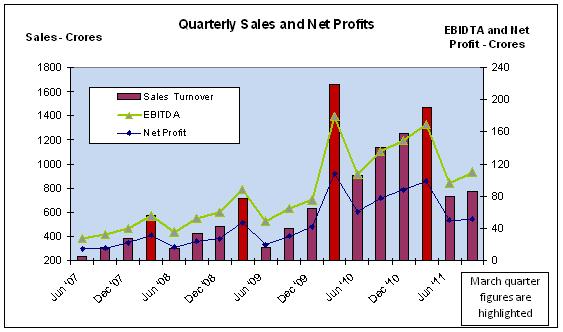
  • Sales have grown at an average of 33.4% over the last 4 years, see Fig 2. Not bad for a firm initially focused on Investment Banking vertical at a time when banks were going bust :-)
  • EBITDA and Net Profits are growing in the 30-33% range CAGR
eClerx Services, JainMatrix Investments

Fig2 – Quarterly Sales and Profits (click to expand)

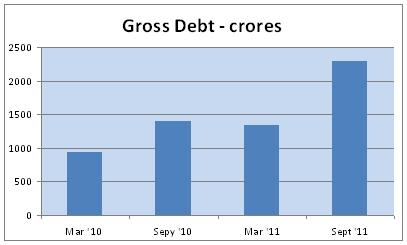
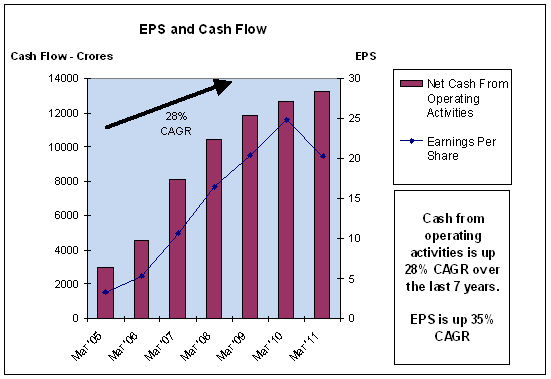
  • The firm is debt free, and with a 30% CAGR growth in Cash from Operations, Cash Flow is excellent
  • EPS has also grown at 29% CAGR over the last 4 years, see Fig 3.
eClerx Services, JainMatrix Investments

Fig 3 – EPS and Cash Flow (click to expand)

Financial Projections, with FY14 estimates

The financials and PE of eClerx has been projected for the next 3 years.

JainMatrix Investments

Key Financials and Projections – eClerx (Click to enlarge)

  • The current PE of eClerx stock is 15.2 right now, above the industry average of 12.
  • The Price and PE chart Fig 4 – shows that the 2008-09 period of US financial weakness had a price impact on eClerx stock.
  • The view of the EPS chart – Fig 5 shows that this fall in prices was unwarranted. The EPS continued its rise thereafter, and the share price smartly recovered.
eClerx Services, JainMatrix Investments

Fig 4 – Price and PE Trends (click to expand)

eClerx Services, JainMatrix Investments

Fig 5 – Price and EPS Trends

  • Cash and Cash equivalents are at 179 crores. This is a healthy war chest with which eClerx can look at new acquisitions or invest in organic growth.
  • PEG is at 0.52 – indicates it is underpriced, and a good investment opportunity

 Risks:

  • Client concentration. The top 5 clients contribute 87% of the revenues. This is an asset – current clients are ramping up (this was 82% last year). However, it is a risk, since any relationship gone sour can affect revenues to the tune of 10-25%.
  • Attrition is high in eClerx at 35%. However their processes are such that within one week, a replacement resource is found and he starts getting billed by the client. This minimizes the impact of high attrition. Also attrition is expected to plateau in the next few quarters due to general slowdown.
  • Financial sector headwinds. The European countries debt, Eurozone crisis and USA’s debt issues are threats to the financial services sector in the USA. However the investment banks are better prepared for this in 2011 compared to 2008, and should be able to weather this storm. For eClerx business is not affected unless a customer ceases operations, as many of the processes they run are critical day to day tasks, part of the core normal functioning of the firm, and not a discretionary expenditure.

Opinion, Outlook and Recommendation

  • The eClerx stock reached a 52 week high of 874 on 8th July this year, and is currently at 16% below this. This is good point to start accumulating this share.
  • At current levels, eClerx share is above the 50 and 200 DMA levels. This indicates the share is likely to continue to move up.
  • Over the past 4 years, the average PE of the stock has been 12. However the business is stable and growing, and should be able to command higher PE levels going forward as the business scales up and the market cap moves into the Mid-Cap range.
  • Near term positives include the weakening of the INR against the USD that should boost eClerx revenues and profitability. It is an exporter of services, but most of its costs are in INR.
  • In the Indian IT/ KPO industry, eClerx is a small player with a good niche. The operating margins at 33-35% are excellent. The real potential for eClerx is to mine their roster of current customers for additional business. This executed will itself provide 30-40% revenue growth in the next few years.
  • Strong business leadership – cofounder / promoters are experienced in banking, investment banking and consulting industries in the US.
  • High Dividend Payout ratio at 60% plus, indicates good management attitude towards  shareholders.
  • The 18 month projection – for March 2013 – for eClerx is Rs 1572, a 110% appreciation from CMP.

…………………………………..

  • Check back on the website www.jainmatrix.com for updates.
  • Like my post on Facebook
  • Do you find this site useful? Please comment below. You can also subscribe for my posts by filling the ‘Sign me up’ box on top right of this page.

Disclaimer:

These reports and documents have been prepared by JainMatrix Investments Ltd. They are not to be copied, reused or made available to others without prior permission of JainMatrix Investments. Any questions should be directed to the director of JainMatrix Investments at punit.jain@jainmatrix.com

Also see: https://jainmatrix.wordpress.com/disclaimer/

Bharti Airtel – Take the call

  • Date: November12, 2011
  • CMP: Rs 396; Large Cap
  • Advice: Safe long term investment
  • Target: 18 month – 800

There is an update on this report called Bharti Airtel – This is a year of consolidation (Aug 2012) available for readers. 

Bharti Airtel is a large telecom player. The market leading India business is seeing high competition, but going forward the profitability will stabilize and improve. The next growth engines are Indian 3G and the 16 country African acquisition.  Invest for the long term in this Indian – going – MNC Blue Chip.

Bharti Airtel – Description and Profile

  • Bharti Airtel is the market leader in the Indian telecom sector. Incorporated as recently as 1995, it is a global telecom operator ranked #5 today in terms of customers.
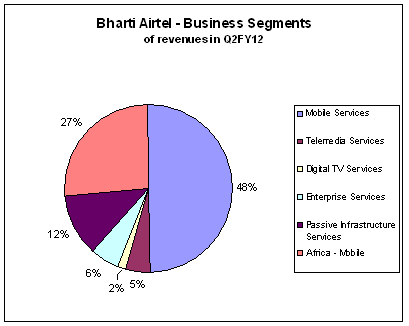
  • Standalone turnover is Rs 38,000 crores (FY’11), and the Market Cap at Rs 1,50,000 crores ranks it #7 in India.  Consolidated revenues in Q2FY12 was Rs 17,200 crore (annualized Rs 61,000 crore)
  • Other than India, Operations are spread over 18+ countries including Bangladesh, Sri Lanka and the African continent. Airtel has an aggregate of 237 million customers as of September 2011.

Businesses are classified as B2C and B2B

  • B2C operations include Mobile, Telemedia (broadband, IPTV and fixed line), and Digital TV (DTH)
  • B2B operations are Enterprise services (end to end telecom services) and Passive Infrastructure Services (Telecom towers)
  • Africa for Airtel is essentially a market for mobile services and Passive Infrastructure Services (Telecom towers)
Bharti Airtel, JainMatrix Investments

Fig 1 – The revenue proportions from business segments (click graphic to enlarge)

  • Strategic Partner – Singapore Telecom is a key Partner and investor in Bharti Airtel.
  • Equipment and Technology Partners – excellence from specialists
  1. For network and telecom equipment, the partners are Ericsson, Nokia Siemens Networks (NSN), Huawei, Alcatel Lucent, ECI, Tejas Networks and Cisco
  2. IBM is the partner for all business and enterprise IT systems, across geographies
  3. The Call Center expertise is from partners like IBM Daksh, Mphasis, Firstsource, Aegis, Tech Mahindra Teleperformance, and HGSL
  • Shareholding pattern is: Promoters 45.5%, Foreign Strategic Partner 22.8%;  FIIs 17.1%;  DII 8.7%; Bodies Corporate 4.1 %; Individuals – retail and Other 1.8%

Industry Snapshot

  • The total number of Indian subscribers of telecom services– wireless & wire line – is 88.6 crores. The tele-density is 73.97% (on 30/06/11), an increase of 4.69% over the previous quarter
  • Gross Revenue during the quarter was 46,891 crores, an increase of 3.03% over the previous quarter
  • The policy environment for Telecom is driven by TRAI, DoT and the Ministry of Communication & IT
  • There are 15 players in the telecom operator space, including PSUs. Here is a comparison of the larger players

Company

Subscribers

millions

ARPU

Rs/ month

MoU

minutes

ARPM

Rs/minute

Market Share %

3G licenses won

3G Bid

Rs Billion

Bharti Airtel

172.51

192

454

0.42

19.91

13 circles

122.95

RCom

144.51

105.8

240

0.44

16.77

13 circles

85.85

Idea

95.11

165.2

413

0.40

11.12

11 circles

57.68

Industry

885.99

93.44

329

100

7 private firms have won 71 circles among them

506

Above telecom data is from April and June 2011 quarters, from TRAI and public reports

Key challenges for Bharti Airtel and strategies being followed:

Bharti Airtel, JainMatrix Investements

  • Focus on network improvements, customer support and new service launches, so Airtel is seen as a stable, technically superior and quality service provider

2.       The draft National Telecom Policy 2011 attempts to ease conditions for M&A in the telecom sector, promote the ‘One Nation-One License’, and possibly infrastructure status for the industry

  • These policies are seen as boosts for the sector, particularly the larger players like Airtel
  • It will hasten the end of the intense competition phase and, through alliances and M&A, lower the number of players to 6-8. This can permit profitable telecom operations for most players.

3.       Airtel won a number of 3G licenses in important circles, but at a high price

  • 3G is the next big thing for Indian telecom players. Driven by a growth in smartphone sales, enabled by the telecom operators, a whole new ecosystem of content, services and functionality is being set up. This includes internet browsing, entertainment services, application stores, video calling, enterprise services, m-Heath, m-Education, m-Commerce, e-governance, etc.  These will drive usage, 3G penetration, subscriptions and ARPU, and help monetize the 3G license assets.

4.       Regulatory uncertainties on issues like Excess spectrum charge, license renewal fees, formation of 3G roaming alliances

  • By working with the industry bodies such as COAI, Bharti Airtel is defending its position on these issues. Many of these new conditions impose additional costs on the Telecom operators, which are unplanned for.

5.       Airtel acquired the African telecom assets of Zain in 2010, for USD $9 billion in cash.

  • This purchase is of a high growth franchise. As per Airtel estimates, Africa will eventually overtake India and China as a telecom market – as population of Africa will peak at 1.8 – 2.0 billion. By leveraging the balance sheet and sound financial engineering, Airtel was able to service this loan for only $200m per year in 2010.

6.       Mobile Number Portability was perceived as a threat for Airtel. However, the first year of experience of this consumer facility shows that it has not materially reduced market shares.

Stock valuation, performance and returns

  • CMP is 395. In the last 7 years, the market price has appreciated at 21% per annum CAGR.  It is below the all time high of 565 in Oct 2007. See Fig 3.
  • However, prices are on an uptrend in the last year or so. PE at 21.5 is still well below the 7 year range of 27.5

Bharti Airtel, JainMatrix Investements

  • EPS growth in the last 7 years has been 35% CAGR. Even so, we can see the trends – EPS had a rapid expansion from 2005 to 2009, but has fallen off in the last 2 years.
  • The Good News? Expectations now are that the period of falling consumer prices in telecom are over. The hyper competition phase has played out, and EPS will stabilize and start their climb once again for Airtel.
Bharti Airtel, JainMatrix Investments

Fig 4 – Price and EPS Trends

  • Sales have grown steadily at 23.4% over the past 7 years. Net profits have also appreciated at 21.3%. We can see however, that profits which were rising rapidly till 2009, have tapered down recently. This is due to industry hyper competition.
Bharti Airtel, JainMatrix Investments

Fig 5 – Sales and Profits Trends (click to enlarge)

  • Telecom is a very resource intensive business. Airtel has managed this well, and has grown the Cash generated from operations at 28% CAGR over the last 7 years. EPS growth has been higher at 35%.
Bharti Airtel, JainMatrix Investments

Fig 6 – Cash Flow and EPS Trends

  • RoCE is at 16% – healthy statistic; RoNW is 17.6%; Price/Book is 3.42
  • Debt / Equity is 0.7 for the consolidated entity. This is a comfortable level for a telecom player.
  • PEG is at 0.61 – indicates it is underpriced, and a good investment opportunity, especially given it’s Blue Chip status

Risks:

  • Poor regulatory conditions in India. The telecom sector continues to be buffeted by ad-hoc ism in policy matters, and overlapping jurisdictions of TRAI, DoT and the Ministry. The revenue short government may exert additional pressure to raise receipts, sacrificing industry growth.
  • The current policy directive is to allow M&As and reduce competition intensity in the sector. If this is not implemented, or even reversed in some way, the hyper competition environment may continue to haunt this sector, affecting profitability and margins.
  • The interest rate has risen in India. This increases debt servicing costs. Expectations are that rates have peaked in India, and should fall going forward.
  • Revenue and capital leakage into unrelated diversifications of Bharti group like Retail, Insurance, foods, etc. However this risk is fading as Bharti Airtel corporate governance standards are high, and investments are being made independently by the holding company, Bharti Enterprises.

Opinion, Outlook and Recommendation

  • Airtel essentially has two large businesses, India (mature asset) and Africa (growth).
  1. In India, the major investments have been made; the revenues are large and growing, and the high competition is expected to ease up. Over the next few quarters, all metrics will point up – Cash flow, operating margins and net profits, in addition to revenues which has held up well.
  2. In Africa, we will see Airtel slowly establish itself, move from #3, 4 or 5 in the market to #1 or 2. In country after country, it is engaging with the government, trade and consumers, to roll out its ‘minutes factory’, ‘network infrastructure sharing’ and ‘partner with the best vendors’ approach.  The 2013 target for Airtel Africa is $5 billion of revenues.
  • The recent bottom of the Airtel share was Rs 255 in June 2010. The share has been moving up thereafter and has appreciated 55% to today’s 396. The stock will continue its upward march, as it continues to deliver on stated corporate goals.
  • At current levels, Airtel share is above 20, 50 and 200 DMA levels. See Fig 7. This indicates the share is likely to continue to move up.
Bharti Airtel, JainMatrix Investments

Fig 7 – Airtel stock is above 20, 50 and 200 DMAs

  • I recommended the Airtel stock in my report in December 2010. See Link.
  • I reiterate my recommendation to Buy.  My 18 month target for this stock is 800.

……………………………………..

  • Check back on the website www.jainmatrix.com for updates.
  • Do you find this site useful? Please comment below. You can also subscribe for my posts by filling the ‘Sign me up’ box on top right of this page.

Disclaimer:

These reports and documents have been prepared by JainMatrix Investments Ltd. They are not to be copied, reused or made available to others without prior permission of JainMatrix Investments. Any questions should be directed to the director of JainMatrix Investments at punit.jain@jainmatrix.com

Also see: https://jainmatrix.wordpress.com/disclaimer/

Hanung Toys and Textiles – Look for the rebound

  • Date: October 24, 2011
  • CMP: Rs 109; Small Cap
  • Advice: High Risk, High Gain stock at attractive entry point
  • Target: 9 month – 200; 24 month – 290

Hanung Toys and Textiles is a small but fast growing manufacturer of textile furnishings and toys. The business performance has been robust. A series of news disappointments has depressed prices. But today it is an attractive contrarian pick.

Hanung – Description and Profile

  • HANUNG Toys & Textiles Ltd is a niche player in Soft Toys, Decorative Cushions & Children’s Room Furnishings. Turnover is Rs 1160 crores (last 4 quarters). The Market Cap is Rs 274 crores.
  • The revenue breakup by category is 65% textile furnishing and 35% soft toys.
  • The CMD of HTTL, Mr. Ashok Kumar Bansal, is a Chartered Accountant who started this company in the 80s.
  • The financial management of this company appears to be conservative and understated; while the business plans are aggressive.
  • HTTL had exports of 75% of sales. See Sales break-up by geography in Fig 1.
Hanung Toys Textiles, JainMatrix Investments

Fig 1 - Hanung - Sales by Geo (click to enlarge)

  • The key facilities consist of toys manufacturing facility, home furnishing production facility and textile processing facility, 3 located in Noida and one in Uttaranchal. The toys manufacturing unit is established in the Noida SEZ wherein the benefits of duty free imports and single window clearance for imports/exports are available.
  • Internationally, products made by HTTL are available on the shelves of Bloomingdales, William-Sonoma Group, Macy’s, JC Penney, Target Stores, Home Depot, Wal-Mart, Anna’s Linens, Ikea, Homebase, Argos, etc
  • In India, HTTL owns ‘Play-n-Pets’ and ‘Muskan’ brands in stuffed toys and ‘Splash’ in Home Furnishings. They have more than 100 distributors for the stuffed toys across the country, including multi-brand outlets like Lifestyle, Shopper’s Stop, Westside, Big Bazar (Pantaloon group), Pyramid, Globus, Landmark, etc. Its ‘Splash’ range of home furnishings is available at 600 stores across the country.
  • The current order book is estimated at Rs 1500-1900 crore, which is about 1.5 years of Sales.
  • Shareholding pattern is: Promoters 65%; FIIs 1%; Bodies Corporate 12 %; Individuals – retail 19%; Other 3%
  • HTTL exports are positioned in the Mid-Market range, making the business less sensitive to Chinese exports.
  • Business potential is very high. In toys, the demand is large in current markets. Quality and price matter here. Competition is mostly from China. In home furnishings, the demand, particularly abroad is very high.
  • In effect, the addressable market for HTTL is 100s of times its current Sales.

Stock evaluation, performance and returns

  • The IPO in Sept 2005 was 8.6 times oversubscribed. Pricing was at Rs 95
  • HTTL has been paying Dividend for last 4 years, which increased from 15% to 20% of late.
  • The price has fallen from Nov 2010 highs of 410, to a CMP today of 109. The volatility is high, see fig 2.
Hanung Toys; JainMatrix Investments

Fig 2 – HTTL stock price – shows high volatility

  • Sales and Profit have however grown very steadily (Fig 3)
  • Sales have grown at 42% CAGR over the last 5 years
  • Profits have grown faster at 44% in this period
Hanung Toys; JainMatrix Investments

Fig 3 - Quarterly income and profits have, however grown steadily. (click to enlarge)

Price Action and Events

  • Price of HTTL peaked in Oct 2010, and then dropped sharply. There was some negative news and bad publicity:
  1. The high interest rates regime has taken a toll on HTTL. Costs have risen, as there is debt on the books of Rs 1000 crores. Debt equity ratio currently is 1.74
  2. Overall the Sensex fell sharply. The Small Cap shares fell faster than large cap shares. HTTL due to it’s volatile nature suffered even more.
  3. A GDR plan – to raise capital and fund growth plans – was dropped due to low share prices.
  4. Textiles sector has not done very well in the last year. Cotton prices have risen sharply.
  • However, HTTL has made several smart moves that are improving prospects
  1. In March 2011, HTTL acquired a controlling stake in the US-based Cody Direct Corp. This firm deals in marketing and distribution of home furnishings. This acquisition will not contribute to topline, but to profitability and operating margins, as some of the middlemen will be removed from the sales cycle.
  2. Plans are on to ramp up capacity, and also a backward integration by setting up spinning plants. A capex plan for the next 2-3 years is in place of Rs 720 crores. This will be raised from cash from operations as well as loans from banks.
  3. The firm is rationalizing interest costs by switching over from the existing Indian Rupee loans to ECB (European Central Bank) or similar, where they can save 3-4% of interest.
  • Another near term trigger is the recent appreciation in the US$ – INR rates. This will boost USD earnings for HTTL, and should reflect in quarterly earnings for Q3 and Q4.

Graphics:

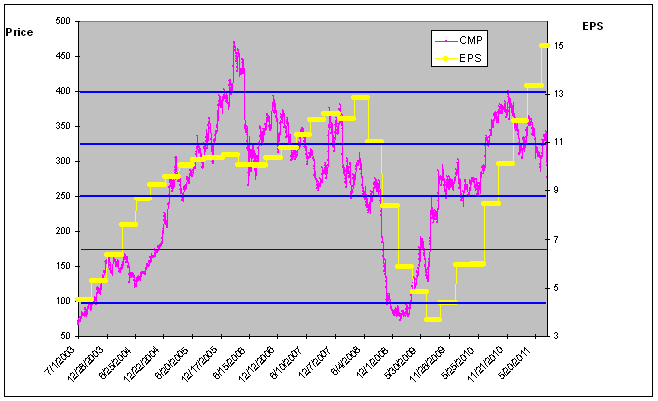
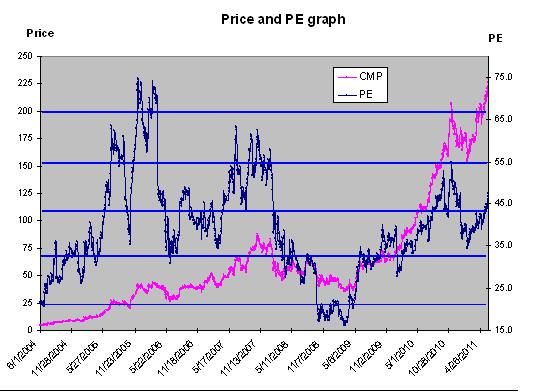
  • The Price and PE graph Fig 4 – shows that valuations are bottoming out and are near all time lows of 2008.
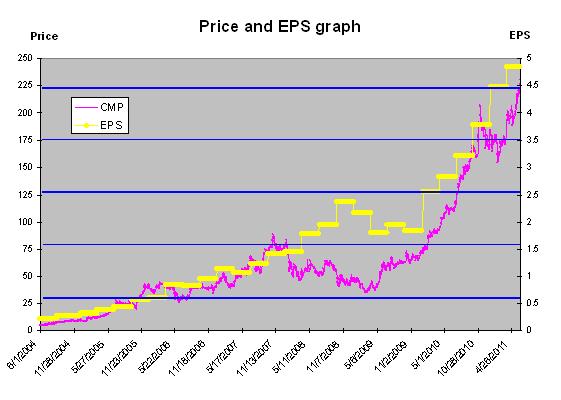
  • The Price and EPS graph Fig 5 – shows that EPS is at all time highs.
  • Put together, we can see that this is a very attractive time to enter the stock as a long-term investor.
Hanung Toys; JainMatrix Investments

Fig 4 - Price and PE Graph (click to enlarge)

Valuations and Financial metrics

  • EPS (adjusted) growth has been 44% CAGR over the last 5 years. The EPS quarterly graph (fig 4) shows a steady rise. This is a small but stable company in a good market that is establishing base and will achieve critical mass of size, brand and reach over the next 5 years.
  • PEG is at 0.05 – indicates underpriced status, a very good investment opportunity
  • RoE is at around 17-20% – healthy statistic.
  • Price/Book is 0.54, this is very attractive.
  • Management has projected 20% revenue growth for the next 2 years.
Hanung Toys; JainMatrix Investments

Fig 5 - Price and EPS Graph (click to enlarge)

Opinion, Outlook and Recommendation

  • This is a volatile small cap stock. There has been a large fall in share price since Oct 2010, by 75%. There is of course a possibility that this falling trend will continue.
  • However, business performance has been excellent. After this recent fall, HTTL now has a PE of 2.26. This is an opportunity for investors to average down their cost of holdings, or enter afresh.
  • The stock may be waiting for a trigger to reverse the price downtrend. Once this happens, the upside is high.
  • Our projection is a Rs 200 price level in 9 months (Aug 2012) and a Rs 290 price level in 24 months (Nov 2013).
  • Retail investors with a risk appetite can start a systematic investment (monthly) at current levels.
Hanung Toys; JainMatrix Investments

Fig 6 - Price Projections (click to enlarge)

Risks:

  • Small size; it is a volatile stock. It falls hard in poor sentiment periods and rises rapidly in good.
  • Current price fall may continue for an unpredictable period, till investor sentiment recovers.
  • Being a small firm, can be affected badly by a single accident, strike or untoward incident
  • Recent GDR was cancelled due to unfavorable market conditions, causing a further fall in price
  • Debt equity is rising, and is at 1.74 as of now.

 Notes

  • Check back on the website www.jainmatrix.com for updates.
  • Like my posts on Facebook
  • Do you find this site useful? Please comment below. You can also subscribe for my posts by filling the ‘Sign me up’ box on top right of this page.

Disclaimer:

These reports and documents have been prepared by JainMatrix Investments Ltd. They are not to be copied, reused or made available to others without prior permission of JainMatrix Investments. Any questions should be directed to the director of JainMatrix Investments at punit.jain@jainmatrix.com

Also see: https://jainmatrix.wordpress.com/disclaimer/

Mundra Port: Infra play at good valuations

………………………………………………………………………………….

There is an update to this report. Read this latest Sept 2012 update called ‘Adani Port – The Great Australian Adventure’. Click this LINK

Introduction

  • Mundra Port and SEZ (MPSEZ) is a Gujarat based infrastructure and exports play. Promoted by Adani Group, it includes the following businesses –
  • India’s largest private port, with volumes having recently crossed 50 MT (FY11) and 15.08 MT in Q1 FY12
  • An SEZ area adjacent to the port, which is being developed on an area exceeding 100 sq km
  • The port has got ranked 5th in India among all ports, major, public and private. The port deals in a number of container and bulk products.
Mundra Port and SEZ

Fig 1 – Mundra Port – Cargo details

Fig 1 – Business Segments in Q1 2011.  MPSEZ handles a broad range of products. A broad-based customer group means lower business risks.

  • Connectivity and logistical facilities extend the Port, berthing and storage to Roads, Rail connection, Air strip and Pipelines based evacuation
  • Port has also recently added specialized car exporting facility
  • The SEZ facility enjoys a series of Indirect and Direct Tax benefits designed to encourage industrialization by the Gujarat Government
  • Power supply will be by a plant being set up by Adani group, that will meet all the SEZ needs
  • The SEZ area is organized into Industrial clusters that include – Engineering, Auto & Auto Ancillaries, Textile & Apparel, Chemicals & Pharma, Plastic Processing, Stone & Minerals, Food & Agro, Global Trading Hub, Timber & Furniture and Metals and minerals

Current Business Outlook

  • The port has rapidly increased business throughput over the last 5 years, venturing into new categories of goods, and working closely with manufacturers and exporters to improve infrastructure
  • Capacity building is ongoing including ICDs under development
Mundra Port and SEZ

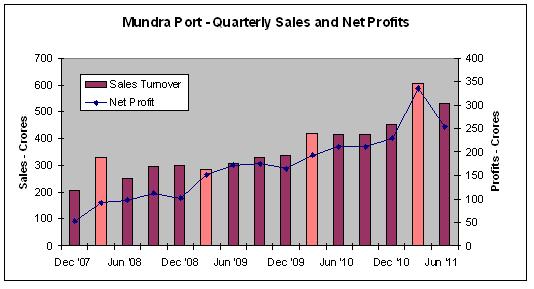
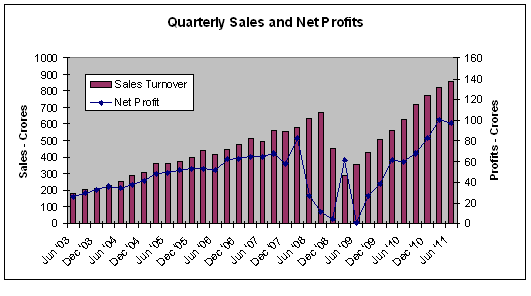
Fig 2 – Mundra Port – Quarterly Sales and Net Profits

Fig 2 – Mundra has shown steady revenue and profit growth.

  • Sales have grown by 32% over the last 5 years
  • Profits have grown an astonishing 128% CAGR over this period
  • Major competition to MPSEZ is from Kandla, JNPT and Pipavav on the Western shores. Mundra is able to provide port access to North India based industry. Additionally
  • Kandla and JNPT have not invested sufficiently in infrastructure due to government constraints.
  • Pipavav is at an early stage of development. Also it is in South Gujarat and logistically more remote.
Mundra Port and SEZ

Mundra Port in Gujarat Map

Additional Developments include:

  • MPSEZ is also developing Dahej Port and Mormugao Port in terms of terminal creation or port operator.
  • Acquisition of Australia Queensland based Abbot Point Coal Terminal (APCT). The coal terminal, has capacity of 50 MT a year, will facilitate the transport of coal from Australian mines to India.

Overview of Share IPO and Stock performance

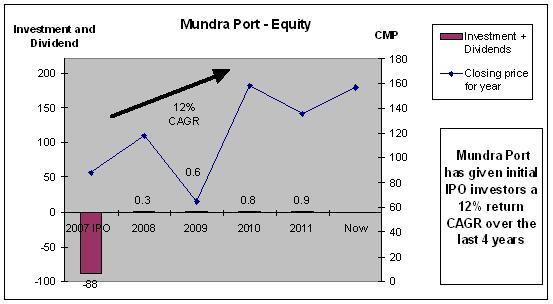
  • The IPO in Nov 2007 was amazingly successful. It was oversubscribed 115 times, and eventually provided huge listing gains. However it was aggressively priced.
  • Business performance over the last 4 years has justified investor confidence in this stock
Mundra Port and SEZ

Fig 3 – Mundra Port Valuations and stock performance

Fig 3 – IPO investors have received a 12% CAGR return over the four years since listing

  • Debt-equity is 0.94 as of Mar’11 (down from 1.7 at IPO time). This is good, for an infra company.
  • Healthy return Ratios. Return on Capital employed – ROCE is 15.4%; Return on Equity – ROE is 23.4%
  • PEG is in the range of 0.84, indicating indicates safety and undervalued status
Mundra Port - EPS and Cash Flow

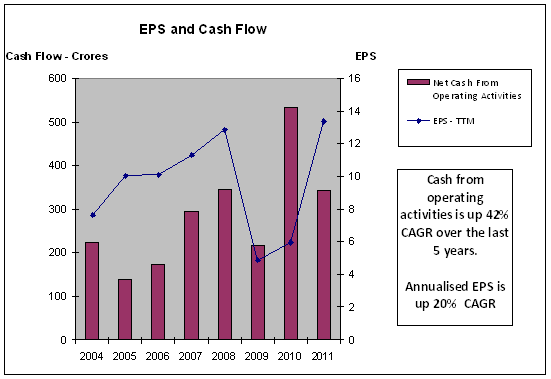
Fig 4 – Mundra Port – EPS and Cash Flow

  • For an infrastructure company, cash is critical. MPSEZ comes out excellent on this count as it has improved Cash flow from operations and EPS (Adjusted for stock split) rapidly in recent years
Mundra Port and SEZ

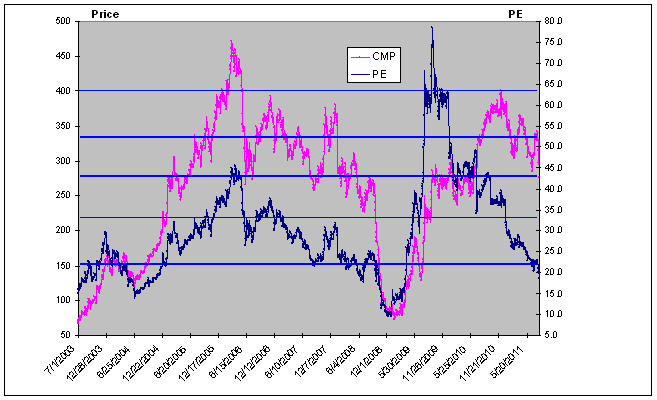
Fig 5 – Mundra Port – Price and PE chart

  • Fig 5 – PE has fallen to attractive levels, and combined with robust business performance gives us a very good entry point for long term investments
Mundra Port and SEZ

Fig 6 – Mundra Port – Price and EPS chart

  • The chart – Fig 6 plots the adjusted market price against the EPS over a 4-year period.
  • EPS shows us a steady quarterly increase indicating stable business improvement

Projections and Investment Advice

  • EPS may slow a little to 40-50% growth range over the next 3 years as competition intensifies and an interest rate driven domestic slowdown takes shape.
  • Even this is very high. Also, MPSEZ is well placed to capture market share from the increase in Indian exports (oil, containers, manufactured goods and minerals) as well as imports (Coal, oil, commodities).
  • SEZ revenues are lumpy, driven by sale of land to industries. However the infrastructure provided and industrialization will drive this business.
  • The recent fall in prices has not affected MPSEZ, and it is expected to ride out this slowdown
  • As long as it stays over 150, MPSEZ share price is in positive territory. Invest

Risks

  • Adani group is a complex group of interconnected firms with cross holdings in group companies like Adani Power, the holding company Adani Group, Adani Enterprises Ltd. and MPSEZ.
  • Recent shareholding reports for MPSEZ indicate the Promoter group has 77%, Institutional is 15% and Public Retail has 7%. Thus unless the Promoters sell more holding soon, it is possible that the promoters may try to buy-back from others and de-list this firm.
  • Intensifying competition. It is possible that Indian government may finally able to grow capacities at Kandla and JNPT (they have both been running close to 100%), overcoming the current lethargy.
  • Pipavav Port is owned by A.P. Moller-Maersk Group, is one of the largest container terminal operators in the world. Over the next few years, APM Terminals will transfer a lot of India business from other ports to Pipavav, and also build good infrastructure here.
  • Recent rumours against Adani Group were that it has powerful political linkages, and interests in illegal mining in Karnataka/ Andhra Pradesh. These rumors affected investor sentiment in Adani Industries. This could also affect MPSEZ in the future. However MPSEZ is a different business, and the possibilities of this are remote.
  • Like my post on Facebook 
  • Subscribe for Reports by filling the ‘Sign me up’ box on top right panel of this page.

Disclaimer:

These reports and documents have been prepared by JainMatrix Investments Ltd. They are not to be copied, reused or made available to others without prior permission of JainMatrix Investments. Any questions should be directed to the director of JainMatrix Investments at punit.jain@jainmatrix.com
Also see: https://jainmatrix.wordpress.com/disclaimer/

Bharat Forge – the Forging Giant Returns

CMP: 291          Date: 12-08- 2011          Advice: Invest in SIP fashion

  • Till 2006 Bharat Forge (BF) was primarily an auto components firm. A number of mergers and acquisitions in the 2004-07 periods saw BF also enter in several new geographies. Manufacturing is in 11 locations and 5 countries: India (4), Germany (3), China (2), Sweden (1) and USA (1).
  • In the last 3 years, BF has executed a de-risking plan and enter into new verticals. For BF the focus in the Non-Auto business is on growing sectors like Power Plants, Marine, Construction & Mining, Oil & Gas, Energy, Aerospace and Railways, and Import substitution for BHEL.  JVs are with respected partners, like NTPC for power, Alsthom for Thermal/ Nuclear turbine/ generation sets and UK based David Brown for gear box manufacturer
Bharat Forge

Change in Revenue Segments

Fig 1 – Business Segments in 2011 (click chart to expand)

 Bharat Forge has successfully diversified from Auto into other verticals, de-risking their overall business profile

Current Business Outlook

  • The fall in auto demand in 2007-09 saw cost cutting measures rolled out to lower the break even for manufacturing facilities. Capacity utilization improved from 53% in 2009, to 70% for standalone and 45% for international entities in 2010. Additional improvements have contributed significantly to profits. All overseas subsidiaries, including its JV in China, FAW Bharat Forge, have see a turnaround and have started contributing to the bottom line, a year ahead of the 2012 target.
  • The auto market began to revive in 2009, and BF was best placed to take advantage of this trend.
  • In June 2011, Bharat Forge quarterly revenues surged to 857 crores, an all time high.
  • The Business environment and demand situation has now become very positive. BF is able to take advantage of surging demand due to spare capacities, low cost production, global presence and nimble design capabilities. Also a series of well timed entries into new non-automotive markets.
Bharat Forge

Quarterly sales and Net Profits

 Fig 2 – Quarterly revenues have surged (click chart to expand)

 Business is surging, in both Auto and non-Auto segments. Profit growth follows in a phased manner, as investments in new businesses break even

Valuations are low, growth is high

  • The stock price peaked in 2006 and has not touched those levels since. But BF has seen a dramatic business recovery in the last two years in terms of Earnings per share – EPS, which has already risen to all time highs.
  • While the BF stock has given investors only 11% CAGR returns over a 7-year period, the aggressive nature of this firm means that the initial period of rapid gain was followed by a period of restructuring and consolidation. The expectation now is another period of rapid gain on all parameters.
  1. Adjusted EPS has seen a recovery post ‘09 and is now into all time high territory
  2. Debt-equity is 0.74 as of Mar’11 (down from 1.21 in ‘10). This is comfortable, and safe.
  3. ROCE and RONW are in 15-17% range indicating healthy returns.
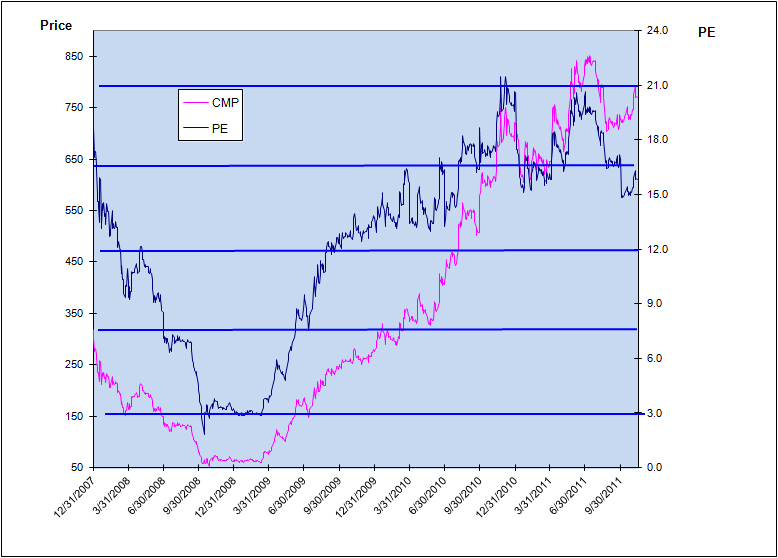
  4. PE has fallen to reasonable levels (compared to historical) indicating safety in investments at this level.
  5. PEG is in the range of 0.3, indicating indicates high safety and undervalued status
Bharat Forge

Fig 3 - EPS and Cash Flow

Bharat Forge

Fig 4 - Price and PE

Fig 4 – PE has fallen to attractive levels, and combined with robust business performance gives us a very good entry point for long term investments – (click chart to expand)

Bharat Forge

Fig 5 - Price and EPS

Fig 5 – Adjusted EPS has retraced rapidly and is into all time high territory

Projection

  • Bharat Forge has been in a period of consolidation, and will see a break out soon
  • EPS has moved to all time highs. With a suitable lag, this will be followed by stock price also moving into new highs. The stock will appreciate to Market Price of 700 in 12-14 months. This is based on an expected PE of 30 range and continued EPS growth seen since the bottom of June 2009.
  • This is an excellent entry point for this stock as it is currently underpriced and ‘out of favour’. The current market weakness has dragged down the market price of the stock. With overall Sensex / market recovery expected in 6-9 months, this share price is expected to recover rapidly.

Risks

  • Auto sector demand in India has been tapering off in recent months. It is expected to have lower growth for 2-3 quarters before recovering. Auto Exports however from India are accelerating.
  • Headwinds, such as Higher raw-material costs like steel and power may restrict margin expansion and EPS growth. The rising commodity costs have hit manufacturers like Bharat Forge.
  • In recent months the increase in interest rates and slowdown in the economy has slowed the growth of the auto industry, particularly in India.
  • However, both these events appear to have played out/peaked, and will stabilise/ reduce in the near future.
  • Business complexity has increased due to addition of a number of new verticals. However, BF is already seeing exciting success from the new ventures.
  • An increase in working Capital in the firm in 2011 saw the Cash Flow fall this year. This stems from investments in new businesses as well as new investments in the Auto business to increase capacity and de-bottlenecking.
  • External factors like stock market sentiments. However our current view is that this will revert to a positive state over the next 9-12 months.
  • Check back on the website www.jainmatrix.com for updates.
  • Like my post on Facebook
  • Do you find this site useful? Please comment below. You can also subscribe for my posts by filling the ‘Sign me up’ box on top right of this page.

Disclaimer:

These reports and documents have been prepared by JainMatrix Investments Ltd. They are not to be copied, reused or made available to others without prior permission of JainMatrix Investments. Any questions should be directed to the director of JainMatrix Investments at punit.jain@jainmatrix.com Also see: https://jainmatrix.wordpress.com/disclaimer/

A Titan for the long term

——————————————————————————————————-

There is an update of this report dated Nov2012, Titan – The Jewel in the Crown 

Titan Industries is a power brand and the largest specialty retail chain in India. It is translating the success in watches into new categories by adding one every 5-7 years, and now also straddles jewellery, eye wear and precision components. Titan is at a very early stage of revenue and profit growth. Invest.

Titan Industries – Description and Profile

  • Titan Industries is a Tata group company selling watches, jewellery, eye wear and precision components. Titan has built excellent brands that drive sales in these consumer categories.
  • They have also set up specialty retail chains to display these products and improve the customer experience. This chain is the largest specialty retail chain in India.
  • Started in 1984 with a joint venture between the Tatas and the Tamil Nadu Industrial Development Corporation for watches, it expanded in 1995 into jewellery and in 2007 into eye wear.
  • Today the turnover is 6050 crores, PAT 430 cr and sales has grown 35% CAGR over the last 6 years.
  • Here is a graphic of Titan’s products, distribution, brands and future growth drivers

Titan Industries

Fig 1 – A snapshot of Titan’s products, brands, distribution and future growth (click to enlarge)

  • The demand for Titan products depends on consumer disposable incomes, and straddle the mid to high end segments
  • In watches, the owned brands are Fastrack, Xylys, Titan and Sonata. High end licensed watch brands include Tommy Hilfiger, fcuk and Hugo Boss.
  • In eye wear, the three in-house brands are Titan, Eye+ and Dash, while the international and luxury brands include Gucci, D&G, Armani, BOSS, Esprit, Daniel Swarowski and Mont Blanc
  • There has been a steady growth in consumer demand except for 2008-09. Recovery is complete, and this trend is expected to continue and even accelerate.
  • Watch parts which were sourced from China, are now being transitioned to production in house in India. This is due to increase in prices from Chinese parts. Even though Titan’s investments requirements and cost of production increase, this gives Titan greater control over the supply chain and quality control.
  • Titan operates 85–90% of its stores through the franchisee model – this allows flexibility in scale and lower cost expansion

Stock evaluation, performance and returns

The Price and Dividend history of Titan is detailed below:

Titan Industries

Price and Dividend History

Fig 2 – Price and Annual dividend history

(Dividend in Rs/share, FV Rs 1) Click to enlarge graphic

Titan IndustriesFig 3 – Quarterly revenues and Profits have grown steadily over the last 8 years

Titan Industries

EPS and Cash Flow

Fig 4 – Cash Flow and EPS are up substantially

  • Sales are growing at 35% CAGR over the last 6 years.
  • Over the same period, EPS (on a steady equity base) has grown 57%. This is remarkable profitability.
  • However, cash from operating activities is up only 19.8% – this is because Titan is investing in building the retail chain as well as in the manufacturing facilities.
  • Putting these together, Titan appears to be in a virtuous cycle of investment – growth – profits that (barring any India/ global slowdown) – is a multi year business acceleration.
Titan Industries

Price and PE

Fig 5 – Price and PE Graph

Titan Industries

Price and EPS

Fig 6 – Price and EPS Graph

  • Even with the rapid appreciation of Titan’s share price in the last 2 years, the PE is around 46. This is historically in the medium/ average range for Titan over the last 7-8 years. Investors seem to have always expected more from Titan :-)
  • EPS  has increased steadily, barring the 2008-09 period where overall the economy had slowed. Post this period, the earnings have rebounded and caught up with the previous growth path
  • ROCE has been at an amazing 42-48% in the last 2 years.
  • PEG is at 0.81 – indicates safety and still undervalued status
  • Very low debt equity ratio, and good cash position indicates strength in the balance sheet.
  • The company has recently approved a share split to 1 Re face value (from 10Rs), and a bonus issue of 1 for 1 held. This will reduce market price by 1/20 and boost retail participation (and shareholder returns in the short run).

Risks:

  • Titan is seen as a proxy for gold. In recent times, Titan has been enjoying appreciation on the inventory due to gold appreciating. A fall in price of gold can be a risk to the gold inventory and the jewellery demand at Titan.
  • Competition in India is intensifying with a host of jewellery and eye wear brands challenging Titan.
  • Precision components is a commodity type business, needing volumes, compared to watches, jewellery and eye-care, which are branding, manufacturing and retailing oriented. This business may never reach profitability levels compared to the other three.
  • So what next after eye care? In the next 2-4 years Titan needs to enter into a new business that falls in it’s sweet spot of takeover of unorganized sector – precision manufacturing – consumer retail where it’s strong brand can be deployed successfully. If it does not, business in India can taper off in the next 7-10 years.

Opinion, Outlook and Recommendation

  • In India the ‘demographic dividend’ and GDP growth have pulled the per capita income to over Rs 54,000. Experts expect consumption to accelerate now, as consumers have more discretionary spending power, (and spend less of total income on food). Titan’s watch, jewellery and eye care categories will ride this consumption wave.
  • In Jewellery and eye care, Titan is addressing a relatively unorganized sector, and by leveraging it’s national brand and distribution network, building credibility and loyal consumers. This is a sustainable model, and Titan enjoys a first mover advantage.
  • Exports too are a big driver of future growth, as the Indian success story is replicated in 26+ countries. In these business categories, margins can be much higher in developed countries, so there is high potential here.
  • Precision components manufacture, while being a lower margin business, has a very large global potential. Anecdotal evidence from Titan’s procurement for watch parts suggests that Indian parts are gaining in competitiveness compared to Chinese equivalents.
  • Titan has built capabilities in branding, design and manufacturing that are strong core competencies.
  • In the last 2 years, share price has appreciated 4 times. For new investors, it may appear to be a case of, closing the stable door after the horse has bolted :-). However, this stock is expected to continue to perform strongly for several years to come.
  • Invest now and systematically for long term outperformance
  • Like my post on Facebook 
  • Subscribe for Reports by filling the ‘Sign me up’ box on top right of this page.

Disclaimer:

These reports and documents have been prepared by JainMatrix Investments Ltd. They are not to be copied, reused or made available to others without prior permission of JainMatrix Investments. Any questions should be directed to the director of JainMatrix Investments at punit.jain@jainmatrix.com Also see: https://jainmatrix.wordpress.com/disclaimer/
Performancing Metrics

My investment rupee says Yes Bank

Yes Bank is an aggressive high potential new generation bank. The recent fall in prices by 28% makes this an attractive entry point for long term investment.

There is an updated report of Yes Bank available at link The Brave Warrior of Indian Banks by JainMatrix Investments includes Q1FY13 results, news updates and FY15 projections.

Yes Bank  – Description and Profile

  • Incorporated in 2003, Yes Bank received the only greenfield (Start up/New Bank) license awarded by the RBI in the last 15 years
  • Founded by bankers Rana Kapoor and Ashok Kapur, (combined stake 32.6%). Other shareholders are Rabobank 18.20%, AIF Capital (private equity), Orient Global (investment firm), Swiss Re, Khazanah Nasional (Malaysia Govt) all 3.5-5% each.
  • It has 185 Branches currently of which 14 were added in Q3 FY11.
  • Market cap is at Rs. 9,300 crores, putting it at #12-13 among all Indian banks, and #7 in private sector
  • The firm has about 4000 employees, including 970 hired already in FY11

Yes Bank has superior strategies

In spite of over a hundred banks as competition, Yes Bank stands out for the following reasons:

  • Seasoned, capable bankers as Management team
  • The firm is nimble and agile, and rapidly enters new high potential industries sectors for advisory, loan and banking services
  • Focus on Knowledge based approach to lending. Loans exposure is to sectors like Food and Agribusiness, Engineering, Infrastructure & Logistics, TMT (Technology, Media & Telecom) and Healthcare.
  • There are four business verticals in the bank: a) Corporate & Institutional Banking b) Commercial Banking c) Business Banking-SME d) Retail Banking.
  • The business focus was Corporate banking till now and on select sectors while providing the entire value chain in those niche sectors. Having achieved some scale, the bank is now widening focus into SMEs and Retail.
  • Aggressive Retail growth plans will help increase low cost CASA deposits, and increase margins. The RBI has granted license for 91 additional branches, so the total may increase to 250 by June ’11
  • Mistakes are made, but it learns from these, and exits fast (example – in 2007, there were a lot of complaints against complex foreign exchange derivative products sold to SMEs, that turned loss making. There were litigations against Yes Bank (and several other banks too). All these have been resolved.
  • Growth has been organic, and may remain as such. The executives believe that for Yes Bank, organic growth comes at a lower cost compared to available banking assets

Stock evaluation, performance and returns

  • It’s IPO in July 2005 was priced at Rs 45. It was 31 times oversubscribed. The maiden dividend was paid in 2010.
  • At CMP of Rs 277 today, the stock has shown a 33% annualized return over the last 6 years! (See Fig 1)
  • Income and Profit too have grown steadily (Fig 2)

Yes Bank, Stock appreciationFig 1 – Yes Bank stock performance (click to enlarge) Source: JainMatrix graphics

Yes Bank, Revenue, ProfitFig 2 – Quarterly income and Profit have grown steadily over the last 5 years Source: JainMatrix graphics

  • NII – the difference between Interest from Loans and Cost of loans – has grown at 41.5 % annually over the last 5 years. This is phenomenal, and indicates good margins
  • NII plus Other Income – Add to this income from fee based services like investment banking, advisory services, etc –  have grown at 37%

Yes bank, Price Earnings trendFig 3 – Price and PE Graph (click to enlarge) Source: JainMatrix graphics

  • After IPO, made at a high valuation, the PE stayed high for a few years (fig 3). The patient investor got rewarded in 2008-2011 period, where the share price rose rapidly.
  • There has been a recent fall, the PE now is low at 14.4 and this gives investors another opportunity to enter

Yes bank, EPS trendFig 4 – Price and EPS Graph Source: JainMatrix graphics

  • EPS (adjusted for equity dilutions) growth has been 36% CAGR over the last 5 years. The EPS quarterly graph (fig 4) shows an amazing parabolic rise. I would say it is a great company just achieving critical mass of size, brand and reach.
  • PEG is at 0.4 – indicates underpriced status, a very good investment opportunity
  • RoE is at around 20% – healthy statistic.
  • Price/Book is 3.08, this is fair for a mid sized fast growing bank.
  • Gross and Net NPAs are at 0.23% and 0.06%. This shows remarkable credit assessments and good processes
  • CASA ratio stands at mere 10.1% as on Q3FY11. This is low by general banking ratios, but this is being addressed aggressively.

Opinion, Outlook and Recommendation

  • India is an underbanked country. The RBI is actively encouraging new banks, and vast swathes of Rural India remain unbanked. The potential for Yes Bank to grow is large.
  • At the same time, competition in urban areas is high, due to presence of public sector, private as well as MNC banks.
  • RBI expects average industry growth rate to be 20% during FY11.  Yes Bank is expected to grow at a far faster rate than industry. It has well-defined, sustainable growth strategies in place.
  • Yes Bank will grow at 35-45% in terms of Profits and NII + fee Income for the next 5 years. With this trajectory, Yes Bank will join the ranks of large well managed private banks like HDFC Bank and Axis Bank
  • The fall in share price by 28% from the Nov 2010 peak to date has made current valuations attractive
  • However a look at the graph of DMA of the stock (fig 5) shows that the stock stays for long periods of time above or below the 200 DMA. It recently went below the 200DMA, so my advice is to wait for the stock to go above this before investing.
  • However retail investors can start to Invest systematically.

Yes Bank technical analysisFig 5 – Price and DMA chart (click to enlarge) Source: JainMatrix graphics

Risks:

  • High competition
  • High interest rates and increased Costs – particularly employee costs
  • Execution risks in rapid bank branch growth
  • Current weakness may mean a period of falling prices before the appreciation resumes (fig 5)

Disclaimer:

These reports and documents have been prepared by JainMatrix Investments Ltd. They are not to be copied, reused or made available to others without prior permission of JainMatrix Investments. Any questions should be directed to the director of JainMatrix Investments at punit.jain@jainmatrix.com

Also see: https://jainmatrix.wordpress.com/disclaimer/
Performancing Metrics