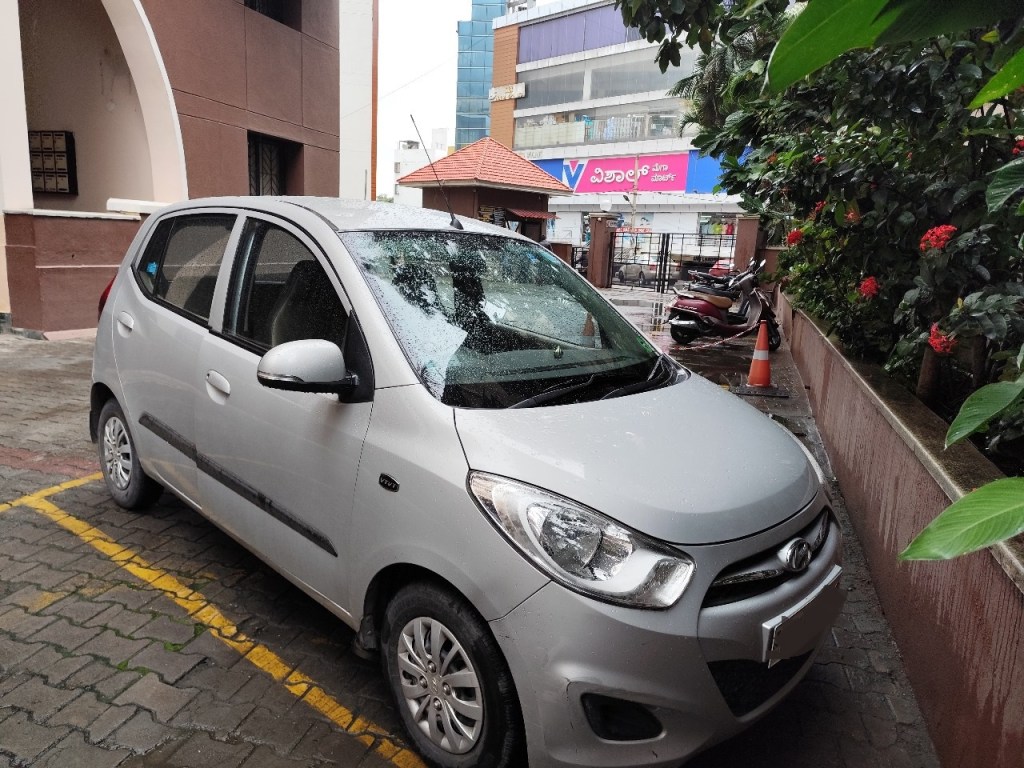
JainMatrix Investments, Hyundai i10

Buying a Car? Here’s the Real Cost

Last week I sold my car. It was a beautiful machine. I bought this Hyundai i10 in 2013. It became the default safe ride for work commutes, local errands and weekend joyrides. Occasionally we travelled intercity in it. Then my son grew old enough, and he learnt to drive in it. He added college commutes and meetings with friends, to the list of activities.

Now 12 years after the purchase, it was time to ring out the old. Selling your used car has also changed over the years. So a call to Spinny and another to Cars24 helped evaluate my options. I got a better offer from Cars24, so I sold it to them.

I felt a little sad to see it go. But I thought I can take my case and put some numbers to my car purchase, usage and sale decisions. And see if something useful comes out of it.

Should one really evaluate a car purchase in numbers? I’m not sure, but lets give it a shot.

Purchase, Sale and Line Items

  1. Purchase – Rs 5,73,000 in 2013 in Bangalore
  2. Annual maintenance – first year 0, from 2014 Rs 6,000, rising to Rs 12,000 recently. Lets assume no major accidents and no major parts replacements, just more repair and wear & tear recently.
  3. Petrol costs – My usage over 12 years was less, just 28,000 km. This can vary widely from person to person. But lets calculate for this. This usage becomes 2,333 km/ year. Petrol prices rose from Rs 72 /lit in 2014 to Rs 100/lit now. Assuming an efficiency of 12 km/lit., one can calculate annual costs.
  4. Sale – Rs 2,90,000 in 2025 in Bangalore
  5. Totaling these in excel and using the IRR function, I got a -12.3% annual return for my car purchase.
  6. However petrol usage is widely different for different folks, so lets remove this and recalculate.
  7. Without petrol, I got a -7.66% annual return on my car purchase.
  8. One missing factor is inflation. Obviously Rs 1 lakh was worth much more in 2014 than today. Lets factor in a 5% annual inflation to all transactions.
  9. The Without Petrol calculation with a 5% inflation now is -12.1% annual return on the car purchase.

Excel Snapshot

Here’s a snapshot of the excel calculations. Click image below to see bigger.

Conclusions and Closing Thoughts

  • Added this point on 17/08 – Some of my blog’s brilliant followers have pointed out – Insurance and auto loan costs should be added here too. Insurance of course is mandatory, and more has to be added on if you want good coverage. I peg this at about 2% additional costs per year. A car loan is optional, so it depends on the buyer if he needs one. Here a loan costs about 9-11%, so this will add substantially to costs. Thanks Bala and Nandu !!
  • So there we go. The cost of a car like Hyundai i10 for me over this period was 14.1% annualized on the invested capital, adding insurance, not including petrol and car loan.
  • To some extent, a car purchase could be both a functional and a status purchase. The latter is difficult to quantify. And widely varies from person to person. Lets leave it at that.
  • This was a good hatchback, but not a luxury car. Numbers could be quite different for this.
  • Conversely, don’t forget how useful a car can be. It is quite safe. Its convenient and always available. Good in rainy weather. Its more useful for groups of 2-5 to travel together. Once you do own a car, you may as well use it extensively, for your work and travel.
  • I haven’t factored in depreciation. Not everyone can get this benefit. The dep. rate for vehicles in India is around 15-20% every year for the first 3-5 years. The highest car dep. rate occurs in year 1 of ownership and can go up to 30%. This can certainly lower the cost of ownership.
  • This is of course a 2013-25 story. For a car purchase now, all the numbers will change, but I suspect the annualized costs may be similar for a similar car.
  • The option we have is to take a cab / auto / bus / train / Metro, or personal 2 wheeler for travel. In fact as public transport improves and becomes convenient, the need for personal transport reduces.
  • For wealth building, buy appreciating assets. For utility and fun, go shopping, including for your car. But don’t forget that a car is definitely a depreciating asset.

Hope this was interesting. Do comment and critique below.

Regards, Punit Jain, JainMatrix Investments.

Disclaimer

  • Punit Jain discloses that he has no shareholding in any of the firms mentioned in this article. This is written from the consumer PoV. He has no other financial interest or transactions, with any firms mentioned here or any group company. In addition, other than that mentioned above, JMI and its promoters/ employees have no direct or financial interest in these companies, and no known material conflict of interest as on date of publication of this report, to the best of his knowledge.
  • This document has been prepared by JainMatrix Investments Bangalore (JMI), and is meant for use by the recipient only as information and is not for circulation. This document is not to be reported or copied or made available to others without prior permission of JMI. This report should not be considered or taken as an offer to sell or a solicitation to buy or sell any security or asset. The information contained in this report has been obtained from sources that are considered to be reliable. However, JMI has not independently verified the accuracy or completeness of the same. Neither JMI nor any of its affiliates, its directors or its employees accepts any responsibility of whatsoever nature for the information, statements and opinion given, made available or expressed herein or for any omission therein. Investment in the securities market are subject to market risks. Read all the related documents carefully before investing. The suitability or otherwise of any investments will depend upon the recipient’s particular circumstances and, in case of doubt, advice should be sought from a SEBI RIA Registered Investment Advisor. JMI has been an equity investment adviser commercially since Nov 2012, and a SEBI certified and registered since 2016, under SEBI (Research Analysts) Regulations. Registration granted by SEBI, and certification from NISM in no way guarantee the performance of the Research Analyst or provide any assurance of returns to investors.
  • Any questions should be directed to punit.jain@jainmatrix.com. Name of the RA as registered with SEBI – Punit Jain, SEBI Registration No. INH200002747. Logo/brand name –

IPOs of Subsidiaries of Listed firms – are Safer and Create Value

20th July 2025

Summary

This article investigates a trend in Indian markets — listing of subsidiaries by Corporates that are large conglomerates and sector leaders. Who really benefits from these listings? Are they a source of genuine value creation? To understand this, we map the data on subsidiary IPOs by reputed Indian Corporates between Jul’23 and Jul’25. Building on our earlier analysis, which focused on a few prominent examples, we now expand the scope to 10 IPOs across diverse industries. This deeper dive presents more robust insights into the value creation effects of these IPOs for the Corporates, their shareholders, and IPO investors.

Subsidiary Listings over 2023-25

We identified 10 IPOs over the last 2 years, of subsidiaries of well known, listed, Corporates. We share the Market Capitalization data over this period (Jul’23 – Jul’25) at three key timelines – See Table 1:

  • Market Cap of the firm prior to listing of Subsidiary (5 days before IPO listing)
  • Post-listing of Subsidiary (30 calendar days after the listing day)
  • Current levels as on (15th July 2025) to uncover whether value is truly created so far.
Table 1 – Market Cap Data (click image to enlarge)

Some Findings:

Table 2 – Average Parameter Performance
  • The combined firms Market Cap one month Post Listing rose by 16%. In 9 of 10 cases, the combined firms market cap rose within 30 calendar days of the subsidiary IPO. See Table 2.
    • The highest post-listing rise was in Tata Motors + Tata Tech, with a combined gain of 33%.
    • Other notable increases include TVS Motor + TVS SCS: 26%
      • Federal Bank + Fed bank Financial: 20%
      • Bajaj Finance + Bajaj Housing Finance: 20%
    • This confirms a pattern: listing a subsidiary can unlock immediate shareholder value, especially when the market perceives the spinoff as a high-potential, distinct scalable business.
  • The average of gains & losses in the IPO subsidiary firms in the period from listing to today was 9%.
    • Only 4 out of 10 firms that IPO’d had positive gains as of today; remaining 6 had losses. Thus there are uncertain returns from IPOs, the firms appear to lose market cap after listing.
    • This is tough to generalize. It could be due to aggressive valuations. Or excess IPO demand.
  • The combined market caps of all the 10 firms (including subsidiaries) gained by an average of 34% in the period from Pre IPO to today. This is a very high number. Even benchmarked against the average Sensex gain of 16% in this period, the combined market caps gain is excellent.

Observations and Patterns

  • Value creation is visible in most Subsidiary listings, for the combined firms.
  • The Corporates often benefit despite initial volatility in market cap.
  • Combined value generally grows faster than Nifty or Sensex.

So, Who Really Gains from a Subsidiary Listing?

  • Corporates: The Parent company benefits from improved market visibility and simplification of the business. Valuation of the subsidiary is easier, and due to value unlocking, the Post-listing combined valuation has risen. Only in 2 of 10 cases, the combined valuation was flat Post listing of subsidiary.
  • Existing Shareholders of Corporates: Shareholders of Corporates don’t automatically benefit from the subsidiary IPO. To get gains, they have to invest additional capital in the subsidiary IPO. There is an IPO quota that helps parent company shareholders to get good allotment.
  • For Subsidiary IPO Investors: The reputation of the parent, coupled with listing of a firm with simpler business, sometimes from high potential sectors, has seen some of these IPOs do well. But with just 9% average gains as of today since listing, and with only 40% of the IPO firms positive today, investing in IPOs must be done carefully.

Conclusion: Value Unlocking, Risks and final thoughts

  • Subsidiary listings unlock value — the data supports this. For Corporates, it’s a clean move that sharpens focus and delivers a mkt. cap. growth. For investors, gains may depend on taking some action. Passive investors in the Corporate may experience short-term stagnation or dips. Active investors in the Corporate, and IPO participants, however may see faster capital appreciation.
  • The best strategy for Corporate shareholders is to actively invest in subsidiary IPOs in good offerings.
    • IPO investing in general is High Risk, but investing in the IPO of a listed company’s subsidiary is a much safer bet, due to past listed history, transparency and better available information.
    • The subsidiary being listed often has a simpler structure & business model, so is easier to value. 
  • As India’s capital markets mature, we observe that legacy structures of complex conglomerates morph and simplify by way of subsidiary IPOs. These may evolve into a strategic norm — not just for restructuring, but as a deliberate value creation mechanism. The IPO of a subsidiary may also be a regulatory requirement (eg. Bajaj Housing Finance, perhaps a few more) so its a compliance activity, not driven by market cap objectives.
  • Excess demand has returned to the IPO market, and so IPO investors need to expect over-subscription and high IPO valuations while evaluating IPO opportunities.
  • These are 10 recent IPOs, from widely different industries, offered at different valuations, we cannot generalize results with high confidence, every new IPO case could be a different situation.
  • Several cases have emerged of firms preferring to raise funds by QIP rather than debt – an aggressive move. This also may result in several equity dilutions in a short time period. Conservative and well run firms prefer to not dilute their Equity Share Capital for years, giving better ROE.

Disclaimer

  • Punit Jain discloses that he has no shareholding in any of the firms mentioned in this article except Bajaj Finance (since April 2003, ownership <1%) and Bajaj Housing Finance (since Sept’24 IPO, ownership <1%), and these have been mentioned here only as one of the 10 samples/ examples chosen. He is also a telecom consumer with services from Bharti Airtel and Reliance Jio. Other than these, he has no financial interest or transactions, with any firms mentioned here or any group company. In addition, JMI and its promoters/ employees have no direct or financial interest in these companies, and no known material conflict of interest as on date of publication of this report, to the best of his knowledge.
  • This document has been prepared by JainMatrix Investments Bangalore (JMI), and is meant for use by the recipient only as information and is not for circulation. This document is not to be reported or copied or made available to others without prior permission of JMI. This report should not be considered or taken as an offer to sell or a solicitation to buy or sell any security. The information contained in this report has been obtained from sources that are considered to be reliable. However, JMI has not independently verified the accuracy or completeness of the same. Neither JMI nor any of its affiliates, its directors or its employees accepts any responsibility of whatsoever nature for the information, statements and opinion given, made available or expressed herein or for any omission therein. Investment in the securities market are subject to market risks. Read all the related documents carefully before investing. The suitability or otherwise of any investments will depend upon the recipient’s particular circumstances and, in case of doubt, advice should be sought from a SEBI RIA Registered Investment Advisor. JMI has been an equity investment adviser commercially since Nov 2012, and a SEBI certified and registered since 2016, under SEBI (Research Analysts) Regulations. Registration granted by SEBI, and certification from NISM in no way guarantee the performance of the Research Analyst or provide any assurance of returns to investors.
  • Any questions should be directed to punit.jain@jainmatrix.com. Name of the RA as registered with SEBI – Punit Jain, SEBI Registration No. INH200002747. Logo/brand name –

Belrise Industries IPO – Strong as the Chassis

  • Date: 21st May 2025
  • IPO is open from 21-23rd May, at ₹ 85-90/share
  • Mid Cap. of mkt cap ₹ 8,000 cr.
  • PE is 27 times.
  • Sector: Auto Components
  • The IPO to raise ₹ 2,150 cr.
  • Opinion: BUY with a 2-3 year perspective
  • See here, an automobile Chassis –

IPO highlights

  • IPO application dates: 21 – 23rd May’25, with Price Band of ₹ 85 – 90 per share, FV: ₹ 5. Lot Size: Investors can bid for a minimum of one lot of 166 shares, and in multiples of this.
  • IPO Size is ₹ 2,150 cr.; it’s entirely a Fresh Issue of shares, no OFS.
  • This IPO will expand the Equity Share Capital of Belrise as it is a Fresh Issue of shares.
  • Objects of Issue: 1) ₹ 1,618 cr. will be used repay or prepay certain borrowings, reducing its debt burden, currently D/E is 1.01 2) A portion will fund capital expenditure to expand and modernize its mfg. facilities, especially for EV and aluminium components. Some funds will support working capital needs, while 3) the rest will go toward general corporate purposes.
  • The IPO share quotas of QIBs: NIIs: Retail is 50:15:35. (Qualified, Non-Institutional Investors)
  • The unofficial/ grey market premium of HMI is ₹ 18/share over the IPO price.
  • IPO allotment is by 26th May, crediting shares/ refunds by 27th, and listing on BSE / NSE on May 28th.

Summary

  • Why Belrise Industries: The Indian auto sector is growing impressively and India is #1 in 2-wheelers and a leader in small cars globally. Belrise is one of India’s largest auto component suppliers, with a diversified portfolio spanning sheet metal, chassis, suspension, plastic/polymer, and EV systems. It has a 24% market share in metal parts of Indian 2W segment, and is #3 here. It caters to leading OEMs such as Bajaj, Hero, TVS, and Tata Motors. With 15 mfg. plants in India, it benefits from proximity to OEMs. Belrise has pivoted towards EV parts like battery packs and electric chassis assemblies, this positions it well for the next phase of auto growth in India and abroad.
  • Why now in IPO: The IPO is a fresh issue, and will help the firm repay debt and fund capex. At current valuations with PE of 27 times, it is reasonably priced among auto component peers, with significant upside potential as volumes scale in India and globally. Belrise is now focusing on CVs and 4W which provide higher volumes and revenue per vehicle.
  • Risks: 1) High dependence on a few OEM customers 2) RM price fluctuations can impact margins 3) Execution risk in scaling up EV and aluminium divisions 4) Supply chain disruptions or cost inflation 5) sector or economic downturn 6) Shift in OEM product design preferences 7) Regulatory risks around import-export policies and tariffs. 8) Location risk – 7/15 of plants are in Mah.
  • Opinion: BUY with a 2-3 year perspective.

Entire Report in PDF format:

Disclaimers and Disclosures

  • Punit Jain discloses that he has no shareholding in Belrise Industries Ltd., or any group company. In addition, JainMatrix Investments Bangalore (JMI) and its promoters/ employees have no direct or financial interest in this company, and no known material conflict of interest as on date of publication of this report. We may apply for the IPO through a stock broker in line with our recommendations.
  • This document has been prepared by JMI, and is meant for use by the recipient only as information and is not for circulation. This document is not to be reported or copied or made available to others without prior permission of JMI. This report should not be considered or taken as an offer to sell or a solicitation to buy or sell any security. The information contained in this report has been obtained from sources that are considered to be reliable. However, JMI has not independently verified the accuracy or completeness of the same. Neither JMI nor any of its affiliates, its directors or its employees accepts any responsibility of whatsoever nature for the information, statements and opinion given, made available or expressed herein or for any omission therein.
  • Investment in the securities market are subject to market risks. Read all the related documents carefully before investing. The suitability or otherwise of any investments will depend upon the recipient’s particular circumstances and, in case of doubt, advice should be sought from a RIA Registered Investment Advisor.
  •  JMI has been an equity investment adviser commercially since Nov 2012, and a SEBI certified and registered since 2016, under SEBI (Research Analysts) Regulations. Registration granted by SEBI, and certification from NISM in no way guarantee the performance of the Research Analyst or provide any assurance of returns to investors.
  • Any questions should be directed to punit.jain@jainmatrix.com. Name of the RA as registered with SEBI – Punit Jain, SEBI Registration No. INH200002747. Logos / brand name –

IRCTC Ltd – Navaratna Back on the Rails – BUY  

  • Date: 10th Apr 2025
  • Large Cap with mkt cap ₹ 57,000 crores.
  • CMP: ₹ 715, current PE: 47 Times
  • Advice: Buy with a price Target of ₹ 1,179
  • Why IRCTC: This next gen Railways PSU has monopolies in internet rail ticketing, food and catering and Rail Neer. High potential segments include Tourism, travel packages and running luxury trains. Indian Railways is making high investments in train networks for speed, safety, passenger amenities and eco-friendly operations. These will accelerate trains as a preferred travel mode. IRCTC has a key passenger facing role in this.
  • Why Now: IRCTC has recovered post Covid and has excellent FY23-25 results. At a PE of 47 times, it is below historical average PE of 55 times, so undervalued. It has also invested on new capacities, new initiatives and better services. Across India we see a travel and tourism rebound at airports, tourist destinations and train stations. Its internet ticketing business is growing share of overall rail tickets, adding to convenience and access. PSUs are safer investments, in a volatile market.
  • Risks: 1) PSUs are slower to respond to market opportunities 2) Frequent transaction failures and website crashes, especially in Tatkal hours 3) It has vast user data and centralized systems, so is exposed to cyber-attacks, which can be damaging 4) Regulator is GoI and regulatory changes is an issue like loss of monopoly 5) Private online travel firms are raising competition 6) Absolute valuations of PE and EV/EBITDA ratios are high, even after a large recent fall.
  • Opinion: Buy with a price Target of ₹ 1,179 by May’27, a 65% upside.

Description and Profile

  • IRCTC (Indian Railway Catering & Tourism Corporation) is a listed subsidiary of Indian Railways (IR). Incorporated in 1999, IRCTC has its HO in New Delhi. It operates in 4 business segments of Catering, Internet Ticketing, Tourism, and packaged drinking water under the name “Rail Neer”.
  • It reported total revenue of ₹ 4,270 cr. and PAT of ₹ 1,111 cr. for FY24. For the last 8 years the Revenue, EBITDA and PAT grew at 17%, 23% and 27% CAGR. It has 2,726 employees.
  • IRCTC runs operations for Indian Railways (IR) in catering services, online railway tickets and packaged water. It has streamlined the ticket booking process with its Online Ticket Booking system, called the advanced Next Generation E-Ticketing (NGeT) System.
  • IRCTC has established strategic partnerships with leading online travel agencies, including MakeMyTrip, RailYatri, and Goibibo to enhance accessibility and convenience in online tickets. It has 5 zonal offices and 10 regional offices; 1 internet ticketing office, 19 Rail Neer Plants, 11 base kitchens and 1 tourism office across India.
  • Revenue from Catering services is 46%, Internet ticketing-30, Tourism-16; Rail Neer 8%.
  • Management team – Sanjay Kumar Jain (CMD), Neeraj Sharma (Govt. Director), Rabindra Nath Mishra (Dir- Finance) and Dr. Lokiah RaviKumar (Dir – Catering & Services). Shareholding of IRCTC is Promoter (President of India) 62.4%, FIIs 7.45%, DIIs 13.72%, Public 15.33, Others 1.1%.

The rest and entire equity research report is available as a PDF, please feel free to download. More such quality reports are available with the JainMatrix Investments paid subscription.

PRICING AND PAYMENT OPTIONS

Also register for free alerts from JainMatrix Investments, by adding your email on the top right panel here.

Disclaimers and Disclosures

  • Punit Jain discloses that he has no shareholding in IRCTC as on date of report. In addition, he has no financial interest or transactions with IRCTC, except occasional train travel bookings. In addition, JainMatrix Investments Bangalore (JMI) and its promoters/ employees have no direct or financial interest in IRCTC, and no known material conflict of interest as on date of publication of this report.
  • This document has been prepared by JMI, and is meant for use by the recipient only as information and is not for circulation. This document is not to be reported or copied or made available to others without prior permission of JM. This report should not be considered or taken as an offer to sell or a solicitation to buy or sell any security. The information contained in this report has been obtained from sources that are considered to be reliable. However, JMI has not independently verified the accuracy or completeness of the same. Neither JMI nor any of its affiliates, its directors or its employees accepts any responsibility of whatsoever nature for the information, statements and opinion given, made available or expressed herein or for any omission therein. Investment in the securities market are subject to market risks. Read all the related documents carefully before investing. The suitability or otherwise of any investments will depend upon the recipient’s particular circumstances and, in case of doubt, advice should be sought from a RIA Registered Investment Advisor. Registration granted by SEBI to JMI, and certification from NISM in no way guarantee the performance of the Research Analyst or provide any assurance of returns to investors.
  • JMI has been an equity investment adviser commercially since Nov 2012, and a SEBI certified and registered since 2016, under SEBI (Research Analysts) Regulations. Any questions should be directed to punit.jain@jainmatrix.com. Name of the RA as registered with SEBI – Punit Jain, SEBI Registration No. INH200002747. Logo/brand names –

Business Standard – Revealing the 100X strategy: ultimate wealth creation

I came across an excellent article on Business Standard.

This is very useful for investors new to Equity. Several important concepts are covered here.

Do Read –

https://www.business-standard.com/economy/analysis/revealing-the-100x-strategy-the-ultimate-instrument-of-wealth-creation-124121701224_1.html

Warm regards

Punit Jain

Mid and Small Cap Stock Trends Nov 2024

27th Nov 2024

JainMatrix Investments, a Research Analyst firm, is pleased to present a note on Mid and Small Cap Market Trends. We have done some research and here are the key findings:

  • The Sensex peaked recently at 85,900 (26Sep) and then fell to 77,100 (21Nov), a fall of 10.2%. For the NIFTY Midcap 100 the fall has been sharper at 11.7%, over the same period.
  • The fall can be described as a recovery to better valuations, and investors can look at starting (or continuing) with equity investments and SIPs at these levels.
  • Our rating and ranking of attractive sectors is:
    • Financials (Bank / NBFC)
    • Power sector
    • Auto and Auto Ancillary (manufacturing)
    • Infotech
    • Consumer QSR,
    • Also travel, tourism and hospitality, pharma and healthcare.
  • Investing Trends: The trends we notice are:
    • Valuations have corrected sharply, but are not cheap yet.
    • However, valuations can remain expensive for extended periods, as we saw in 2004-07, and if they do not get excessive, it should not inhibit investors.
    • Mfg. and IT services can have an export component, the rest are more domestic-focused
    • From 2021 till recently, we have not had big broad corrections, but several waves of sectoral rises and micro-corrections, such as Infotech, Speciality Chemicals, Defense, PSUs, Shipyards and Rail stocks.
    • These cycles have in aggregate kept valuations in check.
    • IPOs too may now become more sober in terms of pricing and valuations, but this route continues to work, and throw up exciting companies, and encourage risk-taking promoters and Private Equity/startup investors.
  • We do not want to choose or trade-off between Large-cap, Mid-cap and small-cap stocks.
  • Large caps have had a big correction as the FIIs pulling out have been more invested in these.
  • Mid-caps present the potential ideas, and if they scale, they are the large caps of tomorrow (and good investments too).
  • Small caps are a higher risk and potentially higher return play and investors with such a risk appetite can look for success here. However, these need deeper primary research as firms are not very good at communicating their story and progress, and may even be secretive.

Suggestions and Disclaimers

  • Investors new to our service may look at our OFFERINGS, and sign up using the PRICING AND PAYMENT OPTIONS link, to grow their Direct Equity portfolios.
  • This note has been prepared by JMI, and is meant for use by the recipient only as information and is not for circulation. This document is not to be reported or copied or made available to others without prior permission of JMI. This report should not be considered or taken as an offer to sell or a solicitation to buy or sell any security. The information contained in this report has been obtained from sources that are considered to be reliable. However, JMI has not independently verified the accuracy or completeness of the same. Neither JMI nor any of its affiliates, its directors or its employees accepts any responsibility of whatsoever nature for the information, statements and opinion given, made available or expressed herein or for any omission therein.
  • Investments in the securities market are subject to market risks. Read all the related documents carefully before investing. The suitability or otherwise of any investments will depend upon the recipient’s particular circumstances and, in case of doubt, advice should be sought from a RIA Registered Investment Advisor.
  • JMI has been an equity investment adviser commercially since Nov 2012, and a SEBI certified and registered since 2016, under SEBI (Research Analysts) Regulations. Registration granted by SEBI, and certification from NISM in no way guarantee the performance of the Research Analyst or provide any assurance of returns to investors.
  • Any questions should be directed to punit.jain@jainmatrix.com. Name of the RA as registered with SEBI – Punit Jain, SEBI Registration No. INH200002747. Logos / brand name –

Hyundai Motor India IPO – This Time It’s Different

  • Date: 15th Oct
  • IPO is open from 15-17th Oct, at ₹ 1,865-1,960/share
  • The IPO is the largest from India, to raise ₹ 27,870 cr.
  • Large Cap. with mkt cap ₹ 1,59,000 cr.
  • Sector: Automobile
  • Opinion: Buy with a 2-year perspective

Summary

Why Hyundai India: As the #2 company in Indian passenger vehicles, Hyundai Motor India has been popular for its attractive cars. Combining good riding with fair prices, it’s products have held up well against Maruti’s value offerings and the Indian, European and Japanese automobile firms. Capacity utilization is close to 100%, so the new plant in Pune by next year will be useful. The financials and balance sheet look healthy to support needed investments. HMI’s auto products have evolved in sync with Indian consumers, and we expect this to continue.

Why now in IPO: 1) This will be India’s largest IPO by value, aiming to raise about ₹ 28,000 cr. The next 7 largest IPOs suffered problems post IPO, but we believe This Time It’s Different, and it will succeed 2) HMI’s strong Indian presence and product excellence can help command a valuation superior to Maruti Suzuki 3) The success of recent IPOs suggests that the large size of this IPO is not an issue 4) The IPO will be Hyundai’s first stock market listing outside South Korea. It’s an opportunity.

Risks: 1) Increase in competitive intensity 2) GoI regulatory changes including taxes, pollution, etc. 3) raw material price inflation 4) any manufacturing or factory disruptions 5) sector or economic downturn 6) increase in royalty to Hyundai Motor Company, South Korea, and related party transaction pricing.

Opinion: Buy with a 2 year perspective

See report in PDF format

Disclaimers and Disclosures

  • Punit Jain discloses that he has no shareholding in HMI, or any group company as on date of report. In addition, JainMatrix Investments Bangalore (JMI) and its promoters/ employees have no direct or financial interest in these companies, and no known material conflict of interest as on date of publication of this report. But Punit Jain is the owner of a Hyundai i10 bought in 2013. And in line with his recommendation, he may apply in the IPO.
  • This document has been prepared by JMI, and is meant for use by the recipient only as information and is not for circulation. This document is not to be reported or copied or made available to others without prior permission of JMI. This report should not be considered or taken as an offer to sell or a solicitation to buy or sell any security. The information contained in this report has been obtained from sources that are considered to be reliable. However, JMI has not independently verified the accuracy or completeness of the same. Neither JMI nor any of its affiliates, its directors or its employees accepts any responsibility of whatsoever nature for the information, statements and opinion given, made available or expressed herein or for any omission therein.
  • Investment in the securities market are subject to market risks. Read all the related documents carefully before investing. The suitability or otherwise of any investments will depend upon the recipient’s particular circumstances and, in case of doubt, advice should be sought from a RIA Registered Investment Advisor.
  •  JMI has been an equity investment adviser commercially since Nov 2012, and a SEBI certified and registered since 2016, under SEBI (Research Analysts) Regulations. Registration granted by SEBI, and certification from NISM in no way guarantee the performance of the Research Analyst or provide any assurance of returns to investors.
  • Any questions should be directed to punit.jain@jainmatrix.com. Name of the RA as registered with SEBI – Punit Jain, SEBI Registration No. INH200002747. Logos / brand name –