NBFC Sector – Can a generational leap of Technology help dominate the Market?

Summary:

This report was published on 25nd Mar 2024, so all prices and news are dated accordingly. This is a research note on 3 leading Indian NBFC firms, Bajaj Finance, Jio Financial Services and L&T Finance Holdings. We profile the firms in terms of their structure, business segments, share price history and key financial parameters. Next we capture their key Qualitative Aspects and do a SWOT analysis of them, to help investors understand these firms better. This report is for educational purposes. We do not set any price targets nor make any company-specific recommendations.

Introduction

In this note, we examine three large players from the Indian Non-Banking Financial (NBFC) Industry.

Brief Profiles – Bajaj Finance Ltd.                      CMP ₹ 6,760                                             

  • Bajaj Finance (BFL) was started in 1987 as a vehicle financing firm and is now is one of the largest and most diversified loan NBFCs in India. BFL is mainly engaged in the business of lending, and has a portfolio across retail, SME and commercial customers with a presence in urban and rural India. It also accepts public and corporate deposits. BFL has two wholly owned subsidiaries, Bajaj Housing Finance and Bajaj Financial Securities, through which it offers home loans and brokerage services & lending.
  • Bajaj Finserv Ltd. is the holding company for the financial services businesses of the Bajaj group. It holds 51.42% stake in BFL. Bajaj Finserv offers general & life insurance, and advisory and investment planning services through subsidiaries Bajaj Allianz General Insurance & Bajaj Allianz Life Insurance. 
  • Leadership in BFL is Sanjiv Bajaj (Chairman), Rajeev Jain (MD&CEO) and Sandeep Jain (CFO).

Jio Financial Services                                             CMP ₹ 345                                                 

  • Jio Financial Services (JFS) started as Reliance Strategic Investments in 1999, but JFS was incorporated in Jul’23. It is a systemically important Non-Deposit taking NBFC (NBFC-ND-SI) registered with RBI. It is a holding company and operates through its consumer-facing subsidiaries namely Jio Finance Ltd., Jio Insurance Broking, Jio Payment Solutions and a JV, Jio Payments Bank. For its asset management business, JFS has entered into a JV with BlackRock with an initial investment of US$ 150 m.
  • JFS was demerged from Reliance Industries and listed in July’23. Shares were awarded in a ratio 1:1, so for every share held of Reliance, shareholders received one share of JFS. 
  • Management – KV Kamath (Chairman), Hitesh Kumar Sethia (MD&CEO), and Abhishek Pathak (CFO).

L&T Finance Holdings                                           CMP ₹ 155                                             

  • L&T Finance Holdings (LTF) offers a diverse range of financial products and services such as Farm equipment finance, Two-wheeler finance, Micro Loans, Consumer loans, home loans, Loans against property (LAP), Real estate finance, infra finance, Infra Debt Fund and other services.
  • It is registered with RBI as a Systemically Important Non-Deposit Accepting Core Investment Co (NBFC-CIC). LTF has an operational presence across India and is headquartered in Mumbai, Mah.
  • LTF is now in the process of changing its name from L&T Finance Holdings to L&T Finance.
  • The promoter is L&T Ltd. LTF successfully completed the merger of subsidiaries, L&T Finance, L&T Infra Credit and L&T Mutual Fund Trustee with itself. This will simplify operations and save costs.
  • Management – Sudipta Roy (MD&CEO), Sachinn Joshi (CFO) and S. N. Subrahmanyan (Chairperson).

This report can be downloaded as a PDF file using link below.

Disclaimer This document has been prepared by JainMatrix Investments Bangalore (JMI), and is meant for use by the recipient only as information and is not for circulation. This document is not to be reported or copied or made available to others without prior permission of JMI. It should not be considered or taken as an offer to sell or a solicitation to buy or sell any security. The information contained in this report has been obtained from sources that are considered to be reliable. However, JMI has not independently verified the accuracy or completeness of the same. Punit Jain discloses that he is an investor in Bajaj Finance Ltd (<1%) since April 2003. He has no positions in L&T Finance or Jio Financial Services, but owns shares in group companies Larsen & Toubro, L&T Technology Services and LTIM; and Reliance Industries (all <1%) as on date of this report. Neither JMI nor any of its affiliates, its directors or its employees accepts any responsibility of whatsoever nature for the information, statements and opinion given, made available or expressed herein or for any omission therein. Recipients of this report should be aware that past performance is not necessarily a guide to future performance and value of investments can go down as well. The suitability or otherwise of any investments will depend upon the recipient’s particular circumstances and, in case of doubt, advice should be sought from a RIA Registered Investment Advisor. Investment in securities market are subject to market risks. Read all the related documents carefully before investing. Punit Jain is a registered Research Analyst under SEBI (Research Analysts) Regulations, 2014. Registration granted by SEBI, and certification from NISM in no way guarantee performance of the RA or provide any assurance of returns to investors. JMI has been publishing equity research reports since Nov 2012. Any questions should be directed to the director of JainMatrix Investments at punit.jain@jainmatrix.com Name of the RA as registered with SEBI – Punit Jain, SEBI Registration No. INH200002747. Logo/brand name –

Large Caps, Mid Caps and Small Caps?

Did you know that the definition of a large-cap, mid-cap and small-cap in India changes every 6 months? This applies particularly for Indian Mutual Funds, so that as of now –

  1. Large-cap companies are those ranked from 1-100 in order of market capitalisation
    • Per the recent review, the large-cap threshold is now ₹ 67,000 cr., up from ₹ 49,700 cr. in Jun’23.
  2. Mid-cap companies are those ranked from 101 – 250 by market cap
    • The range for mid-caps is now ₹ 22,000 – 67,000 cr. The lower limit rose from ₹ 17,400 cr. earlier
  3. And small-caps are all firms with a market cap below 22,000 cr.

This is quite relevant for Mutual Funds, where many define their strategy as Large Caps or Small caps. This definition, and periodic reviews, ensures that MFs stick to their strategy.
For direct investors too, we can loosely follow this definition.

This also means that firms doing well by market cap may transition up from one group to another. Several firms may also transition down, given how sharply the limits have increased. This transition may mean that MFs may buy or exit from them, in order to retain their MF strategy.

JainMatrix Investments is a SEBI registered Research Analyst firm. We publish research recommendations grouped by 1) Large Cap, 2) Mid & Small Cap and 3) Satellite stocks, which is a mixed group. With these investors can invest directly in recommended equities for their Wealth building journey.

Source – Article – AMFI classification: Jio Financial makes it to largecap list, Tata Tech, IREDA midcaps https://www.moneycontrol.com/news/business/markets/amfi-classification-jio-financial-makes-it-to-largecap-list-tata-tech-ireda-midcaps-11996161.html

DISCLAIMER

This document has been prepared by JainMatrix Investments Bangalore (JM), and is meant for use by the recipient only as information and is not for circulation. This document is not to be reported or copied or made available to others without prior permission of JM. It should not be considered or taken as an offer to sell or a solicitation to buy or sell any security. The information contained in this report has been obtained from sources that are considered to be reliable. However, JM has not independently verified the accuracy or completeness of the same. Neither JM nor any of its affiliates, its directors or its employees accepts any responsibility of whatsoever nature for the information, statements and opinion given, made available or expressed herein or for any omission therein. Recipients of this report should be aware that past performance is not necessarily a guide to future performance and value of investments can go down as well. The suitability or otherwise of any investments will depend upon the recipient’s particular circumstances and, in case of doubt, advice should be sought from a RIA Registered Investment Advisor. Investment in securities market are subject to market risks. Read all the related documents carefully before investing. Punit Jain is a registered Research Analyst under SEBI (Research Analysts) Regulations, 2014. Registration granted by SEBI, and certification from NISM in no way guarantee performance of the RA or provide any assurance of returns to investors. JM has been publishing equity research reports since Nov 2012. Any questions should be directed to the director of JainMatrix Investments at punit.jain@jainmatrix.com. Name of the RA as registered with SEBI – Punit Jain, SEBI Registration No. INH200002747. Logo/brand name –

RP Tech – The ICT Distribution Leader – IPO

  • Also known as Rashi Peripherals Ltd.
  • 07th Feb, IPO Opens 7-9th Feb
  • Pricing range – ₹ 295-311/share
  • Valuations: P/E 16.6, EV/EBITDA – 2.07, P/B 2.6 times
  • Small Cap: ₹ 2,000 cr. Mkt cap
  • Sector – Technology

Summary

  • RP Tech distributes global technology brands in India. They specialize in ICT products and have a 9.5% market share in India sales. Part of the ICT global supply chain. The organization and structure set up looks good to handle the growth. At current pricing range, RP Tech looks fairly valued. We expect margin expansion after reduction in debt levels even as it grows rapidly in revenues. Once this happens, valuations will look reasonable.
  • Risks: 1) Thin operating margins, high working capital and high debt 3) Supplier Concentration – top eight brands accounted for 82% of revenue 4) Indirect Tax contingent liabilities.
  • Opinion: Medium rated. Aggressive Investors can SUBSCRIBE for short-term gains.

Here is a note on RP Tech IPO.

IPO highlights

  • The IPO opens from 7-9th Feb 2024 in a Price Band of ₹ 295-311 per share
  • It is a Fresh Issue of ₹ 600 cr. of 6.58 cr. shares, which is 36.6 % of the equity share capital.
  • The promoters are Choudhary & Pansari families that own 89.65% which will fall to 63.41% post-IPO.
  • The main objects of the IPO are 1) Repayment of debts of ₹ 326 cr. and 2) Funding working capital requirement ₹ 220 cr. 3) The remaining 50+ cr. is for general corporate purposes.
  • The lot size is 48 shares and Face Value ₹ 5 per share
  • The IPO share quotas are QIBs: Non-Institutional Investors: Retail is 50:15:35%.
  • The unofficial/ grey market premium of RP Tech is ₹ 70 /share over IPO price. This is a positive.
  • The IPO allotment is likely to be finalized on 12 Feb, refunds will be on 13 Feb, and also crediting of shares to eligible allottees. RP Tech shares will list on BSE and NSE, on 14 Feb.

Introduction

  • RP Tech distributes global technology brands in India. They specialize in products related to Information and Communication Technology (ICT). It has value-added services such as pre-sales, technical support, marketing services, credit solutions and warranty management services.
  • Revenue from operations grew at a CAGR of 26.32% from ₹ 5,930 cr. in FY’21 to ₹ 9,468 cr. in FY’23, PAT generated CAGR of -4.80% and EBITDA with CAGR of 11.38% over last three years.
  • RP Tech is the national distributor for 53 global technology brands and has 50 branches, and 63 warehouses across India, with 8,657 distributors across 680 locations in 28 States and UTs.
  • These 50 branches operated as sales & service centres and warehouses, and distributed and sold 10,508 SKUs and 34.38 million units in FY23. Exports are just 2.6% of the business, rest is domestic.
  • It had 1,433 employees, including 549 in Sales & Marketing and 64 in the technical support team.
  • The company has two business verticals –
  • Personal computing, Enterprise and Cloud Solutions (PES): This includes personal computing devices, enterprise solutions, embedded designs/products and cloud computing.
  • Lifestyle and IT essentials (LIT): This includes products such as (i) components such as graphics cards, central processing units (CPUs) and motherboards; (ii) storage and memory devices; (iii) lifestyle peripherals and accessories such as keyboards, mice, webcams, monitors, wearables, casting devices, fitness trackers and gaming accessories; (iv) power devices such as UPS and inverters; and (v) networking and mobility devices.
  • The Fig 1.1 below shows the Revenue By Vertical; and Fig 1.2 the Market Share by Product

Fig 1.1 – Revenues by Vertical and Fig 1.2 Market Shares

  • The company’s clients include ASUS Global., Dell International, HP India, Lenovo India, Logitech Asia Pacific, NVIDIA Corp, Intel Americas, Western Digital (UK), Schneider Electric IT Business, Eaton Power Quality Pvt. Ltd., ECS Industrial Computer Co. Ltd., Belkin Asia Pacific, TPV Technology India, LG Electronics India, and Toshiba Electronic Components, Taiwan Corporation, among others.
  • RP Tech has a good relationship with marquee customers for a very long time.
  • RP Tech differentiate itself by offering end-to-end services such as pre-sale activities, solutions design, technical support, marketing services, credit solutions and warranty management services.

Fig 1.3 Locations

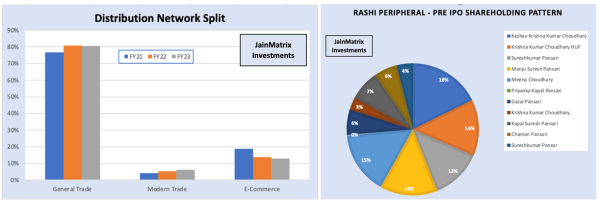
Fig 1.4 – Distribution and 1.5 – Shareholding pattern

  • RP Tech distributes products through several channels or networks – General Trade (81%), e-commerce 13% and Modern trade 6%. Above Fig 1.4 shows the distribution network and channels.
  • See shareholding pattern pre-IPO in Fig 1.5.
  • Below Fig 1.6 – Strong Customer Relationships in years with prominent brands.

Fig 1.6 Clients

  • Fig 1.7 – Key leaders:
  • (L- R) Himanshu Kumar Shah CFO, Krishna Kumar Choudhary, Chairman, Kapal Pansari MD, Sureshkumar Pansari, Vice-Chairman and Rajesh Goenka, CEO.

News, Updates and Strategies

  • In a pre-IPO placement, ace investor Madhusudan Kela’s wife Madhuri Kela invested ₹ 50 cr. and Volrado Venture Partners Fund-III-BETA, a venture capital fund, invested ₹ 100 cr. and were allotted 48.23 lakh equity shares at an issue price of ₹ 311 apiece.
  • A day before the IPO, the firm made allotments to Anchor investors. It allotted 57.88 lakh shares to 18 funds at ₹ 311 per share, at the upper limit. The anchor investors who participated in the bidding process include prominent foreign and domestic institutions such as White Oak Capital, Ashoka India, ICICI Prudential MF, Volrado Venture Partners Fund, and Bajaj Alliance Life Insurance Company. Other notable participants in the bidding round were Aditya Birla Sun Life Insurance Company, SBI General Insurance Company, Singularity Growth Opportunity Fund, and Authum Investment and Infra.
  • Out of the total allocation of 57.88 lakh equity shares, domestic mutual funds were allotted 19.61 lakh equity shares through a total of 8 schemes, amounting to ₹ 61 crore.

Industry Outlook of ICT in India

  • India has a young population, and is a developing nation, so it has a faster growing market than developed nations such as USA, UK, and Canada in terms of retail consumption. They are better exposed to media and technology, which presents an opportunity for domestic consumption in the form of branded products and organized retail.
  • Govt. of India has an initiative of Make in India and is also promoting Electronic Mfg. Clusters throughout the country to provide world-class infrastructure and facilities.
  • The GoI is aiming to increase the production of electronic items to USD 300 billion by Fiscal 2026. The domestic consumption of products is expected to increase from USD 75 billion in Fiscal 2022 to USD 150- 180 billion by Fiscal 2026.
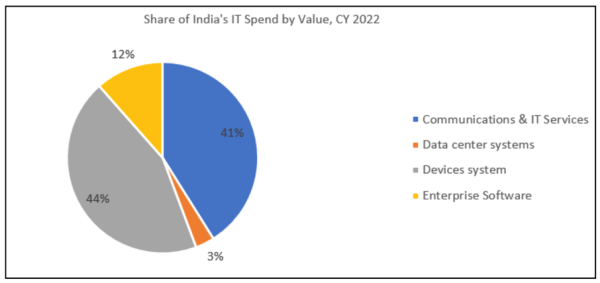
  • India’s ICT Industry size is about 1 lakh cr. now and is expected to reach ₹ 1,08,700 cr. by 2025.

Fig 2 – ICT Industry Size

  • Govt. of India’s Production-linked Incentive (“PLI”) scheme provides Incentives to boost domestic mfg. and attract large investments in IT Hardware value chain with target segments of laptops, tablets, all-in-one PCs, and servers, and boost the export market for the same. In electronic/technology products and telecom and network products, the approved financial outlay over the five years period is ₹ 12,200 cr.
  • We estimate that RP Tech has a Market Share of 9.5% of the Indian ICT distribution market.

Financials of RP Tech

  • RP Tech revenues, EBITDA and PAT over the years are in Fig 3a. Revenue, EBITDA & PAT grew by 26.36%, 11.38% and (4.80) % respectively.
  • Increase in interest costs is hurting their PAT.
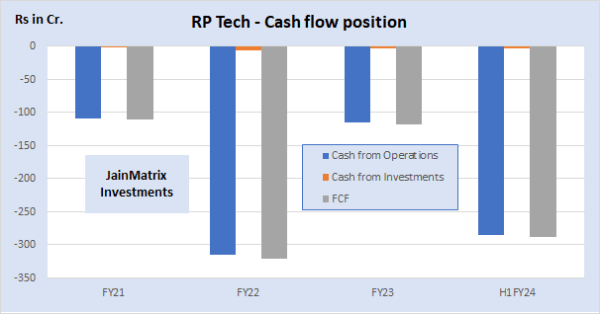
  • In below Fig 3b Cash Flow we can see that the Free Cash Flow FCF is negative. The firm has made many investments in inventories, assets and payables that have made FCF negative.
  • EBITDA Margin is constant over 2.8-3.5% and PAT around 1.30-2.29% variation due to externalities. This is average industry margins.
  • Considering ₹ 326 cr. will used from IPO proceeds for repayment of Debt, the firm’s debt to equity will reduce from current pre-IPO 1.82 to 1.30 post IPO.

Fig 3a – Financials

Fig 3b Cash Flow

Benchmarking

We benchmark RP Tech against listed ICT distribution and mfg. firms, See Fig 3c below.

Fig 3c – Benchmarking

  • P/E currently at 15.74 looks priced overpriced. Its EV/EBITDA is 2.07, which looks reasonable. Thus the valuations of RP Tech looks mixed.
  • The 3 year Sales and Profits growth look low. There was a massive sales growth for RP Tech in FY21 and FY22 during covid, and that is now normalizing.
  • D/E ratio is high, but post IPO, debt should fall as a main object of IPO is to reduce debt.
  • Margins are on par with competitors.
  • Return on Equity and RoCE are fair and in line with industry.
  • Putting this together, we sense that RP Tech will return to steady industry plus growth now, and improve its financial parameters in the next 1-2 years.
  • The strong business relationships, wide distribution network and digital growth of the economy will reflect well on RP Tech.

Positives for RP Tech

  • Strong technical expertise of firm across a range of ICT products for sales, service and support.
  • Long term relationship with marquee global tech clients to ensure availability of products.
  • Reputation as Leading and fastest growing Indian distribution partner for ICT products.
  • Repeat orders constitute 70-80% of business, this showcases the stickiness and moat of RP Tech.
  • Diversified portfolio offering with 10,000+ SKU’s and value-added solutions.
  • Pan-India and multi-channel distribution footprint backed by dedicated in-house infrastructure.

Risks and Negatives

  • High dependency on various vendors, who are global technology brands, revenues generated from distribution of products mfg. by top eight global technology brands amounted to 82% of revenue from operations. Any delay or failure on part of such global technology brands to supply products may materially and adversely affect business, profitability and reputation.
  • Good relationships with Channel Partners and enterprise customers is important as if any of these parties change the terms of their arrangements business could be materially and adversely affected.
  • RP Tech is operating on thin margins, an increase in debt or interest rates can affect the financials. There has been an increase in Debt to equity from 1.23 in FY21 to 1.82 in six month ended Sep’23.
  • Reduction in EBITDA margin from 3.63% in FY21 to 2.83% in FY 23 was due to higher interest rates.
  • Continued negative cash flows can affect the financials of the business. RP Tech will certainly have to stabilize their working capital needs while handling growth.
  • Risk of liability claims. Failure to maintain quality of customer service and deal with customer complaints could materially and adversely affect business and operating results.
  • RP Tech has Contingent Liabilities of ₹ 592 cr. (RHP), of which for Indirect Tax is ₹ 281 cr.
  • A Subsidiary ZNet Technologies Pvt. Ltd., has incurred losses in the last three Fiscals. There is no visibility on profitability.

Overall Opinion and Recommendation

  • India has a large and growing software and Tech industry, and it is an exports leader. Many global firms are setting up Global Competence Centers here. Within India too, technology is permeating the population through devices and internet, at work and leisure.
  • RP Tech is an important player in the ICT industry. It has a strong grip and 9.5% market share in sales. We expect growth at RP Tech to be strong. RP Tech have strengths of stickiness of customer with 70-80% of business from repeat orders and strong relationship with brands. Company management and board looks solid with rich experience in this field.
  • RP Tech is well set and a solid growth prospect in future.
  • However the firm is just settling down from 2-3 years of an unusual post covid business situation. Financials are in a recovery process and may take a few quarters to stabilize. This IPO helps to rest some of the debt. The recovery process needs to continue by controlling the working capital.
  • We expect reduction in debt to equity after IPO even as it grows rapidly in revenue and offerings. Once this happens, RP Tech valuations will rise and this IPO entry price will look reasonable.
  • Risks: 1) Thin operating margins, high working capital and high debt 3) Supplier Concentration – top eight brands accounted for 82% of revenue 4) Indirect Tax contingent liabilities.
  • Opinion: Medium rated. Aggressive Investors can SUBSCRIBE for short-term gains.

Disclaimer

This document has been prepared by JainMatrix Investments Bangalore (JM), and is meant for use by the recipient only as information and is not for circulation. This document is not to be reported or copied or made available to others without prior permission of JM. It should not be considered or taken as an offer to sell or a solicitation to buy or sell any security. The information contained in this report has been obtained from sources that are considered to be reliable. However, JM has not independently verified the accuracy or completeness of the same. JM has no stake ownership or financial interests in RP tech or any group company. Punit Jain intends to apply for this IPO. Neither JM nor any of its affiliates, its directors or its employees accepts any responsibility of whatsoever nature for the information, statements and opinion given, made available or expressed herein or for any omission therein. Recipients of this report should be aware that past performance is not necessarily a guide to future performance and value of investments can go down as well. The suitability or otherwise of any investments will depend upon the recipient’s particular circumstances and, in case of doubt, advice should be sought from a RIA Registered Investment Advisor. Investment in securities market are subject to market risks. Read all the related documents carefully before investing. Punit Jain is a registered Research Analyst under SEBI (Research Analysts) Regulations, 2014. Registration granted by SEBI, and certification from NISM in no way guarantee performance of the RA or provide any assurance of returns to investors. JM has been publishing equity research reports since Nov 2012. Any questions should be directed to the director of JainMatrix Investments at punit.jain@jainmatrix.com. Name of the RA as registered with SEBI – Punit Jain, SEBI Registration No. INH200002747. Logo/brand name –

TCS – Share Buyback – Nov 2023

  • Date 21st Nov 2023
  • CMP: ₹ 3,530/share
  • Large Cap with ₹ 13,00,000 cr. Mkt cap
  • Buy Back price: ₹ 4,150/share; Record Date: 25th Nov

Introduction

TCS is a well-known Large Cap stock. TCS has announced a Buyback offer, here is a note on this. The offer is attractive.

About the Offer

  • TCS approved a buyback offer at ₹ 4,150 /share for the repurchase of 4 cr. shares comprising 1.1% of the share capital for up to ₹ 17,000 cr. It is at a premium of 18% to its current price of ₹ 3,530. The record date is 25th Nov.
  • Objective: The firm has offered to reward and return cash to shareholders. Post-buyback, the equity share capital will reduce, and so the ROE (Return on Equity) of TCS will rise.
  • This is a shareholder-friendly activity. The firm has a healthy balance sheet already, and so uses the fresh cash generated from the business, to buy back shares, as it is a better use of these funds. IT services is a high cash-generating business that has a low requirement of capex or fresh investments.
  • It’s the 4th buyback in 5 years.
  • SEBI has mandated TCS to reserve 15% of the buyback amount for Retail (small shareholders with holdings under  ₹ 200,000 of shares). Current shareholding pattern indicates TCS has 5% Public shareholders, so Retail may have this additional benefit in this buyback.
  • TCS is well-valued and is trading at a PE multiple of 29 times today, above the historical average of 25 times. Its Q2FY24 result was good. The share has however underperformed the Nifty since early 2022.

Opinion

  • If you do not hold TCS shares, you can Buy 48 shares of TCS now as retail, and Offer your shares through the buyback to TCS, and sell the rest soon after for short-term gains. Or sell the shares after 1 year for Long Term Capital gains.
  • There is a good probability that TCS share could rise to the buyback price ₹ 4,150 in a few months.
  • If you already hold TCS shares, then two options:
    • If you hold 48 or fewer shares (i.e. you are a Retail investor in TCS), offer your shares in the buyback, and purchase from the open market after record date 25th Nov to take advantage of the discount.
    • If you hold more than 48 shares, take part in the buyback to the full extent, and purchase shares from the market now to take advantage of the 18% discount, and average down on your holding cost.  
  • Investors can take advantage of tax benefits, as the income generated from this buyback of shares is tax-exempt.

Process of buyback

  • Investors holding Shares in Demat Form can tender shares through their Stock Broker. If you have online access, there will be a BUYBACK page option for TCS, once the offer opens. TCS will inform shareholders about this soon.
  • For more details, see FAQ from TCS on buyback attached.

Disclaimers and Disclosures

Punit Jain discloses that he is a long term investor (less than 1%) in TCS since 2012. Punit Jain was an employee of TCS from 1995 to 2001. He will also take part in this BUYBACK. Other than these, Punit Jain and JainMatrix Investments Bangalore (JMI) and its promoters/ employees have no direct or financial interest in TCS, and no known material conflict of interest as on date of publication of this report. This document has been prepared by JMI, and is meant for use by the recipient only as information and is not for circulation. This document is not to be reported or copied or made available to others without prior permission of JMI. It should not be considered or taken as an offer to sell or a solicitation to buy or sell any security. The information contained in this report has been obtained from sources that are considered to be reliable. However, JMI has not independently verified the accuracy or completeness of the same. Neither JMI nor any of its affiliates, its directors or its employees accepts any responsibility of whatsoever nature for the information, statements and opinion given, made available or expressed herein or for any omission therein. Recipients of this report should be aware that past performance is not necessarily a guide to future performance and value of investments can go down as well. The suitability or otherwise of any investments will depend upon the recipient’s particular circumstances and, in case of doubt, advice should be sought from a RIA Registered Investment Advisor. Investment in securities market are subject to market risks. Read all the related documents carefully before investing. Punit Jain is a registered Research Analyst under SEBI (Research Analysts) Regulations, 2014. Registration granted by SEBI, and certification from NISM in no way guarantee performance of the RA or provide any assurance of returns to investors. JMI has been publishing equity research reports since Nov 2012. Any questions should be directed to the director of JainMatrix Investments at punit.jain@jainmatrix.com. Name of the RA as registered with SEBI – Punit Jain, SEBI Registration No. INH200002747.

JainMatrix Investments – Indian Banking Sector Investment Report

  • The Banking sector in India is looking attractive for equity investments.
  • In this investment report, we have analysed 32 listed banks to identify the best firms on two broad parameters 1) Blue Chip banks 2) High growth and turnaround banks.
  • We identify a 5 bank basket for a 2-3 year period investment horizon.
  • Do read the Risks and Disclaimers sections of this report also.

Introduction

  • The Indian banking system consists of 12 public sector banks, 21 private sector banks, 44 foreign banks, and additionally, regional rural banks, urban cooperative banks and rural cooperative banks.
  • However, only 32 of these banks are listed entities. We limit this sector report to this universe.
  • The Reserve Bank of India (RBI) is the central bank regulating and supervising the banking industry. It formulates and implements monetary policy, issues currency, manages foreign exchange reserves and provides overall direction to the banking sector.
  • This industry has witnessed the rollout of innovative banking models like payment banks and small finance banks. RBI’s new measures are helping the growth of domestic banking industry.
  • With the introduction of technology like mobile banking apps, UPI and payment gateways, artificial intelligence, machine learning, and blockchain, the banking sector is going through a digital transformation. These developments improve usability, security, speed and effectiveness.
  • In 2022, total assets in public & private banking were ₹131 lakh crore & ₹76 lakh cr. resp. see Fig 1a.
  • Interest income for the public sector remained relatively stable; the private sector experienced moderate growth, while foreign banks saw a significant increase in interest income from ‘20 to ‘22.
  • Two key indicators demonstrate the progress. Successive waves of recapitalisation gave banks enough resources to write off most of their bad loans, especially PSBs. They brought down their gross NPAs from 11% of total advances (’18) to 5.9% in ‘22. NPAs for industrial credit also reduced from 23% to 8.4%. Even after these large write-offs, most banks retain comfortable levels of capital.
  • As of FY21, total advances surged to ₹136.75 L Cr. As of March 2023, according to India Ratings & Research, credit growth is at 15% in 2022-23.
  • India is set to become the third-largest Domestic Banking sector by 2050.
  • The Banking sector in India is domestic focused and services Retail and Commercial sectors, and a large number of industries, providing critical capital for growth and new projects.

Recent News, Events and Updates of Banking Sector:

  • HDFC Bank expects 17-18% credit growth this year as there is enough credit demand. (ET 23rd July)
  • The merger entity of HDFC bank and HDFC became the #7 valued lender globally with market cap of ₹ 12 L cr., this is more than Bank of China and Royal Bank of Canada. (ET 18th July)
  • IDFC First bank transformed from an infrastructure lending business into a universal bank. Over the last year, it has given a return of 134% in a period when the Sensex was up just 18%. (ET 24th July)
  • Domestic Indian Banks, which have fast tracked their efforts to enhance their digital capabilities, are luring top-notch tech talent from leading new age companies and global firms. (ET 23rd July)
  • Govt. of India (GoI) instructed Banks not to take harsh steps for collections related to repayment of loans. And to deal with such cases with “sensitivity” and through humane approach. (ET 24th July)
  • S&P Global Ratings predicts that India’s banking sector will see a decrease in weak loans to 3-3.5% of gross advances by Mar’25, based on structural progress and good economic prospects. (ET 20/07)
  • Recently GoI has encouraged public sector banks (PSBs) to consolidate through mergers. GoI indicated in the Union Budget for 2021–22 that it intended to proceed with the privatisation of two PSBs. This will allow both PSBs and PVBs to grow their businesses and succeed.
  • Several nations are planning to introduce a digital currency called CBDC – Central Bank Digital Currency. As per a 2021 Bank for International Settlements (BIS) survey, 90% of central banks were actively investigating the possibilities, 62% were testing, and 26% were implementing pilot projects.
  • State Bank of India (SBI) will set up a trustee company, which will be its wholly-owned subsidiary, for managing the Corporate Debt Market Development Fund (CDMDF). SBI Funds Management Ltd has been identified as the investment manager cum sponsor of the fund. (ET 18th July)

Analysis of the Banks

The 32 listed banks were identified for this report, see Fig 1b. Further, the banks were first classified into PSUs -12, Large cap Private – 8 and Mid and Small cap Private – 12.

Fig 1b – Full List of Banks

Next we ran two assessments on these banks – Blue Chip and High Growth / Turnaround parameters.

Phase I (a) – Blue Chip Banks Funnel

  • The Blue Chip Bank criteria identified were P/E, Mar Cap., ROCE %, NET NPA and Capital Adequacy.
  • We ran these on the 32 listed banks, to get the top 12 and next the top 4 Blue Chip Banks. See Fig 2.

Fig. 2 – Blue Chips

Phase I (b) – Five year Growth Banks Funnel

  • To identify the growth / turnaround leaders, we took 5 year data of criteria – Net Profit Margin, Return on Equity, PE Ratio and Interest Earned, and looked for the trends on these parameters.
  • We ran this on the 32 listed banks, to get the top 12, and further the final top 5.

Fig 3: Growth

  • Note that there was only one common find from both lists – CSB Bank.
  • We thus chose 8 banks for the next phase of analysis, Phase – II. This analysis has three parts – Financial Metrics, Benchmarking and Qualitative Parameters.

Phase II (a) – Financial Metrics

  • Having identified the top 8 banks on two major criteria, we first ran a deep Financial Metrics analysis on these firms, where we took 5 years data for the banks on the following 10 parameters –
    • Net Interest Margin, Earning Yield (%), Cost To Income Ratio (%),
    • Return on average Assets, Return on equity, Gross NPAs %, Net NPAs %, PE ratio
    • Provision coverage ratio, Capital Adequacy Ratio
  • Based on these parameters, the banks were ranked 1-8 and the results were

Fig. 4 – Financial Metrics  

  • Thus BoM, HDFC, CSB, Canara and Bank of Baroda emerged as the top 5 banks here.

Phase II (b) – Benchmarking

  • We ran a Benchmarking analysis to compare these top 8 firms with each other.
  • We took 10 parameters listed below, which were banking specific and covering various aspects of the business, but only the recent year data.
  • We can see that CSB and Union Bank emerge as winners in this comparison, in sum of winners.

Fig. 5 – Benchmarking

Phase II (c) – Qualitative Parameters

  • We identified 6 qualitative parameters of Vision, Management Quality, Governance, Other ESG, Operational Flexibility, Products Flexibility, Litigation and Notices from authorities.
  • We ranked the above 8 firms on these, and summed it up to get the results in Fig 6a.

Fig. 6a – Qualitative Parameters  

Fig 6b – Final Tabulation and Count

  • Putting these three sections of Phase – II together, we got a final score in Fig 6b.

Risks

  • Banking sector is considered a cyclical sector due to a strong correlation with GDP growth.
  • A few years ago, interest rates in India were much higher than developed countries. Many Indian banks and corporates borrowed abroad for cost advantages. Today, the interest rate differential has reduced, even as INR has weakened, and these firms may be affected.
  • This analysis has not deeply covered drivers of future growth of these banks such as new product innovation, rural presence, tech savviness, hiring patterns, M&A and management quality. We have not built price targets for the recommended shares.
  • If Interest Rates rise sharply in India, banks may face lower demand and higher borrowing costs, which can squeeze profit margins. Conversely, a sharp fall in interest rates can reduce the income.
    • Banks give floating rate loans that protect them in case interests rise.
  • The Credit Risk is where Banks lend money to individuals and businesses, and some borrowers fail to repay their loans. It’s doing well now, but in a few years, a deteriorating economy could lead to higher default rates, which can negatively impact a bank’s profitability and asset quality.
  • Regulatory and Compliance Risks: The banking sector is heavily regulated by RBI. Changes in regulations, compliance requirements, or government policies can impact the banks.
  • Cybersecurity and Tech Disruption Risk: Banks store a vast amount of sensitive customer information, and cybercriminals often target this. A data breach can be very damaging. Fintech companies and digital innovations are changing the landscape here. Traditional banks that fail to adapt to these may lose market share.
  • Liquidity Risk: Banks rely on short-term funding to meet obligations. If a bank experiences difficulties in accessing funding, it can lead to liquidity problems that may threaten its operations and solvency. Banks need to not get over leveraged, and maintain an Asset Liability match.
  • Systemic Risk: The banking sector is interconnected, and the failure of a lender or large corporate can have ripple effects throughout the financial system, eg. DHFL and IL&FS.
  • Competition: The banking sector is highly competitive, with both traditional and online banks vying for customers. Intense competition can put pressure on a bank’s margins and profitability.
    • However the Indian market is underpenetrated and underserved, so there is scope to grow
  • Market Risk: Bank stocks like all stocks are subject to market risk. Economic conditions, investor sentiment, market volatility and liquidity outflows can cause banks’ stock prices to fall.

Conclusion and Recommendation

  • Though hampered by the recent economic slowdown, the domestic banking sector has rebounded well from this, and seen a rise in demand for loans and other financial services.
  • Banks over the last 5-6 years are also recovering from a NPA crisis, as multiple actions such as IBC, Sarfaesi Act and collections tightening have helped clear frauds, bankruptcies, delinquencies and old dues. The sector has improved performance recently, with profits up by 23% in Q1FY24 YoY.
  • Based on our analysis in this report, we have identified the top five banks out of 32. See Fig 7. This analysis process is comprehensive, covering fundamental factors such as valuations, margins, growth, internal performance metrics, improvements and qualitative parameters.

Fig. 7 – Final Bank Basket

  • These banks form a good investment Basket. We suggest an equi-weight approach, and an investment time frame of 2-3 years.

Disclaimers

Punit Jain discloses that he is a long term investor (less than 1%) in HDFC Bank (since Aug 2008), Bandhan Bank (since Mar 2018) Yes Bank (since July 2005) and IDFC First Bank (since June 2020), out of the banks mentioned in this report. He and his family may be normal customers, of one or more of these banks for savings and current accounts, credit cards, insurance, etc. Other than this, JainMatrix Investments Bangalore (JMI) and its promoters/ employees have no direct or financial interest in these banks, and no known material conflict of interest as on date of publication of this report.

This document has been prepared by JMI, and is meant for use by the recipient only as information and is not for circulation. This document is not to be reported or copied or made available to others without prior permission of JMI. The information contained in this report has been obtained from sources that are considered to be reliable. However, JMI has not independently verified the accuracy or completeness of the same. Neither JMI nor any of its affiliates, its directors or its employees accepts any responsibility of whatsoever nature for the information, statements and opinion given, made available or expressed herein or for any omission therein. Recipients of this report should be aware that past performance is not necessarily a guide to future performance and value of investments can go down as well. The suitability or otherwise of any investments will depend upon the recipient’s particular circumstances and, in case of doubt, advice should be sought from a RIA Registered Investment Advisor. Investment in securities market are subject to market risks. Read all the related documents carefully before investing. Punit Jain is a Research Analyst under SEBI (Research Analysts) Regulations, 2014. Registration granted by SEBI, and certification from NISM in no way guarantee performance of the RA or provide any assurance of returns to investors. JMI has been publishing equity research reports since Nov 2012. Any questions should be directed to the director of JainMatrix Investments at punit.jain@jainmatrix.com  Name of the RA as registered with SEBI – Punit Jain, SEBI Registration No. INH200002747. logo/brand name –

Who and what is a long-term investor?

A long-term Equity investor is one who
– is willing to wait even 10 years for his investment to achieve satisfactory returns
– is much greedier (I prefer the word Ambitious) than a trader, he wants a 5-20 times return from an investment compared to a 5-20% gain by a trader or other investors. Note – this does not always come through, but when it does, its awesome.
– is able to stay unaffected by notional loss situations, of 30-40%, many times over this journey. He may even use these falls to accumulate more.
– has a very patient and positive mindset. Time is on his side. He is a business owner rather than a trader. He does few transactions, but these are big in value.
– yet he is decisive when required, and has to separate the wheat from the chaff, when he sees it
– has no regrets over past decisions. He has to book real losses many times. He also can make mistakes of smaller allocation. But the future is always very hazy, and the past, crystal clear.
– but he learns continuously. Every decision he makes has to be better than the ones made before. His insights can come from many sources. Mistakes should not be repeated. Only learned from.

This is my mindset as the independent Research Analyst at JainMatrix Investments.

Of course, some of these are difficult to really do, not just for an individual investor, but also for a professional. Join us at JainMatrix for an exciting and profitable journey if you wish to be a long-term equity investor.

PRICING AND PAYMENT OPTIONS

DISCLAIMER

JainMatrix Investments based in Bangalore (hereinafter referred as ‘JMI’) is an independent equity research firm started by Punit Jain. Content in this website should not be considered or taken as an offer to sell or a solicitation to buy or sell any security. The information contained has been obtained from sources that are considered to be reliable. However, JMI has not independently verified the accuracy or completeness of the same. Neither JMI nor any of its affiliates, its directors, or its employees accepts any responsibility of whatsoever nature for the information, statements and opinion given, made available, or expressed herein or for any omission therein. Recipients of this report should be aware that past performance is not necessarily a guide to future performance and the value of investments can go down as well. The suitability or otherwise of any investments will depend upon the recipient’s particular circumstances and, in case of doubt, advice should be sought from an Investment Advisor. Investments in securities market are subject to market risks. Read all the related documents carefully before investing. The suitability or otherwise of any investments will depend upon the recipient’s particular circumstances and, in case of doubt, advice should be sought from a certified Investment Adviser. JM has been an equity investment adviser commercially since Nov 2012. Punit Jain is a SEBI-certified and registered Research Analyst under SEBI (Research Analysts) Regulations, 2014. Registration granted by SEBI, and certification from NISM in no way guarantee the performance of the Research Analyst or provide any assurance of returns to investors. Any questions should be directed to him at punit.jain@jainmatrix.com

Become a Master of Finance

I came across this superb interview today of Harvard Professor Mihir Desai (with Lewis Howes). I understand him well as he has Indian origins. And he is sharing awesome lessons from his long career as a Finance professor. Here you go.

Happy investing,

Punit Jain