Bharat Forge – CMP: 361 – Invest with an 18 month target of 700

Introduction

  • Bharat Forge is a Pune based manufacturer of forged and machined – engine & chassis components. It is the largest exporter of automotive forgings and chassis components from India. It is the second largest in the world, after ThyssenKrupp of Germany.
  • Manufacturing facilities are spread across 11 locations and 5 countries – four in India, three in Germany, one each in Sweden, USA and two in China.
  • The company manufactures a wide range of safety and critical components for passenger cars, SUV’s, light, medium & heavy commercial vehicles, tractors and diesel engines. The company also manufactures specialized components for the aerospace, power, energy, oil & gas, rail & marine, mining & construction equipment, and other industries. Parts are made of steel and aluminium.
  • Business growth has been steady over the last 7 years. The fall from end 2008 to end 2009 due to a global slowdown, and this has been followed by a rapid recovery thereafter.
  • Pre- 2004, Bharat Forge was focused on increasing capacity and the Pune facility became the largest single forging and casting plant.

Fig 1 – In Sept 2010, Bharat Forge achieved all time high revenues of Rs 719 crores, signaling full recovery.

Fig 2 – Business Segments in 2009

M&A

  • A number of mergers and acquisitions in the 2004-2007 period saw Bharat Forge expand to new geographies. In the process it added a number of prestigious customers and was able to supply products to almost all the major automotive firms worldwide as OEM

Diversification

  • Till 2006 Bharat Forge was primarily an auto components firm. The auto demand collapse and forward looking corporate de-risking plans saw the firm fast track entry into other verticals in the period from 2006 to date.
  • Internal targets are to double non-automotive business from 20% in 2008 to 40% by 2012.
  • For Bharat Forge the focus in the Non-Auto business is on fast growing sectors like Power Plants, Marine, Construction & Mining, Oil & Gas, Energy, Aerospace and Railways. Also on Import substitution for BHEL which itself is a big opportunity. Diversification into these sectors is through a series of JVs with respected partners (eg NTPC for power and Alsthom for Thermal/ Nuclear turbine/ generation sets

Current Business Outlook

  • The fall in auto demand in 2007-09 saw cost cutting measures rolled out to ensure a lower break even for these facilities. Capacity utilization was 53% in 2009. This has improved to 70% for the standalone entity and 45% for international entities in 2010. From here all improved utilization will contribute significantly to profitability. We do not anticipate a need for auto capacity increase for several years.
  • As a result of these business initiatives, when the market began to revive in 2009 for auto industry, Bharat Forge has been best placed to take advantage of this trend.
  • Demand is increasing from both domestic business – Commercial Vehicles and Passenger cars, as well as international – UK and USA. Demand growth is led by India and China, and developed economies have stabilized and are expected to slowly recover in terms of business volumes.
  • The Society of Indian Automobile Manufacturers (SIAM) releasing the 2010 sales growth data of 14.82 million units as against 11.32 million units registered in 2009. Sales of passenger vehicles segment grew by 31.34 percent, commercial vehicles segment by 45.24 percent, three-wheelers by 22.03 percent and two-wheelers by 30.51 percent. They said that the growth was due to increasing dispensable incomes, low interest rates and increase in sales base at par with the pre-recession era.
  • The firm has seen all of its overseas subsidiaries, including its joint venture in China, FAW Bharat Forge, turn around and start contributing to the bottom line, a year ahead of the 2012 target
  • India is emerging as a small car-manufacturing hub, with a number of new entrants and a slew of product launches. The luxury market too has grown rapidly. As the market matures, mid sized sedan volumes too will grow. Bharat Forge is a supplier to virtually all the auto manufacturers in India as OEM.
  • Demand for Bharat Forge’s auto components is a derived demand – dependant upon the Auto manufacturers for sales. The India domestic auto market is doing well with many auto models having a ‘waiting period’ of 2-4 months for delivery after booking by the consumer.

Conclusions, projections and Investment advise

Valuations and conclusions

  • The chart (Fig 3) plots the market price (adjusted) against EPS (adjusted) over a 7-year period.
  • The stock price peaked in 2006 and has not touched those levels since. But we can see the dramatic business recovery of Bharat Forge in the last one year in terms of EPS
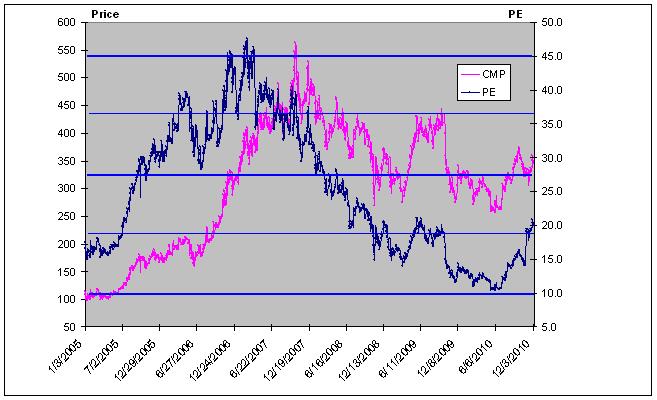
  • The PE of Bharat Forge (Fig 4) has been at high levels of late – rising to as high as 80 times. However if you see this in the light of the short-term squeeze in business environment, this is a passing phase.
  • The Business environment and demand situation has now become very positive. Bharat Forge is well placed to take advantage of surging demand due to sufficient spare capacities, low cost production facilities, global presence and nimble design and manufacturing capabilities. Also a series of well timed entries into new non-automotive markets.
  • We expect EPS to continue recovery and move to all time highs. This will be followed by stock price also moving into new highs territory.
  • Net Cash From Operating Activities has shown a positive trend, barring FY 2009.
  • Debt equity is 1.21 as of March 2010. This is not too high and is 3.5 times the Net Cash From Operating Activities

Fig 3 – Current PE looks high but seen in the context of a rapidly increasing EPS, improving capacity utilization and positive business outlook, it will soon settle to lower levels.
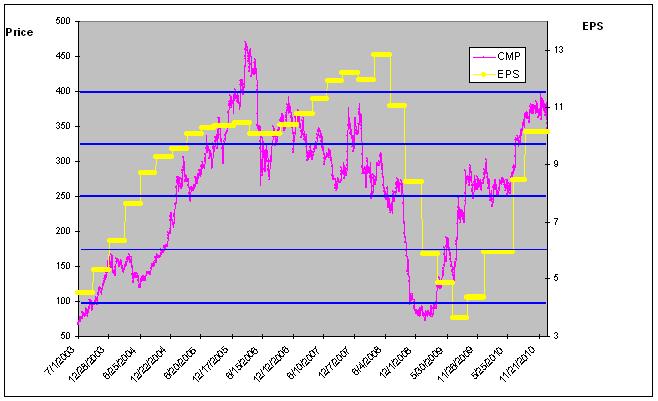
Fig 4  – Adjusted EPS has retraced rapidly and is nearing the 2008 peak.

Projection

  • We expect the stock to appreciate to Market Price of 700 in 18 months.
  • This is an excellent entry point for this stock as it is currently underpriced and ‘out of favour’. The the next 2-3 quarterly results will be positive and the share price may start to reflect it’s true worth.

Risks

  • Higher raw-material costs like steel and power  may restrict margin expansion and EPS growth.
  • Low cost domestic capacity may get exhausted, requiring additional capital investments.
  • Business complexity has increased due to addition of a number of new verticals. Management bandwidth and Vertical/ Technical skill-sets need to be upgraded to meet the business challenges.
  • New subsidiaries and JVs need to rapidly add capacity and win deals – early stage of new businesses are uncertain and need management attention before business stabilizes.
  • External factors like stock market sentiments. However our current view is that this will be positive over the next 12 months at least

Disclaimer:

These reports and documents have been prepared by JainMatrix Investments Ltd. They are not to be copied, reused or made available to others without prior permission of JainMatrix Investments. Any questions should be directed to the director of JainMatrix Investments at punit.jain@jainmatrix.com Also see: https://jainmatrix.wordpress.com/disclaimer/

P&S Bank IPO – Post review on 20th Dec

  • Punjab & Sind Bank IPO closed on Dec 16th with amazing strength – overall over-subscription 51 times with QIB 50 times, HNI 86 times and Retail 44 times !!
  • It exceeded all my expectations – looks like everyone has bet on the winning horse :-)
  • It will be a bit of a lottery if you get any shares. Also with minimum lot size at 50, retail cannot expect any more than this.
  • If they stick to the usual processing times, allotment may be around 26th and listing around 30th.
  • I feel the listing pop thereafter could beat CIL and MOIL as in banking stocks we are in familiar territory. Barring market abnormalities, it could be 60-80%.
  • Good luck with your investments !!

Also see IPO note – click link

Bharti Airtel – CMP:331 – 2 years target 800 – Invest

Bharti Airtel is a bit of an enigmatic company. Emerging from humble origins, it has risen rapidly in the last decade to be today the largest telecom company in India by subscribers, revenues and profitability.

Leaving in its wake the famed business houses of India. It is #7 in India in market cap.

I first entered this stock in 2004; at this time, the stock was trading at a P/E of about 100. The market price was about Rs 161, and had risen from about 22 a few years before. Pretty soon, the price fell 15%.  I held on, thought about it, and then bought some more shares.

Here’s why.

Profile and the growth path

Bharti Airtel Fig 1 – In the last 1.5 years Airtel has under performed. This will change in the next two quarters.

  • Like many new industries, the mobile Telecom industry has emerged from chaos. Even today, the DoT, TRAI and Ministry of Telecom have brought to this sector little clarity, poor governance and transparency. Even so, today at least it is better regulated than 7-8 years ago.
  • In these circumstances, the story of Bharti Airtel is impressive.
  • They follow an outsourcing model and have brought on the best vendors in the world – IBM for software, and Ericsson, Nokia, and Siemens for telecom network – equipment. Today Airtel has the widest all India telecom network
  • More than good vendors, what was commendable was the engagement model with these vendors. All were hired on a SLA based revenue model, where earnings were proportional to number of subscribers and performance against SLAs. At one stroke the Enterprise – Vendor relationship changed from a tug-of war based on negotiation to one of win-win with aligned objectives. These deals in the early 2000s were admired worldwide for their superior structure.
  • Airtel thereafter was free to concentrate on the things that are core to the company – the Airtel brand, the customer experience, customer service and new business avenues
  • Airtel has added several business to its portfolio and now provides Mobile, Telemedia (broadband, IPTV and fixed line), Enterprise (end to end telecom services) and Digital TV (DTH) services – all high growth businesses related to mobile phone services.
  • When the next technology was introduced – 3G, Airtel was ready and won the largest number of circles in the very expensive auction.
  • In the 2007 – 10 period Airtel executed on a strategy to grow overseas. It has successfully launched operations in Bangladesh, Sri Lanka, (through the Zain acquisition), in Africa, totally 19 countries.

Common criticisms of Bharti Airtel, and my take on them:

Criticisms of Airtel My response
1. Airtel paid too much for the Zain acquisition in 2010, and this debt will dampen profits in the years to come They paid $9 billion, in the form of cash. However, by applying fair leverage of balance sheet and good financial engineering, they claim that debt servicing will only cost $200m per year.In fact per Airtel estimates, Africa will eventually overtake India and China as a telecom market – as population of Africa will peak at 1.8 – 2.0 billion
2. Airtel paid too much for 3G in the auction, and this will also hit performance Airtel paid Rs 15,609 crores to get 3G licenses in 13 circles. However, this gives Airtel access to lucrative markets such as Delhi, Mumbai, Andhra Pradesh, Karnataka and Tamil Nadu. This covers 5 of the top 6 cities of India.
3. Airtel has spread itself thin outside India in Africa and 3-4 Asian countries, this is a recipe for disasterFig 2 – Net Cash from operations has shown a steady and substantial growth In India, the penetration is crossed 50% and growth in subscribers will slow. Investments required in networks too have been made. This market is expected to grow now in terms of ARPU as consumers become affluent. Cash flow from operations is expected to increase rapidly, see Fig 2belowAirtel realized that it can now look at new markets, and roll out it’s successful Indian model elsewhere. The most logical market is Africa where mobile penetration is far less than India, and characteristics show that Airtel can develop this market and reap long-term dividends.Bangladesh and Sri Lanka are small markets, but similar to India, and Airtel found entry opportunities here also.

In fact the management of Airtel has found new challenges in these new markets after stabilizing the Indian operations.

4.       There is too high competition in India, and telecom companies here including Airtel are doomed to subpar performance for many years While there are 12-14 players in the current Indian telecom market, it is expected that this number will reduce over the next 1-2 years. This is due to a combination of heavy initial investment required for network rollout and severe pricing pressure due to competition. Inevitably the viability of the market has reduced and newer players have been unable to justify additional investments.This will be positive for Airtel also as it may snap up some of these players, and certainly will soon face less competition in this market.
5.       Just when people were getting convinced about Airtel, the share price plummeted in 2008-9 and it is now a poor stock The stock market recognized the high competition scenario and slowing growth characteristics. Hence the high P/E that players got earlier were reduced sharply and the market prices fell – for all telecom. However, see Fig 3, the EPS growth of Airtel has remained stable.
6. The Telecom sector in India is under a cloud due to regulatory problems, scams, etc. This is expected to clear up soon due to high visibility from media and political parties. In fact with valuations low and uncertainty high, it is a good time to look at an investment in Airtel.

Fig 2: Cash Flow from Operations

Fig 3: Steady increase in Airtel EPS over last 5 years.  EPS is Expected to stabilize now in 2 quarters and grow again.      

Fig 4: Development of Indian Telecom – Source TRAI

Conclusions, projections and Investment advise:

Conclusions

  • Today as the seventh largest Indian firm by market cap, Airtel is poised to show huge multi year growth, profitability and cash flow from Indian and International operations
  • As the 5th largest telecom company globally, Airtel is poised in the next 5 years to explode in terms of revenue, profits and subscriber numbers, eventually encircling the current global leaders.
  • My opinion of Bharti is that it is a fantastic company, run by some of the best and experienced telecom businessmen. They have succeeded in the Indian environment, and will not just continue on this path here, but will also translate this experience to new geographies – of Asia and Africa.
  • Hyper-competition in India has resulted in a temporary blip in performance of the industry. This is created by poor regulation and governmental interference.
  • In spite of these circumstances, Airtel has maintained a good revenue and profit performance, keeping an efficient organization, investing in required capital equipment and riding though this rough patch.
  • MNC telecoms with deep pockets have not been able to overtake Airtel, which is staying ahead.
  • Rapid yet steady increase in cash flow will be used to both lower debt levels and invest in African markets, which will increase profits. Also Airtel is the only telecom firm in India paying dividends.

Fig 5 – Airtel’s PE is far lower than the average over the last 5 years. It will return to 25-30 levels.

Projections

  • As an investor, I would say, this 1-2 year period is the opportunity to buy, for outsized returns over the next decade. In 2 years the telecom sector will recapture investor interest and Airtel will reach my price target of 800.
  • Basis for projection:  (1) stabilization of African operations (2) consolidation in number of Indian telecom players from current 14 to 8-10 leading to reduction in pricing pressures (3) successful 3G launch in 5 of India’s top 6 cities plus partnerships in others; and (4) Launch of number portability will see customers gains for Airtel (5) These will result in growth in market share for Airtel (6) Likely clarity in Indian telecom industry governance and regulation in 8-12 months, with Airtel generally benefiting.