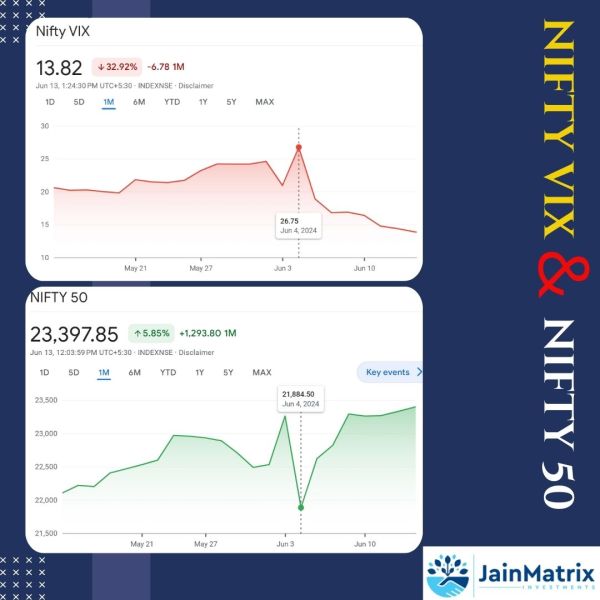
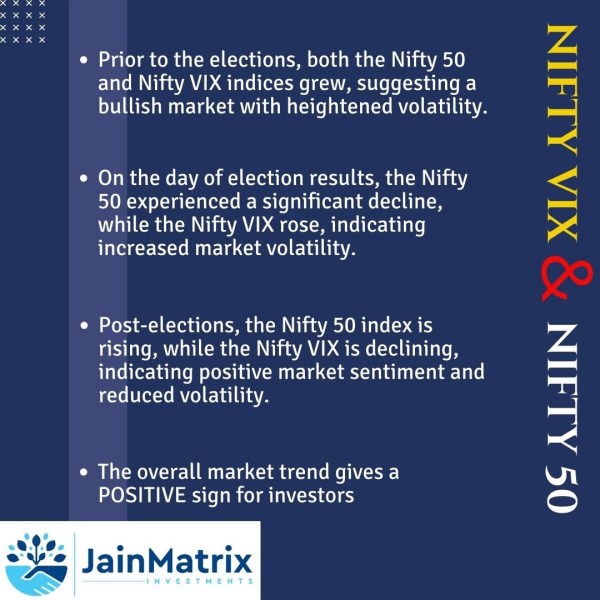
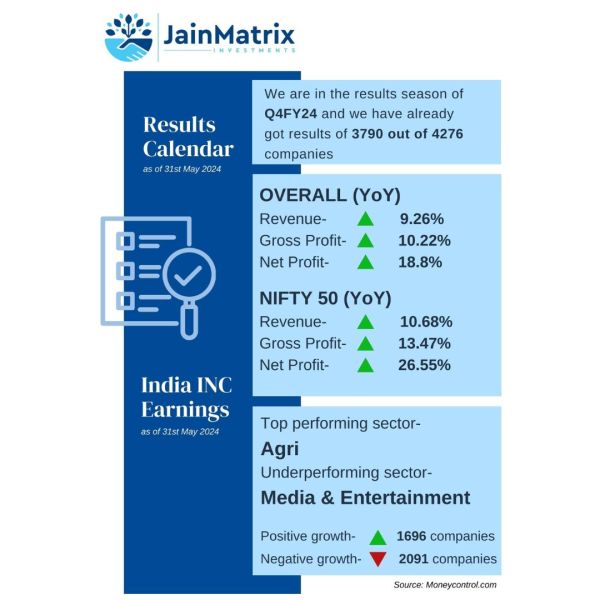
This Results season Looks Good

Visit and like our insta handle to get updates https://www.instagram.com/jainmatrix_investments/

It’s as good a time as any to be a positive investor.

Discover Investment Services from JainMatrix – PRICING AND PAYMENT OPTIONS

Govt to allow JVs with Chinese firms if Indian partner holds majority; Saving is not enough! 3 ways to grow your money to achieve goals

25th June 2024

We want you to think positive, and read just a few good articles, so here goes:

  1. Govt to allow JVs with Chinese firms if Indian partner holds majority – BS 25 June
  2. Saving is not enough! 3 ways to grow your money to achieve goals – ET 25 June
  3. What investors expect from India’s election outcome – ET 31st May
  4. India’s GDP growth is 7.8% in Q4; FY24 growth at 8.2% – BS 31st May
  5. India’s services sector shows strongest growth rates – ET 06th May
  6. ‘Incredibly exciting market’ for Apple: Tim Cook on India – Mint – 06th May
  7. Tax harvesting can help you save tax on Equity investments – BS – 19th Mar
  8. Say hello to a new all-consuming India – ET – 29th Feb 2024
  9. India Needs To Bridge Huge Tech Gap With China – NDTVP – 29th Feb 2024
  10. China +1 success in Indian electronics mfg – TOI – 10th Nov 2023
  11. India will account for 18% of global growth by 2028: IMF – BS – 21st Oct
  12. Global IT spending projected to cross $5 trillion in 2024 – Investing – 21st Oct
  13. It’s the beginning of Bharat Era: Foxconn – ET – 21st Oct
  14. India’s Digital Transformation in 9 years – bt – 04th Sept
  15. Cheap Europe flights could soon be passe, all thanks to France – ET – 12th Sep
  16. Lack of professional financial advice can prove costly later – ET – 04th Sep
  17. India’s July Services PMI At 13-Year High Of 62.3 – FPJ – 22nd Aug
  18. India’s PLI scheme is up for review: What’s the status – ET – 03rd July
  19. S&P assesses Indian banking sector as “strong recovery” – ET – 03rd July
  20. India’s housing sales hit record high despite many challenges – ET – 03rd July
  21. Milestone: IndiGo places order for 500 Airbus aircraft – ET – 22th June
  22. Bank NPAs drop to 1%, lowest in 15 years – ToI – 22th June
  23. India’s retail inflation eases to more than 2-year low of 4.25% in May – ET – 22th June
  24. India’s foreign trade set to cross US$ 1.6 trillion – ET – 05th Apr
  25. India’s power output grows at fastest pace – ET – 05th Apr
  26. Real estate sector on the fast lane – ET – 09th Dec
  27. November sees highest sales in the history of auto industry – ET – 09th Dec
  28. Shift from roads to rail picks up pace, thanks to DFC – ET – 30th Nov
  29. Half a trillion-dollar FII inflows may be heading India’s way – ET – 30th Nov
  30. White collar hiring stabilises and shows uptick : Monster – ET – 01st Sep
  31. Indian mfg growth trends higher as input cost inflation eases – ET – 01st Sep

Regards,

Punit Jain

DISCLAIMER

This document has been prepared by JainMatrix Investments Bangalore (JM), and is meant for use by the recipient only as information and is not for circulation. This document is not to be reported or copied or made available to others without prior permission of JM. It should not be considered or taken as an offer to sell or a solicitation to buy or sell any security. The information contained in this report has been obtained from sources that are considered to be reliable. However, JM has not independently verified the accuracy or completeness of the same. Punit Jain and JM has no ownership or known financial interests in any company mentioned in this note. Neither JM nor any of its affiliates, its directors or its employees accepts any responsibility of whatsoever nature for the information, statements and opinion given, made available or expressed herein or for any omission therein. Recipients of this report should be aware that past performance is not necessarily a guide to future performance and value of investments can go down as well. The suitability or otherwise of any investments will depend upon the recipient’s particular circumstances and, in case of doubt, advice should be sought from an Investment Advisor. Punit Jain is a registered Research Analyst under SEBI (Research Analysts) Regulations, 2014. JM has been publishing equity research reports since Nov 2012. Any questions should be directed to the director of JainMatrix Investments at punit.jain@jainmatrix.com.

Large Caps, Mid Caps and Small Caps?

Did you know that the definition of a large-cap, mid-cap and small-cap in India changes every 6 months? This applies particularly for Indian Mutual Funds, so that as of now –

  1. Large-cap companies are those ranked from 1-100 in order of market capitalisation
    • Per the recent review, the large-cap threshold is now ₹ 67,000 cr., up from ₹ 49,700 cr. in Jun’23.
  2. Mid-cap companies are those ranked from 101 – 250 by market cap
    • The range for mid-caps is now ₹ 22,000 – 67,000 cr. The lower limit rose from ₹ 17,400 cr. earlier
  3. And small-caps are all firms with a market cap below 22,000 cr.

This is quite relevant for Mutual Funds, where many define their strategy as Large Caps or Small caps. This definition, and periodic reviews, ensures that MFs stick to their strategy.
For direct investors too, we can loosely follow this definition.

This also means that firms doing well by market cap may transition up from one group to another. Several firms may also transition down, given how sharply the limits have increased. This transition may mean that MFs may buy or exit from them, in order to retain their MF strategy.

JainMatrix Investments is a SEBI registered Research Analyst firm. We publish research recommendations grouped by 1) Large Cap, 2) Mid & Small Cap and 3) Satellite stocks, which is a mixed group. With these investors can invest directly in recommended equities for their Wealth building journey.

Source – Article – AMFI classification: Jio Financial makes it to largecap list, Tata Tech, IREDA midcaps https://www.moneycontrol.com/news/business/markets/amfi-classification-jio-financial-makes-it-to-largecap-list-tata-tech-ireda-midcaps-11996161.html

DISCLAIMER

This document has been prepared by JainMatrix Investments Bangalore (JM), and is meant for use by the recipient only as information and is not for circulation. This document is not to be reported or copied or made available to others without prior permission of JM. It should not be considered or taken as an offer to sell or a solicitation to buy or sell any security. The information contained in this report has been obtained from sources that are considered to be reliable. However, JM has not independently verified the accuracy or completeness of the same. Neither JM nor any of its affiliates, its directors or its employees accepts any responsibility of whatsoever nature for the information, statements and opinion given, made available or expressed herein or for any omission therein. Recipients of this report should be aware that past performance is not necessarily a guide to future performance and value of investments can go down as well. The suitability or otherwise of any investments will depend upon the recipient’s particular circumstances and, in case of doubt, advice should be sought from a RIA Registered Investment Advisor. Investment in securities market are subject to market risks. Read all the related documents carefully before investing. Punit Jain is a registered Research Analyst under SEBI (Research Analysts) Regulations, 2014. Registration granted by SEBI, and certification from NISM in no way guarantee performance of the RA or provide any assurance of returns to investors. JM has been publishing equity research reports since Nov 2012. Any questions should be directed to the director of JainMatrix Investments at punit.jain@jainmatrix.com. Name of the RA as registered with SEBI – Punit Jain, SEBI Registration No. INH200002747. Logo/brand name –

Real Estate v/s Equity for personal wealth creation

10th Apr 2023

Lets evaluate several publicly available asset classes and try to answer this question. In addition, we will have a face off among two of the largest asset classes – Real Estate and Equity. This will help investors to build clarity and help choose among these assets.

Wealth Options and Components

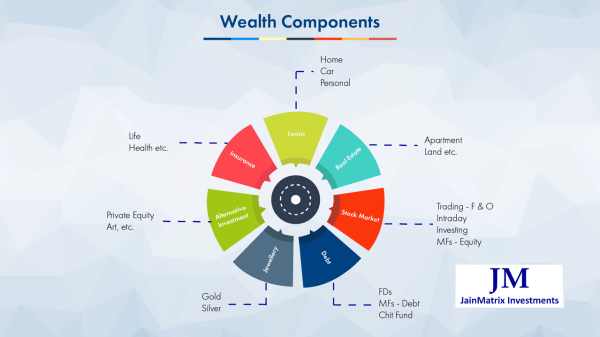
In this Wealth chart Fig 1, we can see various Wealth Options and Components publicly available to investors.

  • The old classic asset is Real Estate (RE), in the form of apartments, land, commercial property, etc.
  • Equity markets are a rising star asset class as the digitization processes have made it transparent and accessible. Equity subcategories are also listed. AIF funds and PMS services are also available now.
  • Debt, Jewellery (and Gold and precious metals) and Alternative assets are also available.
  • Insurance is a wealth protection asset, helping cover some risks.
  • Loans are a part of your wealth, however they can be taken for Appreciating or Depreciating Assets (AA/DA). Loans are better used to buy an AA like house or education, than for DAs like furniture, cars and holidays.

Fig 1 Wealth Options

Choosing among the Asset Classes

Here is a chart of Average Returns versus Risk for each of these assets, Fig 2.

  • Returns for each asset class vary by subclass and by time periods. Here we try to take the multi-year average for each class over 5-6 years period of time.
  • Equity ETFs and MFs returns are simplified as the Nifty index.
  • Direct equity assumes blended returns across market caps.

Fig 2 Wealth and Risk

 Hence the broad principle is – You need to take a higher risk to get a higher return.

  • There are perhaps higher risk asset classes such as F&O and Private equity. Several Wealth Options are not seen here. Its seen that results and returns vary widely among Classes and so results cannot be generalized.
  • All asset classes are probabilistic in terms of returns and risks. This means that while the average returns for RE (for example) may be 8-10% per year, there can be a particular year where this may be 15-20% on the high side and (-10%) on the low side.

The choice among these assets depends upon risk appetite, comfort level and nature of the investor.

  • However the chart points to Equity as a higher returns asset, if we are able to manage the higher risk.
  • Having seen all this, the suggestion to the new investor is to try some of these asset options in small quantities to get a better understanding. Here RE is difficult as it is a big ticket item, but the others can be bought for small sums.
  • A Bank savings account and a Stock broking account would be required to try out these (non RE) assets.

Real Estate versus Equity

In this section we delve deeper into the two most common asset classes – Real Estate and Equity.

Assumptions

Let’s simplify Real Estate to an apartment purchase in the person’s place of work. For own use, and as an upgrade from paying rent. Other Real Estate options such as a second house for investing or a plot for investment or commercial property are not being considered here.

Also Equity will also be simplified as Nifty index investments. Specific products such as MFs, PMS, and Direct Equity investment services such as that offered by JainMatrix Investments will not be considered here.

Comparison

In the following table we compare the Real Estate and Equity asset classes across key parameters. (Table 3)

CriteriaReal Estate – ApartmentEquity – Nifty
Ticket sizeRanges from ₹ 25 lakhs to crores depending on city and location. However if you buy with a loan, you need to pay 20% as down payment.Generally speaking the Nifty ETF products start with ₹ 5000, and go to any number. Direct equity has no minimum.
Source for buying and sellingNew apartments can be bought directly from builders. Second sale or older are from known people or with the help of real estate brokers. Aggregator websites also help with real estate information and brokers.Buying Platform – You will need a Stock Broking account for direct equity purchase. Products like MFs and ETFs can also be bought from Bank account – investment channels. And also directly from Fund website or MF distributors.
Rating for Identifying and buyingThis can be HARD and complex. Here the buyer has to identify the location, size of property, new v/s old, builder, etc. The process involves visiting potential properties, finalizing criteria, rating them, and closing the purchase, followed by registering the property. If you decide to invest in the Nifty, it’s EASY and a simple choice of Nifty ETFs. Otherwise the rating is MEDIUM. There are 5000+ listed firms in India, but homing in to a purchase decision of 5-10-20 shares needs reading, and decisions. JainMatrix Investments provides this advisory service. Similarly choosing among MFs or PMSs.
Time and costs for TransactionsThis can take anything from 2 months to a year. The cost over and above property cost may be Stamp Duty and Registration Tax for new properties, but may also include brokerage depending upon the agent or services used.With digitalization, time to buy is very less, 1-2 days, once the buying platform is in place. Brokerage costs vary from 0.75% of purchase for full service brokers to very low for discount brokers. Other taxes are less than 0.1% except Capital Gains tax.
Selling; and Time and costSelling is also HARD. From a decision to sell, to actual transaction it can take from 2-6 months. Brokers, websites or personal network can help. The cost can be 1-2% of property value. There are payment risks so one has to be disciplined in the process.Selling is EASY. The transaction happens at market rates, and funds are transferred in 1-2 days. Brokerage and other costs are similar as buying.
Total cycle timeSo one can see that the total cycle time for Real Estate is long. It includes Buying time, holding period and selling time.Varies by approach. The Nifty ETF or other equity assets can be held till the cash is required or a better investment has been found. At JainMatrix, we suggest Long Term Investments in quality companies, which allow the money to compound. However periodic pruning of a Direct Equity portfolio can be done every 6 months, to let the winners ride and exit underperformers.
UtilityAn apartment in use by the owner is useful, saves rent and provides pride of ownership.Equity investments appreciate and earn dividend. We must save for a rainy day!!
Capital GainsLong Term Capital Gains kick in at a holding of over 2 years. Typically from buy to sell may be 8-12 years on average.Long Term Capital Gains holding period is over 1 year.
Returns from Investing  A house to stay is a good choice in terms of stability and rootedness rather than just monetary returns. It saves on rent. Having said that, an apartment asset can give 8-10% returns on average. Fig 2.The Nifty has given 12-14% CAGR returns over the past decade. Returns are estimated higher for Direct Equity. See Fig 2.

Real Estate versus Equity Opinion by JainMatrix

In fact both Real Estate and Equities are asset classes that can complement each other. Investments should be started early in the working life, salaried or business. These can be in Equity, as the minimum is a small ticket size. In a few years as this asset grows, and the need arises, it can help to initiate a real estate purchase.

Finally Pros and Cons of Equity

Pros

  • High average returns. Rising asset class.
  • Indian equity markets have achieved a global size, volumes and transparency.
  • Flexible – minimum ticket size is small, but it can scale for larger investments.
  • Fast yet robust – digital enablement now allows a stock broking account to be as easy and convenient to handle as a savings bank account. Buying, selling and dividend transactions also happen digitally. Websites and mobile applications have also improved access and ease of navigation.
  • Tax friendly – the tax rules are encouraging for equity with just 1 year for Long Term Capital Gains, LTCG not being taxed until it crosses a certain sum, and ability to set off losses one year with gains in another year.
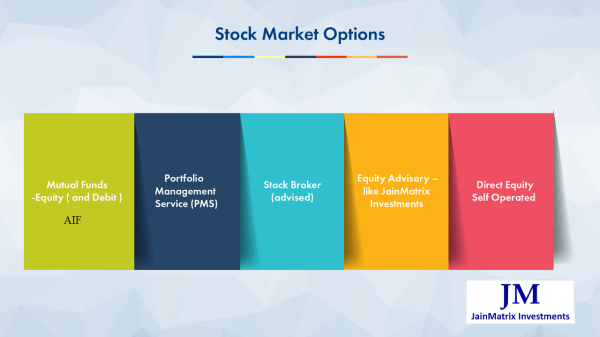
  • Several equity products like Direct Equity access, MFs, PMS, small case and advisory services allow flexible access to all kinds of investors. See Fig 4.

Cons

  • Equity investors are exposed to market risks, and also industry and company specific risks like fraud, global events, war, weather, currency, etc.
  • Fear and Greed are driving forces in equity markets, and equities can alternate between expensive (excessively high valuations) and cheap (too low valuations).
  • Patience is a virtue, and expecting quick returns can be detrimental for investors.
  • Short term Trading versus Long Term Investing is also a difficult choice for those new to equity markets.

Conclusion

Equity penetration in India is low due to lack of access to stock brokers, pre existing fears of stock markets, inertia and invisible nature of equity assets. However a look at developed markets shows that penetration is as high as 50% compared to India’s 5-6%. Further, financialization of Indians’ assets has begun, with We expect steady growth of equity penetration and

Glossary

  • AIF – Alternative Investment Funds are SEBI regulated and pools of funds from specific investors as per a previously defined investment policy. Next version of Mutual Funds
  • PMS – Portfolio Management Service.
  • MF – Mutual Fund
  • ETF – Exchange Traded Fund – a type of MF which is passively managed, and usually shadows a well-known Index or commodity. It typically has lower management fees compared to actively managed MFs.

My Standard Disclaimer

Investment in securities market are subject to market risks. Read all the related documents carefully before investing. This document has been prepared by JainMatrix Investments Bangalore (JM), and is meant for use by the recipient only as information and is not for circulation. This document is not to be reported or copied or made available to others without prior permission of JM. It should not be considered or taken as an offer to sell or a solicitation to buy or sell any security. The information contained in this report has been obtained from sources that are considered to be reliable. However, JM has not independently verified the accuracy or completeness of the same. Neither JM nor any of its affiliates, its directors or its employees accepts any responsibility of whatsoever nature for the information, statements and opinion given, made available or expressed herein or for any omission therein. The suitability or otherwise of any investments will depend upon the recipient’s particular circumstances and, in case of doubt, advice should be sought from a RIA – Registered Investment Advisor.

Punit Jain is a registered Research Analyst under SEBI (Research Analysts) Regulations, 2014. JM has been publishing equity research reports since Nov 2012. Any questions should be directed to the director of JainMatrix Investments at punit.jain@jainmatrix.com

Corporate Transformation: From Cost to Time

Growing up in a middle class home, I have pretty much got used to worrying about cost. Going on a holiday? What’s the best deal you can find? Buying a coffee table? What’s the best price you can find for that size and quality?

In recent years, there has been a new challenge. On getting overworked, and with budgets not a big issue, the issue was, how can I plan that holiday within that limited time? How can I buy that furniture fast and right? Can I do all this today, and still get a good night’s sleep?

Optimize for Time: That’s when the thought struck me. Rather than optimizing for Cost, I need to optimize for Time. Productivity is more important. Speed and accuracy may cost more, but are a better option.

This needs a radical rethink of the way we make decisions. One way to do this is the digital tools available. E-commerce for buying? Check. Travel websites for holidays? Check. Doing everything yourself? No, no. Outsourcing of design and execution? Check. The other way is outside expertise.

In corporate environments too, a more precious commodity than budgets, is the time of the workforce. How can we do this work within this time constraint? Planning and project management tools? Check. Portals, collaboration tools and email for employee collaboration? Check.

An example that comes to mind is the Bangalore Metro – BMRCL. Eleven years after it was set up, the firm has recently bid out for Project Management software that can capture the complexity of its work, help tie the loose ends and do work on time.

Corporate Objectives: Business or Group Leaders with large teams in place have instinctively moved to Time optimization for their teams. The team is fixed (in the medium term) and everyone is on a salary so the objective is for the team is to work better together, and do more. The workload should also be well spread across the team rather than a few getting overworked even as others are relatively free.

What’s changed is the tools, and outsourcing and digital options we have to do this in practice.

Software versus Jobs: Another mental constraint some of us struggle with – is the use of software going to result in the loss of jobs? Is there a trade off between use of software versus number of jobs and employees? This may be true of some legacy bloated PSU firms where employee collaboration is by physical files and paperwork. Collaboration software surely helps teams work better and faster with fewer people. But many of the non collaboration digital tools that we now have access to are just outsourcing the work to another organization that can do it more efficiently. This organization does the work, and grows, while your firm becomes more focused. In effect, total employment may not be affected, but productivity improves.

Example – Second Generation PSUs: The second generation PSUs in India have been set up without legacy workforces and are super focused on their core competencies. Petronet LNG, IRCTC and CONCOR come to mind. They have their own employees handling senior management functions and the core work. Non core work like security, facilities management, recruitment, routine procurement, travel, logistics, canteens, etc. can and are being outsourced to competent agencies. Keeping the core staff low.

The ‘L1’ dilemma: Indian PSU procurement and tendering is famous for awarding projects to the ‘L1’ bidder. Looking back at the performance of projects bid out, perhaps the L2 or L3 bidder would have been a better choice if the primary criteria was not just price, but also Speed, reliability and Quality of work. So many projects flounder on execution after the bidder realizes he is in losses or is unable to handle project challenges. The Total Cost of a Project includes Project bid value, real costs of project, time of project and maintenance for the life of project. So here also for better success rates and performance, the tendering process needs to be ‘L1’ for Total Cost of Project, incorporating a probability of timely completion and penalties and counter guarantees. This is harder to judge, but its time our decision making advances, and gets better results.

Cheers and success to you. Comment on this article if you find it interesting.

Punit Jain

DISCLAIMER

This document has been prepared by JainMatrix Investments Bangalore (JM), and is meant for use by the recipient only as information and is not for circulation. This document is not to be reported or copied or made available to others without prior permission of JM. It should not be considered or taken as an offer to sell or a solicitation to buy or sell any security. The information contained in this report has been obtained from sources that are considered to be reliable. However, JM has not independently verified the accuracy or completeness of the same. This is not an equity research or investment report. Any mention of companies in this report is to illustrate a point and we make no comment here on valuations or investment attractiveness. Neither JM nor any of its affiliates, its directors or its employees accepts any responsibility of whatsoever nature for the information, statements and opinion given, made available or expressed herein or for any omission therein. Punit Jain is a registered Research Analyst under SEBI (Research Analysts) Regulations, 2014. JM has been publishing equity research reports since Nov 2012. Any questions should be directed to the director of JainMatrix Investments at punit.jain@jainmatrix.com.

An interview with Indra Nooyi

An excellent interview with one of the sharpest global business leaders – Indra Nooyi – amazingly grounded ….. she has such wonderful Ideas about solving today’s problems …. superb viewing for every Indian ……

A View on the Sensex

Date: 28th Nov 2021

The Sensex Returns V/S GDP Growth chart

Chart Explanation

  1. Chart Notes: 2021SF is 2021 So Far. CY is calendar year. Also a positive ‘High-Low Return’ number indicates that intra-year high was after intra-year low and vice-versa. Data Sources: wikipedia, Bloomberg, Credit Suisse.
  2. The CY Sensex returns reflect key events – 1999 dot com up; 2000 crash, 2008 crash etc.
  3. The average CY Sensex return over 20 year period is 18%.
  4. The High Low Return is the intra CY volatility. The GDP real growth line largely runs similar to Sensex return while being mostly positive and smoothened out. Except 2020.

Key Observations

  1. The CY Sensex return over 2018-2021SF isn’t very high. It looks like just average returns. The volatility is high with higher highs and lower lows. GDP growth has fallen in 2020 and now looks in recovery mode.
  2. It does appear that the GDP fall is not reflected in the Sensex returns.

Conclusion

  • Sensex returns have been low to average, contrary to public opinion. Volatility has been high.
  • A good GDP recovery in CY21-23 can raise Sensex returns to above average levels.

Disclaimer:

This document has been prepared by JainMatrix Investments Bangalore (JM), and is meant for use by the recipient only as information and is not for circulation. This document is not to be reported or copied or made available to others without prior permission of JM. It should not be considered or taken as an offer to sell or a solicitation to buy or sell any security. The information contained in this report has been obtained from sources that are considered to be reliable. However, JM has not independently verified the accuracy or completeness of the same. Neither JM nor any of its affiliates, its directors or its employees accepts any responsibility of whatsoever nature for the information, statements and opinion given, made available or expressed herein or for any omission therein. Recipients of this report should be aware that past performance is not necessarily a guide to future performance and value of investments can go down as well. The suitability or otherwise of any investments will depend upon the recipient’s particular circumstances and, in case of doubt, advice should be sought from an independent expert/advisor. Punit Jain has applied for certification under SEBI (Research Analysts) Regulations, 2014. Any questions should be directed to the director of JainMatrix Investments at punit.jain@jainmatrix.com