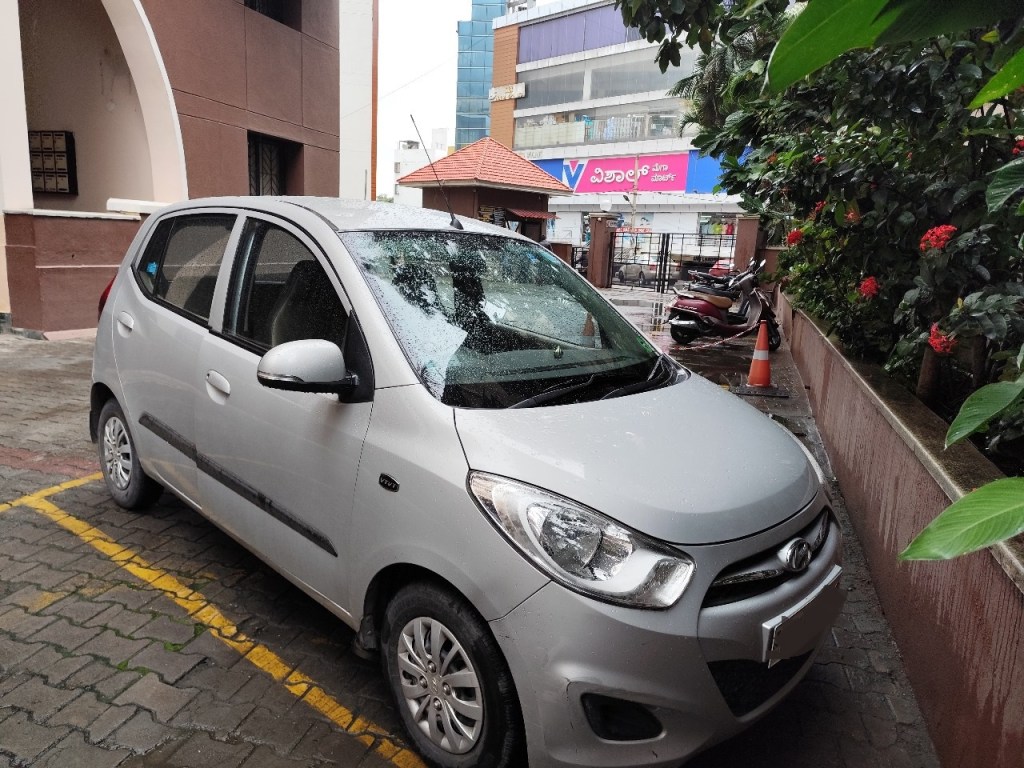
JainMatrix Investments, Hyundai i10

Buying a Car? Here’s the Real Cost

Last week I sold my car. It was a beautiful machine. I bought this Hyundai i10 in 2013. It became the default safe ride for work commutes, local errands and weekend joyrides. Occasionally we travelled intercity in it. Then my son grew old enough, and he learnt to drive in it. He added college commutes and meetings with friends, to the list of activities.

Now 12 years after the purchase, it was time to ring out the old. Selling your used car has also changed over the years. So a call to Spinny and another to Cars24 helped evaluate my options. I got a better offer from Cars24, so I sold it to them.

I felt a little sad to see it go. But I thought I can take my case and put some numbers to my car purchase, usage and sale decisions. And see if something useful comes out of it.

Should one really evaluate a car purchase in numbers? I’m not sure, but lets give it a shot.

Purchase, Sale and Line Items

  1. Purchase – Rs 5,73,000 in 2013 in Bangalore
  2. Annual maintenance – first year 0, from 2014 Rs 6,000, rising to Rs 12,000 recently. Lets assume no major accidents and no major parts replacements, just more repair and wear & tear recently.
  3. Petrol costs – My usage over 12 years was less, just 28,000 km. This can vary widely from person to person. But lets calculate for this. This usage becomes 2,333 km/ year. Petrol prices rose from Rs 72 /lit in 2014 to Rs 100/lit now. Assuming an efficiency of 12 km/lit., one can calculate annual costs.
  4. Sale – Rs 2,90,000 in 2025 in Bangalore
  5. Totaling these in excel and using the IRR function, I got a -12.3% annual return for my car purchase.
  6. However petrol usage is widely different for different folks, so lets remove this and recalculate.
  7. Without petrol, I got a -7.66% annual return on my car purchase.
  8. One missing factor is inflation. Obviously Rs 1 lakh was worth much more in 2014 than today. Lets factor in a 5% annual inflation to all transactions.
  9. The Without Petrol calculation with a 5% inflation now is -12.1% annual return on the car purchase.

Excel Snapshot

Here’s a snapshot of the excel calculations. Click image below to see bigger.

Conclusions and Closing Thoughts

  • Added this point on 17/08 – Some of my blog’s brilliant followers have pointed out – Insurance and auto loan costs should be added here too. Insurance of course is mandatory, and more has to be added on if you want good coverage. I peg this at about 2% additional costs per year. A car loan is optional, so it depends on the buyer if he needs one. Here a loan costs about 9-11%, so this will add substantially to costs. Thanks Bala and Nandu !!
  • So there we go. The cost of a car like Hyundai i10 for me over this period was 14.1% annualized on the invested capital, adding insurance, not including petrol and car loan.
  • To some extent, a car purchase could be both a functional and a status purchase. The latter is difficult to quantify. And widely varies from person to person. Lets leave it at that.
  • This was a good hatchback, but not a luxury car. Numbers could be quite different for this.
  • Conversely, don’t forget how useful a car can be. It is quite safe. Its convenient and always available. Good in rainy weather. Its more useful for groups of 2-5 to travel together. Once you do own a car, you may as well use it extensively, for your work and travel.
  • I haven’t factored in depreciation. Not everyone can get this benefit. The dep. rate for vehicles in India is around 15-20% every year for the first 3-5 years. The highest car dep. rate occurs in year 1 of ownership and can go up to 30%. This can certainly lower the cost of ownership.
  • This is of course a 2013-25 story. For a car purchase now, all the numbers will change, but I suspect the annualized costs may be similar for a similar car.
  • The option we have is to take a cab / auto / bus / train / Metro, or personal 2 wheeler for travel. In fact as public transport improves and becomes convenient, the need for personal transport reduces.
  • For wealth building, buy appreciating assets. For utility and fun, go shopping, including for your car. But don’t forget that a car is definitely a depreciating asset.

Hope this was interesting. Do comment and critique below.

Regards, Punit Jain, JainMatrix Investments.

Disclaimer

  • Punit Jain discloses that he has no shareholding in any of the firms mentioned in this article. This is written from the consumer PoV. He has no other financial interest or transactions, with any firms mentioned here or any group company. In addition, other than that mentioned above, JMI and its promoters/ employees have no direct or financial interest in these companies, and no known material conflict of interest as on date of publication of this report, to the best of his knowledge.
  • This document has been prepared by JainMatrix Investments Bangalore (JMI), and is meant for use by the recipient only as information and is not for circulation. This document is not to be reported or copied or made available to others without prior permission of JMI. This report should not be considered or taken as an offer to sell or a solicitation to buy or sell any security or asset. The information contained in this report has been obtained from sources that are considered to be reliable. However, JMI has not independently verified the accuracy or completeness of the same. Neither JMI nor any of its affiliates, its directors or its employees accepts any responsibility of whatsoever nature for the information, statements and opinion given, made available or expressed herein or for any omission therein. Investment in the securities market are subject to market risks. Read all the related documents carefully before investing. The suitability or otherwise of any investments will depend upon the recipient’s particular circumstances and, in case of doubt, advice should be sought from a SEBI RIA Registered Investment Advisor. JMI has been an equity investment adviser commercially since Nov 2012, and a SEBI certified and registered since 2016, under SEBI (Research Analysts) Regulations. Registration granted by SEBI, and certification from NISM in no way guarantee the performance of the Research Analyst or provide any assurance of returns to investors.
  • Any questions should be directed to punit.jain@jainmatrix.com. Name of the RA as registered with SEBI – Punit Jain, SEBI Registration No. INH200002747. Logo/brand name –

The Changing World Order, and the India Opportunity

07th April – Time to read article – text 10 min, video 43 minutes.

  • Today the Indian markets fell sharply, up to 5%, but lets look at this event in the global context.
  • I came across this wonderful video by Ray Dalio recently, (43 minutes) and this helps us put the current market scenario in context.

My lessons from this video:

  • The USA is in a down cycle and is showing the classic signs of this – more expenditure than revenue, high and rising debt, signs of domestic unrest and discomfort, and now this big one, new tariffs that are trying to curb imports and hopefully boost domestic production.
  • China has been rising for long in trade and defense, with strong manufacturing, and till now was a big exporter to USA and ran a massive trade surplus.
  • As USA fights China in the trade war, there may be bumps here, but this is a period of transition as China finds other markets and continues its rise.
  • In an era of extended cold wars (USA-Russia) and nuclear powered countries, my expectation is that modern transition of Big Cycles will happen in the form of Trade wars and slow stagflation of economies.
  • One example here is of Japan, which was a rising economic power till the 1980s, and could not sustain the rise, but has preserved its economy, and GDP has grown at about 1-2% p.a for 2-3 decades

So where is India and what is India’s play?

  • China is a manufacturing giant, making products in high volumes, from metal – steel and aluminium, to cars, EVs, toys, furniture, ships, trains, etc.
  • India’s play is in services –
    • Indian IT services industry is a miracle, with customers in over 150 countries. It gained momentum in the 1990s, and is today a massive industry commanding 50% of the global outsourced IT services market.
    • The second generation of Outsourced services has already rolled out – consisting of – Engineering services, contract medical & pharma services and Knowledge Process Outsourcing.
    • Global Competency Centers (GCCs) of many MNCs present in India also provide additional services like Marketing, Legal, HR, transaction processing, Finance and Accounts, etc.
  • The following Services sectors must learn from the Indian IT services giants and look at the global market potential:
    • Banking, Financial Services and Insurance – We have yet to see Indian BFSI firms grow aggressively abroad and establish a global brand. Given the domestic strengths and penetration, this is possible.
    • Hotel Chains – not just Taj hotels, but also Oberoi, ITC, Leela, etc. can also expand globally.
    • Education – Indians spend $60 billion (₹5.1 lakh cr.) per year on education abroad, mostly graduation and post grad degrees. This is 4X the entire GoI annual education budget. Quality education should be available more easily domestically, at a fraction of the cost in USA, UK or Australia. This will save outflows, and can even earn inflows.
    • Tourism – If packaged well, tourism to India can attract large numbers. The Himalayas in Kashmir, HP and Arunachal, the Goan and Kerala beaches, the Taj Mahal, historic forts and monuments, food and rich culture, etc. can draw in millions for the exotic Indian holiday.
    • Healthcare – the opportunity exists not just for domestic services, but medical tourism in India, and also hospital chains in the developed world, where there is a shortage. Yoga and Ayurveda are traditional Indian healthcare systems already admired globally.
    • Telecom – Bharti Airtel ventured successfully to Africa, the next stage is a global brand, and even other companies can roll out the India success model.
    • Aviation – Indigo & Air India have the opportunity to grow globally, building on the India base.
    • Retailing – the success by Reliance Retail, Zudio (Trent) and DMart can expand globally. Titan with Tanishq can also be in this category.
    • Food services – the Jubilant Foodworks franchise in India is a scalable QSR model, and Indian chains can expand abroad. Saravanaa Bhavan has expanded into several countries. Indian food is popular internationally, so there is a demand that can be tapped.
    • Infrastructure services – firms like L&T already have global footprints, and other firms with a good domestic projects roster can grow internationally.
    • Logistics – as India itself improves its infra, expands domestic capacities and cuts the costs of logistics, opportunities exist globally in Ports, Shipping and Railway services, where we can deliver projects to friendly nations through GoI.
    • Shipping – Indian shipmen dominate global merchant navies & shipping. India’s coastline stretches for 7,500 km. But how big is the Indian merchant shipping industry? There is massive potential here.

How can this play in Services be accelerated?

  • The need is for Industry focused colleges, universities and education, practical training with industry participation, and for skills development of the students at scale.
  • GoI should provide Plug and play industry infrastructure – Offices and Factory parks, ready with connections of water, electricity, road connectivity access and ready to occupy workspace.
  • Focus on growth in Tier 2 cities and towns by Govt. and current industry players.
  • Exports have to be encouraged more. The IT Services industry grew on the basis of all exports being Income Tax free in the 1990s. While GST is exempt today, broader encouragement like Global Sales Support desks, Trade Commissions, Think Tanks on exports markets, desks by Ministry of External Affairs, and various Ministries of GoI, and loans / funding will help.
  • While english speaking is an advantage for services, competence in Japanese, German, Spanish and French may also help in communication and business. A case – In a recent Vietnam holiday, we visited a mid sized Suits and Garments Tailoring showroom. A few minutes later, a batch of 20 odd Italian tourists walked in. I was stunned to see, a showroom sales staff made a fluent 20 minute presentation in Italian to them. Selling them 8 hour turnaround formal suits and traditional women’s dresses. No doubt the tourists bought lots of clothes that day.

Manufacturing and related thoughts

  • Manufacturing in India remains a massive opportunity, with the first objective to meet domestic needs. Here the sectors with potential are Defense, Shipping, Railways, airplanes, electronic products – mobiles, laptops, TVs, music equipment, Air conditioners and gadgets. Silicon chips are a key input which also can be made domestically.
  • PLI schemes have been started in 14 sectors to accelerate them.
  • Assembly in India is just the first step to get the supply chain and value add to increase in India.
  • We have to build on our success stories in automotive and pharmaceutical mfg. When will we be able to see an Indian made car succeed all over the world? Who will do this – Tata Motors? M&M?
  • The success of Indian 2W is admirable – Bajaj Auto, Eicher Motors and Hero Motors are doing well.

  • Why do Indian companies not list abroad? A quick check on ADRs and GDRs from India reveals a very short list of 10-11 companies. Any Indian company with significant global presence should list in USA or Europe.
    • Many years ago Cognizant listed in USA. It was riding global trends – HQ and listing in USA, IT workforce primarily in India, and customers in USA and spread across the world.
    • Chinese companies have long exploited this trend. A quick search reveals 286 Chinese companies listed in USA. Why have Indian companies missed this trick? The deepest stock market in the world is USA, listing here can give rich valuations, and help raise growth funds for Indian firms.
  • A large number of MNCs operate in India with subsidiaries, GCCs and factories or development centers. Like Hyundai India and Schneider Electric Infra., can they be nudged to list in India? This would cement their presence and commitment to India, and help to deepen Indian markets.
  • India has benefited from the free markets of the last few decades. With USA imposing tariffs for protection, India should continue trade with USA while growing free markets and trading with other countries and gain from global trade growth. To do this, it will have to lower tariff and non tariff barriers and sign Free Trade Agreements. At present 6-7 FTAs are under negotiation.
  • Japan can be an excellent target country, for Indian firms to partner with Japanese MNCs, and help them develop India as a manufacturing base for global sales, with success stories like Maruti Suzuki.

Conclusions

  • So Mr Leading Indian Bank CEO. USA isn’t just the place where you go on annual vacation to your brother’s house to admire the opulence and great roads. It’s the place you go with a crack team of CFO, CMO, retail head and CHRO, and plot your company’s 40% annual growth for the next decade.
  • In the wake of Trump Tariffs, we see a change in global order, with China emerging strong.
  • As some doors close, others can be opened. Indian firms have an opportunity to grab large chunks of the global services pie, while some can excel in select manufacturing opportunities.
  • We see a future of the parallel rise of China and India, CHINDIA, in the next BIG Cycle.
  • However there is little hope of cooperation, their rise will be independent and mutually exclusive, offering different products and services.

Disclaimers and Disclosures

  • Any mention of companies in this article are purely to explain and illustrate a point, and these are not investment suggestions.
  • This document has been prepared by JMI, and is meant for use by the recipient only as information and is not for circulation. This document is not to be reported or copied or made available to others without prior permission of JMI. This report should not be considered or taken as an offer to sell or a solicitation to buy or sell any security. The information contained in this report has been obtained from sources that are considered to be reliable. However, JMI has not independently verified the accuracy or completeness of the same. Neither JMI nor any of its affiliates, its directors or its employees accepts any responsibility of whatsoever nature for the information, statements and opinion given, made available or expressed herein or for any omission therein. Investment in the securities market are subject to market risks. Read all the related documents carefully before investing. The suitability or otherwise of any investments will depend upon the recipient’s particular circumstances and, in case of doubt, advice should be sought from a RIA Registered Investment Advisor. Registration granted by SEBI to JMI, and certification from NISM in no way guarantee the performance of the Research Analyst or provide any assurance of returns to investors.
  • JMI has been an equity investment adviser commercially since Nov 2012, and a SEBI certified and registered since 2016, under SEBI (Research Analysts) Regulations. Any questions should be directed to punit.jain@jainmatrix.com. Name of the RA as registered with SEBI – Punit Jain, SEBI Registration No. INH200002747. Logo/brand names

Business Standard – Revealing the 100X strategy: ultimate wealth creation

I came across an excellent article on Business Standard.

This is very useful for investors new to Equity. Several important concepts are covered here.

Do Read –

https://www.business-standard.com/economy/analysis/revealing-the-100x-strategy-the-ultimate-instrument-of-wealth-creation-124121701224_1.html

Warm regards

Punit Jain

Mid and Small Cap Stock Trends Nov 2024

27th Nov 2024

JainMatrix Investments, a Research Analyst firm, is pleased to present a note on Mid and Small Cap Market Trends. We have done some research and here are the key findings:

  • The Sensex peaked recently at 85,900 (26Sep) and then fell to 77,100 (21Nov), a fall of 10.2%. For the NIFTY Midcap 100 the fall has been sharper at 11.7%, over the same period.
  • The fall can be described as a recovery to better valuations, and investors can look at starting (or continuing) with equity investments and SIPs at these levels.
  • Our rating and ranking of attractive sectors is:
    • Financials (Bank / NBFC)
    • Power sector
    • Auto and Auto Ancillary (manufacturing)
    • Infotech
    • Consumer QSR,
    • Also travel, tourism and hospitality, pharma and healthcare.
  • Investing Trends: The trends we notice are:
    • Valuations have corrected sharply, but are not cheap yet.
    • However, valuations can remain expensive for extended periods, as we saw in 2004-07, and if they do not get excessive, it should not inhibit investors.
    • Mfg. and IT services can have an export component, the rest are more domestic-focused
    • From 2021 till recently, we have not had big broad corrections, but several waves of sectoral rises and micro-corrections, such as Infotech, Speciality Chemicals, Defense, PSUs, Shipyards and Rail stocks.
    • These cycles have in aggregate kept valuations in check.
    • IPOs too may now become more sober in terms of pricing and valuations, but this route continues to work, and throw up exciting companies, and encourage risk-taking promoters and Private Equity/startup investors.
  • We do not want to choose or trade-off between Large-cap, Mid-cap and small-cap stocks.
  • Large caps have had a big correction as the FIIs pulling out have been more invested in these.
  • Mid-caps present the potential ideas, and if they scale, they are the large caps of tomorrow (and good investments too).
  • Small caps are a higher risk and potentially higher return play and investors with such a risk appetite can look for success here. However, these need deeper primary research as firms are not very good at communicating their story and progress, and may even be secretive.

Suggestions and Disclaimers

  • Investors new to our service may look at our OFFERINGS, and sign up using the PRICING AND PAYMENT OPTIONS link, to grow their Direct Equity portfolios.
  • This note has been prepared by JMI, and is meant for use by the recipient only as information and is not for circulation. This document is not to be reported or copied or made available to others without prior permission of JMI. This report should not be considered or taken as an offer to sell or a solicitation to buy or sell any security. The information contained in this report has been obtained from sources that are considered to be reliable. However, JMI has not independently verified the accuracy or completeness of the same. Neither JMI nor any of its affiliates, its directors or its employees accepts any responsibility of whatsoever nature for the information, statements and opinion given, made available or expressed herein or for any omission therein.
  • Investments in the securities market are subject to market risks. Read all the related documents carefully before investing. The suitability or otherwise of any investments will depend upon the recipient’s particular circumstances and, in case of doubt, advice should be sought from a RIA Registered Investment Advisor.
  • JMI has been an equity investment adviser commercially since Nov 2012, and a SEBI certified and registered since 2016, under SEBI (Research Analysts) Regulations. Registration granted by SEBI, and certification from NISM in no way guarantee the performance of the Research Analyst or provide any assurance of returns to investors.
  • Any questions should be directed to punit.jain@jainmatrix.com. Name of the RA as registered with SEBI – Punit Jain, SEBI Registration No. INH200002747. Logos / brand name –

Understanding the Sensex Surge among Global Economic Challenges

A social media contact asked a question:

Good morning friends. I was reading the newspaper and saw the Sensex touching an all-time high of 80k. Can anyone help simplify, why is the market is so high when industries and companies are globally low on business, employees are getting laid off, and the job market is weak. Is this a bubble in waiting caused by FIIs?

My response and answer:

1) The Indian index mostly reflects the Indian economy and Indian companies. These are doing well. The Indian GDP is up smartly in the last 2-3 years, industrial policies are stable and encouraging, tax collections are improving, and infrastructure like transportation and electricity are getting better. The recovery from the Covid challenges of 2020 and 2021 has been good.
2) The ex-India global scenario is not so good. USA is recovering from Covid but has election uncertainty, Europe is flat, RoW is bit gloomy due to the two wars. In general, there is high inflation and interest rates. China is struggling with a tariff war with USA and internal policy and capital allocation issues.
3) This in fact makes India an attractive investment destination for global funds looking for good returns. It’s doing the best among the larger economies and is quite open to capital inflows through FPI and FIIs.
4) In India, Equity as an asset class is gaining importance and acceptance for wealth storage and growth – along with the traditional Real Estate. This is mainly due to digital access, ease of transactions and lower transaction costs. Even so, the current Equity penetration is still low, with about 15 crore demat accounts, and even among these investors, a low proportion of financial assets.

In our recent article, we had seen these signs – NIFTY VIX and NIFTY 50: Market Sentiment Post Elections

Discover Investment Services from JainMatrix – PRICING AND PAYMENT OPTIONS

DISCLAIMERS

This document has been prepared by JainMatrix Investments Bangalore (JMI), and is meant for use by the recipient only as information and is not for circulation. This document is not to be reported or copied or made available to others without prior permission of JMI. This report should not be considered or taken as an offer to sell or a solicitation to buy or sell any security. The information contained in this report has been obtained from sources that are considered to be reliable. However, JM has not independently verified the accuracy or completeness of the same. Neither JM nor any of its affiliates, its directors or its employees accepts any responsibility of whatsoever nature for the information, statements and opinion given, made available or expressed herein or for any omission therein. Investments in the securities market are subject to market risks. Read all the related documents carefully before investing. The suitability or otherwise of any investments will depend upon the recipient’s particular circumstances and, in case of doubt, advice should be sought from a RIA Registered Investment Advisor. JMI has been an equity investment adviser commercially since Nov 2012, and a SEBI certified and registered since 2016, under SEBI (Research Analysts) Regulations. Registration granted by SEBI, and certification from NISM in no way guarantee the performance of the Research Analyst or provide any assurance of returns to investors. Any questions should be directed to punit.jain@jainmatrix.com. Name of the RA as registered with SEBI – Punit Jain, SEBI Registration No. INH200002747. Logo/brand names are –

JainMatrix Investments – Large Cap Report June 2024

Subscribers and Investors,

JainMatrix Investments, a Research Analyst firm, is pleased to present its latest update of our LC stocks basket. Key points are

  • Introduction: It’s our 11th year of the Large Cap stocks basket
  • This update report is dated 21st June, and the report covers 11 stocks
  • All these firms are Blue Chip, well-known large-cap firms
  • The objective of this basket is that these stocks must outperform the Nifty / Sensex by 2-3% per year
  • The LC stocks have performed excellently over the years
  • Recommendation Changes:
    • In our last report, we had 7 BUYs and 3 HOLDs
    • In this, we introduce a new BUY, upgrade a HOLD to a BUY and downgrade a BUY to a SELL
    • So we now have 8 BUYs and 2 HOLDs as the final stocks recommendations
    • These 8 BUYs represent 8 highly rated sectors, and are high performers within these sectors
  • LC Trends: The trends we notice and capture in our report are:
    • Broad Optimism post General Elections
    • More domestic focus rather than exports
    • Consumption and infrastructure are the main themes.
    • Several sectors are witnessing a cyclical upswing that should be sustained for several years.
  • Based on our research, this detailed LC report includes 1-2 page notes on all these stocks and 2-year Target Prices for May 2026.
  • Current subscribers may note the changes recommended.
  • Investors new to our service may sign up using PRICING AND PAYMENT OPTIONS link, to grow their Direct Equity portfolios.

Disclaimers

This document has been prepared by JainMatrix Investments Bangalore (JM), and is meant for use by the recipient only as information and is not for circulation. This document is not to be reported or copied or made available to others without prior permission of JM. This report should not be considered or taken as an offer to sell or a solicitation to buy or sell any security. The information contained in this report has been obtained from sources that are considered to be reliable. However, JM has not independently verified the accuracy or completeness of the same. Neither JM nor any of its affiliates, its directors or its employees accepts any responsibility of whatsoever nature for the information, statements and opinion given, made available or expressed herein or for any omission therein. Investment in the securities market are subject to market risks. Read all the related documents carefully before investing. The suitability or otherwise of any investments will depend upon the recipient’s particular circumstances and, in case of doubt, advice should be sought from a RIA Registered Investment Advisor. JMI has been an equity investment adviser commercially since Nov 2012, and a SEBI certified and registered since 2016, under SEBI (Research Analysts) Regulations. Registration granted by SEBI, and certification from NISM in no way guarantee the performance of the Research Analyst or provide any assurance of returns to investors. Any questions should be directed to punit.jain@jainmatrix.com. Name of the RA as registered with SEBI – Punit Jain, SEBI Registration No. INH200002747. Logo/brand names are –

NIFTY VIX and NIFTY 50: Market Sentiment Post Elections

The Indian General elections are done with, and we have the observations of the last month –

NIFTY VIX – is a ‘Volatility Index’, first introduced by the NSE in 2008. It is an Index representing expected annual volatility in Nifty50 over the next 30 days. It being a leading indicator simply reflects investors’ sentiment about the market.

NIFTY 50 – The NIFTY 50 is a benchmark Indian stock market index representing the weighted average of 50 of the largest Indian companies listed on the National Stock Exchange.

Follow JainMatrix Investments for more such updates.

Discover Investment Services from JainMatrix – PRICING AND PAYMENT OPTIONS